Daniel sent us this one, and it's a callback to an episode we did about what it would take to self-host something like ChatGPT in your house. We concluded you'd basically be living inside a jet engine with a sauna attached and your neighbors would form a legal coalition against you. But Daniel had a follow-up question that's actually really good and I don't think we ever addressed it directly. His mother's family ran a picture framing business, and they had three-phase electricity in the shop for the industrial machines. He always wondered — what's actually insufficient about a normal home outlet that makes high-power equipment need something different? Is it just a different socket shape on the wall, or does it go all the way back to the grid connection? And practically speaking, where's the cutoff between what regular single-phase can handle and when you genuinely need three-phase? What are we talking about in terms of actual wattage draw?

Oh, this is a great question. And it gets at something that most people sense is important but never quite get explained properly. The socket shape is the least interesting part of it. The real answer is about how power gets delivered and why the physics of three-phase is just fundamentally better for anything with a serious motor or a serious power appetite.
Before you get too deep into the physics, and I know you will, let me just say — by the way, today's episode is powered by DeepSeek V four Pro. So if any of this sounds unusually coherent, that's why.
Well, let's see if it can keep up. So the place to start is with what's actually coming into your house right now. In North America, a typical residential service is what they call split-phase two forty volts. You get two hot legs and a neutral coming in from the transformer on the pole. Each hot leg is one twenty volts relative to neutral, and between the two hot legs you get two forty volts. That gives most homes either a hundred amp or two hundred amp service. So at two hundred amps times two forty volts, your absolute theoretical maximum is forty-eight thousand watts — forty-eight kilowatts — before the main breaker trips.
In practice you're never pulling that continuously.
The continuous load rating is eighty percent of the breaker rating under the National Electrical Code. So on a two hundred amp service, you can pull about thirty-eight kilowatts continuously. And that sounds like a lot, right? Most homes cruise along at maybe two to five kilowatts when nothing crazy is running. But here's where it gets interesting. A single NVIDIA H one hundred GPU — the kind of thing you'd use if you were trying to run something like ChatGPT — pulls about seven hundred watts at peak. A server with eight of them pulls something like ten kilowatts. So two of those servers and you've eaten more than half of a very beefy home electrical service.
And we were talking about what, dozens of these things for a real deployment?
But even setting aside the sheer quantity of power, there's the question Daniel's really asking. What is three-phase, and why is it different? So single-phase power — what you have in your house — delivers power in a sine wave. The voltage goes up, comes down, crosses zero, goes negative, comes back up. It does this sixty times a second in North America, fifty times a second in Europe and a lot of the rest of the world. At the zero crossing, the instantaneous power delivered is also zero. It's pulsing. For lights and electronics with power supplies that smooth this out, that's fine. For a big electric motor starting up under load, that pulsing is a problem. You get torque ripple, vibration, and a big surge of inrush current every time you start it.
Three-phase smooths that out.
Three-phase power is three separate alternating currents on three separate conductors, each offset by one hundred twenty degrees from the others. So at the exact moment one phase is crossing zero, the other two are at roughly eighty-seven percent of their peak — one positive, one negative. There is never a moment where the total power delivery drops to zero. It's continuous. It's smooth. And for a motor, this means you get a rotating magnetic field naturally. A three-phase motor doesn't need a starting capacitor or a start winding. It just spins. That's why every industrial machine with a serious motor uses three-phase. It's smaller, simpler, more efficient, and the starting torque is vastly better.
When Daniel's mother's picture framing shop had three-phase for the shrink wrappers and saws and whatever else, it wasn't just about raw wattage. It was about the kind of load those machines put on the electrical system.
And this is the part that most explanations skip. There are really two separate reasons you'd want three-phase. One is motor loads. If you've got a motor bigger than about five horsepower, single-phase just gets impractical. The starting current would be enormous, the motor would be physically huge, and the efficiency would be terrible. The second reason is total power draw. Even if you don't have big motors, if you need more than about forty or fifty kilowatts of total load, you start hitting the practical limits of what a single-phase service can deliver without requiring absurdly thick conductors.
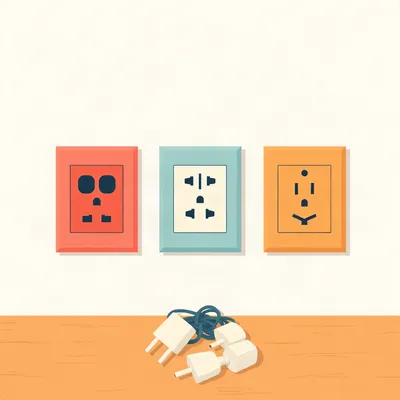
Let's talk about those conductors for a second, because I think this is where the socket shape question Daniel asked actually connects to something deeper. When you see a three-phase outlet in a workshop, it does look different. It's usually a round plug with four or five pins instead of the parallel blades you see on a normal outlet. But that's not just for the sake of being different.
No, it's absolutely functional. In a single-phase circuit, you're delivering power on two current-carrying conductors, plus a ground for safety. In a three-phase circuit, you've got three current-carrying conductors plus sometimes a neutral, plus a ground. You physically need more pins. But more importantly, the reason three-phase lets you deliver more power with less copper is the beautiful part. For the same amount of power delivered, a three-phase circuit uses less current per conductor than a single-phase circuit. And since the heat losses in a wire are proportional to the square of the current, that's a huge deal. If you cut the current by a factor of root three by going to three-phase, you cut the losses by a factor of three. Or, you can deliver the same power with thinner, cheaper wire over a longer distance.
Which is why the entire electrical grid is three-phase. Every transmission line you see, every substation, every distribution feeder — it's all three-phase. The single-phase that comes to your house is just one leg tapped off a three-phase distribution line.
That's the answer to Daniel's question about whether getting three-phase means something changes at the infrastructure level. In most cases, yes. If you're in a residential neighborhood, the transformer on the pole outside your house is probably a single-phase transformer. It's taking one phase of the medium-voltage distribution line and stepping it down to the split-phase two forty that goes to your house. To get three-phase, the utility has to bring in all three phases. In some cases, that means replacing the transformer with a three-phase unit. In other cases, if you're in an area where three-phase is already running down the street — which is more common in commercial and industrial zones — it might just mean running a new service drop from the pole to your building.
This isn't cheap.
It can be eye-watering. If the utility has to extend three-phase distribution lines to reach you, you're talking tens of thousands of dollars, sometimes more than a hundred thousand if you're far from existing three-phase infrastructure. Even if three-phase is already at the street, a new service drop and a three-phase panel and meter might run you anywhere from three thousand to fifteen thousand dollars depending on the complexity and local utility fees. And then there's the electrician's work inside the building to install the three-phase panel, run circuits, and put in the appropriate outlets. It's not a trivial project.
For the hypothetical of self-hosting a large language model at home, you'd almost certainly need three-phase. Let's actually run the numbers on that. What did we figure you'd need for something even approaching a useful ChatGPT-scale deployment?
Let's be clear about what ChatGPT actually is. The public version is running on thousands and thousands of GPUs across multiple data centers. You're not replicating that at home. But let's say you wanted to run a respectable open-source model — something like Llama three seventy billion parameters, doing inference with reasonable throughput. You could do that with maybe four to eight H one hundred GPUs. That's one to two server nodes. Each node pulls about ten kilowatts. So you're looking at ten to twenty kilowatts just for the compute. Add cooling, because these things convert almost all of that electricity into heat. A ten-kilowatt server rack in a closed room will turn that room into an oven in under an hour without active heat rejection. So you need air conditioning or liquid cooling that's pulling another three to five kilowatts. Now you're at maybe twenty-five kilowatts continuous.
Which is pushing right up against the practical limit of a two hundred amp residential service, and you haven't even turned on your oven or your clothes dryer.
And that's the thing. A two hundred amp single-phase service can theoretically deliver thirty-eight kilowatts continuous, but that's the whole house. If your AI rig is pulling twenty-five of that, you've got thirteen left for everything else. A typical electric range pulls seven to ten kilowatts when all burners and the oven are going. A central air conditioner pulls three to five. An electric water heater pulls about four and a half. You start adding these up and you're tripping the main breaker every time you try to cook dinner.
The cutoff Daniel asked about — where's the line between what single-phase can do and what needs three-phase — it's not a single number, is it?
It depends on what else you're doing, but there are some practical rules of thumb. In North America, most residential electricians will tell you that if you need a circuit larger than about fifty amps at two forty volts single-phase — that's about twelve kilowatts — you're starting to enter territory where three-phase should at least be considered. And if you need a motor larger than five or seven and a half horsepower, single-phase is just not the right tool. In Europe and much of the rest of the world where residential service is typically two hundred thirty volts single-phase at anywhere from forty to one hundred amps, the threshold is even lower. A lot of European homes top out at about fifteen to twenty kilowatts total.
This is where the socket question gets interesting internationally. Daniel mentioned that plugs differ by country, and that's absolutely true, but there's a deeper commonality. The IEC six zero three zero nine standard — the blue commando plugs and sockets — are used globally for single-phase industrial connections, and the red ones are for three-phase. They're round, they're rugged, they lock in place, and you see them in workshops and on construction sites and at events everywhere from Germany to Australia. The physical design is standardized internationally in a way that domestic plugs never have been.
The red IEC six zero three zero nine three-phase connectors are rated for different current levels — sixteen amps, thirty-two amps, sixty-three amps, one hundred twenty-five amps. At four hundred volts in Europe, a thirty-two amp three-phase connector can deliver about twenty-two kilowatts. A sixty-three amp connector can deliver about forty-three kilowatts. And these are continuous ratings. So if you're setting up your hypothetical home data center, you'd probably be looking at a sixty-three amp three-phase feed, which gives you a comfortable forty-plus kilowatts to play with. That's enough for a couple of GPU servers plus cooling without sweating about the clothes dryer.
The physical installation for that is not just a different socket on the wall. You'd have a separate three-phase distribution board — a breaker panel — with three-phase breakers. These are physically wider than single-phase breakers because they have to interrupt three poles simultaneously. The wiring from the street would come into a three-phase meter, then to the three-phase panel, and then out to your loads.
Let's talk about meters for a second, because this is something people don't realize. If you get three-phase service, your utility will install a three-phase meter. These are more sophisticated than the single-phase meters most homes have. They measure power across all three phases independently, and they can do things like measure power factor and demand charges. In many commercial rate schedules, you don't just pay for the total kilowatt-hours you use. You also pay a demand charge based on your peak power draw during the billing period, measured in kilowatts. If you spike to fifty kilowatts for fifteen minutes, you pay for that peak for the whole month. So if you're running a GPU cluster that's pulling a steady load, you might actually have a more predictable bill than a factory that starts and stops big motors all day.
Demand charges are the hidden gotcha that a lot of people don't know about until they get their first commercial electric bill and their eyes pop out of their head. But for a constant compute load, you're right, it's actually more manageable. You're essentially a base load customer.
Which brings us back to the AI hosting question. If you were actually serious about doing this at home — and I want to be clear, this is still a terrible idea for about a dozen reasons we covered in the original episode — but if you were serious, the electrical service is actually one of the more solvable problems. You call the utility, you pay for the three-phase drop, you get an electrician to install the panel and circuits, and you're done. The noise, the heat, the physical space, the fact that you're essentially building a small data center in what used to be your garage — those are harder problems. But the electricity itself? Solved problem, just expensive.
There's something I want to dig into that Daniel hinted at in his question. He said he never understood what "insufficient" means about a normal outlet. And I think a lot of people have that same confusion. They look at a wall outlet and think, well, it can power a space heater that gets red hot, or a hair dryer that's basically a small flamethrower. How much more power could you possibly need? And the answer is that you can need a surprising amount more, but the real issue isn't just the maximum wattage of one outlet. It's the cumulative load across the whole house, and it's the nature of the load — whether it's resistive, like a heater, or inductive, like a motor, or electronic, like a server power supply.
A standard North American outlet is on a fifteen or twenty amp circuit at one hundred twenty volts. That's eighteen hundred to twenty-four hundred watts maximum. A space heater pulls about fifteen hundred watts. A hair dryer pulls about eighteen hundred. So yes, you're near the limit of a single outlet with those. But the reason you don't need three-phase for a hair dryer is that it's a purely resistive load. It doesn't care about the zero crossing. It doesn't need starting torque. It's just a wire that gets hot. And it runs for five minutes at a time. The electrical system is designed around diversity — the assumption that not everything is running at full power simultaneously.
A server rack runs twenty-four seven at a near-constant load. There's no diversity factor. If it's pulling ten kilowatts, it's pulling ten kilowatts every hour of every day. That's eighty-seven thousand six hundred kilowatt-hours per year. At the average US residential rate of about sixteen cents per kilowatt-hour, that's about fourteen thousand dollars a year just in electricity for one server rack.
Again, that's one rack. If you're doing anything that resembles a real deployment, you're multiplying that. The power bill quickly exceeds the cost of the hardware. This is actually one of the reasons the big AI companies are so obsessed with locating data centers near cheap hydroelectric power. The electricity cost dominates the total cost of ownership over the lifetime of the hardware.
Let's circle back to Daniel's core question and give him the clean answer. What does it mean to get three-phase electricity? It means that instead of having two hot conductors coming into your building with a single alternating voltage between them, you have three hot conductors with three alternating voltages that are staggered in time. This gives you smoother power delivery, the ability to run big motors efficiently, and the capacity to draw much higher total power — typically above about forty or fifty kilowatts — without needing impractically thick wiring. The socket on the wall is different because it needs more pins and is rated for higher current, but the socket is just the visible tip of a change that goes all the way back to the utility transformer and the distribution grid.
The practical threshold for considering three-phase? If you're drawing more than about twelve kilowatts on a single piece of equipment, or if you've got motors above five horsepower, or if your total building load is going to exceed about forty kilowatts on a regular basis, you're in three-phase territory. Below that, single-phase is almost certainly fine. And for the vast majority of homes, single-phase will always be fine. The average home never comes close to needing three-phase. It's only when you start doing industrial things — or running a small data center in your basement — that the question even comes up.
Just to put a finer point on the AI hosting scenario, because I know that's what sparked this whole conversation. A single H one hundred GPU draws about seven hundred watts. Eight of them in a server is ten kilowatts plus. Two servers is twenty kilowatts, plus cooling. That's already challenging on a two hundred amp residential service and impossible on a hundred amp service. If you wanted to do any kind of training, not just inference, you'd need even more. Training a model the size of GPT four from scratch took something like twenty-five thousand GPUs running for months. The power draw for that is in the tens of megawatts. That's a small power plant, not a residential connection.
That's why the hyperscalers — Microsoft, Google, Amazon — are the ones doing the training. They're building data centers with dedicated substations. Some of these facilities have their own high-voltage transmission lines feeding them directly from the grid at one hundred fifteen kilovolts or higher. They step it down on site through their own transformers. At that scale, you're not even thinking in terms of three-phase versus single-phase. You're thinking about which voltage class of three-phase distribution you need and whether you need redundant feeds from separate substations for reliability.
Which is a whole different universe from a picture framing shop with a three-phase shrink wrapper. But the physics is exactly the same. It's the same three sine waves, one hundred twenty degrees apart, just at vastly different scales.
There's one more thing I want to mention because it's a common point of confusion. People sometimes hear about two hundred eight volt three-phase versus four hundred eighty volt three-phase in the US, or two hundred thirty volt versus four hundred volt in Europe, and they wonder what the difference is. In a three-phase system, you have two voltages available. The phase-to-phase voltage — the voltage between any two of the three hot conductors — and the phase-to-neutral voltage. In a two hundred eight volt three-phase system, which is common in commercial buildings in North America, you get two hundred eight volts phase-to-phase and one hundred twenty volts phase-to-neutral. That's convenient because you can still plug in normal one hundred twenty volt equipment. In a four hundred eighty volt system, you get four hundred eighty volts phase-to-phase and two hundred seventy-seven volts phase-to-neutral. That's used for larger motors and industrial equipment, and you typically have a separate step-down transformer to get one hundred twenty volts for standard outlets.
In Europe, the standard is two hundred thirty volts phase-to-neutral and four hundred volts phase-to-phase. So a European three-phase outlet gives you four hundred volts between phases, which is why their three-phase connectors are rated at four hundred volts even though their single-phase outlets are two hundred thirty.
And this is where the international standardization actually works pretty well. The IEC six zero three zero nine system means that a red three-phase connector in Germany and a red three-phase connector in Australia are functionally identical. Same voltage, same pin configuration, same current ratings. It's one of those rare cases where the world actually agreed on something.
Unlike domestic plugs, where every country apparently had a committee whose sole job was to make sure their plug was incompatible with everyone else's.
There is a interesting historical reason for that, actually. Most countries built out their electrical grids before international standardization was even a concept. By the time anyone thought to standardize, there were millions of installations already in place and retrofitting would have been impossibly expensive. The industrial connectors got standardized later, starting from a cleaner slate. But that's a tangent for another episode.
If someone listening is actually considering three-phase for a home workshop or a serious home lab, what should they know about the process?
First, check whether three-phase is even available on your street. If you see three wires on the crossarm of the pole instead of one, plus a neutral lower down, you might already have three-phase distribution. In a lot of suburban neighborhoods, three-phase runs down the main roads but the residential side streets only get single-phase taps. If you're on a side street, the cost goes up. Second, talk to your utility's commercial or industrial service department, not the standard residential customer service line. Residential reps often don't even know the process for requesting a three-phase service upgrade. Third, get a commercial electrician involved early. They can do a load calculation — which is a formal document per the National Electrical Code in the US or the equivalent standard elsewhere — that spells out exactly what your expected loads will be. The utility will want to see this before they'll even quote you a price.
The load calculation is where a lot of people get tripped up. You can't just say "I want three-phase." You have to demonstrate that you have a legitimate need for it. The utility isn't going to spend tens of thousands of dollars upgrading their infrastructure so you can feel cool about having an industrial outlet in your garage. You need to show that you're actually going to use the capacity, and that the single-phase service can't reasonably meet your needs.
Which, for the AI hosting scenario, you absolutely could demonstrate. A load calculation showing two ten-kilowatt server racks plus cooling plus the existing house loads would clearly exceed what a two hundred amp single-phase service can support. The electrician would do the math, submit it to the utility, and they'd say, yep, this person actually needs three-phase. Here's the quote.
Then you pay the quote, they do the work, and you have three-phase power. And then you discover that the noise from your GPU servers is so loud you can't sleep, the heat is so intense your air conditioning bill is astronomical, and your neighbors have filed a noise complaint with the city. But hey, at least your electrical service is properly sized.
The original episode really was a comedy of errors. Every single problem we identified compounded on the others. It wasn't just one thing that made home AI hosting impractical — it was the convergence of power, cooling, noise, space, and cost. The three-phase question is the one piece of that puzzle that actually has a straightforward answer, even if the answer is expensive.
I think that's what Daniel was really getting at. He had this experience of seeing three-phase in his mother's shop and knowing it was different and important, but never having the "why" explained. And the "why" turns out to be elegant. It's not arbitrary. It's not just a bigger plug. It's a fundamentally different way of delivering electrical power, and it's the way the entire world works once you get above a certain scale.
The elegance of three-phase is one of those things that, once you understand it, you start seeing it everywhere. Every factory, every office building, every hospital, every data center, every shopping mall — it's all three-phase. The single-phase in your house is the exception, not the rule, in terms of how power is actually distributed on the grid. Your house is a tiny single-phase island in a vast three-phase ocean.
That's a good image. And the ocean is three-phase because Nikola Tesla figured out in the eighteen eighties that three-phase was the sweet spot. Two phases would work but delivers less power per conductor. Four phases would work but requires more conductors and more complexity for no real benefit. Three phases gives you constant power delivery, efficient use of conductor material, and natural rotating magnetic fields for motors. It's one of those engineering optimizations that's so perfect it's never been improved on in over a century.
Tesla's original patent for the three-phase induction motor was in eighteen eighty-eight. We are still using essentially the same design. The materials have improved — better magnetic steel, better insulation, variable frequency drives for speed control — but the fundamental principle is untouched. That's rare in any field of engineering.
The fact that it's still the standard across every country, every voltage level, every application from a fractional-horsepower pump motor to a gigawatt-scale generator, tells you something about how fundamentally right that optimization was.
There's a parallel here to something in computing, actually. The reason we still use binary logic — ones and zeros — instead of ternary or some other base isn't that binary is theoretically optimal. It's that it's practically optimal. It's the simplest thing that works reliably. Three-phase is the same kind of sweet spot. It's the minimum number of phases that gives you constant power delivery and a self-starting rotating field. Anything less doesn't work as well, anything more adds complexity without proportional benefit.
It connects back to the AI hosting question in an interesting way. The people building the massive GPU clusters are dealing with exactly the same three-phase power distribution that a factory uses. The electrical infrastructure of a data center is more similar to a car factory than it is to an office building. The loads are constant, they're enormous, and they require the same kind of industrial-grade power distribution that heavy manufacturing has used for a century. The technology on top is cutting-edge AI, but the electrons flowing into the building don't care what they're powering.
The electrons are flowing in ever-increasing quantities. I saw a Bloomberg piece recently that OpenAI has reached a ten gigawatt AI capacity milestone, years ahead of their target. That's the output of roughly ten large nuclear reactors, just for one company's AI infrastructure. The scale of the electrical engineering required to support that is staggering. Substations, transmission lines, backup generators, uninterruptible power supplies — it's the kind of infrastructure that used to be reserved for entire cities, and now a single company is deploying it for AI compute.
It all starts with those three sine waves, one hundred twenty degrees apart. The same physics that ran Daniel's mother's shrink wrapper is running the largest AI models on the planet. There's something kind of beautiful about that.
There really is. So to give Daniel the concise answer he was looking for. Three-phase electricity uses three alternating currents offset by one hundred twenty degrees, which provides continuous power delivery instead of the pulsing power of single-phase. This makes it ideal for large motors and high total power loads. It requires a different physical socket because you need more conductors, and it usually requires changes at the utility infrastructure level — a different transformer, possibly new lines from the street. The practical cutoff is around twelve kilowatts for a single load, or forty-plus kilowatts for a total building load, or any motor above about five horsepower. For a home AI hosting setup with multiple GPU servers, you'd almost certainly need three-phase, and you'd be looking at a sixty-three amp four hundred volt feed in Europe or something like a two hundred amp two hundred eight volt feed in North America, giving you a comfortable forty to fifty kilowatts of capacity.
If you're just running a single high-end GPU for inference on a modest open-source model, a normal residential outlet is probably fine. It's when you scale up that the three-phase question becomes unavoidable.
One RTX four thousand ninety pulls about four hundred fifty watts. That's well within what a standard outlet can handle. It's when you start clustering them that the math changes fast.
Now, Hilbert's daily fun fact.
Hilbert: The Greenland shark can live for over four hundred years, making it the longest-living vertebrate known to science. Some individuals alive today were born before the telescope was invented.
Four hundred years. That shark has seen some things.
It has seen zero things, probably, because Greenland sharks are often partially blind due to a parasitic copepod that attaches to their corneas.
Okay, that fact got darker than I expected.
Nature is like that. To wrap up, the thing I hope listeners take away from this is that three-phase isn't mysterious. It's not some exotic industrial secret. It's just the mathematically elegant way to deliver large amounts of power efficiently, and it's all around us whether we see it or not. The fact that most homes don't have it is a historical accident of how residential electrification happened, not a reflection of it being unusually specialized.
If you ever find yourself in a situation where you're asking "do I need three-phase," the answer is probably no — unless you already know you need it, in which case you definitely do. The use cases announce themselves by their sheer power appetite.
Thanks as always to our producer Hilbert Flumingtop. This has been My Weird Prompts. You can find every episode at myweirdprompts dot com or wherever you get your podcasts. If you've got a question like Daniel's — something you've always wondered about but never quite got explained — send it our way. We love this stuff.
That's the show.