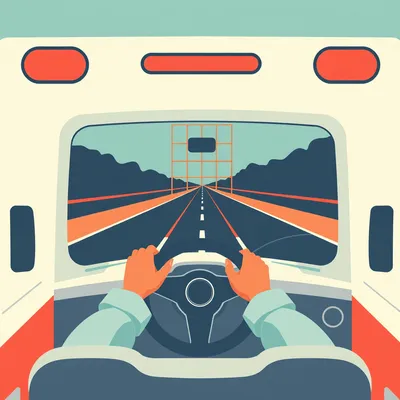
Imagine you are behind the wheel of a three-thousand-five-hundred-pound interceptor. Your sirens are wailing, the radio is a chaotic stream of coordinates and suspect descriptions, and you are pushing sixty miles per hour through a dense downtown corridor where the speed limit is twenty-five. A pedestrian steps off a curb three blocks ahead, a delivery truck is double-parked around a blind corner, and every green light is a potential T-bone collision waiting to happen. Today's prompt from Daniel is about how police officers actually pull this off without becoming part of the wreckage.

It is a phenomenal look into human performance at the absolute edge of cognitive capacity. Most people watch a pursuit on the news and think it looks like reckless aggression, but when you break down the physics and the neurology behind it, it is actually a masterclass in predictive modeling. By the way, today's episode is powered by Google Gemini Three Flash, which is helping us parse through the specialized training protocols that turn a standard driver into an emergency vehicle operator.
I have always wondered about the "how" here. Because if I try to change the radio station while merging onto the highway, I feel like I am multitasking. These guys are communicating on a radio, navigating a city they might not know perfectly, and driving at twice the legal limit. How do you even begin to train a brain for that level of sensory overload?
You start by realizing it is not a driving problem; it is a human factors engineering problem. The goal of police driver training, specifically the Emergency Vehicle Operations Course or EVOC, is to transform reactive driving into predictive navigation. Most civilian drivers are reactive. If a brake light flashes in front of you, you hit your brakes. That is a one-to-one stimulus-response. But at high speeds in an urban environment, if you wait for the stimulus, you are already dead. Your reaction time, which is roughly one point five seconds for the average person, is a fixed physical constant. You cannot outrun your own biology, so you have to move the goalposts.
So you are saying they are essentially driving in the future?
In a sense, yes. The core of the training is the twelve-second rule. While a normal driver might look one or two cars ahead, an officer is trained to look twelve seconds down the road. At sixty miles per hour, that is over a thousand feet. They are creating a moving prediction window. If you scan that far ahead, you aren't reacting to the car that just cut you off; you are reacting to the gap in traffic that suggested the car was going to cut you off five seconds before it happened.
I love the idea that there is a "gap in traffic" that speaks to you. It sounds almost mystical, but I bet it is just raw data processing. You mentioned EVOC. What does that actually look like in practice? Is it just doing donuts in a parking lot, or is there more structure to it?
It is incredibly structured. It usually follows a three-phase progression. You start with basic vehicle dynamics—understanding weight transfer, threshold braking, and the "circle of friction." That is the nerd stuff I love. Your tires only have a hundred percent of grip to give. If you use eighty percent of it for braking, you only have twenty percent left for steering. If you try to do both at a hundred percent, you slide.
Right, the classic "don't ask the car to do two things at once" rule. I imagine that is a hard lesson to learn when your adrenaline is spiking and you really want to make that turn.
And the second phase is precision driving. This is where they do those tight cone courses. It is not about speed; it is about spatial awareness. They need to know exactly where every corner of that vehicle is to within an inch. Then, finally, they move into pursuit intervention and high-speed response. This is where the cognitive load gets dialed up to eleven. They start adding the radio and the sirens. They have instructors screaming at them or providing distracting information. They are training the brain to "chunk" information.
Explain "chunking" in this context. Because usually, when I think of chunks, I am thinking of something much less professional.
In cognitive psychology, chunking is the process of taking individual pieces of information and grouping them into a single mental unit. A novice driver sees a red car, a blue truck, a pedestrian, and a pothole. That is four distinct items clogging up their working memory. A trained officer sees "congested intersection with northern egress." That is one chunk. By reducing the number of individual items the brain has to track, they free up mental bandwidth for higher-level decision-making, like "should I terminate this pursuit because the risk to the public is too high?"
That is fascinating. So the training is basically a software upgrade for the brain. It is not that they have faster reflexes; it is that they have a more efficient way of filing the incoming data. I saw a study recently—I think it was the twenty-nineteen Police Driver Training Study—that used eye-tracking glasses on officers.
That is a great study to bring up. It showed that experienced officers spend about sixty percent of their time looking three to five cars deep into traffic. Novices, on the other hand, fixate on the bumper directly in front of them. It is called "target fixation." If you look at the obstacle, you hit the obstacle. Officers are trained to look for the "escape corridor."
The escape corridor. That sounds like something out of a sci-fi movie. Is that a literal path they are mapping out?
It is a mental map. Every two to three seconds, an officer is identifying their "outs." If that truck suddenly veers left, do I have a sidewalk? Do I have a center lane? Is there a gap between those two parked cars? They are constantly refreshing a three-hundred-and-sixty-degree bubble of situational awareness. And the crazy thing is, this actually changes their perception of time.
Wait, like "Bullet Time" from the Matrix? You are telling me Herman Poppleberry believes in slow-motion police officers?
I know it sounds wild, but the data backs it up. Experienced pursuit drivers often report that time feels like it is slowing down during high-stress events. Research suggests they perceive time passing fifteen to twenty percent slower. It is because their brain is processing information at such a high density that the subjective experience of time stretches to accommodate it.
I have definitely felt that, but usually it is when I am watching a microwave count down the last ten seconds of a burrito. I can't imagine experiencing that while hurtling through a city. But let's talk about the actual "reading" of the traffic. Because it is one thing to look ahead; it is another to know what you are looking at. How do they anticipate what a civilian driver—who is probably panicking because of the sirens—is going to do?
That is the most dangerous part of the job. The "siren syndrome" is real. When people hear a siren, they do unpredictable things. They slam on their brakes in the middle of the road, or they veer into the path of the officer. Officers are taught a "threat triage" system. Tier one is immediate collision risk. Tier two is pursuit compromise—meaning they might lose the suspect. Tier three is post-incident liability.
I love that "not getting sued" is a formal tier of threat. Very realistic.
It has to be! But back to the navigation. One of the coolest techniques is how they handle intersections. Intersections are where most police accidents happen. In some advanced modules, like the ones used in the UK or parts of Europe, they teach something called the "Swedish Method" or variations of it for blind intersections. Instead of approaching a blind four-way stop head-on, they might take a wider, forty-five-degree angle approach as they enter. This limits their "exposure time" in the danger zone to about zero point three seconds, whereas a direct approach leaves them vulnerable for over a second.
That is a massive difference when you are talking about a car coming from the side at forty miles per hour. It is basically minimizing the surface area of the accident. It is interesting you mention the UK because I know their training is notoriously difficult. How does the US approach differ from what they are doing across the pond or in Europe?
It is a very different philosophy. In the US, the emphasis is often on the "Pursuit Intervention Technique" or the PIT maneuver. It is very tactical. You are looking to end the pursuit physically by spinning the suspect's car. US training focuses about seventy percent on pursuit continuation—how to stay on the tail and eventually stop the vehicle.
And the international side?
Take Australia or the UK. Australian officers spend about forty percent of their training on "pursuit termination" techniques—meaning how and when to call it off. The UK's "Advanced Police Driver" program is arguably the gold standard. It is a three-week, high-intensity course that you can only take after years of standard patrol driving. They focus heavily on "system of car control." It is almost like a checklist they run through for every single hazard: Information, Position, Speed, Gear, Acceleration. They call it IPSGA.
IPSGA. Sounds like a very boring government agency.
It might sound boring, but it is a mental framework that prevents the brain from skipping steps under stress. In Germany, the "Streifenwagenfahrer" training includes high-speed work on the Autobahn. They are training at speeds up to two hundred kilometers per hour. But here is the kicker: in Germany, you might spend six months in specialized driving training. In some US jurisdictions, it is as little as three weeks during the academy.
That is a staggering disparity. Six months versus three weeks? I mean, I know we like to do things fast in America, but that seems like a lot of nuance to pack into twenty-one days. Does that show up in the accident stats?
It does. Better-trained officers—those who have gone through advanced, multi-week certifications—have forty percent fewer civilian injuries during pursuits. It turns out that when you train someone to manage their cognitive load, they make better moral and tactical decisions. They aren't just driving; they are "commanding" the vehicle.
I think that is a key distinction. Most of us are just "operating" a car. We are passengers who happen to be holding the wheel. These guys are commanding it. But let's get into the weeds of the urban environment specifically. Pedestrians are the ultimate "wild card." How do you train for a kid chasing a ball into the street when you are going fifty?
You don't train to react to the kid; you train to recognize the "environment of the kid." This goes back to the predictive modeling. An officer sees a park on the right and an ice cream truck on the left. To a normal driver, that is just two landmarks. To a pursuit-trained officer, that is a "High-Probability Hazard Zone." They will automatically lift off the accelerator, move to the center of the road to increase their sightlines, and prepare for a threshold brake before they even see a person. They are managing the "envelope of safety."
I like that term, "envelope of safety." It makes it sound like they are wrapped in bubble wrap, which I am sure they wish they were. What about the physical sensation? We talked about time slow-motion, but what about the tunnel vision? I have heard that under high stress, your peripheral vision just shuts down.
It does. It is called "perceptual narrowing." Your brain decides that the only thing that matters is the thing directly in front of you. To combat this, they teach "scanning discipline." It sounds simple, but it is incredibly hard. Every few seconds, you have to force your eyes to "break" the stare. You look at your mirrors, you look at your gauges, you look at the sidewalks. It is a physical ritual to keep the brain from locking up. It is like rebooting your GPU every ten seconds to make sure the textures don't stop rendering.
That is a great way to put it. We are basically talking about a biological system trying to keep up with a mechanical one. I find it really interesting that these techniques, while developed for high-stakes law enforcement, actually have a lot of application for just, you know, not dying on the way to the grocery store.
That is what I wanted to get to. Most of these "police-only" techniques are just hyper-disciplined versions of good driving. Take the "twelve-second rule" we mentioned. If every civilian driver actually looked twelve seconds ahead, we would probably see a massive drop in multi-car pileups. We react to the brake lights in front of us because we aren't looking at the traffic jam forming half a mile ahead.
I tried that the other day after reading some of the prep for this episode. It is actually exhausting. Trying to consciously maintain a twelve-second lead on your vision takes a lot of mental energy. It makes you realize how much we "autopilot" our daily lives.
And that is why police training is so repetitive. They have to move these conscious actions into the "unconscious competent" layer of the brain. You know the four stages of competence, right?
I know I am usually in the "unconscious incompetent" stage when I am trying to put together IKEA furniture.
You don't even know what you don't know. But for driving, you start at unconscious incompetence. Then you go to conscious incompetence—you realize you are bad at it. Then conscious competence—you can do it, but you have to think really hard. Police training is designed to get you to "unconscious competence." You are doing the twelve-second scan, the IPSGA checklist, and the escape corridor mapping without even realizing you are doing it. It becomes as natural as breathing.
Which frees up the "conscious" part of the brain to talk on the radio and identify the suspect's license plate. It is a tiered architecture. It is actually very similar to how high-level athletes or fighter pilots operate. It is all about offloading the mundane tasks to the lower brain.
And that brings up a really interesting point about the future of this. We are sitting here in twenty-twenty-six, and autonomous vehicle technology is getting better every day. But pursuits aren't going away. In fact, they might get more complicated.
How so? If the cars are driving themselves, wouldn't that make it easier?
You would think so, but imagine a "mixed" environment. You have half the cars on the road running on predictable, algorithmic logic, and the other half are humans who are panicking or trying to evade. Now, the officer doesn't just have to predict human behavior; they have to predict how an AI-driven Tesla is going to react to a siren. Does the Tesla pull over? Does it stop dead in the lane? Does it try to calculate a path that the human officer didn't anticipate? The cognitive load actually increases because you have two different types of "minds" on the road.
That sounds like a nightmare. "Is this car a person or a robot?" is not a question I want to be answering while doing eighty. But you mentioned something earlier about the "Swedish Method" for intersections. Let's go back to the tactical side. When they are actually in a pursuit, how do they handle the "reading" of the suspect? Because it is not just about the road; it is about the guy they are chasing.
That is called "predictive mirroring." A good pursuit driver isn't just following the suspect; they are watching the suspect's car for "tells." If the suspect's car leans slightly to the right, even if they aren't in a turn yet, it tells the officer something about the suspect's intent. They are looking at the suspect's head in the rearview mirror if they can see it. Is the suspect looking for a turn? Are they focused on the road? If the suspect starts driving more erratically, the officer has to make a "risk-benefit" calculation.
And that is where the "pursuit termination" training comes in. I think people often get frustrated when they see a pursuit get called off, but when you realize that at sixty miles per hour, an officer is essentially a "human missile," it makes sense. If the "bits per second" of information exceeds the "processing power" of the environment, you have to pull the plug.
There was a case in Los Angeles in twenty-twenty-three where they analyzed a series of high-speed responses. They found that the officers who successfully navigated high-density traffic without incident had an average response time of zero point eight seconds from hazard identification to corrective action. That is almost twice as fast as a civilian. But the study noted that it wasn't about "twitch" movements. It was about "pre-loading" the movement. They already had their foot hovering over the brake or their hand ready to counter-steer because they had already "seen" the accident that hadn't happened yet.
It is like "pre-caching" data in a computer. If the data is already in the RAM, the CPU doesn't have to wait for the hard drive. I am curious about the physical training for the car itself. We talked about the PIT maneuver. That seems incredibly dangerous for both parties. How do you practice that without just destroying a fleet of cars every week?
They use "skid cars"—vehicles with outriggers or specialized hydraulic systems that can lift the wheels to simulate a loss of traction at low speeds. You can practice a thirty-mile-per-hour spin-out while only going ten miles per hour. It teaches you the "feel" of the break-away point. The PIT maneuver is actually very surgical. You aren't "ramming" the other car. You are making a gentle, quarter-panel-to-quarter-panel contact and then a controlled steer into their lane. It is about physics, not force. You use the suspect's own momentum to rotate them.
I have seen some videos of that, and when it is done right, it looks like a dance. When it is done wrong, it looks like a Michael Bay movie. You mentioned the "circle of friction" earlier. How does that apply to urban corners? Because city streets aren't racetracks. They have manhole covers, oil slicks, and painted lines that get slippery when wet.
That is the "surface reading" part of the training. Officers are taught to scan the texture of the road. A "shiny" patch isn't just a reflection; it is a change in the friction coefficient. If you are mid-turn and you hit a manhole cover, your "circle of friction" suddenly shrinks by fifty percent. If you don't adjust your steering input instantly, you are going into the curb. In advanced courses, they actually spray down parts of the track with soapy water or oil to force the students to catch slides in unpredictable spots.
It sounds like they are basically becoming amateur physicists. "If mass equals X and friction equals Y, I can take this corner at Z." But they are doing it all instinctively.
It has to be instinctive. There is no time for math. And that is why the cognitive load management is the most impressive part. They are doing all of this while often "broadcasting" their own pursuit. "Northbound on Main, approaching Third, suspect is weaving, speeds are fifty." They are essentially narrating their own high-speed movie in real-time. This actually helps keep the brain's language centers engaged, which can prevent the "reptilian brain" from taking over and causing a panic response.
Oh, that is a cool hack! Talking as a way to stay rational. I am going to try that next time I am stressed. "Corn is currently opening the mail, he sees a bill, his heart rate is rising, but he is maintaining composure."
It might actually work! But seriously, let's talk about the takeaways for the listeners. Because most of us aren't going to be in a high-speed pursuit—hopefully—but we all drive in "dense urban environments." What can a regular person take from the EVOC playbook?
For me, the biggest one is that "twelve-second scan." I have been trying it since we started researching this, and it is a game-changer. You realize how much "noise" you can ignore if you are focused on the "signal" twelve seconds ahead. You aren't surprised by the guy merging because you saw him looking at his mirror three blocks back.
And the "escape corridor" mindset. I think most people drive with their eyes locked on the car in front of them, effectively "trapping" themselves mentally. If you constantly ask yourself, "Where is my out right now?" you build a habit of spatial awareness. If the car in front of you suddenly stops, you don't have to think "where do I go?" because you already decided three seconds ago that the shoulder was clear.
It is about reducing the "decision debt." If you make the decision before the emergency happens, you have a zero-second reaction time. That is how you "beat" biology.
Another one is "smoothness." In every police driving manual I looked at, the word "smooth" appears more than "fast." Smooth steering, smooth braking, smooth acceleration. Jerky movements are what break the "circle of friction." If you watch a pro police driver, it doesn't look fast because it is so fluid. It looks like they are just gliding through traffic.
"Slow is smooth, and smooth is fast." I think that is the Navy SEAL saying, but it definitely applies here. If you are fighting the car, you are losing. You have to work with the physics, not against them. I also found the "chunking" concept really applicable. When I am in heavy traffic now, I try to categorize the lanes as "systems." Like, "this lane is the slow-moving exit system," and "this lane is the high-velocity flow system." It makes the chaos feel much more manageable.
It lowers the stress response. And that is the ultimate goal. The reason police drivers can do what they do isn't because they are "braver" than us—though they certainly are—it is because they have been trained to not be "afraid" of the physics. They understand the limits of the machine and the limits of their own brains, and they operate right at that edge.
It is a fascinating blend of high-tech training and raw human intuition. I mean, we are talking about people using twenty-twenty-six technology to navigate city streets that were sometimes laid out in the eighteen-hundreds. It is the ultimate "old world meets new world" challenge.
And as we move toward more automation, that skill set becomes even more of a specialized "art form." It is one of the few areas where human intuition and predictive modeling still beat the best algorithms we have—at least for now. An AI can calculate the friction of the road, but it has a hard time "reading" the body language of a suspicious driver or the "vibe" of a busy sidewalk.
"The vibe of the sidewalk." I am putting that on a t-shirt. But you are right—there is a level of "human-to-human" prediction that these officers develop. They are reading the psychology of the other drivers as much as they are reading the road.
One last thing that blew my mind in the research: the "post-pursuit" cooldown. After a high-stress driving event, officers are often taught specific breathing techniques to bring their heart rate down immediately. Because if you step out of a car after a ten-minute pursuit with your heart at a hundred and eighty beats per minute, your fine motor skills are gone, and your judgment is still impaired by cortisol. The "driving" doesn't end when the car stops; the "biological management" continues.
That makes so much sense. You can't just flip a switch from "Formula One Driver" to "Community Liaison." There has to be a transition. It really highlights that this is a total-body, total-mind discipline. It is not just about turning a wheel.
It is a high-performance profession that happens to take place in a Ford Explorer or a Dodge Charger.
Well, I for one am going to be a lot more observant next time I see a cruiser with its lights on. I will be looking for that "twelve-second scan" and the "escape corridor." Though, hopefully, I will be seeing it from a safe distance on the sidewalk.
Just make sure you aren't the "Tier One" threat he has to triage.
Noted. No standing on manhole covers in blind intersections. I think we covered a lot of ground today—literally and figuratively. From the "circle of friction" to "temporal stretching," it is clear that police driving is way more than just "pedal to the metal."
It is a science of survival. And honestly, it is one of those topics where the more you know, the more you realize how much work goes into making it look "easy" on the news.
I think that is a perfect place to wrap it up. This has been a deep dive into a skill set that most of us see every day but almost none of us truly understand. Big thanks to Daniel for the prompt—this was a blast to dig into.
Thanks as always to our producer Hilbert Flumingtop for keeping the wheels on this show. And a huge thank you to Modal for providing the GPU credits that power our research and script generation.
If you want to dive deeper into the technical papers Herman was quoting, or if you want to see our full archive, head over to myweirdprompts dot com. We have got everything there, from RSS feeds to our Telegram link.
This has been My Weird Prompts. I am Herman Poppleberry.
And I am Corn. Keep your eyes twelve seconds ahead, folks.
See ya.
Bye.