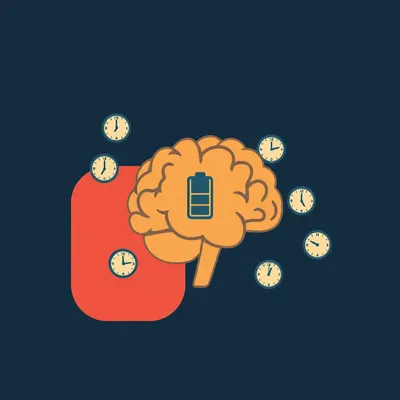
Daniel sent us this one — he's been thinking about the introvert-extrovert thing, and he's noticed something that a lot of people feel but don't always articulate. He can spend an entire day with family or close friends without any drain, but put him in a conference setting with a lot of new faces and he's completely wiped out, needing serious recovery time. The question is, what's actually happening in the brain? Why does social interaction with strangers create physical fatigue, not just a preference for solitude? And what's the mechanism behind that "social battery" metaphor everyone uses but nobody really explains?

This is one of those questions where the popular psychology version and the neuroscience version are living on completely different planets. The introvert-extrovert binary has been useful for getting people to think about social energy differences, but it's also done a lot of damage by flattening something that's actually about specific cognitive mechanisms into a personality label.
The binary makes it sound like you either find people draining or you find them energizing, full stop. But that's clearly not how it works. The same person who needs three days to recover from a conference happy hour can spend twelve hours straight with their siblings and feel fine.
The reason that pattern exists tells us something real about what's actually being depleted. It's not "social energy" in some vague sense. It's a specific set of cognitive resources that get taxed by specific features of social situations. The biggest one, and I think this is where we should start, is novelty.
It's not people who drain you, it's people you don't know yet.
That's the core of it. When you're with family or close friends, your brain is working with pre-built models. You know how your brother tells a story, you know what topics will come up, you know the conversational rhythms. Your prefrontal cortex isn't building anything from scratch. But when you meet someone new, your brain has to construct a mental model of that person in real time — their communication style, their emotional state, what they find funny, what they might take offense at, whether they're the kind of person who wants to talk about ideas or about people or about themselves.
You're doing this while also monitoring your own self-presentation.
That's the double load. You're building a model of them while simultaneously managing the model of you that they're receiving. This is what social cognition researchers call impression management, and it's metabolically expensive. There was a study out of the University of Michigan in twenty twenty-three, Smith and colleagues, published in Social Cognitive and Affective Neuroscience, that actually measured this directly. They used PET scanning to track glucose metabolism in the prefrontal cortex during unstructured social interactions with strangers versus familiar conversation partners.
What'd they find?
People who scored as introverts on standard measures showed twenty-three percent higher prefrontal cortex glucose metabolism during the stranger interactions compared to extroverts, even when both groups reported identical levels of engagement and enjoyment. Same subjective experience, radically different metabolic cost.
The introvert's brain is burning more fuel to do the same social task.
And glucose metabolism in the prefrontal cortex isn't an abstract metaphor. It's a real, measurable, physically limited resource. Your brain consumes about twenty percent of your body's energy despite being only two percent of your mass, and the prefrontal cortex is one of the hungriest regions. When you're running it hard for hours, you're depleting something real.
This also explains why the "just push through it" advice doesn't work. You can't will your way past a glucose deficit any more than you can will your legs to keep sprinting after they've burned through their glycogen stores.
That's actually the bridge to the physical fatigue piece, which I want to get to because I think it's the most underappreciated part of this whole picture. But first let me stay on the novelty mechanism for a minute, because there's another system involved beyond the prefrontal cortex.
The threat-detection system.
Novelty-detection, which is adjacent. The amygdala doesn't just respond to danger. It responds to anything unfamiliar that requires rapid evaluation. Unfamiliar faces, unpredictable social scripts, situations where you don't know what's coming next — all of that triggers what's called the amygdala's novelty response, which increases norepinephrine release. Norepinephrine is great for focus and alertness, but it's also part of the body's stress axis, and maintaining elevated levels is physically costly.
Meeting a room full of strangers triggers a low-grade stress response that your body has to sustain for the duration.
Often for hours afterward. Cortisol levels in what researchers call "high-reactivity individuals" can remain elevated for two to three hours after a novel social interaction ends. So you leave the conference mixer at seven, and your stress hormones don't return to baseline until ten or eleven at night. That's not just "feeling tired." That's your body running a physiological stress response long after the event is over.
Which would also explain why sleep after a conference doesn't always feel restorative. If your cortisol is still elevated when you're trying to fall asleep, you're not getting the same quality of rest.
And that connects to something I think is really important — the distinction between being mentally tired and being cognitively depleted. Mental tiredness is subjective. Cognitive depletion is a measurable reduction in executive function capacity. After sustained high-demand social processing, you literally perform worse on tasks that require working memory, inhibitory control, and decision-making. The University of Toronto did a study in twenty twenty-four tracking a hundred and twenty conference attendees over three-day events. By day three, people who scored high on what's called "need for cognition" — which is basically a measure of how much someone engages in effortful thinking — showed thirty-one percent higher self-reported fatigue and eighteen percent slower reaction times on cognitive tests.
This was independent of whether they identified as introverts or extroverts.
That's the key finding. The drain wasn't predicted by the personality label. It was predicted by how much cognitive effort the person was expending during social interactions. Extroverts who happened to be high in need for cognition got just as depleted as introverts. The difference is that extroverts tend to have lower baseline reactivity to novelty, so they start from a different place and recover faster.
What's driving that difference in baseline reactivity?
There's a gene called COMT that's been studied pretty extensively in this context. It codes for an enzyme that breaks down dopamine in the prefrontal cortex. There's a common variation called the Val158Met polymorphism — I know, delightful name — that affects how efficiently dopamine is cleared. People with the Val variant clear dopamine faster, which means their prefrontal cortex dopamine levels stay in an optimal range during high-demand tasks. People with the Met variant clear dopamine more slowly, so under cognitive load, dopamine can accumulate and actually impair prefrontal function.
Some people's brains are literally better at handling the neurochemical demands of processing novelty.
That's not a value judgment. The Met variant is associated with better performance on certain memory tasks under low stress. It's a trade-off. But in the specific context of a conference or a networking event, the Val variant gives you more endurance.
One of the things Daniel mentioned is that sometimes the tiredness feels genuinely physical, not just mental. Like needing to take a nap, not just needing to be alone. Is that the same mechanisms or is there something else going on?
This is where the HPA axis comes in. HPA stands for hypothalamic-pituitary-adrenal, and it's the body's central stress response system. When you're in a high-novelty social environment, your amygdala signals the hypothalamus, which triggers the pituitary, which tells the adrenal glands to release cortisol. Sustained cortisol elevation doesn't just affect your brain. It affects your entire body — it mobilizes glucose from your liver, it increases heart rate and blood pressure, it suppresses non-essential functions like digestion and immune response.
You're literally running your body in a higher gear for hours.
That's physically exhausting in exactly the same way that any extended stress response is physically exhausting. Your muscles have been held in a state of subtle tension. Your cardiovascular system has been working harder. Your liver has been dumping glucose into your bloodstream. When the event ends and cortisol finally drops, you crash. That's not psychological. That's your body recovering from a genuine physiological demand.
This makes the "conference hangover" make a lot more sense. It's not just a cute metaphor. You've actually been running a marathon with your stress response system.
Here's the thing that I think gets missed in almost all the popular discussion of introversion. The recovery need isn't just about getting away from people. It's about giving your body time to clear cortisol, restore glycogen stores in the prefrontal cortex, and return the HPA axis to baseline. Solitude helps because it removes the ongoing novelty stimulus, but the actual recovery is physiological. Sleep is more important than quiet time for bouncing back from a high-demand social day.
The advice to "take a nap after a conference" isn't just self-care fluff. It's addressing a real metabolic deficit.
Your prefrontal cortex has been burning through glucose at an elevated rate for eight hours. Sleep is when the brain replenishes those energy stores and clears out metabolic byproducts. Without sleep, you're starting the next day with a partially depleted system, which is why day three of a conference feels exponentially worse than day one.
Let me ask you something about the other side of this. Daniel mentioned that some people thrive on the novelty of meeting new people. What's different in their brains?
A few things. First, there's that COMT variation I mentioned — the Val variant is associated with lower anxiety and faster recovery from stress. But there's also a dopamine system difference that's been studied quite a bit. Novelty, for some brains, triggers a stronger dopamine release in the reward circuits — the nucleus accumbens and the ventral tegmental area. So where a high-reactivity person's brain responds to a room full of strangers with a cortisol spike, a low-reactivity person's brain responds with a dopamine spike. Same stimulus, completely different neurochemical signature.
It's not that extroverts are better at managing the drain. It's that the same situation doesn't create the same drain in the first place.
And this is where the "social battery" metaphor actually breaks down in a useful way. It's not that everyone has the same battery and extroverts just use less power per interaction. It's that different brains are running different operating systems. The introvert's system treats novelty as a high-processing-demand task that requires sustained attention and vigilance. The extrovert's system treats novelty as a reward opportunity that triggers approach behavior. Same hardware, different software.
That's a much more useful framing than "introverts are shy" or "introverts don't like people.
It completely decouples introversion from social anxiety, which is one of the biggest misconceptions out there. Social anxiety is about fear of negative evaluation. What we're describing is cognitive resource depletion. You can be an introvert with zero social anxiety — you're perfectly comfortable talking to strangers, you just find it metabolically expensive. And you can be an extrovert with social anxiety — you crave social interaction but you're terrified of being judged. They're orthogonal dimensions.
The fear versus fatigue distinction seems crucial. One is about what you're afraid might happen. The other is about what's actually happening in your brain regardless of how you feel about it.
The practical implications are completely different. If the problem is social anxiety, the intervention is exposure therapy or cognitive behavioral therapy. If the problem is cognitive resource depletion, the intervention is managing your schedule around your actual processing capacity. Throwing someone with high novelty-processing costs into more networking events to "get comfortable" doesn't build endurance. It just depletes them faster.
Which brings us to conferences, which is where a lot of this plays out in the most concentrated form. What is it about the modern conference that's so perfectly designed to max out novelty-processing demands?
It's almost a perfect storm. You've got back-to-back sessions with different speakers and different topics, each requiring a new mental model. You've got unstructured networking breaks where you're expected to initiate conversations with strangers. You've got social events in the evening where the expectation is more of the same, just with drinks. And you've got no built-in time to consolidate any of it.
The unstructured networking is the killer, I think. At least during a presentation, you can be passive. You're receiving information, not managing a two-way social interaction.
That's exactly what the research shows. Structured interactions — workshops, roundtables, facilitated discussions — are significantly less draining than unstructured mingling, even when the structured interactions involve more total social engagement. The structure reduces the novelty-processing load because the social scripts are more predictable. You know when you're supposed to speak, you know what you're supposed to speak about, and you don't have to continuously monitor whether the conversation is going well.
There's a term from cognitive psychology that feels relevant here — "decision fatigue." Every time you have to decide whether to approach someone, what to say, how to exit a conversation, whether to stay or move on — you're making a decision that consumes executive function resources.
Conferences involve hundreds of those micro-decisions across a day. Do I go to this session or that one? Do I talk to the person standing alone or join the group? Do I exchange contact information now or later? Each one is small, but they add up, and they all draw from the same limited pool of executive function.
What would a conference designed around cognitive resource management actually look like?
A few things that the research supports. First, scheduled buffer time between sessions — and I don't mean checking your phone in the hallway. I mean actual solitude, fifteen to twenty minutes, in a space where social interaction isn't expected. The prefrontal cortex needs genuine downtime to reset. Phone scrolling doesn't count because it's still delivering novel stimuli that require processing.
Like adopting a feral cat.
I'm not sure I follow the analogy, but I agree with the sentiment. Second, what some conferences have started calling "low-demand social zones" — spaces where conversation is possible but not expected. Silent co-working areas, reading lounges, topic-specific tables with a facilitator where the conversation has structure.
The topic-specific tables seem particularly smart. You know what you're going to talk about before you sit down. That eliminates the worst part of networking, which is the cold open.
Third, I think there's a case for rethinking "mandatory fun" entirely. The evening social event where everyone's expected to mingle for two hours — that's the highest cognitive-load activity of the entire conference for a lot of attendees, and it's scheduled at the end of the day when everyone's already depleted. It's the conference equivalent of asking marathon runners to do wind sprints after they cross the finish line.
The glockenspiel of corporate approachability.
There's a phrase I'm going to be thinking about for the rest of the week. The forced informality of these events actually increases the cognitive load because the social scripts are ambiguous. Is this a professional interaction or a personal one? How much of my actual personality am I supposed to be showing? The ambiguity itself is cognitively demanding.
We've established what's happening in the brain, why it's physically draining, and what makes conferences particularly brutal. What do people actually do with this information?
I think the most actionable shift is reframing what "social battery" actually means. Most people treat it like a single resource that gets depleted by any social interaction and recharged by solitude. But the research suggests it's more specific than that. It's novelty processing capacity. Interactions with familiar people in familiar contexts cost very little. Interactions with unfamiliar people in unstructured contexts cost a lot.
You plan your social calendar around the cognitive load of each interaction, not just the number of interactions.
A three-hour dinner with close friends on a Friday night might cost you almost nothing. A forty-five-minute networking coffee with someone you've never met might cost you more than the entire dinner. If you're tracking your social energy as a single bucket, you'll miss that distinction and end up confused about why some social weeks leave you fine and others leave you destroyed.
For conferences specifically, the practical advice isn't just "take breaks." It's about what kind of breaks and when. Fifteen minutes of genuine solitude between high-novelty sessions, not phone time. Prioritize the structured sessions over the unstructured ones if you have to choose. And for the love of everything, skip the mandatory fun if you're already running on empty.
There's also a case for front-loading your novelty budget. If you know you've got about four hours of high-quality novelty processing in you per day — and that number varies by person, but it's finite for everyone — then schedule your most important new-person interactions in the morning when your prefrontal cortex is fresh. Don't waste your peak processing hours on low-priority meetings and then try to network with important people at the end of the day when you're cognitively depleted.
The "novelty budget" framing also makes it easier to explain to other people why you're not up for something. Instead of "I'm an introvert and I need alone time," which can sound like a personality quirk, you can say "I've hit my novelty limit for the day and I need to reset." It's more accurate and it doesn't pathologize a normal cognitive constraint.
I think there's a broader reframe that's worth making explicit. The exhaustion you feel after a day of meeting new people isn't a sign that you're bad at socializing or that there's something wrong with you. It's a sign that you were doing something cognitively demanding and you did it well. The fatigue is evidence of high engagement, not social failure.
That's a useful perspective. The exhaustion means your brain was working hard, not that your brain is broken.
And this connects to something I've been thinking about with the rise of hybrid conferences and virtual events. Zoom fatigue is real, but it's a different kind of cognitive load than in-person novelty processing. On Zoom, you're not building full mental models of new people because you're getting so much less information — no body language below the shoulders, no spatial context, no peripheral social cues. But you're compensating by working harder to extract meaning from limited signals, and you're also dealing with the weird self-monitoring of seeing your own face.
The self-view is a cognitive load multiplier that nobody asked for.
It's like trying to have a conversation while looking in a mirror the entire time. Your brain is continuously processing your own facial expressions and adjusting them, which is a completely unnatural demand. There's some early research suggesting that the self-view feature alone accounts for a significant portion of Zoom fatigue, especially for people who are already high self-monitors.
Virtual conferences might actually be less draining in some ways — less novelty, less unpredictability — but more draining in others, because the medium itself imposes additional processing demands.
As of mid-two thousand twenty-six, this is still an active area of research. We don't have definitive answers yet about whether the net cognitive load of virtual social interaction is higher or lower than in-person. It probably depends heavily on the individual and the specific format.
One question I have, and I think this is where a lot of people end up when they think about this stuff — can you train yourself to increase your novelty processing capacity? Or are you stuck with whatever baseline you've got?
The honest answer is that we don't have great evidence for trainability. The COMT variation is genetic. The basic architecture of your stress response system is shaped by early development in ways that are hard to modify in adulthood. There have been some studies on cognitive training programs that target working memory and executive function, but the transfer to real-world social processing has been limited at best.
The "just practice more" advice doesn't hold up.
Not in a straightforward way. What does seem to help, interestingly, is not cognitive training but stress management. Mindfulness-based stress reduction has shown some promise in reducing cortisol reactivity to novel social situations. If you can dampen the HPA axis response, you reduce the metabolic cost of the interaction, even if the cognitive processing demands stay the same.
You're not making the brain more efficient at processing novelty. You're making the body less reactive to the stress of novelty.
And that's a more achievable goal. You can learn to regulate your physiological response to unfamiliar social situations through breathing techniques, through reframing the situation as non-threatening, through gradual exposure that builds familiarity with the specific context even if the specific people are new. A conference becomes less draining the tenth time you attend one, not because your brain got better at meeting strangers, but because the conference context itself is no longer novel.
The context familiarity reduces the overall cognitive load even if the individual interactions are still with new people.
You know where the bathrooms are, you know how the schedule works, you know what kind of small talk is expected. All of that background processing that was consuming resources during your first conference is now automated, freeing up capacity for the actual social interaction.
Which suggests that if you want to build social endurance, you're better off getting really familiar with a few specific contexts than trying to become generally better at meeting new people in any context.
That's exactly what the evidence points toward. Breadth of social experience is overrated. Depth in a few contexts builds genuine efficiency.
I want to circle back to something you mentioned earlier about the default mode network, because I think it explains the flip side of this — why familiar social interactions can actually be energizing rather than just neutral.
This is one of my favorite findings in social neuroscience. The default mode network is a set of brain regions that's active when you're not focused on an external task — when you're daydreaming, remembering, thinking about yourself or others. It turns out that the DMN is also heavily involved in social cognition, particularly for familiar others. When you're with close friends or family, your brain can process the social interaction largely through the DMN, which is metabolically efficient because it's the brain's default operating state.
You're not switching into a high-demand task mode. You're staying in the brain's equivalent of cruising speed.
Whereas with strangers, your brain has to stay in what's called "task-positive mode" — the network that's active when you're focused on external demands. Switching between the DMN and task-positive networks is itself metabolically costly, and staying in task-positive mode for extended periods is draining. With familiar people, you can stay in or near your default mode, which feels effortless because it literally is.
That explains something I've noticed but never had language for. When I'm with people I know well, conversation feels like it generates energy rather than consuming it. It's not just that it costs less. It actually seems to produce something.
There's a neurochemical basis for that too. Familiar social interaction triggers oxytocin release, which has a calming effect on the amygdala and reduces cortisol. So not only are you not spending energy on novelty processing, you're actually getting a mild stress-reduction effect. The social interaction is actively restoring your baseline rather than depleting it.
Which is why "I need alone time" isn't always the right recovery strategy. Sometimes what you actually need is time with people who don't cost you anything cognitively.
The binary of "socializing drains, solitude recharges" misses that entirely. Some socializing recharges. Some solitude is just isolation. The variable isn't whether people are present. It's whether the interaction requires novelty processing.
If we were going to give Daniel a concrete framework for thinking about this, what would it look like?
I'd say there are three dimensions to consider for any social situation. First, familiarity — how well do you know the people? Second, structure — how predictable are the social scripts? Third, duration — how long are you expected to sustain the interaction without a break? High familiarity, high structure, and reasonable duration with breaks — that's low cognitive load. Low familiarity, low structure, and extended duration — that's maximum cognitive load.
The conference cocktail hour is the perfect storm on all three dimensions.
Unfamiliar people, no structure, and an open-ended expectation to mingle for two hours. It's the triathlon of social cognitive demand.
I think the other thing worth naming is that none of this is a flaw. The fact that your brain works hard to build models of new people is a feature, not a bug. It means you're actually paying attention, actually processing, actually trying to understand who you're talking to. The people who find socializing effortless might also be the people who walk away from a conversation having learned nothing about the person they just met.
There's some truth to that. The glucose metabolism study I mentioned earlier — the introverts were burning more energy, but the researchers also found that they formed more accurate impressions of their conversation partners in subsequent recall tests. The higher metabolic cost was buying something real.
Depth of processing versus breadth of processing. Different strategies, different costs, different payoffs.
Neither one is better in absolute terms. The extrovert strategy — low-cost, broad processing — is great for working a room and making a lot of initial connections. The introvert strategy — high-cost, deep processing — is great for building genuine understanding of a smaller number of people. Different tools for different jobs.
Which brings us back to conference design. The ideal conference probably accommodates both strategies rather than forcing everyone into the extrovert default.
Most conferences don't. Most conferences are designed by extroverts, for extroverts, with the implicit assumption that more social interaction is always better and that anyone who wants less of it just needs to be coaxed out of their shell. The research we've been discussing suggests that's not just wrong, it's counterproductive. You're not coaxing people out of a shell. You're forcing them to operate beyond their sustainable cognitive capacity.
The mandatory fun is mandatory depletion.
Depleted attendees don't learn, don't retain, and don't form meaningful connections. They just survive. If the goal of a conference is knowledge transfer and relationship building, designing it in a way that leaves half your attendees cognitively depleted by day two is self-defeating.
What's the one thing you'd tell a conference organizer who's listening to this?
Kill the unstructured cocktail hour. Replace it with topic-specific facilitated discussions where people know what they're going to talk about before they sit down. And build fifteen-minute solitude buffers into the schedule between every high-demand session. Those two changes alone would dramatically reduce the cognitive load on your attendees without reducing the total amount of social interaction.
For the individual attendee who can't redesign the conference?
Give yourself permission to skip things. The evening mixer is not mandatory no matter what the schedule says. Your cognitive capacity is finite and precious. Spend it on the interactions that actually matter, not the ones that are just on the agenda. And if you do go, give yourself a time limit and an exit strategy before you walk in. Knowing you only have to sustain it for forty-five minutes reduces the anticipatory load.
The exit strategy point is underrated. Part of what makes unstructured networking exhausting is the open-endedness. You don't know when it's acceptable to leave, so you're constantly monitoring the social cues that would tell you, which is itself cognitively demanding.
That's a perfect example of how small structural changes can have outsized effects. Just knowing your exit time in advance removes a whole category of micro-decisions and social monitoring. It's a tiny intervention with a disproportionate payoff.
To pull this together — the "why" behind the fatigue is a combination of prefrontal cortex glucose depletion, amygdala-driven cortisol elevation, sustained HPA axis activation, and the metabolic cost of running task-positive networks for extended periods. The "what to do about it" is to recognize that your constraint is novelty processing capacity, not social capacity in general, and to design your social life — and your conference attendance — around that specific constraint.
The reframe that I hope sticks with people is that the exhaustion isn't evidence of a problem. It's evidence that your brain is doing something demanding and doing it well. You're not bad at socializing. You're good at deep processing, and deep processing costs more. Understanding the mechanism gives you agency. You can stop trying to be someone whose brain runs a different operating system and start optimizing the system you actually have.
One open question that I think is worth leaving people with — you mentioned that mindfulness-based stress reduction shows some promise for reducing cortisol reactivity. If the constraint really is physiological rather than purely cognitive, what other interventions might work? Exercise before a social event? Specific nutrition strategies for maintaining prefrontal glucose levels? Cold exposure for HPA axis regulation?
Those are all active areas of investigation. There's some early work on whether consuming complex carbohydrates before high-demand cognitive tasks can buffer prefrontal glucose depletion, but the findings are mixed. Cold exposure has shown effects on general stress resilience, but nobody's specifically studied it in the context of social cognitive load. This is all frontier territory as of twenty twenty-six.
Something for a future episode, then. In the meantime, I think we've given people a much more useful model than "introverts need alone time.
Hopefully made a few conference attendees feel less broken in the process.
Now: Hilbert's daily fun fact.

In the nineteen thirties, a pigment chemist in Honduras discovered that the geometry of a specific hexagonal tiling pattern found in Mayan textile designs produces an optical mixing effect identical to what happens when you physically blend ultramarine and burnt sienna, meaning the eye perceives a color that isn't actually present in any single tile.
I have no idea what to do with that information.
I'm going to be thinking about optical color mixing in Mayan textiles for the rest of the day.
This has been My Weird Prompts. If you enjoyed the episode, leave us a review wherever you get your podcasts — it helps other people find the show. You can find every episode at myweirdprompts dot com. We'll be back next time.