So Daniel sent us this one, and it's a live one. He's asking about the US mine clearance operation currently underway in the Strait of Hormuz — what it actually means to mine a sea passage, how you go about removing mines when you don't have a map of where they are, and what makes this particular operation so technically and strategically complicated. The short version: Iran laid mines in one of the most critical waterways on earth, did it so haphazardly that they apparently lost track of where the mines are, and now the US is trying to clear a path through what one source described as "Death Valley." There's a lot here.

Herman Poppleberry, and yeah, this is genuinely one of the most fascinating military-technical situations I've followed in years. Not because it's dramatic — though it is — but because it exposes something most people don't think about: the unglamorous, painstaking, almost archaeological work of making a body of water safe again after someone has turned it into a weapon.
And before we get into the weeds, quick note — today's episode is brought to life by Claude Sonnet 4.6, which is writing our script. The friendly AI down the road doing the heavy lifting while we take the credit. Classic arrangement.
The arrangement we've all come to love. Okay, so let's start with the geography, because the Strait of Hormuz is not just strategically important in an abstract sense. It is physically constrained in ways that make this problem dramatically harder than it would be in open water.
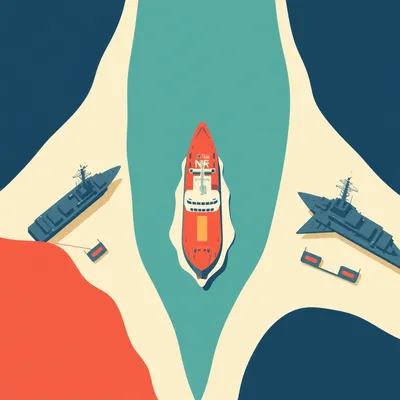
Twenty-one miles wide at its narrowest point. Which sounds like a lot until you realize the actual shipping lanes are one mile wide each — one inbound, one outbound — with a two-mile buffer between them. You're essentially threading supertankers through a corridor.
And before the conflict, roughly one hundred thirty vessels a day were transiting that corridor. By April eleventh, that number had dropped to nine. Nine vessels per day. Less than seven percent of normal traffic. The IEA director said fifteen million barrels of crude and five million barrels of other oil products are stranded in the Gulf every day. The IEA's emergency release of four hundred million barrels — the largest in history — only covers about twenty-six days of the shortfall.
So the pressure to get this done fast is enormous. But the nature of the problem is that fast and mine clearance are basically incompatible.
That tension is the whole story. And to understand why, you need to understand what Iran actually deployed. Because not all mines are created equal, and the specific weapons Iran chose make this significantly harder.
Walk me through what they laid.
So US intelligence confirmed two primary types. The Maham-3 and the Maham-7. The Maham-3 is a moored mine — it floats below the surface, tethered to the seabed by a cable. It uses magnetic and acoustic sensors to detect nearby vessels without requiring physical contact. It has an electronic timer controlling when it's active, and the sensors can be configured through coded inputs. First publicly shown in 2015, domestically manufactured.
So it's not a dumb contact mine. It's a smart weapon.
Right, it's not sitting there waiting to be bumped into. It's listening. The Maham-7 is more interesting and more dangerous from a clearance standpoint. It's a limpet-style mine — rests on the seabed rather than floating. Uses acoustic and three-axis magnetic sensors. Designed for medium-sized ships, landing craft, smaller submarines. But the critical feature is its shape. The casing is engineered specifically to scatter incoming sonar waves rather than reflect them cleanly. So when you sweep the area with sonar, the mine doesn't return a clear signature. It's designed to be invisible to the primary tool you'd use to find it.
That's a genuinely clever piece of engineering. In a horrifying way.
Deeply unpleasant, yes. And then there's the EM-52, which is a seafloor mine made of non-magnetic composites — so it doesn't trigger magnetic detection either — and when its acoustic sensors detect a ship's signature above, it launches a rocket-propelled three-hundred kilogram warhead upward to strike the hull from below.
So you have mines that are acoustically stealthy, magnetically stealthy, and kinetically lethal from a distance. This is not the WWI-era ball-with-spikes image most people have.
Not remotely. And the US also has to contend with the possibility of older types — Soviet-era contact mines, manually-placed limpet mines attached by divers — because Iran's stockpile is a mix of domestically produced weapons, Chinese-supplied, Russian-supplied, and legacy Soviet equipment. The Defense Intelligence Agency estimated in a 2019 report that Iran has more than five thousand naval mines in total.
How many were actually laid in the strait?
This is where the numbers get murky and the story gets really strange. CBS News and the Wall Street Journal reported "at least a dozen." CNN reported "a few dozen." And the reason nobody has a firm number is not just intelligence uncertainty — it's that Iran itself reportedly doesn't know the precise answer.
Which is the detail that made me do a double-take when I first read about this. Explain that.
So the New York Times reported, citing US officials, that Iran deployed mines using decentralized IRGC small boat crews — each boat carrying two or three mines — without a clear command chain and without a systematic record of where each mine was placed. US officials described the deployment as "haphazard." Iranian Foreign Minister Abbas Araqchi acknowledged what he called "technical constraints" to reopening the strait, which is a remarkably diplomatic way of saying we don't entirely know where our own weapons are.
And the US destroyed sixteen of those minelaying vessels on March tenth, plus over forty-four mine layers total. So the people who physically placed the mines may be dead. Any records they kept may be gone.
Which creates a situation that is genuinely unprecedented in the history of mine clearance operations. Normally, when a conflict ends or a party agrees to cooperate, you get charts. You get coordinates. You get the mine type and fusing information. That's how the international conventions around mine clearance are supposed to work. Here you have three simultaneous failures of that process: Iran won't cooperate politically, Iran can't cooperate fully even if it wanted to because the information doesn't exist, and the mines may have physically moved because currents in a turbulent strait can drag moored mines from their original positions.
So the US is essentially doing archaeology in a live minefield.
That's not far off. And let me walk through what the clearance process actually looks like in practice, because I think most people's mental model of minesweeping is wildly out of date.
The image of a boat dragging a big net.
Right, which is roughly how it worked in World War Two. Modern mine countermeasures — MCM in the naval jargon — is a three-phase process: detect, identify, neutralize. And each phase is harder than it sounds.
Detection uses a combination of side-scan sonar, which sends acoustic pulses across the seabed and produces detailed imagery of objects on the bottom, autonomous underwater vehicles and remotely operated vehicles that survey large areas and transmit sonar data back to operators, helicopter-towed sensors, and specialized towed systems like the AN/AQS-20C, which is pulled by unmanned surface vehicles specifically so you keep sailors outside the minefield. The AN/AES-1 Airborne Laser Mine Detection System uses lasers to detect mines near the surface from helicopters.
So you're building a picture of the seabed.
A very slow picture. And the Strait is not cooperating. The seabed has natural objects — rocks, debris, wrecks — that produce sonar signatures similar to mines. Currents create noise. And the Maham-7's sonar-scattering design means some mines may not appear clearly even with good equipment.
Then identification.
Every suspicious object has to be individually examined to determine whether it's actually a mine and what type. This matters enormously for neutralization, because different mines require different approaches. You can't just detonate everything indiscriminately — that risks triggering sympathetic detonations and you'd destroy equipment you might need. An ROV goes in, gets close, takes imagery, and operators make a judgment call.
And then the actual removal.
This is where the maritime security expert Scott Truver's quote really lands. He said a single device can take hours to clear, and in the meantime you're essentially standing still while operations are underway. Emma Salisbury from the Foreign Policy Research Institute put it plainly: you are performing controlled explosions for each individual mine, and your ships are going to be in that dangerous area for a long time. The AN/ASQ-235 Airborne Mine Neutralization System deploys from MH-60S helicopters and lowers a torpedo-sized tube carrying expendable destructor vehicles — essentially small shaped charges that swim toward the mine and detonate against it. There's also the AN/WSQ-46 Barracuda system for near-surface mines.
So for each mine: you sweep, you find something, you investigate, you identify, you deploy a neutralization vehicle, you detonate, you verify it's gone, you move on to the next one. Hours per mine. Potentially dozens of mines. In a corridor that Iranian shore batteries and drone swarms can reach.
CENTCOM described the strait in those terms — essentially, the MCM vessels are slow-moving, non-maneuverable ships operating in range of shore-based missile systems. Retired Admiral James Foggo said even if clearance began immediately, getting fully underway would take at least a month, and would require continuous combat air patrol overhead to protect the minesweepers, followed by destroyer escorts for any tankers attempting transit.
Which is why it's so notable that the ships CENTCOM sent through on April eleventh were Arleigh Burke-class destroyers — USS Frank E. Petersen Jr. and USS Michael Murphy — not dedicated minesweepers. They were there to "set conditions," as CENTCOM put it.
To establish a protected envelope for the MCM assets to follow. Admiral Brad Cooper's statement was careful: "Today, we began the process of establishing a new passage, and we will share this safe pathway with the maritime industry soon." Note the word "soon" doing a lot of work there. Not "we have cleared the passage." Not "it's safe now." The process has begun.
Let's talk about the capability gap, because this is the part of the story that should make people genuinely angry. The US Navy has been neglecting mine warfare for decades.
This is where institutional failure meets strategic consequence in a very direct way. Mine warfare receives less than one percent of the total US Navy budget. Scott Truver wrote about this in a Naval War College paper in 2015 — warning explicitly that the US lacked sufficient MCM capability to deal with a sophisticated Iranian mining campaign. That warning sat on a shelf for eleven years.
And then, in January of this year — weeks before Operation Epic Fury launched on February twenty-eighth — the US loaded four Avenger-class minesweepers onto a transport ship in Bahrain and sent them to Philadelphia for disposal.
The USS Devastator, Dextrous, Gladiator, and Sentry. Wooden-hulled ships, built between 1987 and 1994, that were the backbone of US MCM capability in the Gulf. Gone. The logic was that the Littoral Combat Ship — the LCS — was supposed to replace them with a modular MCM package using unmanned systems and helicopters.
The "little crappy ship."
That nickname has earned its place in the lexicon. The LCS has been plagued by cost overruns, hull cracks, and reliability issues for years. And the MCM package specifically — the Pentagon's own Director of Operational Test and Evaluation reported in March that no operational testing of the LCS MCM package was conducted in fiscal year twenty twenty-five. The report said operational effectiveness "cannot be determined due to insufficient performance data." Which in plain English means: we don't actually know if this system works.
And where were the LCS ships when the conflict started?
USS Santa Barbara and USS Tulsa were in Singapore. USS Canberra was also in Asia. Emma Salisbury said she was "honestly completely baffled" as to why. Having a mine countermeasures capability that is not in theater is not particularly helpful is how she put it, which is the most restrained possible framing of what is a genuinely catastrophic planning failure.
There's a historical stat that puts this in context. Since World War Two, fifteen of nineteen US Navy ships sunk or severely damaged were mine victims. More than all other weapons combined. Three US warships were damaged by Iranian mines in the Persian Gulf since 1988 alone. The threat profile has been consistent for decades.
And the 1988 case is worth dwelling on, because the parallels are uncomfortable. The USS Samuel B. Roberts was a guided-missile frigate operating in the Persian Gulf during the Tanker War. April fourteenth, 1988 — almost exactly thirty-eight years ago — she struck an Iranian mine. The explosion blew a hole in her hull large enough to drive a truck through, injured twenty-seven sailors, nearly sank the ship. The Reagan administration responded with Operation Praying Mantis four days later, damaging or sinking three Iranian warships and destroying two oil platforms.
Same country, same waters, same weapon, thirty-eight years later.
What has changed is the sophistication of the mines. The Roberts struck a relatively simple moored contact mine. The Maham series is sensor-fused, sonar-resistant, and manufactured domestically by Iran rather than imported. What hasn't changed is the fundamental asymmetry of the cost equation. Iran's mines reportedly cost around thirty-five thousand dollars each. The US response has involved a twenty-billion-dollar insurance program, the largest emergency oil reserve release in history, and a full naval war. A CIA report declassified in 2009 actually laid this out explicitly — it noted that Iran recognized the limitations of their mine warfare capability and adopted a doctrine where "a few mines or the threat of mining would be used to deter shipping... such mining would be just as effective as a blockade." The document was written decades ago. The strategy hasn't changed.
The threat was always about signaling as much as actual physical denial. You don't need to mine every square mile of the strait. You just need to make insurers and shipping companies believe there might be a mine anywhere.
Which is exactly what happened. Major marine war risk providers scrapped coverage for Persian Gulf vessels. Supertanker costs hit record highs. Oil spiked to nearly one hundred twenty dollars a barrel at peak before settling around eighty-seven to eighty-eight dollars. US gas prices went up roughly a dollar per gallon. Schools closed in Pakistan. South Korea imposed fuel price caps for the first time in thirty years. Thailand ordered government employees to work remotely to cut fuel consumption. The ripple effects from a weapon that costs thirty-five thousand dollars per unit.
And then there's the extortion angle, which I find almost baroque in its audacity. Iran has been charging a two million dollar toll to ships transiting through Iranian territorial waters.
A protection racket through a minefield they can't fully map. And it was apparently part of their formal negotiating position — the ten-point demand list Iran presented included this toll arrangement as a continuing feature of any settlement. You laid mines haphazardly, you don't know where they all are, and you're charging two million dollars per ship to transit waters that may or may not be safe. It's extortion layered on incompetence.
The ceasefire talks in Pakistan failed on April twelfth, which is the day before the blockade announcement. So the diplomatic off-ramp closed the day before the situation escalated further.
The blockade adds another dimension entirely. Trump ordered a full naval blockade of all Iranian ports, effective ten AM Eastern on April thirteenth. CENTCOM said it would be enforced "impartially against vessels of all nations entering or departing Iranian ports." Which means the US is now simultaneously trying to clear a minefield and enforce a blockade in the same body of water. Those are not naturally compatible operations.
Let's talk about the European angle, because this is where geopolitics gets genuinely complicated. The US has historically relied on European allies for MCM operations. Poland has more than two dozen mine-clearing ships. The UK, France, and Turkey have significant fleets. In the Gulf War and Iraq War, European NATO MCM assets were central to the operation.
And this time they've largely declined to participate. The framing from European governments has been consistent: this is an American war of choice, started by a US-Israeli military campaign, and European nations don't want to be drawn into it. Trump has publicly berated them for it.
Which raises a question that goes beyond mine clearance. What does collective security actually mean when one member of the alliance initiates a conflict the others didn't sanction? The NATO mutual defense framework was designed around Article Five — an attack on one is an attack on all. But there's no Article Five equivalent for "one ally starts a war and needs help cleaning it up."
And the Europeans aren't wrong that they weren't consulted on Operation Epic Fury. But the counter-argument is that the Strait of Hormuz isn't just an American interest — Europe is deeply exposed to Gulf oil and LNG. Germany, Italy, the Netherlands, all of them. The twenty percent of global seaborne oil that transits the strait doesn't stop at the American coastline.
So they're declining to help clear a problem that is actively costing their own economies.
That's the tension. And it's not resolved. The US is proceeding largely alone, with the MCM capability gaps we've described, in waters that remain genuinely dangerous.
What does success actually look like here? CENTCOM said they'd "share this safe pathway with the maritime industry soon." But what does a cleared strait actually mean in operational terms?
At minimum, it means a verified corridor — probably the existing shipping lanes — where the seabed has been systematically surveyed, identified anomalies have been neutralized, and there's sufficient confidence that the probability of a mine strike is low enough for commercial insurers to re-engage. Lloyd's List Intelligence estimated that even with naval escorts, oil tanker flows would remain at least ten percent below normal, and potentially significantly lower depending on Iran's response to the clearance operation.
Because even a cleared lane doesn't solve the political problem. If Iran decides to lay more mines, you start over.
And the blockade announcement creates a new incentive for Iran to do exactly that. The question of whether Iran has the capacity to continue mining operations after losing forty-four-plus minelaying vessels is genuinely uncertain. The IRGC has more small boats. They have more mines — five thousand in the inventory. But the US has also been degrading their naval capability systematically since the start of the campaign.
There's also the detection question that I want to come back to. The Maham-7's sonar-scattering design means some mines may not appear on standard detection equipment. How does the US deal with that?
Multiple overlapping detection methods. The AUVs, the side-scan sonar, the airborne laser systems — each has different physics, and a mine that scatters acoustic waves may still produce a magnetic anomaly or a visual signature. But it's not guaranteed. The honest answer from the MCM community is that there is no single system that reliably detects all mine types, and the Maham-7 was specifically designed to defeat the most common detection approaches. The US is using redundant systems and accepting some residual risk.
Which is a polite way of saying that after all this work, there might still be mines in the cleared corridor that nobody found.
That's the irreducible uncertainty of MCM operations. You can reduce risk to an acceptable level. You cannot reduce it to zero. And in a strait where the party that laid the mines can't provide a complete inventory, "acceptable level" requires a significant margin of caution.
The underwater drone announcement is interesting in that context. CENTCOM said additional forces including underwater drones would join the operation in the days after April eleventh. These aren't the towed systems — these are autonomous vehicles that can be programmed to sweep a grid pattern and flag anomalies without putting sailors in the water.
The operational logic is compelling. You can deploy dozens of small AUVs simultaneously, covering large areas in parallel rather than sequentially. They can carry multiple sensor types. If one gets destroyed by a mine, you've lost a drone, not a sailor. The question is how well the anomaly-detection algorithms handle the Hormuz seabed specifically, which is complex and full of natural false positives.
And you still need humans in the loop for the neutralization phase. The AUV finds something, a human operator reviews the data, an ROV goes in for identification, and then either a human diver or a neutralization vehicle handles the actual explosive disposal.
The fully autonomous neutralization systems exist in research contexts but aren't operationally deployed for this kind of work yet. The legal and ethical frameworks for autonomous weapons systems haven't caught up with the technology, and the stakes of a false positive — detonating something that isn't a mine, or failing to detonate something that is — are too high for a fully automated decision loop right now.
Alright, let's bring this to practical takeaways, because there's a lot of signal in this story beyond the immediate operational picture.
The first thing I'd take away is the mine warfare capability gap as a template for how strategic neglect accumulates risk. Less than one percent of the Navy budget for decades. A 2015 warning paper that predicted this exact scenario. Dedicated minesweepers decommissioned weeks before the conflict. A replacement system with no operational testing data. When the bill comes due, it comes due all at once and in the worst possible operational context.
The asymmetric cost equation is the second thing. Thirty-five thousand dollars per mine. Twenty billion dollar insurance program. Record oil prices. Schools closing in Pakistan. South Korea's first fuel price caps in thirty years. This is Iran's strategic doctrine in miniature, and it works. Not because the mines are technically sophisticated enough to defeat a modern navy in a conventional sense, but because the threat of mines is sufficient to paralyze commercial shipping and drive up insurance costs. You don't need to sink ships. You need to make people believe you might.
The third takeaway is about the "no cooperation" problem as a distinct category of MCM challenge. The standard frameworks for mine clearance assume that eventually, someone provides a chart. That's how international maritime law is supposed to work. Here you have a situation where the laying party can't provide that information even if they wanted to, because the information was never systematically recorded. That's a new wrinkle in mine warfare doctrine, and the MCM community is going to be writing about this for years.
And the fourth one for me is the European MCM question. Poland has twenty-four-plus mine-clearing ships. The US is struggling with this operation largely alone. The conversation about collective security obligations in a conflict one party started unilaterally is going to outlast the immediate operational picture by years.
The open question that I keep coming back to: even when the US announces a cleared corridor, the geopolitical situation that produced the mines hasn't been resolved. The blockade is in effect. Ceasefire talks have failed. Iran still has thousands of mines in inventory and small boats capable of deploying them. A cleared strait is a technical achievement. Whether it stays clear is a political question.
And that is genuinely unresolved as of right now.
Very much so.
Alright. Thanks as always to our producer Hilbert Flumingtop for keeping this operation running. And big thanks to Modal for the GPU credits that make this show possible — we genuinely could not do it without them. This has been My Weird Prompts. Find us at myweirdprompts dot com for the RSS feed and every way to subscribe. We'll see you next time.