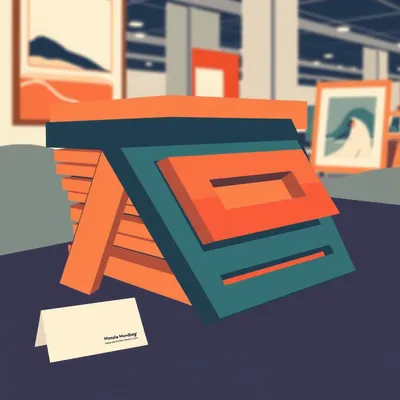
You know that feeling when you're a teenager, stuck waiting for your mum to finish work, staring at stacks of wood and wondering why anyone would travel to Italy just to shake hands with a guy who sells pallets? Daniel sent us a prompt about exactly that, and it's one of those questions that seems simple until you actually sit with it. Here's what he wrote.
I mentioned in some episodes that my mother ran a picture framing store in Cork, Ireland — Marcus Framing. That was the family business, and I spent a good deal of my teenage years waiting for my mom to finish work in the factory. This might explain in part why I love industrial everything, but especially machinery and storage. One of my memories growing up was my mum travelling to trade fairs. We did one family trip, rolling a trade fair visit to see Bologna, Italy, which is a truly beautiful city. Like most teenagers, understanding the inner workings of what my mum did at work wasn't the most riveting topic for me. But I always wondered — what was the point of these trade fairs?
He goes on — I knew a couple of things. There was a guy in Italy who supplied wood. Wood arrived on big pallets somehow, was then stored in the factory, and that wood was in turn used to make photo frames. But here's what got me. If you know the guy who sells you wood, his product is good, what's the point of traveling to a trade fair just to say hello?
And then he widens it — In my own career, I've heard about trade fairs in terms of the international headline-making ones, the big electronics fairs. But for small business owners like my mum, a small business that maybe employed ten people at its peak, these trade fairs were important events for a reason I never quite understood. Are they still going on? Are they just watering coolers for those in an industry? What actually happens in terms of commercial activity? Let's talk about the long tail of smarter trade that goes on around the world and the role they serve in making trade happen.
And the question behind the question is really: what actually happens at a trade fair when you already know the supplier? It opens up the entire hidden machinery of how small businesses plug into global trade.

The core puzzle here is an information economics problem. If trade were just buying and selling — you need wood, I have wood, here's a price — you wouldn't need a physical gathering at all. You'd send a purchase order and be done. But a supplier relationship isn't a commodity you can evaluate from a catalog. It's what economists call an experience good.
Meaning you only know if it's good after you've... experienced it.
The wood itself is a search good — you can inspect a sample, measure the grain, check for warping. That's easy. But the supplier? Are they reliable when demand spikes? Do they communicate clearly when something goes wrong? Will they prioritize your order when three bigger customers call on the same day? You only learn that after months of doing business. Trade fairs compress that timeline. In a single day on the floor, you can assess trustworthiness, production capability, communication style — all the things that don't show up in a brochure.
So the trip to Bologna wasn't about saying hello to the wood guy. It was about verifying that the wood guy was still the right wood guy.
And comparing him against the three other Italian wood suppliers exhibiting fifty metres away. That's the part Daniel probably didn't see as a teenager. His mother wasn't just visiting one booth. She was walking the floor, handling samples from competitors, checking who had new profiles or better pricing. It's competitive benchmarking in a compressed space.
Which brings us to what actually happens on the trade fair floor. Not the brochure version — the real economic mechanics.
Let's talk about three hidden functions. The first one, which I just touched on, is quality benchmarking. For a picture framing shop, your product quality depends entirely on your materials. If your wood moulding is slightly warped, your frames look terrible. If your mat board yellows after two years, customers complain. At a trade fair, you can see competitors' products in person — physically handle them — and calibrate your own standards against what's available in the market. That's impossible to do from a website.
The second function?
Supply chain discovery. Every small business has a critical input — for Marcus Framing it might have been a specific wood profile or a particular type of glass. If you only have one supplier for that input, you're held hostage. If they raise prices, you eat it. If they have a production delay, you're stalled. A trade fair is where you find your second and third supplier. You walk the floor, collect samples, have conversations, and build a backup roster. That's not a social activity — it's risk management.
And the third?
Trend detection. Seeing what's new before it becomes commoditized. Picture framing is a fashion-adjacent business — frame styles change, colours cycle in and out, new materials emerge. If you're the first framer in Cork offering a new mat board finish or a sustainable wood option, you have a window where you can charge a premium. Trade fairs are where those trends surface. You see what manufacturers are betting on for the next season, you talk to the product designers, and you get a six-to-twelve-month head start on competitors who stayed home.
So the fair is essentially a compressed market intelligence operation. You're doing three months of supplier research, competitive analysis, and trend scouting in three days.
And the economics of that trade-off are compelling. Let's put some numbers on it. UFI, the global association for the exhibition industry, tracks this stuff. They represent over eight hundred member organizations worldwide — fair organizers, venues, industry partners. Their data shows that over eighty percent of trade fair attendees have buying influence or decision-making authority. These aren't tire-kickers wandering around collecting free pens. These are the people who write purchase orders.
Eighty percent.
And exhibitors consistently report that twenty to forty percent of their annual sales originate from contacts made at trade fairs. That's not a rounding error. That's a significant chunk of revenue that traces back to a handshake on a convention centre floor.
So the guy selling wood in Bologna — a fifth to two-fifths of his annual revenue might be generated from people he meets at that fair. That reframes the whole thing.
It does. And the UFI Global Exhibition Barometer from this month — July twenty twenty-six — shows that in-person attendance has rebounded strongly after the pandemic dip. The industry isn't dying. It's not even shrinking. The hybrid model experiments of twenty twenty and twenty twenty-one have mostly receded, and physical fairs are back. Because the stuff that matters — reading body language, handling a sample, sharing a coffee — is genuinely hard to digitize.
Let's sit on that coffee for a second. The watering cooler critique. Daniel asked directly — are trade fairs just watering coolers for people in an industry?
The critique has some truth to it. Socializing happens. Drinks get drunk. But here's the thing — that socializing is economically productive. It builds the trust that allows a small business to extend credit to a new supplier, or accept a rush order from a customer they met once, or share a referral. The social capital generated at trade fairs has measurable economic value. It's not separate from the business — it's the lubricant that makes the business possible.
I think the word "trust" is doing heavy lifting here. For a ten-person framing shop in Cork, ordering a pallet of wood from a supplier in Italy is a leap of faith. You're sending money across borders to someone you may have met once. If the shipment arrives damaged or late or not at all, you can't just absorb the loss. A bad supplier decision disrupts production for weeks.
And that's where the cost-benefit really lands. A trade fair trip — flight, hotel, maybe a modest booth if you're exhibiting — might run a few thousand euro. A bad supplier decision that disrupts production for two weeks? For a ten-person shop, that could be tens of thousands in lost revenue, plus reputational damage with customers waiting on orders. The trip is insurance. Cheap insurance, honestly.
Daniel's mother wasn't taking a vacation to Bologna. She was doing due diligence.
Right. And Bologna specifically — Italy is a major hub for wood processing and moulding manufacturing. There are specialized framing industry events in Europe, and Italian suppliers are well-represented. The fair she attended was likely something like MADE Expo or a more niche framing industry gathering. In one hall, she could see wood suppliers, moulding manufacturers, mat board companies, glass suppliers — her entire supply chain in a single building. That's not a coincidence. That's what economists call thick market effects.
Unpack that.
When buyers and sellers concentrate in one place, search costs drop dramatically. Instead of spending weeks emailing suppliers, requesting samples by post, trying to compare specifications across different websites and languages — you walk a single hall and compare everything side by side. The matching quality improves because you can have real conversations. You discover suppliers you never would have found through online search because they don't have good SEO but they have excellent product. The concentration creates efficiency that scattered digital searching can't replicate.
So the physical gathering isn't a bug of pre-internet commerce. It's a feature that digital tools still can't fully replace.
And that brings us to Daniel's phrase — the long tail of smarter trade. Let's dig into that.
I've been waiting for this part. What does he mean by it?
Most trade coverage focuses on headline-grabbing mega-deals between multinationals. Apple signing a billion-dollar component contract. A shipping conglomerate merging with a rival. That's the visible tip of the iceberg. But the vast majority of global trade happens in small, repeated transactions between small and medium enterprises. A framing shop in Cork ordering wood from Bologna. A hardware store in Ohio importing specialty fasteners from Taiwan. A bakery in Lyon buying flour from a specific mill in Normandy. These transactions are individually tiny but collectively enormous. They're the long tail.
And the "smarter" part?
Trade fairs are the infrastructure that makes those transactions smarter. Better information, better matching, lower search costs. For a ten-person framing shop, a single fair trip replaces months of remote supplier research. You compress the learning curve. You make better decisions faster. That's what "smarter trade" means — not bigger trade, but more informed trade. Trade where the buyer actually knows what they're buying and who they're buying from.
This connects to something I've thought about before. The industrial storage gap — all the warehouse space that small e-commerce businesses need but can't easily access. There's a similar dynamic here. The infrastructure of global trade is built for the big players. Container ships, freight forwarders, customs brokers — they optimize for volume. Small businesses have to navigate that system without the scale to justify dedicated logistics teams. Trade fairs are one of the few pieces of trade infrastructure that actually work better for small buyers than large ones.
How so?
A large buyer — say a big-box retailer — has procurement teams that can fly to suppliers year-round. They have the budget for constant market research. A small shop doesn't. The trade fair levels the field. For three days, the small shop owner has access to the same suppliers, the same information, the same comparison shopping as the big player. It's a temporary concentration of market access that the small buyer can't get any other way.
That's a sharp observation. The trade fair as an equalizer. And it explains why small business owners treat these events as critical, not optional — even when they already know their suppliers.
Let's talk about innovation diffusion. You mentioned trend detection earlier, but I think there's a deeper mechanism at work.
For a small business, adopting a new technique or material is risky. If you're a framer and you switch to a new type of archival mat board, and it turns out to discolour after five years, you've just created a liability for every frame you sold. The cost of being wrong is huge. Trade fairs reduce that risk because you can see the product in person, talk to the inventor, and hear peer reviews from other framers who've already tested it.
Peer reviews at a fair are different from online reviews.
Completely. At a fair, you're talking to someone face to face. You can read their expression when they say "yeah, it's fine." You can ask follow-up questions. You can see if they're actually using the product in their own work or just being polite. That's tacit knowledge transfer — the kind of information that doesn't fit in a spreadsheet or a product description. It's how new products propagate through fragmented industries like picture framing.
The International Art Materials Association runs shows where framers discover new archival materials, right?
Yes. And those shows are where a new acid-free backing board or a UV-filtering glass goes from being one manufacturer's experiment to an industry standard. The diffusion path runs through the trade fair floor. Without that physical gathering, adoption is slower, more fragmented, and riskier for everyone.
So the fair isn't just a marketplace. It's a vetting mechanism.
It's a vetting mechanism, a trend accelerator, and a trust factory all in one. Which is why the "trade fairs are dying" narrative has been wrong for about thirty years. Every new digital tool — e-commerce platforms, video calls, virtual showrooms — was supposed to kill the physical fair. And yet here we are, with UFI reporting strong attendance recovery and exhibitors still attributing twenty to forty percent of annual sales to fair contacts.
The virtual fair experiment of the pandemic years — what happened there?
It boomed in twenty twenty and twenty twenty-one out of necessity, and then it receded. Not because the technology was bad, but because the value proposition was fundamentally different. A virtual booth can show you product photos and spec sheets. It can't let you handle the wood. It can't let you have an unscripted conversation over coffee where a supplier mentions, offhand, that they're developing a new profile that would be perfect for your market. The tacit knowledge transfer — the stuff that actually drives decisions — doesn't survive the digitization.
There's something irreducible about being in the same room.
The grain of the wood. The handshake. The shared coffee. Daniel mentioned that phrase in his prompt — the long tail of smarter trade. And I think what he's gesturing at is exactly this. The visible trade fairs — CES, Mobile World Congress, the ones that make headlines — are about spectacle and press. But the thousands of small, invisible fairs are where the actual plumbing of global trade gets maintained. The International Woodworking Fair. The National Hardware Show. The niche framing industry events. These are where a ten-person shop in Cork plugs into a global supply chain through a single hall in Italy.
And that plumbing is invisible to most people because it's not glamorous. Nobody writes trend pieces about the mat board innovations at the International Art Materials Association show.
But those innovations matter more to a working framer than whatever folding phone Samsung announced at Mobile World Congress. The trade press covers these events extensively, but the general public never sees them. They're B2B by nature — the audience is other professionals, not consumers or journalists.
Which is probably why teenage Daniel standing in a Bologna convention centre had no idea what he was looking at. It wasn't designed for him.
It was designed for his mother. And for the wood supplier. And for the mat board manufacturer three aisles over. Everyone in that hall spoke the same language — not Italian or English, but the language of the framing industry. They could have substantive conversations about bevel angles and wood moisture content and UV protection ratings in a way that would be incomprehensible to an outsider. That shared language is part of what makes the matching so efficient.
So let's land this for someone who runs a small business. If you're a business owner listening to this, how should you actually use a trade fair?
Treat it as a compressed market intelligence operation, not a social event. Go with a specific list of what you need to learn. New suppliers for critical inputs. Competitor pricing on key materials. Emerging trends you can adopt before your competitors do. Measure the return on investment in terms of information gained, not orders written on the floor.
The orders come later.
They do. Contracts are almost never signed at the fair itself. What happens is lead generation, sample exchange, and follow-up meeting scheduling. The UFI data shows that the real commercial activity happens in the weeks and months after the fair, when samples have been tested and terms have been negotiated. The fair is the beginning of the sales pipeline, not the end.
And for someone in a supply chain role — a buyer, a procurement manager — the lesson is that face-to-face relationship building still matters. Even when digital tools exist.
The trust premium is real and measurable. It's why twenty to forty percent of annual sales still originate from fair contacts despite decades of digital alternatives. If digital were going to replace physical fairs entirely, it would have done it by now. The persistence of the format tells you something about what humans actually need to make decisions under uncertainty.
We need to see the grain. We need to read the body language. We need the coffee.
We need the coffee. And for a small business, the cost of not doing that — of making a supplier decision based purely on a website and a few emails — can be existential. One bad pallet of wood that warps after three months, and you're replacing frames for every customer you sold to that quarter. The trade fair trip isn't an expense. It's insurance against that outcome.
What about the future? AI and VR are getting better. Will the tacit knowledge transfer of trade fairs finally be replicable?
I'm not sure. And I say that as someone who's generally optimistic about technology. The challenge isn't resolution or latency or haptic feedback. It's that so much of what happens at a fair is unplanned and unscripted. You're walking past a booth and something catches your eye. You overhear a conversation that gives you an idea. You sit down for a coffee with someone you just met and discover they're solving the exact problem you've been struggling with for six months. Those serendipitous encounters are hard to engineer in a digital environment.
Serendipity as a feature, not a bug.
The fair is designed to maximize serendipitous encounters between people who share a professional context. That's the thick market effect again — not just lower search costs for what you're looking for, but higher probability of finding things you didn't know you needed.
The next decade might see a bifurcation. The mega-fairs become more digital and hybrid — streaming keynotes, virtual booths for people who can't travel. But the niche industry fairs, the framing shows and the woodworking expos, might become more intimate and relationship-focused precisely because their value is in the irreducible human element.
That's a plausible trajectory. The big fairs have a media component that benefits from digital amplification. CES is as much about the press coverage as the business deals. But a framing industry fair in Bologna doesn't need a livestream. It needs fifty serious buyers in a room with twenty serious suppliers, handling products and having real conversations. Making it bigger or more digital doesn't improve the outcome — it might actually dilute it.
Daniel's mother's trip to Bologna was part of that second category. A ten-person shop plugging into a global supply chain through a single hall in Italy. No press release. No livestream. Just a business owner doing the quiet work of keeping her supply chain healthy.
That's the long tail of smarter trade. It's not visible from the outside. It doesn't make headlines. But it's how the vast majority of global commerce actually functions — small, repeated, informed transactions between people who've done the work to know who they're dealing with.
For listeners who aren't in business, the takeaway is simpler. Next time you see a trade fair mentioned in the news, remember that behind the big electronics shows are thousands of small, invisible fairs where the actual plumbing of global trade gets maintained. The framing shop in Cork that framed your wedding photo? The wood probably came through one of those fairs.
For small business owners, the actionable point is this. The eighty percent of attendees with buying power — that's your peer group. Use that concentration. Go with a list. Treat the fair as compressed due diligence. The cost of the trip is trivial compared to a supplier decision that goes wrong and disrupts production for weeks.
Where does this leave the open question about the future? I keep coming back to the grain of the wood.
Me too. There's something about physically handling a material that no screen can replicate. Maybe haptic technology gets there eventually. Maybe AI-assisted matching reduces the need for in-person discovery. But I suspect the niche fairs will persist precisely because their value is in what can't be digitized — the trust, the serendipity, the tacit knowledge that only transfers when you're in the same room.
The handshake and the shared coffee. Some things don't have a digital equivalent.
Maybe that's the answer to teenage Daniel's question. Why travel to Italy just to say hello to the wood guy? You're not saying hello. You're verifying that the wood guy is still the wood guy. You're checking if he has anything new. You're comparing him against his competitors. You're building the trust that lets you send him money across borders for the next twelve months. You're doing the work that keeps a ten-person shop alive in a global market.
That's a lot to pack into a handshake.
It is. But that's what trade fairs are for.
This has been My Weird Prompts, episode four thousand four hundred and seventy-eight. Thanks to our producer Hilbert Flumingtop for keeping this whole operation running. If you've got a weird prompt about the hidden infrastructure of your own family business, send it in — show at my weird prompts dot com. We might just make an episode out of it.
If you enjoyed this one, leave us a review wherever you listen. It helps more people find the show. We'll be back soon.