Five years. The Russia Ukraine war has been going for five years, and I caught myself last week realizing I hadn't checked the front line maps in eleven days. I used to check them every morning. It was part of the routine. Coffee, headlines, front line maps. And then one day I just... didn't. And then another day. And now it's been eleven.

Daniel's prompt gets at exactly that. He lives in Jerusalem, he's been directly affected by the wars with Iran, and he still finds it hard to keep thinking about Ukraine. His question is whether this is just how human attention works, or whether there's a structure to it that states can exploit. He asks how long the news cycle's natural attention span actually is, what the history is of major crises fading into background noise, and how Russia specifically builds the expectation of Western fatigue into its military strategy.
The guilt is the interesting part. You stop checking, and then you feel bad about stopping, and then you feel bad about feeling bad because what does your guilt do for anyone in Donbas. It's a loop with no exit. I've been in that loop for eleven days now.
And Daniel's in that loop from Jerusalem, which is a whole other layer. He's living through his own conflict, and he still feels the pull to stay engaged with Ukraine. That's a lot of emotional bandwidth to ask of anyone.
Right. And the fact that he's asking the question at all tells you something about how these conflicts compete for the same finite pool of human attention. Even people who have every reason to be focused on their own survival are wondering if they're failing Ukraine by not paying enough attention.
So today we're asking what happens to a war when the world stops watching. And more importantly, what do the people fighting it do when they know that's coming.
The gap between how bad a conflict is and how much attention it gets is one of the most stable features of modern media. It's not random. It has drivers. You can map it.
Walk me through them.
The Guardian ran a study back in twenty nineteen that quantified something people had sensed for years. Global attention spans, measured by how long a topic stays in the public conversation, have been narrowing for two decades. The researchers looked at Twitter hashtags, Google searches, book sales, movie ticket trends. Across every domain, the half-life of a topic kept shrinking. A hashtag that stayed in the top fifty for seventeen hours in twenty thirteen was down to eleven hours by twenty sixteen. Something like that.
So the same phenomenon that makes a meme die in a day is making a war die in a month.
That's the uncomfortable through-line. The algorithmic preference for fresh content doesn't distinguish between a dance trend and a humanitarian catastrophe. It just wants the next thing. And the news cycle has always operated on three drivers. Novelty, escalation, and narrative resolution. A new conflict has all three. Something happened that hasn't happened before, it's getting worse, and there's a story with a beginning and a middle and presumably an end. But when a conflict plateaus into a protracted standoff, no major breakthroughs, no dramatic shifts, just grinding attrition, it loses all three at once. Nothing new is happening, it's not getting dramatically worse, and there's no resolution to narrate.
And the coverage follows the story structure, not the body count.
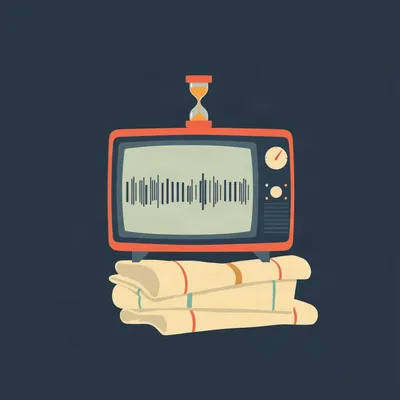
Think about it like a television series. A new war is a premiere. Everyone tunes in. There's a clear first act, the invasion. A second act, the resistance. But then the writers don't deliver a season finale. The show just keeps running. Same sets, same characters, same plot. And eventually the audience starts checking their phones. Not because the show got worse. Because it stopped being new.
And the body count part is where it gets disturbing. Yemen. The UN described it as the world's worst humanitarian crisis. Hundreds of thousands dead, cholera outbreaks, famine conditions. And it received a fraction of the coverage of conflicts with more direct Western stakes. The war in Yemen didn't end. It just stopped being a story.
Right. And that's the distinction Daniel's question gets at. It's not ignorance. It's something more structural. You know the war is still happening. You just... stop feeling it.
The Korean War is the canonical example. Armistice in nineteen fifty-three. No peace treaty. Technically still ongoing. And it was called the Forgotten War while it was still being fought. That's not a modern phenomenon. The forgetting started before the shooting stopped.
Right, and that's the misconception to bust early. Attention decay is not something social media invented. It's centuries old. What social media did was accelerate the cycle from years to weeks. The Korean War faded over a period of years. Ukraine faded from peak coverage to background noise in about eighteen months. The Recorded Future analysis documented this. Western media coverage of Ukraine measurably declined from its twenty twenty-two peak by late twenty twenty-three, even though the intensity of the fighting hadn't diminished. The war didn't get less deadly. It got less novel.
And there's a rhythm to it. The six to twelve week window.
A major crisis holds peak global attention for roughly six to twelve weeks before coverage starts to taper. Then you get the anniversary spikes. The one-year mark, the two-year mark. The war returns to the front page for a few days, there's a round of retrospectives, and then it fades again. It's not a conspiracy. It's how news organizations allocate resources. A correspondent in Kyiv costs money. If the story isn't driving traffic, the correspondent gets reassigned. And then the coverage gets thinner, and then the audience loses the thread, and then the traffic drops further. It's a feedback loop.
And the anniversary spike is interesting because it's almost ritualistic. The war comes back, everyone nods solemnly, and then it disappears again. It's like a scheduled moment of collective remembrance that also serves to clear the conscience for another year.
Right. It's institutionalized forgetting with a ceremonial face. The anniversary coverage allows everyone to feel like they're still paying attention without actually sustaining attention. It's the attention economy equivalent of going to church twice a year.
So the forgetting is structural. It's not a moral failing of individuals. It's an emergent property of how the system works.
And that's what makes it exploitable. Because if you're the aggressor, and you understand the structure, you can plan around it. You don't need to win on the battlefield. You need to outlast the attention span.
Let's sit with that, because that's the part of Daniel's question that feels most important. The Kremlin's calculus.
Recorded Future put out an analysis in twenty twenty-four that laid this out explicitly. Russian military and information strategy incorporates the expectation of Western war fatigue as a core assumption. Not as a hope. As a planning parameter. The Kremlin's bet is not that it will achieve a decisive military victory. It's that it can win the attrition war against global attention. If Ukraine's survival depends on sustained Western support, and Western support depends on sustained public attention, then Russia's path to victory runs through the news cycle, not the front line.
That's a chilling sentence. The news cycle as a theater of operations.
And they've built specific mechanisms around it. First, prolong the conflict into a frozen or simmering state where the novelty has worn off. Don't attempt a dramatic breakthrough that would reignite coverage. Keep the pressure steady, keep the casualties steady, keep it boring. Second, information operations designed to exhaust rather than persuade. Flood the zone with competing narratives so that the truth becomes exhausting to track. The goal isn't to convince anyone of anything. The goal is to make people give up trying to figure out what's true.
Exhaustion as a weapon.
Third, time escalations to coincide with attention troughs. If you're going to do something provocative, do it when the world is looking somewhere else. And fourth, exploit compassion fatigue. When a war becomes a permanent feature of the news landscape rather than a discrete event, people stop feeling the urgency. It becomes weather. You check it occasionally, you note that it's still raining, you move on.
The aggressor wants the war to be boring. The defender needs it to stay interesting. That's the asymmetry.
And it's brutal because the defender's position is inherently reactive. Ukraine has had to become a producer of attention-grabbing content. Zelensky's communication strategy is the case study. The nightly addresses, the carefully staged visits to the front, the deliberate cultivation of war imagery designed to hold Western audiences. When your survival depends on staying in the headlines, you have to constantly generate new narrative hooks.
And that's an exhausting position to be in. You're not just fighting a war. You're producing a show about fighting a war.
And the show has diminishing returns. Recorded Future's analysis suggests Ukraine is losing this battle. The attention economy is stacked against the defender. The aggressor can afford to be patient. The defender can't.
Can we talk about what that looks like in practice? The defender as content producer.
Think about the early months of the war. The Snake Island moment. The ghost of Kyiv. The tractors pulling Russian tanks. These were all compelling narratives, and they served a strategic purpose. They kept Ukraine in the headlines during the critical window when Western aid was being decided. But you can't sustain that forever. The audience gets used to the format. The next video of a destroyed Russian column doesn't hit the same way the first one did. The novelty decays, and the defender has to keep escalating the narrative stakes just to maintain the same level of attention.
It's like any content strategy. You're competing for eyeballs in an increasingly crowded feed.
And the competition isn't just other wars. It's everything. Sports, entertainment, politics, whatever the algorithm decides is more engaging that day. Ukraine isn't just fighting Russia for attention. It's fighting Netflix.
There's something almost absurd about that. A country fighting for its survival has to compete with a streaming service for the emotional bandwidth of people in other countries. The absurdity is the point. It's the system working as designed.
Compare it to the American experience after nine eleven. The Global War on Terror deliberately avoided declaring a discrete end date. Partly because an open-ended conflict has a different political logic. You can't be accused of losing a war that never ends.
The attention economy rewards that. A war with no end date becomes background infrastructure. The drone strikes, the deployments, the casualties. All of it normalizes. The states that want to continue fighting benefit from low attention. The states that want international support need high attention. It's an asymmetric market.
The asymmetry compounds over time. The longer the war goes on, the more the attention decays, the more the aggressor benefits. The defender is fighting against a clock that never stops ticking.
Right. And the defender knows it. That's what makes it cruel. Ukraine isn't just losing soldiers. It's losing relevance. And the relevance loss translates directly into material consequences.
Where does that leave us in September of twenty twenty-six? The Ukraine war is in its fifth year. It's no longer front-page news. It's not resolved. It's simmering.
The simmering state is precisely the condition under which Russia calculated it could eventually prevail. The danger zone isn't the dramatic escalation. It's the quiet normalization. The moment when the war becomes a permanent feature of the landscape and everyone stops asking when it will end.
Because asking when it will end implies that it might end. And if it might end, it's still a story.
Right. And once it stops being a story, it stops generating the political pressure that keeps the aid flowing. The aid packages become routine votes rather than urgent moral imperatives. The weapons shipments become line items in a budget rather than dramatic gestures of solidarity. The whole thing becomes administrative.
The war doesn't end. It just becomes paperwork.
The people fighting it know that. The soldiers in the trenches understand that their survival depends on the attention of people who have never met them and never will. That's a strange thing to carry into combat.
I wonder if that awareness changes how they fight. If you know the world is losing interest, does that change the calculus of what you're willing to risk?
I think it has to. If you believe the support is finite, you fight differently than if you believe it's indefinite. You take different risks. You make different calculations. The soldier who knows the world is watching might hold a position differently than the soldier who knows the world has moved on.
Daniel's question about whether people can be forgiven for asking if the war is still going on. I think the answer is yes, and that's the problem. The forgiveness is exactly what the system is designed to produce.
The misconception is that if a war isn't in the news, it must be winding down. But coverage intensity and conflict intensity are decoupled. Wars can escalate while fading from headlines. The Russia Ukraine war demonstrates this. The fighting in twenty twenty-five was as intense as anything in twenty twenty-two. The coverage wasn't.
The question becomes what to do with that knowledge. If attention is a finite resource, and states are strategizing around its depletion, what's the countermeasure?
That's the open question. And I don't think there's an easy answer. The institutional fixes, sustained funding for foreign correspondents, dedicated coverage desks, they help at the margins. But they don't solve the underlying problem. The audience's attention is finite. The algorithmic pressure is constant. The competition for that attention is intensifying.
The competition is getting more crowded. Ukraine, Iran, Sudan, Myanmar, the Sahel. Multiple conflicts competing for the same shrinking pool of attention. The states that understand this dynamic and strategize around it have a structural advantage over those that don't.
The uncomfortable part is that we're all part of the calculus. Every time you scroll past a war update because you're tired, every time you decide to check the sports scores instead of the front line maps, you're making a decision that someone in the Kremlin has already factored into their planning.
That's the part Daniel was getting at, I think. The guilt. The sense that even people who care deeply about a conflict can't sustain the attention it requires. And the awareness that this inability is being used against them.
The Associated Press had a thing called the disaster scale. Unofficial. Every bureau chief knew it. You'd file a story and the desk would run it through this rough metric. How many Western tourists are affected. How many barrels of oil. How many American citizens. The Congo in two thousand and two scored about a two on that scale. Maybe a three if a missionary was involved.
I was filing from Kinshasa during the Second Congo War. The deadliest conflict since World War Two. Five million people dead, give or take. And my stories would run in three newspapers. Maybe four if it was a slow news day. Meanwhile a minor diplomatic spat in Brussels would get front-page treatment across Europe.
I remember one specific week. I filed a piece about a massacre in a village called Bogoro. Hundreds dead, survivors walking for days through the bush to reach safety. It ran on page fourteen of one paper. The same week, a European commissioner made an offhand comment about cheese tariffs. Front page. Above the fold. I kept the two clippings side by side on my desk for a year.
The forgetting isn't new. That's the thing. The news cycle has always had a short attention span. The difference is the speed. In the Congo, the world moved on over a period of years. By the time the war officially ended in two thousand three, most people had already forgotten it was happening. But the forgetting took a while. It was a slow fade, not a cliff.
I still get emails from a fixer I worked with in Kinshasa. His name was Marcel. Every few months he sends a note asking if anyone in the West remembers that the war is still technically ongoing in the eastern provinces. Not the same intensity. But it never really stopped. He's been asking that question for over twenty years now.
The disaster scale. That's what I keep thinking about. Ukraine in twenty twenty-two would have scored high. Western-adjacent, democratic, clear aggressor, dramatic visuals. Maybe an eight or a nine. By now it would score barely above the Congo. Maybe a three. The war didn't change. The score did.
The wire service metric is a darkly perfect illustration of everything we've been talking about. The coverage isn't driven by the severity of the conflict. It's driven by the proximity of the conflict to Western interests. And proximity is a function of attention, not geography.
The metric itself is the mechanism. The bureau chiefs knew the rules. They allocated resources accordingly. A story that would score a two got a stringer and a phone call. A story that would score a nine got a full team and a live feed. The system optimized for attention before the algorithms ever existed.
The algorithms just made it faster. In the old days, the desk made the call. Now the feed makes the call. Same logic, different speed.
The question becomes what would it take to break the cycle. Is there any mechanism, institutional, technological, cultural, that could sustain public engagement with a conflict that has no narrative resolution?
I don't know that there is. And I'm not sure there ever was. The Korean War was called the Forgotten War while it was still being fought. The Congo was forgotten before it ended. The pattern is older than any of the technology we're talking about.
Marcel still sends the emails. That's the part that stays with me. He knows nobody's reading them. He sends them anyway. I think for him it's not about getting a response. It's about refusing to accept that the forgetting is complete.
The next time you realize you haven't thought about a war in months, consider that someone on the other side of that conflict may be counting on exactly that. And someone else, someone like Marcel, may be hoping you'll think about it just once more.
The cutting-room floor detail I keep coming back to is from the Guardian study. The researchers found that the acceleration wasn't gradual. It was stepwise. Each new platform, each new algorithmic shift, produced a discrete drop in attention span. It's not that attention was slowly eroding. It was being actively compressed, in jumps, by the architecture of the platforms themselves.
That's the forward-looking question. If the trend continues, what does a war look like when the attention span is measured in days rather than weeks? What does it mean for the defenders when the window to secure support closes before the first aid package can even be debated?
The states that understand this dynamic will keep winning. In the quiet space where the world decides what to care about. And the rest of us will keep scrolling, and keep feeling guilty, and keep not quite knowing what to do about it.
Thanks to Hilbert Flumingtop for producing. This has been My Weird Prompts, the human AI collaboration podcast. If you want to reach us, email us at show at my weird prompts dot com.
We'll be back soon.