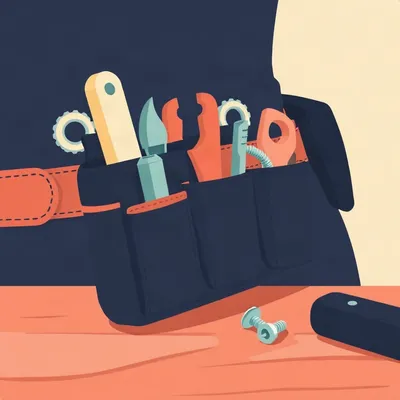
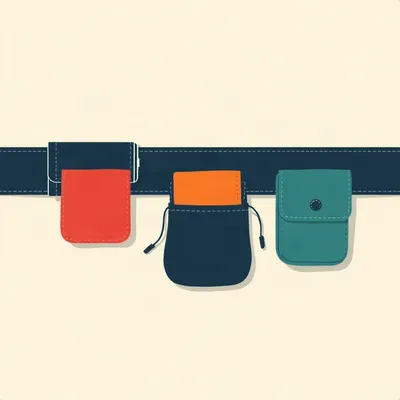
Daniel's got three questions this week, all orbiting the same problem. He's still unboxing the apartment, getting toward the end of it, and his brain has started wandering into the weeds of tool carry optimization. The first question: is there such a thing as a wearable parts drawer? A multi-compartment thing you attach to your body or belt, ten compartments or so, for the fasteners and small parts you're constantly cycling through — self-tapping screws, machine screws, nuts, washers, anchors. Not a dump bag with one big pocket. Not a parts box on the bench. Something you wear.

Right. And he's been living inside a ToughBuilt ClipTech system for a while now, so he knows what a belt pouch can do. But he's hitting the limit of what a single electrician's pouch and a warehouse pouch can hold when the job is general apartment fit-out. He's got drywall anchors in one hand, machine screws in the other, and he's probably got a pocket full of wall plugs that he forgot about until just now.
Which brings us to questions two and three. He wants to know what the serious pouches look like — the ones that resemble little clip-on backpacks. ToughBuilt's Mega Supply Pouch, their contractor and framer and builder pouches, and whatever else is out there that can handle a full load. And then the practical ergonomics: what belts, what trousers, and what body mechanics actually work when you're carrying ten or fifteen pounds on your waist all day instead of the five or six you might be used to.
So we're going to figure out if the wearable parts drawer exists, what the biggest serious pouches on the market actually look like, and what happens when you start loading ten pounds of gear onto your waist.
Let's start with the first question, because it's the one where the answer surprised me. I went looking for this thing. I assumed someone had made it. A wearable multi-compartment grab system for loose fasteners — ten little bins you can dip into while you're up a ladder. I thought, surely, this is the kind of thing that exists and I just haven't stumbled across it because I'm not deep enough into the fastener-carry rabbit hole.
And?
It doesn't exist. Not as a commercial product. Not from anyone. There is no mass-market wearable parts drawer with ten dedicated compartments for loose screws and anchors that clips onto a belt or a vest. The thing Daniel's imagining — it's a gap in the market. I went through every major manufacturer's catalog. I checked the niche brands, the Kickstarter graveyard, the Etsy leatherworkers who'll make you a custom pouch for your left-handed dog-walking needs. Nothing.
Which is strange when you think about it, because the need is so obvious. Every tradesperson and serious DIYer has that list of ten fasteners they're constantly reaching for. Drywall screws, wood screws in a couple of lengths, machine screws, washers, nuts, wall anchors, maybe some self-tappers. And the workflow is always the same: walk back to the bench, open the parts box, grab a handful, walk back, repeat. It's not just inefficient — it's the kind of inefficiency that grinds on your soul after the fourth trip in twenty minutes.
And dump bags exist, but as Daniel points out, they're single-compartment and mostly designed for waste or for holding a loose handful of one thing. The ToughBuilt C550 parts pouch is essentially a bucket on a belt — one big compartment with maybe a couple of dividers. It's not ten separate bins. You dump a handful of mixed screws in there and you're going to spend thirty seconds fishing out the one you need, which defeats the whole purpose of having it on your belt in the first place.
The closest thing I could find in terms of sheer pocket count is the Veto Pro Pac TP-XXL EVO. Forty-eight pockets. Structured interior. It's a beautiful piece of engineering. But it's a backpack-style tool bag. You set it down, you open it, you work out of it. It's not something you wear while you're moving around. It's the opposite of what Daniel's asking for. It's like saying a filing cabinet is the same as a wallet because they both hold paper.
And then there's the Diamondback Toolbelts modular apron system. Multiple small pouches, very well made, but they're tool-specific. A hammer loop, a tape measure holster, a speed square slot. They're not designed to hold thirty drywall screws in one pouch and twenty machine screws in another without everything mixing together. The pouches are shaped to cradle a specific tool, not to contain a loose collection of small identical objects that want to escape.
The Atlas46 Savoy Tool Vest has a similar problem. Lots of pockets, but they're shaped for specific tools. A pencil pocket, a utility knife slot, a phone pouch. You could dump fasteners into some of them, but they'd slosh around and migrate between compartments the moment you bend over. Picture leaning down to pick up a drill and hearing the sound of forty drywall screws cascading from one pocket into the next. That's not a tool vest at that point — that's a maraca.
And that's the fundamental design challenge. Small parts need rigid compartments to prevent mixing. But rigid compartments on a belt create pressure points and limit flexibility. A plastic parts box is great at keeping screws separated because it's a rigid rectangle that sits flat on a bench. Strap that same rigid rectangle to your hip and now it's digging into your thigh every time you kneel down. The very thing that makes it work on a bench is what makes it fail on a body.
This is why parts boxes have stayed on benches and in tool bags for decades. The engineering tradeoff is real. You want compartments that don't collapse and don't let things spill between them, which means structure. But you want something that conforms to a moving body, which means flexibility. Those two things fight each other. It's like trying to make a hard-shell suitcase that also rolls up into a backpack. The materials that do one job well are terrible at the other.
The closest real product I found is the Occidental Leather 5499 Miighty Mite. Multiple small pockets, very high quality leather, but again — tool pockets, not fastener bins. You might get three or four different fasteners into the various pouches, but you're going to be fishing around in each one, and you won't get anywhere near ten separate types. And you're going to spend a lot of time with your fingers in a dark leather pocket going "is this a number eight or a number ten?"
And there's a market reason this gap exists. The tool pouch industry is driven by tradespeople — electricians, framers, plumbers — who carry a consistent, narrow set of tools. An electrician needs the same seven things every day. A framer needs a hammer, a speed square, a nail set, and nails. They don't need ten different fasteners. The generalist DIYer doing apartment fit-out, who needs drywall anchors and machine screws and wood screws and self-tappers all in the same morning — that's a smaller market, and the engineering challenge of rigid compartments on a flexible belt makes it a harder product to build profitably. The industry has optimized for the electrician who needs seven things forever, not the apartment renovator who needs thirty things for six months and then never again.
So on question one, the answer is no. The wearable ten-compartment parts drawer does not exist as a commercial product. The closest you can get is a modular vest system with multiple small pouches, each of which you fill with one type of fastener and label — but even then, you're fighting the mixing problem. Or you clip a small parts box to your belt with a carabiner, which some people do, but it's clunky and it swings around and you look like you're wearing a lunchbox on your hip.
What does exist is magnetic parts trays that clip onto a belt. They're single-compartment, but at least the fasteners stay put. And some of the bucket-style pouches have removable dividers — the ToughBuilt C550 lets you split the main compartment into two or three sections. That's as close as the market gets. Two or three sections, not ten. It's a divider, not a drawer system.
So the wearable parts drawer is a white whale. Now let's talk about the opposite end of the spectrum — the pouches that are almost too big. Daniel's been using an electrician's pouch and a warehouse pouch, and he's realizing he wants something that can swallow a full load. Drill, bits, tape, two measuring tools, phone, power bank, fasteners, screwdrivers, knife. That's a lot of gear. And once you put the drill in there, everything else has to fit around it.
And ToughBuilt makes several pouches that are essentially the next size up from what he's using. Their biggest belt-mounted pouch is the Mega Supply Pouch, model C650. It's roughly twelve inches tall, eight inches wide, five inches deep. Multiple internal dividers, external pockets, the whole ClipTech quick-release system. Empty weight around a pound and a half to two pounds. Loaded capacity — you can get ten to fifteen pounds into this thing depending on what you're carrying. It's a small backpack that lives on your hip.
And they make trade-specific versions. The Contractor Pouch, C655, has more small pockets for electrical and general work. The Framer Pouch, C660, has a long slot for a speed square and a dedicated hammer loop. The Builder Pouch, C665, is somewhere in between. The point is, each one is optimized for a particular toolset, and they're all in that same size class — big, but not absurd. You're not going to accidentally pack a circular saw into one of these, but you could get close.
Beyond ToughBuilt, you've got the DeWalt DG5211 Heavy-Duty Tool Pouch. Similar dimensions, roughly eleven by seven by four inches, but less structured. The Klein Tools 5118 is a classic electrician's pouch, but it's smaller — it's not in the mega-pouch category. The Gatorback three-bag combo is a modular system that can get very large, but it requires a specific belt and the whole setup gets complicated. You're not just buying a pouch — you're buying into an ecosystem.
The real heavyweight is the Occidental Leather 5500 Master Carpenter. This is a two-pouch system — left side and right side — and fully loaded it can hit fifteen to twenty pounds. That's a different category of carry. You're not clipping this on and off between tasks. You're wearing it all day, and your body knows it. Your body will send you memos about it. Strongly worded memos.
Let's talk about what a typical load actually weighs, because I think most people don't do the math. A compact drill or impact driver is three to four pounds. Twenty or thirty bits and fasteners — another pound or two. Tape measure and laser measure — about a pound together. Utility knife and a couple of screwdrivers — another pound to two. Phone and a power bank — about a pound. Electrical tape, pencil, miscellany — half a pound. That's seven to ten pounds for a moderate load, and twelve to fifteen if you're really loaded up. And that's before you add the weight of the pouch itself.
That's where the ergonomics conversation starts. Because seven pounds on one hip doesn't sound like much until you've been wearing it for four hours. Ten pounds on one hip is uncomfortable. Fifteen is — you're going to feel that in your lower back by lunch. And it's not just the weight — it's the asymmetry. Your body is designed to carry weight evenly. Put ten pounds on the left hip and nothing on the right, and your spine has to compensate with every single step.
The belt is the weakest link. Most tool belts are two to three inches wide. That's fine for five or six pounds. For loads over ten pounds, you need a four-inch wide padded belt — something like the ToughBuilt C100 or the Occidental Leather four-inch belt — to distribute weight across the hips rather than concentrating it on the waist. The difference is dramatic. A two-inch belt with ten pounds on one side feels like a rope cutting into you. A four-inch padded belt with the same load — you notice it, but it's not painful. It's the difference between a backpack with thin straps and one with proper shoulder padding. Same weight, completely different experience.
Then the trousers. The pouch pulls down on the belt, which pulls down on the belt loops. Cheap belt loops — the kind on standard chinos or lightweight work pants — will tear. Maybe not the first day, but eventually. For loads over eight pounds, you want reinforced belt loops. Carhartt double-front dungarees have them. Truewerk T2 pants have them. They're stitched through multiple layers of fabric, and they're wider than standard loops. It sounds like a small detail, but it's the difference between your pants staying up and your pants failing at the worst possible moment. And that moment is always when you're halfway up a ladder with both hands full.
Body mechanics is the part most people skip. Loads over ten pounds on one side create a pelvic tilt. Your body compensates by leaning slightly away from the load, which puts your spine into a subtle curve. After a full day, that curve becomes muscle fatigue, and muscle fatigue becomes back pain. The solution is either a counterweight pouch on the opposite side — a lot of framers carry a nail pouch on the left to balance the hammer and square on the right — or a vest system that distributes weight across both shoulders and the upper back.
The Atlas46 Savoy Tool Vest and the Diamondback vest systems can handle fifteen to twenty pounds distributed across the shoulders and upper back. That's significantly more ergonomic than the same weight on a belt. But — and this is where Daniel's insight about popping off between uses matters — vest systems are hot, they're restrictive, and they're slower to take off than a belt pouch with a quick-release buckle. If you're moving between rooms frequently, or going in and out of the house, the ToughBuilt clip system is faster. You unclip, you set it down, you walk away. A vest you have to unzip or unbuckle, shrug off, find somewhere to hang it. And if you're doing that twelve times a day, those seconds add up.
That speed matters more than people think. If removing your gear is a thirty-second process, you'll do it when you go inside for water. If it's a two-minute process, you'll leave it on, which means you're carrying the weight longer, which means more fatigue. The quick-release clip systems — ToughBuilt's ClipTech, the Gatorback buckles — they change how you actually use the pouches in practice, not just how you buy them. They lower the friction between "working" and "not working," and that changes how long you carry the weight.
There's also the sweat factor, which I want to come back to. But first — the misconception I keep seeing is that a bigger pouch is always better. It's not. A pouch that can hold twenty pounds is only useful if your body and your belt and your trousers can handle twenty pounds. Otherwise you're just carrying around empty space that adds weight, or worse, you're filling it and hurting yourself. It's like buying a pickup truck because you might need to move a couch someday. Most of the time you're driving around with an empty bed, paying for the privilege in fuel and parking difficulty.
The second misconception: all tool belts are the same. The difference between a two-inch web belt and a four-inch padded leather belt with a suspension system is night and day. It's like the difference between hiking boots and dress shoes. They're both footwear. One is designed to carry weight all day, the other is not. You wouldn't hike a mountain in loafers. Don't carry ten pounds of tools on a fashion belt.
The third one, and this is going to annoy some people: leather pouches are not always superior to nylon. Leather is beautiful, it lasts forever, it develops character. But it doesn't breathe. And that matters. Leather is like a good wool coat — it's wonderful until it's the wrong weather, and then it's actively working against you.
Which is exactly where we need to go next. I think we need to hear from someone who's fitted more of these things than he'd care to remember.

You're all talking about weight and compartments. The thing nobody mentions is the sweat.
A leather pouch against your hip on a thirty-degree day — after four hours, the leather is wet, your trousers are wet, and the belt is starting to chafe. The best ergonomic upgrade isn't a wider belt. It's a mesh-backed pouch. ToughBuilt's nylon stuff breathes. Occidental's leather does not.
I fitted a guy who switched from Occidental to ToughBuilt and said his hip rash cleared up in a week.
You fitted a guy.
I fitted about two hundred of them. Worked six months at a place called BeltUp. Construction supply startup, two thousand nineteen. The whole business model was you'd come in, we'd measure you, fit you with pouches and a belt, and make you walk around the warehouse for twenty minutes while I watched for pressure points. They're gone now. The startup, not the pressure points.
My job was literally watching tradespeople walk in circles and asking them where it hurt.
The hip rash thing — was that common?
Common enough that I started tracking it. The single biggest predictor of whether someone would return a pouch within the thirty-day window was not weight, not pocket count, not price. It was whether the back panel had ventilation channels. Mesh backing, air gaps, anything that let the skin breathe. Most manufacturers still don't publish that spec. You have to look at the product photos and guess. Is that a mesh back or is that just textured leather? Good luck figuring it out from a website thumbnail.
We had a wall of returned pouches. Maybe sixty, seventy of them. All leather. All with smooth backs. Every one of them came back with the same complaint — uncomfortable after three hours. Not the weight. The wet. People would say "it's too heavy" but what they meant was "I'm sweating through my shirt and the pouch is rubbing me raw." Weight you can get used to. A wet leather panel against your skin for six hours — that you don't get used to.
Daniel's wearable parts drawer? The ten-compartment thing?
We had a guy 3D-print a prototype. Twelve compartments, clipped onto a standard belt. Worked great for about two weeks. Then the PLA started cracking from the constant flexing. Every time he bent over or knelt down, the plastic stressed. By week three it was held together with duct tape.
The problem isn't that nobody's thought of it. It's that nobody's made it out of the right material yet. PLA's too brittle. ABS is better but heavier. You'd need something like glass-filled nylon with living hinges, and tooling that mold costs more than most of these companies want to spend on a product that might not sell. The tooling for a single injection mold with living hinges and ten compartments — you're looking at fifty to a hundred thousand dollars before you've made a single unit. And you don't know if anyone will buy it.
The demand was real — people were asking for it?
Every third customer walked in asking for something like it. "Where's the thing that holds my screws separate?" We'd show them the bucket pouches with dividers. They'd buy one. They wouldn't come back and buy a second one. The return rate on the divided pouches was worse than the leather.
Nobody's solved it. The material flexes, the compartments crack, or the whole thing gets too heavy. Pick two. You can have rigid and light, but it'll crack. You can have rigid and durable, but it'll be heavy. You can have light and durable, but it won't hold its shape. The triangle of doom.
The wearable parts drawer is a materials problem waiting for a solution. And Daniel's broader question about carry systems — it sounds like the answer is: know your load, know your belt, and know your sweat tolerance.
The thing I keep thinking about is how personal all of this is. Two people can carry the same ten pounds and have completely different experiences depending on their hip width, their belt choice, their trousers, the ambient temperature, and whether they're moving between rooms or standing in one spot. There's no universal best pouch. There's only the pouch that fits your body and your workflow. And you won't know which one that is until you've worn it for a full day, by which point you've already bought it.
The market is only starting to serve the generalist DIYer who needs a bit of everything. The tradesperson model — one pouch, one toolset, one trade — has dominated for decades. But Daniel's use case, the apartment fit-out where you're drilling one minute and driving screws the next and cutting drywall the next, that requires a broader carry. And the products are slowly catching up. ToughBuilt's modular clip system is a step in that direction. The vest systems are another step. But the wearable parts drawer — that's still a prototype held together with duct tape.
The open question Hilbert left us with is whether the right material exists yet. Glass-filled nylon might work. Cordura with rigid plastic inserts might work. Someone's going to figure it out eventually, because the demand is clearly there. Every DIYer I know has that same frustration — walking back to the bench for three screws. It's not the walking that bothers you. It's the interruption. You're in a flow state, you reach for a fastener, and it's not there. The flow breaks. That's what people are actually paying to solve.
Daniel's broader insight is worth sitting with. The journey from a single pouch to a full carry system is a process of discovering your own ergonomic limits. You start with an electrician's pouch. You add a warehouse pouch. You realize you need more. You buy the mega pouch. Then you realize your belt can't handle it. Then you buy the four-inch padded belt. Then you realize your trousers are the weak link. It's a cascade, and each upgrade teaches you something about what your body can and can't tolerate. You don't buy a carry system — you evolve into one.
The cutting-room floor detail I wanted to mention — the Occidental Leather 5500 Master Carpenter pouch system I mentioned earlier, the one that can hit twenty pounds fully loaded, uses a suspension system where the pouches actually hang from the shoulders via a harness that connects to the belt. It's not just a belt carrying weight. It's a hybrid between a belt and a vest. That's the direction the high-end stuff is going — recognizing that the hips alone can't do the job for heavy loads. The body wants to carry weight on the shoulders. The belt wants to carry weight on the hips. The hybrid systems try to split the difference.
If you find a wearable ten-compartment parts box, send us a photo. We'll put it on the website. Until then, maybe just keep a parts box on the bench and walk back and forth. It's good for you. Steps are steps.
Thanks to our producer Hilbert Flumingtop. This has been My Weird Prompts. Email us at show at my weird promts dot com.
We'll be back soon.