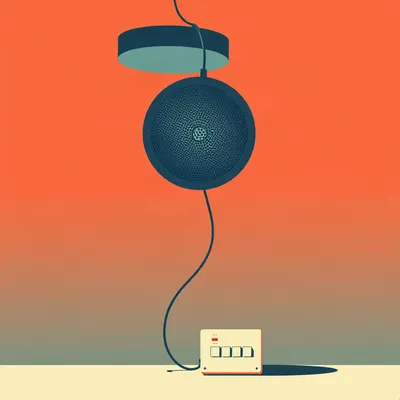
Daniel sent us this one — and it's the first prompt for the podcast, which feels like a small milestone. He's got this hold music playing in the background at home, part of some pre-bedtime routine he's inflicting on the household along with circadian rhythm adjustments. And he's asking, essentially, who actually makes this stuff? The music that's designed to be ignored. What's the history behind it, who are the key figures, are there radio stations dedicated to it, and where would you even go to see it performed live?

You can hear it faintly in his recording too — that unmistakable, pleasantly bland, slightly jazzy, never-resolve-too-hard chord progression. It's the musical equivalent of beige wallpaper.
Which is exactly the point. It's not supposed to be Shazamed. It's designed to be the thing you don't notice you're hearing. And yet someone's making it, someone's paying for it, and somewhere there's probably a guy who's the Beyoncé of this world and we've just never heard of him.
Oh, there absolutely is. And by the way — quick aside — DeepSeek V four Pro is writing our script today. Which feels appropriate for a conversation about background systems doing invisible work.
The AI writing the script about background music. But let's get into this, because the history of elevator music is genuinely stranger and more interesting than most people realize.
The term everybody kind of knows is Muzak — which is actually a brand name, not a genre. It's like calling all tissues Kleenex. Muzak was a company, founded in the nineteen thirties by a guy named George Owen Squier. He was a major general in the U.Army Signal Corps, which is already an unexpected origin story for background music.
Wait — a military general invented elevator music?
Squier had been working on something called wired radio — transmitting music over electrical power lines, rather than through the air. This was before FM radio was widespread. He patented the system in the nineteen twenties and realized the commercial potential wasn't in competing with broadcast radio, but in piping music directly into businesses. Offices, hotels, restaurants, and eventually, yes, elevators.
The whole thing starts not as an artistic movement but as a technical hack for distributing audio over power lines.
The company originally called itself Wired Radio Incorporated. They coined the name Muzak in nineteen thirty-four — it's a portmanteau of "music" and "Kodak." Squier apparently admired the Kodak brand name and wanted something similarly short and memorable.
Which is funny because Kodak was all about capturing moments and Muzak was all about making sure nobody remembered a single note of what they just heard.
The first major commercial installation was in nineteen thirty-six. And the real breakthrough came during World War Two, when Muzak was piped into factories producing war materiel. The government actually commissioned it. There were studies showing that carefully programmed background music increased worker productivity and reduced fatigue. After the war, all those factory managers who'd seen the results brought Muzak into their peacetime operations.
The science of background music was tied up with industrial efficiency from the very beginning. It wasn't entertainment — it was almost like acoustic ergonomics.
That's exactly the right way to put it. And this is where we get into something called "stimulus progression." Muzak developed a system where they'd program music in fifteen-minute blocks. Each block would gradually increase in tempo and orchestral density — more instruments, brighter arrangements — and then reset. The idea was to subtly counteract the natural energy dips workers experience throughout the day.
Like a psychological pacing mechanism disguised as soft jazz.
They called it "ascending curve" programming. It was researched. They had psychologists and industrial engineers working on this. And the music itself was almost entirely instrumental covers of popular songs. Not the originals — Muzak had their own in-house arrangers and session musicians who would re-record everything.
Which brings us to Daniel's question about who actually records this stuff. Because if it's all covers, someone's in a studio somewhere playing a very smooth version of a Beatles song that's been drained of anything that might distract a factory worker.
This is where the story gets wonderfully specific. For decades, the primary recording hub for Muzak was in Seattle. The company had a massive library of custom recordings, and they employed a stable of extremely skilled session musicians — people who could walk into a studio, sight-read an arrangement, and nail it in one or two takes. These weren't amateurs. They were some of the best session players in the business.
The anonymous virtuosos of background music.
One of the key figures was a composer and arranger named Lennie Moore. He wrote and arranged hundreds of Muzak tracks. Donny Marrow was another major name in that world. These are people who could take any popular song, strip it down to its harmonic skeleton, and re-orchestrate it so it would be pleasant but never demanding. No jarring key changes, no dramatic dynamic shifts, no lyrical content that might distract someone from assembling a toaster.
What's wild is that this required real compositional skill. You're not just playing the song badly — you're deliberately making specific musical choices to reduce cognitive engagement while maintaining a pleasant affective state. That's harder than just playing it straight.
And there's an interesting philosophical question buried here about what this music is actually doing. Is it even music in the traditional sense, or is it something closer to acoustic architecture? The Muzak corporation themselves stopped calling it music in their internal documents. They referred to it as "audio architecture" or "environmental sound design.
Which is honest, in a way. If you're designing an acoustic environment rather than creating art, you're making different choices. The goal isn't expression — it's effect.
That distinction is why a lot of musicians despise this genre. It's not that the compositions are bad — it's that the entire enterprise is built around the idea that music shouldn't be listened to. It's the negation of what most composers are trying to achieve.
Yeah, but I think that's also what makes it fascinating as a cultural artifact. It's music that exists to not-exist in your consciousness. And Daniel's question about who's making it now — has the industry changed? Because I can't imagine there's still a massive studio operation in Seattle churning out covers of Taylor Swift songs for dentist waiting rooms.
The industry has transformed dramatically. Muzak as a company went through bankruptcy — they filed for Chapter eleven in two thousand nine, emerged, and were eventually acquired. The brand still exists, but the business model is completely different. Most background music today is either licensed from massive production music libraries, or it's algorithmically generated. Companies like Soundtrack Your Brand — that's the actual name — provide streaming services specifically for businesses. Spotify has a business tier.
It's been platformized like everything else. Instead of a team of arrangers in Seattle, you've got a playlist algorithm.
Yes, but the playlists are curated by actual music supervisors. And there's still a demand for original background music. If you call your insurance company and hear hold music, that's often a licensed track from a production music library — companies like Epidemic Sound, Artlist, Musicbed. These libraries commission original instrumental music by the thousands. Composers submit tracks that are tagged with moods — "uplifting corporate," "contemplative ambient," "positive and driven.
The Lennie Moore of today is probably a freelance composer uploading tracks to a library, tagging them with metadata, and hoping they get picked up by a business playlist.
And some of these composers make a very good living. Production music pays royalties. If your track gets placed in a major retail chain that plays it across three thousand locations multiple times a day, those micro-payments add up. There are composers who've made six figures from what is essentially elevator music.
See, that's the detail I wanted. There's an entire parallel music industry that most people don't know exists, where the success metric isn't streams or chart position — it's placement density across commercial spaces.
It's not just instrumental covers anymore. The modern version of Muzak spans everything from ambient electronic to lo-fi hip-hop to what's now called "corporate acoustic" — which is this very specific genre of fingerpicked guitar, light percussion, maybe some glockenspiel, all designed to convey "we're a tech company but we're approachable.
The glockenspiel of corporate approachability. I know exactly the sound you mean. It's in every startup's onboarding video.
It's become a semiotic marker. You hear that particular acoustic guitar tone and the gentle chime, and your brain immediately registers "this organization has a values statement.
Let's talk about Daniel's other question — the radio stations. Is there anywhere you can actually tune in to hear this stuff? Because it seems like a format that shouldn't exist. Who would voluntarily choose to listen to music designed for not-listening?
This is one of my favorite parts of the research. There are actually dedicated stations and online streams. And some of them have surprisingly devoted followings.
Of course they do. The internet ensures that every possible niche has its congregation.
The most famous example is probably "Muzak Radio" — there have been various online streams over the years dedicated to vintage Muzak recordings. But the broader category of what we'd now call "easy listening" or "beautiful music" radio has a long broadcast history. In the nineteen seventies and eighties, there were hundreds of FM stations in the U.playing what was called "beautiful music" — largely instrumental, lush string arrangements, very low-key. Stations like KOST in Los Angeles, WRFM in New York, KABL in San Francisco.
Like the cable, but smoother.
These stations had enormous ratings at their peak. Beautiful music was actually the most popular radio format in America for a stretch in the early nineteen seventies. It wasn't a niche thing — it was mainstream.
Which suggests that a lot of people did want music they could ignore. Or at least music that wouldn't demand anything from them.
And the format declined as demographics shifted and FM radio fragmented, but it never entirely disappeared. Today, you've got online stations like "Lounge FM," "The Smooth Lounge," "Ambient Sleeping Pill" — these are direct descendants of the Muzak tradition. There's a whole YouTube ecosystem of "lo-fi hip-hop radio — beats to relax slash study to," which is fundamentally the same concept: continuous, unobtrusive background audio designed to modulate mood without demanding attention.
The lo-fi girl is the George Owen Squier of the twenty-first century.
That stream has been running for years and has been listened to by tens of millions of people. It's the same principle — stimulus progression, mood management, non-distracting audio architecture. Just with anime visuals and a slightly different harmonic palette.
I think that's worth pausing on, because it means the core insight behind Muzak wasn't a mid-century fad — it was tapping into something fundamental about how humans use sound. We've always had background music. It's just the delivery mechanism that changes.
Court musicians in medieval times were essentially providing background ambience for banquets. The player piano in the early twentieth-century department store. The string quartet at the hotel brunch. Muzak just industrialized and systematized it.
Daniel's third question — live performances. And this is where my imagination fails me, because the phrase "live elevator music concert" sounds like a contradiction in terms. The whole point is that it's not a performance you attend to.
Yet, there is absolutely a live scene for this. Several of them, actually.
Of course there are.
The most prominent is probably the "elevator music" revival that's been happening in certain corners of the indie and experimental music world. There are bands that have explicitly adopted the aesthetic of vintage Muzak and perform it live — not as parody, but as genuine appreciation for the craft.
They're covering the covers.
There's a group called the "Muzak Ensemble" that performs faithful recreations of classic Muzak arrangements. There are "easy listening revival" nights at venues in cities like Portland and Austin. And then there's the whole "vaporwave" phenomenon, which is essentially a genre built around sampling and recontextualizing the sounds of eighties and nineties corporate background music.
Vaporwave is basically Muzak that's aware of itself as Muzak.
Yes, and the live vaporwave shows can be interesting — artists like Saint Pepsi and Luxury Elite have done live performances that are essentially elevator music concerts. The audience knows they're listening to something that was designed to be ignored, and that awareness creates this strange, ironic-but-not-really-ironic listening experience.
I think Daniel might also be asking about something more literal. Like, if you're a genuine enthusiast of hold music — and I'm sure such people exist — where would you go to hear the real thing performed?
There are a few festivals and events. The "Muzak Appreciation Society" has organized listening events. There's an annual gathering called the "Easy Listening Festival" in the UK. And some of the original Muzak session musicians have done reunion concerts — there was one in Seattle a few years back where some of the surviving arrangers and players from the classic era performed selections from the Muzak library.
That's actually kind of touching. These anonymous craftsmen finally getting a moment where people are actually listening to them.
Some of them were moved by it. These were musicians who spent decades knowing that their work was being heard by millions of people every day, but never listened to. To finally sit on a stage and have an audience pay attention — I imagine that's a complicated feeling.
It's like being the most famous invisible person in the world. Your art has touched more ears than most platinum-selling artists, but nobody knows your name and nobody was ever supposed to notice what you did.
There's a dignity in that, honestly. There's something admirable about being good enough at your craft that you can make it disappear. It's the musical equivalent of a really well-designed door handle — you only notice it when it's done badly.
The bad hold music is the one you remember. The stuff that makes you want to throw your phone at the wall after twenty minutes on hold with the cable company. That's the door handle that snags your sleeve.
That's actually a useful way to distinguish between good and bad background music. The good stuff — the classic Muzak, the well-produced modern ambient — it achieves its effect without ever being noticed. The bad stuff intrudes. It has a melodic hook that snags your attention, or a sudden dynamic shift that pulls you out of your conversation, or a tone that's just slightly too bright for the space.
Who decides what's good? Are there background music critics? Is there someone whose job is to evaluate the hold music of various insurance companies?
There absolutely are. Not critics in the traditional sense, but there are audio branding consultants. Companies like Mood Media — which actually acquired parts of the old Muzak corporation — they employ music programmers whose entire job is to curate playlists that match a brand's identity. A luxury hotel wants something different from a fast-casual restaurant chain. A medical waiting room has different requirements than a retail clothing store.
The medical waiting room is a specific challenge, I'd imagine. You've got people who are anxious, possibly in pain, waiting for potentially bad news. The music has to walk this line between being calming and not feeling funereal.
There's actual research on this. Studies have shown that certain tempos and harmonic structures can reduce perceived waiting time and lower cortisol levels in medical settings. Slow, legato string arrangements in a major key tend to perform well. Avoid minor keys. Avoid anything with a pronounced beat. The goal is to create what researchers call a "soothing but not sedating" acoustic environment.
"Soothing but not sedating" feels like it could be the tagline for the entire genre.
It really could. And the medical context is actually where Muzak got one of its earliest and most enduring footholds. Dentist offices were early adopters. The logic was straightforward — the sound of the drill is anxiety-inducing, and masking it with pleasant, predictable music reduces patient stress.
Which explains why so many people have this very specific Pavlovian response to certain kinds of soft jazz. You hear that muted trumpet and suddenly you're eight years old and terrified in a dentist's chair.
And that's the dark side of background music as a psychological tool — it can create negative associations just as easily as positive ones. If you've had traumatic medical experiences, the sound of generic waiting-room music can be triggering.
Which raises an interesting question about Daniel's pre-bedtime experiment. He's introducing this music into his home as part of a wind-down routine. But if the music carries those kind of institutional associations — doctor's offices, corporate hold lines — is he going to condition himself to feel like he's waiting for a root canal every night at nine PM?
That depends entirely on the specific music he's using and his personal history with it. If he's playing the kind of ambient, neutral background music that's designed for sleep — and there's a huge market for this, apps like Calm and Headspace have entire sleep music libraries — then the associations are likely to be positive or neutral. But if he's literally playing vintage Muzak covers of pop songs, I could see that backfiring.
The unconscious mind is not great at distinguishing between "this is the music I chose to relax to" and "this is the music that played while I was on hold for forty-five minutes trying to dispute a billing error.
There's a reason that hold music has become a cultural punchline. It's music that's been weaponized by bureaucracy. The longer you hear it, the more powerless you feel.
Yet, Daniel's doing this voluntarily. Which I respect. There's something perversely admirable about reclaiming hold music as a tool of domestic tranquility.
It's like adopting a feral cat. You know it wasn't meant to be a pet, but you're going to try anyway.
Let's talk about the economics for a minute, because I'm still stuck on this idea of the invisible music industry. How big is this market? What are we actually talking about in terms of money?
The global background music market was valued at roughly one point five billion dollars recently, and it's projected to grow significantly. The business music streaming sector alone — that's companies providing licensed music to commercial spaces — is a multi-hundred-million-dollar industry. Mood Media, one of the largest players, services something like five hundred thousand commercial locations worldwide.
Half a million locations. So when you walk into a store and there's music playing, there's a very good chance that music is being provided by a company whose entire business model is "you don't notice us.
The licensing is complex. If a store just plays regular Spotify over their speakers, they're technically violating the terms of service — consumer streaming licenses don't cover public performance. Businesses need specific commercial licensing, which is why services like Soundtrack Your Brand exist. They handle the royalty payments to performing rights organizations so the business doesn't get sued.
The background music industry is also a quiet giant in the music licensing world. All those micro-payments to composers, all those performance royalties — it's a significant revenue stream for the music industry that most people never think about.
It's one of the few areas where session musicians and composers can actually make a stable living. The streaming economy has been brutal for recording artists, but production music — music made specifically for licensing rather than for consumer listening — has been a relatively reliable income source. You're not dependent on playlist algorithms or viral moments. You just need to produce high-quality, well-tagged tracks that music supervisors find useful.
It's almost like the background music economy is a refuge from the attention economy. You succeed by not being noticed.
Which is philosophically fascinating. We're living in an era where most creators are desperately trying to capture and hold attention. Background music composers are doing the opposite — they're trying to be so smoothly competent that they slip past your conscious awareness entirely.
The zen masters of the music industry.
Some of them take real pride in that. I found interviews with production music composers who talk about their work as a form of service. They're not making music for themselves — they're making music that serves a specific function in someone else's environment. It's almost like being a musical carpenter.
Build me a chair that nobody notices they're sitting in.
And that chair has to support people of different weights, in different rooms, for different durations. The craft is in the invisibility.
Let's circle back to Daniel's specific questions, because I want to make sure we actually answered what he asked. He wanted to know about the history — we covered Squier, the power-line origins, World War Two factories, the Seattle session musicians. He wanted to know about radio stations — we talked about the beautiful music format, the online streams, the lo-fi hip-hop descendants. He wanted to know about live performances — we mentioned the revival bands, the festivals, the vaporwave scene. And he wanted to know who actually makes this stuff.
Which we covered — the transition from in-house Muzak arrangers like Lennie Moore and Donny Marrow to the modern ecosystem of production music libraries and freelance composers. I think the one thing we haven't touched on is the actual listening recommendation. If Daniel wants to explore this genre more deeply, where should he start?
Because "just put yourself on hold with your insurance company" is not a practical suggestion.
For the historical stuff, there are archives of vintage Muzak recordings available — some on YouTube, some on dedicated collector sites. The "Muzak Archives" project has digitized hundreds of hours of classic Muzak tracks. For the modern equivalent, I'd point him toward the lo-fi hip-hop streams, or the "Ambient" and "Chill" playlists on any streaming platform. And if he wants the authentic hold-music experience, there are actually playlists titled "Hold Music" or "Elevator Music" on Spotify that compile exactly this kind of material — some of it vintage, some of it newly produced in that style.
For live experiences, he'd probably need to keep an eye on the event listings in cities with active experimental music scenes. The easy listening revival isn't exactly touring arenas.
No, but it's out there. And I think there's something valuable about engaging with this music as a listener — actually paying attention to something designed to be ignored. It's like looking closely at the texture of a wall. You start to notice details you'd never see otherwise.
The chord voicings in classic Muzak are interesting once you start paying attention. There's a reason they used a lot of major seventh chords and suspended harmonies — they create a sense of pleasant ambiguity that never fully resolves. Your ear doesn't get the closure it expects, so you don't get that little dopamine hit of a satisfying cadence. The music just keeps floating.
That's deliberate. A strong cadence would pull your attention. The music would announce "this phrase is complete," and you'd notice it. So the arrangers avoided strong resolutions. They'd cycle through chord progressions that felt pleasant but never landed with finality.
It's anti-music in a very specific technical sense. Music normally works by creating and resolving tension. Background music works by never creating enough tension to need resolving.
Which is why it can play for hours without becoming fatiguing. Your brain isn't doing the predictive processing work that active listening requires. It's just registering "pleasant sound present" and moving on.
That brings us back to Daniel's circadian rhythm experiment. If the goal is to create an acoustic environment that signals "it's time to wind down" without demanding cognitive engagement, then this is actually a very sound choice, pun absolutely intended. The question is just whether the specific associations of the genre work for him or against him.
My pediatrician background makes me twitchy about people disrupting their sleep architecture, as you know. But if he's using this as part of a consistent wind-down routine — dim lights, no screens, gentle background audio — the routine itself is probably more important than the specific music. The brain learns the pattern.
Consistent cues, consistent response. It's classical conditioning with soft jazz.
If it works, it works. I'm not going to argue with results.
To summarize for Daniel — the music he's playing has a lineage that runs from a U.Army general through wartime factories, through a studio in Seattle staffed by anonymous virtuosos, through bankruptcy and acquisition, into the streaming era where it's been reborn as lo-fi hip-hop and corporate acoustic and ambient sleep playlists. It's a hundred-year tradition of music designed to be felt but not heard.
The people who make it are still out there — not in a single studio in Seattle anymore, but distributed across the world, uploading tracks to production libraries, tagging them with moods, hoping their particular shade of beige finds its way into someone's waiting room or hold queue or bedtime routine.
It's a strange, invisible, fascinating corner of the music world. And now Daniel is voluntarily bringing it into his home, which I think makes him either a pioneer or a madman.
The line is thin. And now: Hilbert's daily fun fact.
Hilbert: In the nineteen forties, an anthropologist studying quipu — the knotted-string accounting system of the pre-Columbian Andes — discovered that some quipu keepers on the island of Kiribati had independently developed a nearly identical knot-based accounting method, despite having no known historical contact with Andean civilizations. The Kiribati system used the same base-ten positional notation and color-coded cord categories, but the knot-tying direction was reversed — clockwise instead of counterclockwise — which the researcher described as quote, "a behavioral anomaly that suggests convergent evolution of administrative cognition.
Convergent evolution of administrative cognition. That's a phrase I didn't expect to hear today.
Clockwise knots in Kiribati. I have questions I didn't have thirty seconds ago.
This has been My Weird Prompts. Thanks to our producer Hilbert Flumingtop. If you enjoyed this, leave us a review wherever you get your podcasts — it helps. We're at myweirdprompts dot com. I'm Corn.
I'm Herman Poppleberry. Until next time.