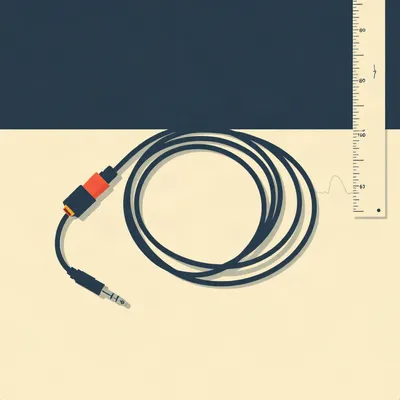
The cable in the box. The one with the speakers. Red and black, two conductors, everyone has handled one, and almost nobody can name it.

Right, and that's the fun of this one, because it's a thing people have owned a dozen times over and never once had to call it anything. You just plug it in.
Daniel's written in with a whole set of questions about exactly that. He says he's never known the name for the red and black cable that comes with speakers, that carries the audio and the power between the amplifier and the speakers. He guesses at a name, says he thinks it's properly called "red and black two conductor table," and then says he suspects that's wrong. Which it is, but we'll get there.
One of the better guesses I've heard, though.
He points out the confusing bit, which is that RCA cables are also frequently red and black, but that those do a completely different job, linking amplifiers and components together rather than driving speakers. Then he asks what voltage and current this cable actually carries. He asks what the different thickness ratings are, because he's noticed the spec changes depending on the current you expect to push through it.
He noticed that? That's the whole answer, right there. He's already found the hinge.
He also asks the practical question, which is the good one. If you're working backwards and you don't know your current, how do you figure out what gauge you need from the speaker system you're connecting? And finally, is this the standard cable for multi-speaker systems, or does anything past a couple of home speakers require something else entirely?
Six questions in there. Six.
Let's start with the name, because Daniel's instinct that he doesn't know it is the perfect entry point. This cable has a real name, it's been in the language for a century, and almost nobody uses it.
Zip cord. Also zip wire, also zip-cord speaker wire. The definition is the giveaway: two or more conductors held together by an insulating jacket that can be easily separated just by pulling them apart. That parallel-bonded construction is the whole thing. Two conductors molded side by side, and the moment you need them apart, you just pull and they split down the seam.
Hence zip.
The sound of the thing separating.
In Australia they call it figure-8 cable, which is a fair description of the cross-section. Two circles joined in the middle.
And here's the part that explains Daniel's confusion about RCA. The same physical product is sold for a pile of different jobs. Low-voltage DC power. Trailer lights. Automotive wiring. Speaker connections. It's sold by gauge and length, and it isn't really a speaker cable at all — it's a general-purpose two-conductor cable that happens to be excellent for driving speakers, and the speaker industry adopted it. So the same red and black wire that runs your trailer lights might be the exact same spool as the one behind your bookshelf speaker.
Which is why the red and black convention keeps colliding with RCA in people's heads.
Right. Red and black on zip cord is just polarity. Red is positive, black is negative, and it's marked that way so you can keep the two speakers in phase with each other. Red and black on an RCA pair is something completely different — it's channel identification, red for right, white or black for left. Same two colors, entirely unrelated meaning.
So what actually separates them as cables? Not the colors.
Signal level, and therefore current. An RCA cable carries line level — the pre-amplified signal, the one that hasn't been through a power amplifier yet. That's typically half a volt to about a volt. It's a weak, fragile signal, and that's why RCA cable is shielded, and why it's unbalanced, and why it's fussy about noise. It's carrying something small enough that interference matters.
And speaker cable carries the signal after the amplifier has been at it.
Speaker level. The amplifier has already done its work. The signal is large, and the current is what the cable has to survive. The numbers here are the whole point of the episode. An instrument or microphone cable carries a few milliamperes. An eight-ohm speaker driven by a hundred-watt amplifier pulls about three and a half amperes. A line-level input at six hundred ohms pulls about two milliamps.
So roughly a thousandfold difference in current between the two cables people confuse because they're both red and black.
Three and a half amps against two milliamps. You can't swap those. You physically cannot connect a speaker-level output to a line-level input — you'd be feeding a signal a thousand times hotter than the input expects, and you'd probably damage something. They're not cousins. They're not even in the same trade.
So we've got the name, zip cord, and the reason it's not RCA despite the matching colors. Now the numbers, because that's where Daniel's question about voltage and current actually lives.
Voltage is the red herring. That's the first thing to get out of the way, because people see "three hundred volt" printed on the jacket of a speaker cable and assume that's what the cable is doing.
And it very much isn't.
It isn't. The insulation on speaker cable is commonly rated at a hundred and fifty volts or three hundred volts. A fourteen-gauge CL2 zip cord from Southwire is rated a hundred and fifty volts. Consolidated's twelve and fourteen gauge zip is rated three hundred. But that rating is about the insulation's ability to safely sit in a wall or a conduit without breaking down or catching fire. It's a safety and code number, not a performance number.
And the actual signal voltage is far lower.
Fifty watts into an eight-ohm speaker produces roughly twenty volts. Twenty. Against an insulation rating of a hundred and fifty minimum. The rating is seven and a half times higher than anything the signal will ever ask of it. Which is why the cable's voltage rating tells you nothing at all about how it will sound.
There's a line from the Parts Express guide that puts this exactly right: current needs copper, voltage needs insulation.
That's the entire episode in six words. Voltage is handled by the plastic. Current is handled by the metal. So if you want to know what gauge you need, you don't look at voltage at all. You look at current, and current is set by power and impedance.
Give me the arithmetic.
A hundred-watt amplifier into an eight-ohm speaker, about three and a half amperes. Now halve the impedance. Two eight-ohm speakers in parallel present a four-ohm load, and a four-ohm load on the same hundred watts draws about seven amperes. Double the current, same amplifier, same wire. And if you go to two ohms, the current doubles again. That's the fundamental rule that drives everything downstream: lower impedance means more current, and more current means you need more copper.
Which brings us to gauge, and this is the part Daniel was circling when he said the spec changes with the current.
Gauge is the American Wire Gauge system. It dates to eighteen fifty-seven — it's older than the lightbulb, older than recorded sound. And the counterintuitive bit is the direction: smaller number means thicker wire. Eight gauge is a fat cable. Twenty gauge is thin. Every three steps down in the number doubles the copper. So thirteen gauge has twice the copper of sixteen gauge. Sixteen has twice the copper of nineteen.
And doubling the copper halves the resistance.
Roughly, yes, because resistance is inversely proportional to cross-sectional area. Here's the resistance per thousand feet, and this is worth sitting with because it explains everything. Eight gauge: zero point six three ohms. Ten gauge: one ohm. Twelve gauge: one point six. Fourteen: two point five. Sixteen: four. Eighteen: six point four. Twenty gauge: ten point one ohms per thousand feet.
So from eight to twenty, the resistance goes up by a factor of sixteen.
Sixteen times. Same length of cable, same signal, sixteen times the resistance. And resistance is what eats your power.
How much does it eat?
This is the number that makes it real. On a fifty-foot run into an eight-ohm speaker, eighteen gauge loses five point seven percent of the power. Ten gauge on the same run loses one point two percent. Now run it at four ohms. Eighteen gauge loses sixteen point seven percent. Ten gauge, four point eight percent. Now two ohms. Eighteen gauge loses twenty-four percent of your amplifier's power, in the cable, as heat.
A quarter of the amplifier, spent heating the wire.
On a fifty-foot run. And notice the pattern — as the impedance drops, the loss on the same cable gets dramatically worse. That's why the subwoofer crowd cares about gauge and the bookshelf crowd mostly doesn't. A two-ohm load on thin wire is where it actually bites.
And this is all just I-squared-R, isn't it? Power lost equals current squared times resistance.
It always is. That's the beautiful and annoying thing about audio. All the mystique, and underneath it's a nineteenth-century equation you could teach to a bright fourteen-year-old.
So what are the actual practical rules? If someone walks into a shop, what do they buy?
The standard guidance from the wire guides: eighteen gauge for home or car speakers up to about twenty-five feet, at fifty watts RMS or less. Sixteen gauge for longer runs, or if you're pushing seventy-five to a hundred watts. Fourteen gauge for runs of a hundred feet or more, or for high-power two and four-ohm subwoofers. Another way of putting it: eighteen gauge is fine for about fifty watts into a four-ohm load, or about a hundred watts into eight ohms, at fifty feet and a hundred feet respectively.
And peak power versus RMS matters here, doesn't it?
Hugely. Speaker and amplifier marketing loves peak power. "Two thousand watts!" on the box. Peak is a momentary figure, it's meaningless for sizing. You size on RMS, on continuous, because that's the current the cable has to carry for hours without complaint. Size on the peak number and you'll buy a cable far heavier than you need, or, worse, size on the wrong number and undersize it.
There's another wrinkle, which is that not all copper is copper.
No, and this catches people out. Copper-clad aluminum. CCA. It's aluminum wire with a thin copper skin, and it's cheaper, and it's sold everywhere as speaker wire. It has sixty-one percent of the conductivity of pure copper. So thirty-nine percent more resistance for the same gauge. If you buy CCA, you have to step up one to two gauges to match the performance of pure copper. Sixteen gauge copper-clad aluminum is roughly equivalent to eighteen gauge pure copper, not sixteen.
Which is exactly the kind of thing a spec sheet will bury.
It's the kind of thing a spec sheet will mention in four-point font at the bottom of the listing, yes.
There's one more consequence of resistance I want to get to, because it's the one people don't hear about, and it's the one that actually shows up as a difference in sound rather than just a number.
Damping factor.
Explain it, because it's the reason a long thin run sounds different rather than just quieter.
An amplifier doesn't just push the speaker cone out. It also has to stop it, to control its motion, because a speaker cone is a mass on a spring and it wants to keep moving after the signal stops. The amplifier's low output impedance gives it electrical control over the cone, and the ratio of the speaker's impedance to the amplifier's output impedance is called the damping factor. Higher is better. Thirty, fifty, a hundred, those are healthy numbers.
And the cable sits in that path.
The cable's resistance adds directly to the amplifier's output impedance. So a long run of thin cable raises the source impedance the speaker sees, and the damping factor collapses. When it collapses, the amplifier loses its grip on the cone, and the audible result is loose, boomy, flabby bass, because the cone is ringing on after the note instead of stopping crisply. That's the honest reason gauge matters beyond just power loss, and it's the one that makes the biggest practical difference in a room with a lot of bass.
So the wire isn't just delivering a signal. It's part of the control loop, effectively.
It's part of the damping. It's in there.
There's a genuine disagreement hiding in this topic, and I want to put it on the table because Daniel's whole series is about the fundamentals, and this is one of the fundamentals of audio culture rather than of audio physics.
Go on.
The exotic cable debate. Oxygen-free copper, silver-plated, hand-braided, cryogenically treated, sold at two hundred dollars a meter. Is there anything there?
The honest answer is that the sources flatly disagree, and neither side is stupid. The wire gauge guides are blunt about it. The quote that's going around is that oxygen-free pure copper wire will not deliver any noticeable improvements in sound or power. That it's not worth spending more money on it, that it's a great marketing feature for retailers but the data shows an amazingly small difference in performance.
It is. And then Parts Express, who are a serious outfit, concede that esoteric cables probably offer some improvement in critical monitoring applications. So you've got one side saying the measured difference is negligible, and the other saying that in a mastering room, at a specific place, there might be something. And I'll be honest with you, I don't think either of them is wrong, because they're not measuring the same thing.
What are they measuring?
One is measuring the electrical transfer function of the cable, which is essentially flat, and the other is measuring the behavior of a whole system in a specific room. Those can both be true. What I will say is this: if your issue is power loss over fifty feet at four ohms, buying a hundred-dollar-per-meter cable and running it at eighteen gauge is insane. You've bought jewelry and hung it in a lossy path. The physics doesn't care about how pretty it is.
The engineering answer is that the number that matters is resistance, and the number that determines resistance is gauge, and material, and length. And a fancy cable with poor gauge loses to a cheap cable with good gauge every time.
Every time. That's not even close to a debate.
So let's say the debate stays unresolved but the physics is settled. Now the practical one. Daniel's question about working backwards.
This is my favorite question of the six, because it's the one where the arithmetic actually helps you. You need three numbers. Amplifier power, in RMS not peak. Speaker impedance in ohms, from the back of the speaker or the spec sheet. And cable length, and this is where people get it wrong, because you measure the run — the distance from amp to speaker — and then you double it, because the current has to travel out and come back. A fifty-foot run is a hundred feet of conductor. Sizing uses the loop.
Out and back. The electrons don't teleport.
The electrons do not teleport. So a fifty-foot run is really a hundred feet of wire in the calculation, and that's the trick that makes people undersize everything.
Walk me through a concrete one.
Say you've got a hundred-watt amplifier, eight-ohm speakers, and a thirty-foot run to each speaker. Thirty feet one way, so a sixty-foot loop. From the resistance table, eighteen gauge drops six point four ohms per thousand feet, so sixty feet is about zero point four ohms of loop resistance. Against an eight-ohm load, that's a five percent loss. That's fine. You can live with that. Eighteen gauge or sixteen gauge, either one.
Now change one variable.
Now drop to four ohms. Same amplifier, same run, same eighteen gauge. The resistance is the same, but now it's against a four-ohm load, so the proportional loss doubles. Ten percent. And the damping factor is halved too, because the same absolute ohms of cable resistance is now a bigger fraction of a smaller load impedance. That's why low-impedance speakers, and low-impedance is what a lot of tower speakers and subwoofers are, need more copper for the same distance.
And the rule of thumb is?
Go up two gauge sizes for every step from short to long. Eighteen to sixteen to fourteen. Or in a chart: eighteen gauge for runs under twenty-five feet at modest power, sixteen gauge for medium runs or higher power, fourteen gauge for runs over a hundred feet or for high-power two-ohm and four-ohm work. And if you're running CCA rather than pure copper, step up another one or two on top of that.
Now the last question, and it's the one that opens the door to a whole different world. Is zip cord the standard for multi-speaker systems?
For a couple of home speakers, yes. Absolutely. Zip cord is what you use. But past roughly fifty feet, or past the point where you're driving several speakers from one amplifier, it stops being the right tool, and the reason is exactly the power loss we've been talking about. If you've got sixteen speakers spread across a floor of an office building, and every one of them is on a fifty or a hundred-foot run of eighteen gauge, you're throwing away a huge fraction of your amplifier power as heat in the walls, and the ones at the far end will be noticeably quieter than the ones near the amp.
And you can't just keep buying thicker cable forever, because at some point the copper cost becomes absurd.
It does, and the industry solved this a hundred years ago by borrowing the solution from the electrical grid. Constant-voltage systems. High impedance. Seventy volts in this country, a hundred volts overseas.
Which sounds terrifying when the home speaker signal is running at twenty volts.
It sounds terrifying, and it's completely safe, because it's a low-current line. Step-up transformer at the amplifier, step-down transformer at every speaker. The transformer at the amp steps the voltage way up and the current way down. The transformer at each speaker steps the voltage back down and the current back up, into whatever the speaker needs. The high voltage, low current path over the long cable minimizes I-squared-R loss, because loss scales with current squared. Cut the current by a factor of ten and you cut the loss by a factor of a hundred. It's the same reason the grid runs at hundreds of kilovolts rather than at the two hundred and thirty volts that actually comes out of your wall socket.
Give me the numbers.
A hundred-watt amplifier on a seventy-volt line produces seventy volts, one point four one amperes, and sees about fifty ohms. So instead of driving three and a half amps into a low impedance, it drives one and a half amps into fifty ohms. The cable sees a much friendlier load, so it can be thinner and much longer. And every speaker on the line has a tap set for how much power it wants to draw from that line. A speaker tapped for one watt gets one watt. A speaker tapped for five watts gets five. You just add up the taps and make sure the total stays under the amplifier's rating.
And the name — why "seventy volts" when the peak is higher?
Because seventy volts is the RMS value. The peak of a sine wave at seventy volts RMS is a hundred volts. So the "seventy-volt" line is really a hundred-volt peak system, and that's why it's called a hundred-volt line overseas. Same system, different naming convention.
What's the cost of all this elegance?
A transformer per speaker, and transformers are not free and not perfect. Small paging transformers start around five dollars. Large ones with extended low-frequency response run seventy to two hundred dollars each. And they add a bit of distortion and a bit of insertion loss. So you pay for the long-run capability with a small amount of signal quality, and in a supermarket background-music system that trade is completely obvious. In a mastering studio it would be absurd.
And there's a limit.
There's a hard limit, and it's one of the most common mistakes in the field. The industry line is that it's a myth that you can connect an unlimited number of speakers to a seventy-volt line. You can connect a lot of them, far more than you could on a low-impedance amp, but not an unlimited number. There's still a power budget and an impedance floor, and you still have to add up your taps and not exceed the amplifier.
Are there amps that skip the transformer entirely?
There are. Some of the Crown amplifiers offer transformerless high-voltage outputs directly, at seventy, a hundred, a hundred and forty, and two hundred volts. The two-hundred-volt systems have been used for runs exceeding a mile, which is the point where you're basically redistributing audio like a utility.
All right. So to Daniel's last question: zip cord for home, constant-voltage transformer systems for distributed commercial audio, and both of them are somewhere between the same thing and a completely different thing.
Hilbert: I agree with you.
Well then.
Hilbert: I agree with you about the ordinary stuff. The zip cord, the eight-ohm, the run. That all matches what I've seen. But there's a thing you didn't say and I want to say it, which is that the person who actually had to do this never had any of those tables. I had a relative, name was Merv, he wired the sound for a motel conference room, the kind of room that gets rented for a bar mitzvah on Saturday and a sales meeting Monday. He ran the wire before the ceiling went in. Sixteen speakers, all of them on one seventy-volt line, all tapped for two watts except the two at the front of the room which he tapped for five because they were doing the announcing.
He knew to tap the front ones heavier.
Hilbert: Anybody who's set foot in the room would know that. The taps are just little screws on the back of the speaker with numbers on them, and you pick a number, and if you pick wrong the front is too loud or the back is too soft and you go back up the ladder. There's no other way to do it. You can't dial it in from the amplifier because the amplifier doesn't know where the speakers are.
So the tap is the volume setting for that speaker, permanently, at install time.
Hilbert: Permanently. Which means the guy who set it made a decision about the room that nobody will ever revisit, and if the room is used differently next year, the taps are still the taps. That's the part that isn't in the tables. The tables tell you how much power the line can take. Somebody has to decide how it's spent, and once the ceiling's in, that decision is expensive to change. Merv got a call nine months later because the new manager wanted the back half of the room louder for a presentation and there was nothing to do except pull tiles and re-tap them. It cost the motel about a thousand dollars to move some little screws.
Which is the real hidden cost of a system where the configuration lives inside the ceiling instead of on a knob.
Hilbert: That's what I'd have told you years ago if anybody had asked. And Merv, he was good at it. He could tap a room by walking it and listening once and then going up the ladder and leaving. He had it right by feel. I've never seen the table that teaches that part.
So the guidance gives you the budget, and the installer has to spend it room by room. That's a different skill from the arithmetic.
The arithmetic lets you not fail. It doesn't get you to good.
Hilbert: No. That part's up a ladder.
Herman, let me put the two unresolved things on the record, because we promised Daniel a set of answers and we should be honest about which ones don't have one. First, the exotic cable debate. The data says the difference between plain copper and the expensive stuff is astonishingly small, and a serious parts house still concedes there might be a case in critical monitoring. I don't think we resolve that today.
I don't think we should. The thing that is settled is that gauge beats material every single time, and that's what people should take away if they take away anything.
Second, the constant-voltage system itself. It's elegant, it minimizes loss over long runs, it lets you drive dozens of speakers from one amplifier. But it puts a transformer at the amplifier and a transformer at every speaker. That's two magnetics in the signal path that aren't there in a home system.
Which is the trade nobody mentions. You've fixed the resistance problem and introduced a distortion problem. And for background music, nobody cares. For anything where you care about the sound, you wouldn't do it, and that's a perfectly reasonable engineering position.
Here's what I keep chewing on, and I'll leave it as an open question rather than an answer. Multi-room audio is becoming normal in homes. Whole-house systems, ceilings full of little speakers, long runs everywhere. Every one of those is a distributed multi-speaker installation, and everything we said about seventy-volt systems should start applying to them. But nobody installs a seventy-volt line in a house. So the question is whether the home will adopt the constant-voltage trick, or whether wireless just gets good enough that the question evaporates before anyone has to answer it.
If it's wireless, the gauge chart becomes a page in a history book. Not a bad place to end up, honestly.
To Daniel we owe six answers — the name, the contrast with RCA, the voltage and current, the gauge system and how it scales, the reverse calculation, and the constant-voltage answer for large systems. I think we got through most of them.
We got through all of them. Daniel just might not like two of them.
Nobody ever does. Thanks to Hilbert Flumingtop for producing. This has been My Weird Prompts. If you want to send something in, my weird prompts dot com. We'll be back soon.