AI for Builders: Coding Assistants, Agentic Workflows, and Productivity at Scale
The gap between “talking to AI” and “getting AI to do work for you” is wider than most people realize. These nine episodes explored what it actually takes to build effective AI-powered workflows — from the fundamental memory architectures that let AI systems retain context, to the practical realities of AI coding assistants, to the emerging world of autonomous agents that act rather than advise.
The New Way to Build Software
-
Vibe Coding & The Rise of the AI Orchestrator examined the shift that’s transforming software development: instead of writing code line by line, AI-assisted development involves describing intent and iterating on generated output. The episode explored what “vibe coding” actually means in practice — when it works, when it produces unmaintainable garbage, and how the role of a developer changes when the bottleneck shifts from writing code to specifying, reviewing, and integrating it.
-
The Mystery of Model Rot: Why Your AI Code Assistant Changes investigated a frustrating phenomenon that AI-assisted developers encounter regularly: the same prompt that worked reliably for months suddenly produces worse output. “Model rot” — or more precisely, model updates that change behavior in ways that break established workflows — is a real problem with real consequences for codebases built around AI-generated code. The episode examined the causes, the diagnostic approaches, and strategies for building AI workflows that are more robust to model changes.
-
Modular Code Indexing: Separating AI Memory from Intelligence looked at the infrastructure for making AI genuinely useful on large codebases. An AI assistant that only sees the current file is far less useful than one that understands the architecture of the entire codebase. The episode covered indexing strategies, chunking approaches, and the architectural question of whether code intelligence should live in the model itself (via fine-tuning) or in a retrieval system (RAG).
Memory: The Architecture of Context
-
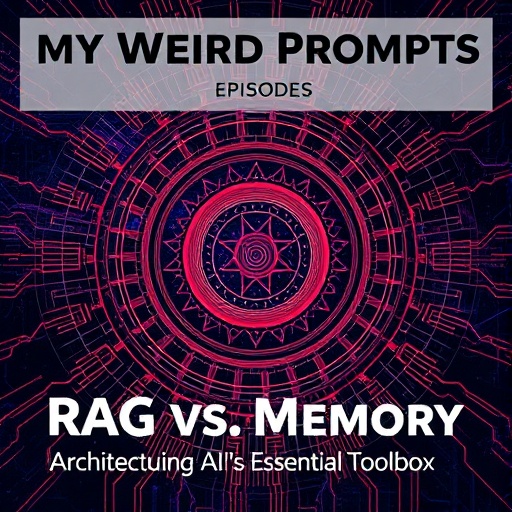
RAG vs. Memory: Architecting AI’s Essential Toolbox laid out the fundamental dichotomy in how AI systems handle information that wasn’t in the training data. Retrieval-Augmented Generation (RAG) fetches relevant information from an external store at inference time and injects it into context. In-weights memory bakes knowledge directly into model parameters during training or fine-tuning. The episode explained when each approach is appropriate and the tradeoffs between them.
-
AI Memory vs. RAG: Building Long-Term Intelligence went deeper on the practical implementation of long-term memory for AI agents. Most AI interactions start from zero — the model doesn’t remember what you discussed yesterday. Building systems that accumulate user-specific knowledge over time requires careful decisions about what to remember, how to retrieve relevant memories efficiently, and how to prevent memory contamination. The episode covered the technical approaches and the gotchas of building memory-augmented agents.
Voice and Presence
- The War on the Screen: Voice Control and AI Agents made the case that voice is underused as an AI interaction modality, particularly for productivity workflows. The episode covered voice-activated AI agents that can execute multi-step tasks, the latency and accuracy requirements for voice interaction to feel natural, and the workflows where voice dramatically outperforms typing. For people who use speech-to-text extensively, this episode explored what becomes possible when voice is treated as a first-class interface rather than an afterthought.
Scaling Output
-
Building an Ideation Factory: Beyond Generic AI Ideas addressed a specific use case: using AI not just to generate one good idea, but to produce a large, diverse set of ideas quickly and then systematically improve the best ones. The episode examined the prompt engineering and workflow design needed to prevent AI ideation from converging on the same generic suggestions every time, and the organizational systems for capturing and processing high volumes of AI-generated ideas.
-
From Apps to Agents: Building Your Digital Workforce covered the spectrum from simple automation to genuine agentic systems. The episode mapped the progression: prompt templates, chains of prompts, tool-using assistants, and finally autonomous agents that can plan, act, observe results, and adapt. The hosts examined the practical threshold where agentic complexity pays off versus adding unnecessary overhead, and the categories of work that benefit most from delegation to AI workflows.
The Industry View
- The Agency Evolution: From AI-Washing to AI-First examined the rapidly changing landscape of AI service businesses. Some agencies are genuinely transforming their operations — using AI to do in minutes what previously took days. Others are AI-washing: adding AI to their pitch deck without fundamentally changing their processes. The episode provided a framework for distinguishing genuine AI transformation from theater, and examined what sustainable competitive advantage actually looks like in an AI-augmented services business.
The most productive AI users aren’t the ones who prompt the hardest — they’re the ones who build the right infrastructure. These episodes cover the conceptual and practical foundations for getting from conversation to delegation.
Episodes in this playlist