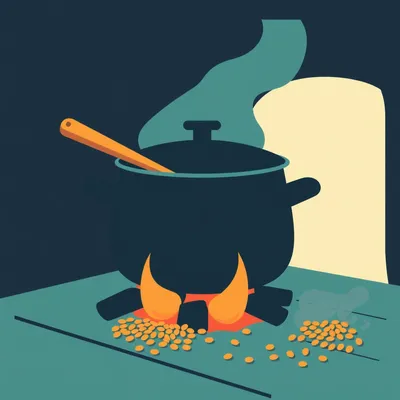
Daniel sent us this one — he wants a playbook for throwing a Shabbat dinner in two weeks where the main dish has been simmering the entire time. A perpetual cholent, basically. Vegetarian base, chicken added near the end, beans, grains, the whole thing. And here's the kicker — the guests don't know until someone asks for the recipe. At which point you have to tell them you started cooking before they even got the invitation.

This is the most Daniel prompt we've ever received. It's a food safety question wrapped in a dinner party anxiety wrapped in a Jewish legal thought experiment. I love it.
It's also surprisingly timely. NPR ran that piece last June about the thirty-day perpetual stew at a Brooklyn restaurant — flavor peaked around day ten to fourteen, which lines up almost suspiciously well with a two-week dinner party timeline. And the New York Times covered a Bushwick apartment version back in twenty twenty-three where the cook was tossing in whatever was about to go bad and calling it chaos theory of flavor.
Which is a fantastic phrase, by the way.
Here's what's interesting — nobody has actually published a deadline-driven playbook for this. The NPR piece was documentation, the Times piece was a vibe piece about Brooklyn, but if you want to serve a two-week perpetual stew to guests who don't know what they're eating, you're on your own.
The cholent angle is perfect because it's already a dish built around the idea of cooking without cooking. Traditional cholent goes into the oven before Shabbat and stays there until lunch the next day — the whole point is you can't light a fire on the Sabbath, so the food needs to be ready before and stay hot after. Extending that to two weeks is just taking the logic to its natural, mildly unhinged conclusion.
Mildly unhinged is the sweet spot for this show.
It really is. So let's lay out what we're actually talking about. A perpetual stew is a pot kept at a continuous simmer — above one hundred forty degrees Fahrenheit, the USDA safe holding temperature. Below that, bacteria can multiply. Above that, they can't. The pot never stops, you eat from it daily, and you replenish as you go. Medieval kitchens did this for months at a time.
Cholent is the ideal vehicle because it's already designed for long, slow cooking. Beans, barley, potatoes, meat — these ingredients benefit from hours of heat. The question is whether they benefit from days of it.
According to the NPR piece, they do — up to a point. The Brooklyn restaurant reported that flavor compounds kept developing through about day fourteen, then plateaued. After three weeks, things started getting muddy. So a two-week timeline lands right in the sweet spot.
Which brings us to the core of Daniel's question. He's not just asking how to keep a pot simmering for two weeks. He's asking how to land a dinner party with it — how to build toward a specific meal on a specific date, with specific dietary requirements, while eating from the pot the entire time, and keeping the whole thing secret until someone asks for the recipe.
There's a psychological dimension worth naming upfront. Daniel mentioned he tried a three-day chicken stew before and found it deeply unappetizing — but he wasn't sure if it was the food or the mental revulsion. That's real. We have a visceral reaction to food we know is old, even if it's perfectly safe. Part of this playbook is training yourself out of that reaction.
The host becomes both the cook and the test subject. You're eating this stew from day two onward, partly because you need to eat, and partly because you need to build confidence that what you're serving on day fourteen is actually good.
And by the time guests arrive, you should be so familiar with the flavor that you can recommend it honestly — not as a prank, not as a stunt, but as a genuinely good meal that happens to have been cooking for two weeks.
Alright, so let's get into the mechanics. Day one through three — this is what I'm calling the foundation phase. You're not making stew yet. You're making the thing that stew will eventually grow out of.
Start with a vegetable-heavy base — onions, carrots, celery, garlic, tomatoes — in a slow cooker on low, typically around one ninety to two hundred degrees Fahrenheit. Add water, bay leaves, thyme, salt. That's it. No beans, no grains, no protein. You're building a concentrated broth, and you're letting it simmer for a full twenty-four hours before you even taste it.
This is where most people mess up, because the instinct is to throw everything in at once. But if you add beans and barley on day one, by day four they'll have dissolved into paste. If you add chicken on day one, by day three it'll be stringy and exhausted. The foundation phase is about patience.
It's also about learning how your specific slow cooker behaves. Every model holds temperature differently. Verify with a thermometer that your low setting actually keeps the contents above one forty. If it doesn't, use the high setting or find a different vessel.
Day one through three, you've got a pot of aromatic vegetable broth simmering away. You're not eating from it yet — there's nothing substantial to eat. Day two is when you start tasting, adjusting salt, maybe adding a splash of acid if it's flat. But the real eating begins around day three or four, when you introduce the beans and grains.
This is where the decision tree comes in. Daniel asked whether you should follow a recipe or be spontaneous, and the answer is — neither. A recipe assumes fixed inputs and fixed outputs. A perpetual stew is a dynamic system. What you need is a set of rules. If the broth tastes flat, add acid — lemon juice, vinegar, tomato paste. If it's too thin, add more beans or barley, which will release starch and thicken it. If it's too salty, add potatoes — they absorb salt. If it's too thick, add water or stock.
The potato trick is one of those things that sounds like folk wisdom but actually works. Potatoes are basically salt sponges. Drop a few chunks in, let them simmer for an hour, fish them out, and the overall salt level drops. And you can eat the potatoes, so nothing's wasted.
Day three through five is the bean and grain phase. This is when you add dried kidney beans, cannellini beans, barley. These need time — dried beans can take hours to soften properly, and in a perpetual stew you want them to absorb flavor gradually. The key food safety rule here is about what happens when you eventually add meat.
Never add raw meat directly to a pot that's been simmering for days. The pot is at two hundred degrees, yes, but raw chicken needs to hit an internal temperature of one sixty-five Fahrenheit to be safe. If you just drop it in, the exterior might cook while the interior stays in the danger zone too long. Instead, par-cook the chicken separately — sear it, roast it, whatever — until it reaches one sixty-five internally, then add it to the stew.
I'm a retired pediatrician, I've seen things. Trust me on the chicken.
Days five through seven — this is what Daniel called the inevitable first failure window, and I think he's right to build it into the timeline. You should intentionally let the pot cool below one forty at least once, just to see what happens.
Not in the sense of ruining dinner on purpose. But if you're going to maintain a perpetual stew for two weeks, you need to know what failure looks like. The smell changes first — it goes from rich and savory to something sour and wrong. A film develops on the surface. The texture gets weird. If you've never experienced this, you might not recognize it in time to avoid serving it.
That's actually a solid point. In medicine we call it developing clinical judgment — you need to see the pathology to recognize health. If your stew dips below one forty for more than two hours, the USDA says discard it. The bacteria that produce toxins can survive even if you bring it back to a boil. So you document what went wrong, you throw it out, and you restart from day one with better habits.
This is why the two-week timeline has margin built in. If you fail on day six, you've still got eight days to rebuild. You won't hit the full two-week flavor peak, but an eight-day stew is still going to be excellent. Fail twice and you order pizza and tell your guests there's been a change of plans.
The maturation phase kicks in around day seven through ten. This is where the magic happens. If you've added chicken by this point — par-cooked, as we said — the collagen from the bones and connective tissue breaks down into gelatin. The broth becomes silky, almost velvety. The starches from the beans and barley thicken everything. Flavor compounds concentrate as water evaporates and gets replaced.
This is also when you need to be most attentive. You're eating from it daily, which means you're removing volume and adding new ingredients to compensate. Every time you ladle out a portion, you're changing the balance. Too much removal without replenishment and the stew gets too concentrated. Too much replenishment without removal and it gets watery.
The NPR piece mentioned that the Brooklyn restaurant had a dedicated person checking the stew every few hours, tasting, adjusting. For a home cook, twice-daily checks are probably sufficient — once in the morning, once in the evening. Taste, adjust salt and acid, top up with water or stock if needed, add a handful of something if the flavor needs depth.
This is where the chaos theory of flavor from the Times piece really applies. The Bushwick cook was adding leftover wine, vegetable scraps, herb stems — whatever was about to go bad. The stew became a running record of what the household had eaten that week. Which is either charming or horrifying depending on your temperament.
I find it beautiful. It's a culinary diary. Every bowl is a snapshot of a moment in the life of the kitchen. A perpetual stew isn't a dish you make, it's a process you maintain. The ingredients on day fourteen might be completely different from the ingredients on day one, and that's not a bug. It's the whole point.
Days ten through fourteen — the guest prep phase. This is where you stop improvising and start aiming for a target. Forty-eight hours before the dinner, stop adding new ingredients entirely. Let everything meld. The flavors need time to settle into each other. If you add something new on the morning of the dinner, it'll taste like that thing plus stew, rather than tasting like a unified dish.
Day twelve is when you add the final chicken. Daniel specified that the stew needs to include chicken for the Shabbat dinner, and this timing is important. Chicken thighs, bone-in, skin removed, par-cooked to one sixty-five, then added to the pot. They need twenty-four to forty-eight hours to become tender without turning to mush. Any longer and the meat starts to disintegrate.
Day thirteen is final seasoning. Taste, adjust salt, maybe a final splash of acid to brighten it. This is also when you should ladle out a portion and eat it as if you were a guest — sit down, use a proper bowl, pay attention to the texture and flavor. If something's off, you've got twenty-four hours to fix it.
Then day fourteen — Friday evening, Shabbat dinner. The stew has been simmering for two weeks. It's rich, complex, deeply savory. It looks like cholent, it tastes like cholent, it contains all the traditional cholent ingredients. Nobody at the table knows it's been cooking since early July.
Until someone asks for the recipe.
And this is where Daniel's prompt gets interesting on a social level. You have to disclose. The prompt is clear about that. When someone asks for the recipe, you tell them you started this two weeks ago. The question is how you frame it.
I think the framing matters enormously. If you say "surprise, you just ate two-week-old stew," people are going to recoil. That's the mental revulsion Daniel described. But if you say "I've been maintaining a perpetual cholent — it's a medieval technique, here's how it works, the flavor peaks at exactly this point in the cycle" — suddenly it's a story. It's an experience. You're not serving them old food, you're serving them a demonstration of a cooking method that predates refrigeration.
Cholent gives you the perfect cultural framing. You're not doing something weird to the food. You're extending a tradition that already exists. Cholent is already the dish you start before Shabbat and eat during Shabbat. You've just started it a little earlier.
Two weeks earlier. But the principle is the same. The fire never goes out. The pot never stops. It's a meditation on time and tradition and the boundary between preparation and consumption.
You're getting philosophical.
It's a philosophical dish. What is a perpetual stew, really? Is it the ingredients? They change daily. Is it the pot? You could transfer it to a new pot and it would still be the same stew. Is it the process? The continuous simmer? That's the closest thing to a definition, but it means the stew is an activity, not an object. You're not making a thing, you're sustaining a system.
Which is why it's so hard to write a recipe for it. A recipe says: do these steps, get this result. A perpetual stew says: maintain these conditions, observe these patterns, respond to what you find. It's closer to gardening than cooking.
Or closer to keeping a sourdough starter. A sourdough starter is a living system — you feed it daily, you use part of it, you maintain it, it develops a unique character based on your kitchen's environment. A perpetual stew is the same idea, but for savory food instead of bread.
Nobody looks at a sourdough starter and says "ew, that's been alive for six years." They say "wow, can I have some of your starter?" The perpetual stew deserves the same respect.
So to bring this back to Daniel's specific situation — he's in Jerusalem, he's hosting Shabbat dinner, he wants a vegetarian-then-chicken cholent that's been simmering for two weeks. The playbook we've outlined is: foundation phase days one through three, bean and grain phase days three through five, intentional failure window days five through seven, maturation phase days seven through ten, guest prep phase days ten through fourteen. Par-cook the chicken, maintain temperature above one forty, taste daily, adjust with the decision tree, stop adding new ingredients forty-eight hours before serving, and prepare a short, confident explanation for when someone asks for the recipe.
Eat from it daily. That part's non-negotiable. You can't serve guests a stew you haven't been eating yourself. The confidence has to be genuine.
The confidence is the secret ingredient. And that confidence matters more than most people realize. Daniel mentioned that earlier three-day chicken stew he tried — the one he found unappetizing but couldn't tell if it was the food or his own head getting in the way. That's not a small detail. That's the entire psychological hurdle of this project.
It's the difference between a perpetual stew and a big batch of soup you reheat. With soup, you make it, you chill it, you reheat it. The cooking stops. Your brain knows the cooking stopped. With a perpetual stew, the cooking never stopped — but your brain doesn't have a category for that. It just has a category for "old food.
That's exactly the category error. Old food sitting in the fridge at forty degrees is a bacterial playground. Food held above one forty is in stasis. Time works differently. The USDA doesn't have a time limit on the safe holding temperature — they have a temperature limit. Stay above one forty, and the clock essentially stops ticking.
Why would anyone do this instead of just making cholent the normal way? You could get a perfectly good result with an overnight cook.
One is flavor depth. The NPR piece documented something that home cooks have known anecdotally for centuries — certain flavor compounds keep developing well past the twenty-four hour mark. The Maillard reaction products from the initial searing, the breakdown of proteins into amino acids, the slow conversion of starches into sugars — these processes don't just stop because you've decided dinner is ready. A two-week stew has complexity you literally cannot achieve in eight hours.
The second reason?
The second reason is that it's an incredible party trick. Imagine sitting at a Shabbat table, eating what you think is a normal cholent, and then learning it's been simmering since before you RSVP'd. That's a story people tell other people. That's the kind of dinner party that becomes folklore.
It's also deeply impractical, which I think is part of the appeal. Nobody needs a two-week stew. But once you know it's possible, the fact that you're not doing it starts to feel like a failure of imagination.
Now, the day-by-day mechanics are where this either works or sends someone to the emergency room. Let's walk through the full two-week timeline, starting with the foundation phase — days one through three.
Onions, carrots, celery, garlic, tomatoes — all into the slow cooker on low, around one ninety to two hundred degrees Fahrenheit. Add water, bay leaves, thyme, salt. That's it. No beans, no grains, no protein. Let it go for a full twenty-four hours before the first taste. The goal is a deep, concentrated vegetable broth — the scaffolding everything else will hang on.
You're learning how your specific slow cooker behaves. Verify with a thermometer that the low setting actually keeps the contents above one forty. If it doesn't, switch to high or find a different vessel. This is not the detail to discover on day eleven.
Day three through five is when the eating actually starts. You add dried beans — kidney, cannellini — and barley. These need time to soften and absorb flavor gradually. The broth you built in the foundation phase is now the medium they're cooking in. And this is where the food safety rule about meat becomes critical. Never add raw chicken directly to a pot that's been simmering for days. Par-cook it separately first — sear it, roast it, whatever gets it to one sixty-five internally — then add it in.
Days five through seven — the inevitable first failure window. Daniel was right to build margin into the timeline for it.
I'd go further. You should intentionally let the pot cool below one forty at least once, just to see what failure looks like. The smell changes first — it goes from rich and savory to something sour and wrong. A film develops on the surface. The texture gets strange. If you've never experienced this, you might not catch it in time.
That's clinical judgment. You need to see the pathology to recognize health. If the stew dips below one forty for more than two hours, the USDA says discard it. The bacteria that produce toxins can survive even if you bring it back to a boil. Document what went wrong, throw it out, restart from day one with better habits. The two-week timeline can absorb one failure — you'll still hit an eight-day stew, which is excellent.
The maturation phase — days seven through ten — is where the magic happens. If chicken has been added by this point, the collagen from bones and connective tissue breaks down into gelatin. The broth becomes silky, almost velvety. Starches from the beans and barley thicken everything. Flavor compounds concentrate as water evaporates and gets replaced.
This is also when you need to be most attentive. You're eating from the pot daily, removing volume and adding new ingredients to compensate. Too much removal without replenishment and the stew gets over-concentrated. Too much replenishment without removal and it gets watery. For a home cook, twice daily checks are sufficient — morning and evening, taste, adjust salt and acid, top up with water or stock if needed.
This is where the chaos theory of flavor really applies. The Bushwick cook was adding leftover wine, vegetable scraps, herb stems — whatever was about to go bad. The stew became a running record of what the household had eaten that week. It's a culinary diary. Every bowl is a snapshot of a moment in the life of the kitchen.
Days ten through fourteen — the guest prep phase. Stop improvising and start aiming for a target. Forty-eight hours before the dinner, stop adding new ingredients entirely. Let everything meld. If you add something new on the morning of the dinner, it'll taste like that thing plus stew, rather than a unified dish.
Day twelve is the final chicken addition. Chicken thighs, bone-in, skin removed, par-cooked to one sixty-five, then added to the pot. They need twenty-four to forty-eight hours to become tender without turning to mush. Any longer and the meat starts disintegrating into the broth.
Day thirteen is final seasoning. Taste, adjust salt, maybe a final splash of acid to brighten it — lemon juice or a tiny bit of vinegar. Then ladle out a portion and eat it as if you were a guest. Sit down, use a proper bowl, pay attention. If something's off, you've got twenty-four hours to fix it.
Day fourteen — Friday evening, Shabbat dinner. The stew has been simmering for two weeks. It's rich, complex, deeply savory. It looks like cholent, tastes like cholent, contains all the traditional cholent ingredients. Nobody at the table knows it's been cooking since early July. Until someone asks for the recipe.
That moment of revelation is where the whole project gets interesting on a social level. The prompt is clear — you disclose when asked. But how you disclose determines whether your guests are impressed or horrified.
The difference between "you just ate two-week-old stew" and "I've been maintaining a perpetual cholent using a medieval technique — here's how it works.
One is a prank, the other is a demonstration. You're not tricking anyone — you're serving them good food that happens to have an unusual preparation method. The trick is only in the delayed reveal.
There's also an honesty question lurking here. Is it ethical to serve guests food without telling them it's been simmering for two weeks? I'd say yes, as long as the food is safe and you're prepared to disclose when asked. You're not hiding an allergen or a health risk. You're hiding a technique.
The technique is the whole point. If you told people upfront, they'd spend the entire meal thinking about the stew instead of tasting it. The delayed reveal lets them experience the food honestly first, then reframe the experience afterward. It's the culinary equivalent of not telling someone the plot twist before they watch the movie.
I think you prepare a short explanation in advance — something you can deliver without sounding defensive. Something like: "I started this pot on July fifth and it's been simmering ever since. It's a perpetual stew — the temperature never drops below one forty, so it's completely safe. The flavor actually peaks around the two-week mark." Then you answer questions. You don't oversell it. You let the fact speak for itself.
The cholent connection gives you an extra layer of credibility here. You're not doing something alien to the tradition — you're extending it. Cholent exists because Jewish law prohibits cooking on Shabbat, so the food has to go in before sundown Friday and stay hot until Saturday lunch. A perpetual cholent is just that same principle, stretched across two weeks. The fire never goes out. The pot never stops. It's the most traditional untraditional cholent imaginable.
You could even frame it as a meditation on time and preparation. Shabbat is already about separating the sacred from the ordinary, the day of rest from the days of labor. A stew that's been simmering for two weeks blurs that boundary in an interesting way. When did the cooking start? When does it end? Is it still cooking during Shabbat, or has it been cooking since before Shabbat in a way that makes the question meaningless?
That's the philosophical wormhole this opens up. If the pot never stops simmering, is it ever really "cooked"? Traditional Jewish law cares deeply about when cooking happens relative to Shabbat. A perpetual stew that started weeks ago technically began cooking long before Shabbat — but it's also still cooking during Shabbat. It occupies both states simultaneously.
Schrodinger's cholent.
I was trying to avoid saying that, but yes. The point is, when a guest asks for the recipe, you're not just giving them an ingredient list. You're inviting them into a different way of thinking about what cooking is. Is it a dish or a process? If the ingredients change daily, is it still the same stew? These are interesting questions, and they're the kind of thing that turns a dinner party into a memorable evening.
Compare it to sourdough. Nobody blanches when you tell them your sourdough starter has been alive for six years. They ask if they can have some. A perpetual stew is the savory equivalent — it's a living system you maintain, not a dead thing you reheat. The daily feeding, the environmental character, the way it reflects your specific kitchen — it's all the same logic.
That's the frame that makes the reveal work. You're not saying "I fed you old food." You're saying "I've been cultivating this for two weeks, and tonight you got to taste it at its peak." The confidence has to be genuine — which is why eating from the pot daily matters so much. By day fourteen, you're not nervous about serving it. You're excited.
Let's pull this into something someone can actually print out and tape to their fridge. The two-week playbook, stripped down. Days one through three — build the broth. Onions, carrots, celery, garlic, tomatoes, water, bay leaves, thyme, salt. No beans, no grains, no meat. Verify your slow cooker holds above one forty with a thermometer. Taste at twenty-four hours, adjust salt.
Days three through five — add dried beans and barley. This is when it becomes food you can actually eat. The broth you built is now the cooking medium. If the flavor's flat, add acid. If it's thin, the barley will thicken it. If you oversalt, drop in potato chunks, let them absorb, fish them out.
Days five through seven — the failure window. Let the pot cool once, on purpose, so you learn what spoiled smells like. Sour, wrong, filmy on top. If it drops below one forty for more than two hours, discard everything and restart. The timeline absorbs one failure.
Days seven through ten — maturation. This is when collagen breaks down, starches thicken, flavors concentrate. Check twice daily. Taste, adjust, replenish. The decision tree is your recipe now: flat means acid, thin means starch, salty means potato, watery means reduce the lid time.
Days ten through fourteen — guest prep. Stop adding new ingredients at the forty-eight hour mark. Par-cook chicken thighs to one sixty-five, add them on day twelve. Final seasoning on day thirteen. Day fourteen, you serve.
The food safety checklist is short but non-negotiable. Thermometer twice a day, minimum. Never raw meat into the pot — par-cook to one sixty-five first. Discard if the temperature dips below one forty for more than two hours. Lid on except when adding ingredients. Clean utensil every single time you ladle.
Prepare what I'm calling the confession script. When someone asks for the recipe, you say: "I started this pot two weeks ago. It's been simmering ever since, above one forty the whole time, so it's completely safe. The flavor actually peaks around now. It's a perpetual cholent — same principle as overnight cholent, just extended." Short, confident, informative. You're not apologizing. You're explaining.
For anyone listening who wants to try this — start with three days, not fourteen. A three-day test run teaches you the rhythm without the dinner party pressure. If it fails, you've learned something. If it succeeds, you've got the confidence to scale up. The first failure is part of the education.
After all this, you're left with a question that's weird. Is a perpetual stew a dish or a process? Because if the ingredients change completely over two weeks — if the carrots from day one are long gone and the beans from day four have been replaced twice — what exactly are you serving? It's not the same stew. But it's also not a different stew.
It's the Ship of Theseus in a slow cooker. And I think the answer is that it's a process. The stew isn't defined by its ingredients, it's defined by the continuity of the simmer. The pot never stopped. That's the identity. Everything else is temporary.
Which blurs the line between cooking and fermentation in a way that I find interesting. Fermentation is a process — you're not making sauerkraut, you're maintaining an environment where sauerkraut happens. A perpetual stew is the same logic applied to hot food instead of cold.
I wonder if that's where this is headed culturally. Interest in food preservation and low-waste cooking has been climbing for years. Sourdough had its pandemic moment. Fermentation is mainstream now. Perpetual stew feels like the next frontier — it's the same "living system" appeal, but for the main course instead of the bread basket.
What would a perpetual stew restaurant even look like? You walk in, and there's just one pot. It's been going since the place opened. The menu changes daily based on what got added that morning. You don't order a dish, you order a moment in the stew's life.
The Brooklyn restaurant from the NPR piece was basically that. A thirty-day stew as the centerpiece. I could see a whole category of restaurants built around this — the pot is the brand, the continuous simmer is the gimmick, and the chef's job is curation rather than cooking. Every bowl is a limited edition.
Daniel, if you actually pull this off — if you serve a two-week perpetual cholent at Shabbat dinner and someone asks for the recipe — send us the playbook. We want to know what worked, what failed, what you'd do differently. We might feature it in a future episode.
If it fails catastrophically, send us that too. Those are usually the better stories.
This has been My Weird Prompts. Thanks to our producer Hilbert Flumingtop for making this show possible.
If you enjoyed this episode, leave us a review wherever you listen to podcasts — it helps other people find the show. You can also reach us at show at my weird prompts dot com.
I'm Corn.
I'm Herman Poppleberry. Keep the pot simmering.
And now: Hilbert's daily fun fact.
Hilbert: In the late sixteen hundreds, a French naturalist documented a nudibranch off the coast of Niger that, when disturbed, secreted a compound chemically identical to the ink of a different sea slug species found only in the South Pacific — despite the two populations having no possible contact for millions of years.
...right.