Daniel sent us this one — and I'll be honest, I read it and thought, finally, someone's asking the question that's been quietly driving me insane. He's built this elaborate home inventory system, Homebox fork, everything gets a number, storage boxes get numbers, and the whole thing hinges on one deceptively simple problem: getting a mark to stay on a surface. And it won't.

This is one of those topics where the more you dig, the more you realize the word "permanent" is doing an almost criminal amount of heavy lifting in the marketing. I went down a rabbit hole on this. We're talking polymer chemistry, surface energy, the difference between adhesion and absorption — and honestly, most of what's sold as permanent marker is permanent only if you never touch it, never expose it to light, and ideally seal it in a vacuum chamber.
The Schrödinger's marker. Simultaneously permanent and gone.
Let's start with the two failure modes the prompt describes, because they're actually completely different chemical problems masquerading as the same frustration. The Ziploc bag situation — writing on a plastic bag, the mark looks great, a month later it's vanished — and then the pencil case situation, where an Edding paint pen that's supposed to write on everything just wipes right off a shiny surface after two days of curing.
These are the industrial-grade ones. The ones that cost more than the pencil case they're marking.
The Edding seven fifty-one paint marker and the Sakura versions — these are what industrial maintenance crews use. They're not supposed to fail. So when they do, it's telling us something specific about the surface chemistry.
Walk me through the Ziploc failure first. Why does a Sharpie or a generic permanent marker just...
The short answer is polyolefins. Ziploc bags are made from polyethylene — specifically low-density polyethylene for the flexible body of the bag. Polyethylene and polypropylene are what chemists call low surface energy plastics. Their surface energy is around twenty-nine to thirty-one dynes per centimeter. Most permanent marker inks have a surface tension that's higher than that, which means the ink literally can't wet the surface properly. It beads up microscopically.
It's sitting on top like water on wax.
Because polyethylene is also non-porous — there's nothing for the ink to bite into — you're relying entirely on weak van der Waals forces to hold the pigment particles in place. The slightest mechanical abrasion, even just sliding against another bag in a storage box, and those particles come right off. The ink isn't fading chemically. It's being physically removed, particle by particle.
Which explains why it looks great when you first write it, and then gradually, mysteriously, it's just... You're not imagining it. It's literally flaking off at a microscopic level.
Here's where the Sakura Identi-Pen is interesting. The prompt mentions it's the only one that reliably works on Ziploc bags. Sakura uses a different solvent system — it's xylene-based, which means it can actually etch into the polyethylene surface slightly. The solvent partially dissolves and swells the polymer at the surface, allowing the pigment to become mechanically locked in when the solvent evaporates and the polymer re-hardens.
It's not adhesion in the sticky sense. It's more like welding.
That's exactly the right way to think about it. The solvent creates a microscopic interlocking structure at the surface. The pigment gets trapped in the polymer matrix itself. You'd have to actually remove a layer of the plastic to get the mark off.
Which brings us to failure mode number two, the one that really seems to have stumped the prompt. The Edding paint pen on the shiny pencil case. This is an oil-based paint marker. It says it writes on everything. Two days of curing, and it wipes right off with a finger. What's happening there?
This one's almost certainly a surface contamination problem, and I want to be specific about this because it's the thing most people never think about. Those shiny pencil cases — the "kind of fake metallic thing going on," as the prompt describes it — are typically made from PVC or polyurethane with a metallic-effect topcoat. And here's the key: during manufacturing, these things are sprayed with a release agent. It's a thin layer of silicone or stearate compound that prevents the material from sticking to the mold during production.
The marker isn't even touching the plastic. It's touching the release agent.
And oil-based paint markers, for all their durability, are terrible at penetrating silicone release agents. The paint cures on top of the contaminant layer, and then when you run your finger over it, the whole thing just shears off at the contaminant interface. It's not that the marker failed — it's that it never reached the surface in the first place.
That's almost more infuriating than if it just didn't work.
It really is, because the fix is so simple and nobody tells you about it. You need to clean the surface first. Not just wipe it — you need to use isopropyl alcohol, at least seventy percent concentration, and literally scrub the surface to remove that release agent. On some plastics, a quick pass with very fine steel wool or a melamine sponge — a Magic Eraser — can also micro-abrade the surface and give the paint something to grip onto.
We've got two completely different failure modes — low surface energy on polyethylene, and release agent contamination on PVC — and from the user's perspective, they look identical. You write something, it disappears, you conclude markers don't work.
That's before we even get to the outdoor problem. The prompt mentions the Jerusalem test bed, which is actually a brutal proving ground. Intense UV exposure for much of the year. Most permanent marker pigments are organic dyes, and organic dyes get absolutely destroyed by ultraviolet radiation. The UV photons break the chemical bonds in the dye molecules — it's called photodegradation — and the color literally bleaches out.
Even if the marker adheres perfectly, the sun will just...
Over time, yes. Unless you're using a pigment-based marker rather than a dye-based one. This is the fundamental distinction that almost no consumer packaging makes clear. Dye-based inks use molecules dissolved in the solvent — each one is vulnerable to UV attack. Pigment-based inks use solid particles suspended in the binder — often inorganic compounds like carbon black, iron oxide, titanium dioxide. These are essentially tiny rocks. UV doesn't break them down nearly as easily.
The outdoor markers — the Edding and Sakura paint pens that are holding up outside — those are pigment-based.
The Edding seven fifty-one uses a pigmented acrylic binder system. When the solvent evaporates, the acrylic polymerizes into a solid film with the pigment particles embedded in it. It's basically a thin layer of plastic with rocks in it. That's why it survives outdoors.
Which is the point where I have to ask: if we're going to this much trouble, why not just use a label maker?
Because labels have their own failure modes, and the prompt is very specific about this. The things being marked are small, irregular electronic adapters — XLR to three-point-five millimeter, micro HDMI to mini HDMI. These have curved surfaces, grooves, ridges. A label, even an industrial one with aggressive adhesive, can only make full contact on a flat or gently curved surface. On something like a cable adapter with complex geometry, the label is making contact at a few points, and the rest is just floating. Over time, temperature cycling — the adapter gets warm during use, cools down afterward — causes the adhesive to creep and the label peels off from the edges.
The prompt mentions cable-wrap labels that claim to solve this and then don't.
The cable-wrap labels use a flag-style design where you wrap the label around the cable and it adheres to itself. The problem is that the adhesive-to-adhesive bond is strong, but the adhesive-to-cable bond is the same weak link. The whole assembly just slides along the cable or rotates. It's a mechanical failure, not a chemical one.
We're back to markers. But now we know that different surfaces need different markers, and even the same surface might need preparation. Let me try to synthesize this into something actually useful. If someone has a home inventory system — tools, cables, adapters, boxes — and they want to mark things once and never think about it again, what's the decision tree?
I'd break it into four surface categories, each needing a different approach. Category one: porous surfaces. Wood, cardboard, paper, uncoated metal that's been lightly oxidized. These are easy. Almost any permanent marker works because the ink absorbs into the surface. You're relying on absorption and mechanical locking within the pores.
The easy case.
Category two: low surface energy plastics. Polyethylene, polypropylene — your Ziploc bags, plastic storage bins, polyethylene cable jackets. For these, you need a marker with a solvent that can etch the surface. Xylene-based markers are the standard here. The Sakura Identi-Pen uses xylene. The Edding eight hundred series also uses xylene. These solvents partially dissolve the polymer surface and create that mechanical interlock we talked about.
If you can't find those specific brands?
Look for "xylene" on the marker or in the safety data sheet. If a marker says "low odor" or "xylene-free," it's going to fail on polyethylene. The low-odor markers use alcohol-based solvents, which evaporate too quickly and don't etch polyolefins at all. The odor is the price of adhesion.
Category three: high surface energy but non-porous surfaces. Metals, glass, ceramics, PVC. For these, paint markers are ideal — the Edding seven fifty-one, the Sakura Paint Marker, the Uni Paint Marker. These use an oil or acrylic binder that cures into a solid film. But — and this is the part everyone skips — you have to clean the surface first. Isopropyl alcohol, a lint-free cloth, scrub it down. If it's a new manufactured item, assume there's a release agent on it.
Category four is the outdoor stuff.
Category four: anything that's going to see sunlight, rain, temperature extremes. For this, you want pigment-based paint markers specifically. Not dye-based, pigment-based. The Edding seven fifty-one is pigment-based. The Sakura Pen-Touch is pigment-based. And for absolute maximum durability, after the paint has fully cured — give it a full forty-eight hours — you can apply a clear UV-resistant topcoat over the marking. Just a tiny brush of clear acrylic sealer. It adds a sacrificial layer that takes the UV damage instead of the pigment.
That's dedication. A topcoat for your label.
It sounds obsessive, but think about the alternative. The prompt describes spending an hour searching through boxes for one tiny adapter. If a ten-dollar marker and thirty seconds of surface prep saves you that hour even once, you're ahead. If it saves you that hour five times over the life of the item, the return on investment is astronomical.
There's a deeper point here about the psychology of these systems. The prompt mentions that relabeling things makes you feel like "there are a million and one things I would rather be doing right now." And that's the kill switch for any organizational system. The moment maintenance becomes annoying, the system dies.
This is why I think the marker question is actually more important than the software question. You can have the most elegant inventory database in the world, but if the physical markings fail, the whole thing collapses. The database becomes a list of things you theoretically own but can't find.
The ghost inventory. Items that exist in the system but not in any locatable physical reality.
That's worse than no system at all, because now you're maintaining a fiction. You're updating records for things that are effectively lost. The cognitive overhead of a broken system is higher than the cognitive overhead of no system.
Let's talk about what the prompt specifically asks for. If you're equipping yourself for a home inventory system, what's the actual shopping list?
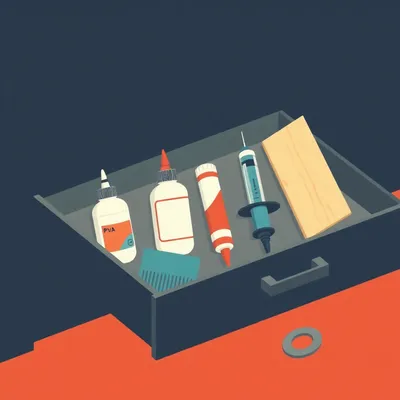
I'd recommend four items, and this is going to sound like a lot, but each one solves a specific problem. First, a xylene-based permanent marker for polyethylene and polypropylene surfaces. Sakura Identi-Pen in black is the one the prompt already found works. Stick with it. Second, an oil-based paint marker for metals, glass, and PVC. The Edding seven fifty-one or the Sakura Pen-Touch. Get a fine tip — you're marking small items, not shipping crates. Third, a small bottle of isopropyl alcohol, ninety percent or higher, and some lint-free wipes. This is not optional. This is the surface prep that makes everything else work. Fourth, for the absolute worst-case surfaces — the things that nothing will stick to — keep a few sheets of adhesive vinyl label stock and a pair of scissors. Sometimes the best solution is to create a flat surface where none exists.
That last one is a concession to reality.
There are some surfaces — silicone rubber, certain fluoropolymers, surfaces that are constantly flexing — where no marker will ever work reliably. For those, you create a flag label by wrapping a small piece of vinyl around the cable or component and writing on that. The vinyl adhesive is engineered for low surface energy plastics. It's not elegant, but it works.
The prompt also mentions engraving as a last resort, and seems to think it's overkill. But I wonder if that's actually true for certain items.
For metal tools, engraving is genuinely the most durable option. An electric engraver costs twenty or thirty dollars, and the mark is literally cut into the metal. It can't rub off, it can't fade, it can't be removed by solvents. For a set of wrenches or screwdrivers that are going to see hard use, engraving is probably easier than trying to find a marker that will survive the abuse.
For the tiny adapters — the micro HDMI to mini HDMI connectors — you're not going to engrave those. There's no surface area.
And that's where the fine-tip paint marker is the sweet spot. A dot of paint with a number on it, keyed to the inventory system. It's small enough to fit on the connector housing, durable enough to survive being tossed in a bag of adapters.
Let me ask about a failure mode the prompt didn't mention but I've run into. What about marking on rubber? Like the rubberized coating on some tool handles, or silicone cables?
Rubber and silicone are the nightmare surfaces. Rubberized coatings often contain plasticizers — oils that keep the rubber flexible — and those plasticizers migrate to the surface over time. Any mark you make will essentially float on a thin layer of oil and eventually lift off. Silicone has extremely low surface energy, lower even than polyethylene, and almost nothing bonds to it chemically.
Those surfaces are just...
For direct marking, yes. You need a mechanical solution — a tie-on tag, a heat-shrink label, something that physically attaches rather than chemically bonds. Heat-shrink tubing with a printed label inside it is actually a great solution for cables. You slide the tubing over the cable, write on it or print a label, and then heat it. The tubing shrinks and grips the cable mechanically. No adhesive, no surface chemistry to worry about.
I want to circle back to something about the Ziploc bag problem, because I think there's a subtlety here that matters. The prompt says the Sakura Identi-Pen works, but everything else fails. But Ziploc bags aren't just polyethylene. The name-brand ones often have a coating or treatment to make them easier to open, or to give them that slightly matte texture for writing on.
Ziploc brand bags specifically have a write-on label area that's been surface-modified, usually by corona treatment or plasma treatment, to increase the surface energy. If you write on that patch, even a standard permanent marker will work reasonably well. But if you write on the untreated part of the bag, or on a generic brand bag that doesn't have the treatment, you're back to the low surface energy problem.
Which means the failure might be inconsistent even within the same box of bags.
You write on the label patch, it works. You write two inches to the left, it fails. And you conclude that markers are unreliable — when actually, you're just seeing the difference between treated and untreated polyethylene.
The lesson here seems to be that "permanent marker" as a category is a lie, but a very specific kind of lie. It's not that the markers don't work. It's that "permanent" is always conditional on the surface, the preparation, and the environment. And none of that is on the package.
The packaging says "permanent on most surfaces" and the word "most" is doing an enormous amount of work. What they mean is "permanent on paper, cardboard, and a few other things we tested in the lab." They don't mean "permanent on the polypropylene handle of your favorite screwdriver that's been absorbing hand oils for five years.
There's another invisible contaminant.
Human skin oils are a major adhesion killer. If you've handled an item, you've deposited a thin layer of sebum on it. Paint and ink don't bond well to sebum. This is why even on metal tools, you should wipe the surface with alcohol before marking. It's not just manufacturing residue — it's you.
Every time I think we've found the bottom of this, there's another layer.
Welcome to surface science. It's a field where the answer to "why didn't this stick" is always "what was on the surface that you couldn't see?
Let's talk about the outdoor test the prompt mentions. Jerusalem sun, Edding and Sakura paint pens holding up so far. How long should those realistically last?
Under Jerusalem's UV conditions — intense, comparable to the American Southwest or the Australian outback — a good pigment-based paint marker should last three to five years before noticeable fading. A dye-based marker might last six months. And it's not just UV — outdoor markers also have to deal with thermal cycling. The paint film expands and contracts at a different rate than the substrate. Over time, that differential expansion can cause micro-cracking, and then moisture gets in and accelerates the failure.
Even the best outdoor marker has a lifespan.
Everything has a lifespan. The question is whether the lifespan is longer than the useful life of the item you're marking. For a plastic storage bin that lives outdoors, three to five years is probably enough — the bin itself might be getting brittle and cracked by then. For a metal tool you expect to pass down to your children, you might want to engrave it.
I want to address something the prompt touches on that I think is the real emotional core here. The frustration of doing this work and having it fail is disproportionate to the actual cost of the marker. It's not about the money. It's about the feeling that you tried to be organized, you did the thing, you followed the system, and the world just... unmade your effort.
There's a term for this in human-computer interaction research. It's called the "cost of coordination breakdown." When an organizational system fails, the user doesn't just lose the benefit of the system — they also lose the time they invested in setting it up, and they experience a psychological penalty that makes them less likely to trust similar systems in the future. It's a triple loss.
Getting the marker right isn't a trivial detail. It's the difference between a system that reinforces itself and a system that trains you to stop using it.
This is why I think the prompt's question — "what would you be buying?" — is actually asking something deeper. It's asking: how do I make this system trustworthy? How do I know, when I put something away with a number on it, that the number will still be there when I need it? That's a question about reliability engineering, not just about markers.
Let's answer it properly. If you want a marking system that's trustworthy, you need to think in layers. Layer one is surface preparation — the alcohol wipe, the abrasion, the removal of contaminants. Layer two is marker selection — matching the marker chemistry to the surface chemistry. Layer three is protection — the UV topcoat for outdoor items, the placement of the mark where it won't experience abrasion. And layer four is fallback — having a plan for the surfaces where markers simply won't work.
That's a really good framework. And I'd add a layer zero, which is testing. Before you mark fifty items, mark one and abuse it. Rub it, flex it, leave it in the sun, get it wet. Find out if your chosen marker and surface are compatible before you commit.
Destructive testing for home organization. I love it.
It sounds excessive, but it takes five minutes and it saves you from the slow-motion heartbreak of opening a box a month later and finding all your labels have turned into ghost marks.
Let's get specific about some products, because the prompt asks for concrete recommendations. The Sakura Identi-Pen — that's the xylene-based one for polyethylene. What's the actual product name or number someone should look for?
It's the Sakura Identi-Pen Permanent Marker, and the key thing to look for is that it says "xylene-based" or you can check the safety data sheet. It comes in black, red, blue, and green. The black is the most fade-resistant because carbon black pigment is basically indestructible. The fine point version is better for small items. They're usually around four to six dollars per pen.
The Edding seven fifty-one?
That's the Edding seven fifty-one Paint Marker. It's an oil-based, pigment-based paint marker with an acrylic binder. It comes in multiple tip sizes — the extra-fine or fine is what you want for adapters and small tools. These are more expensive, usually eight to twelve dollars per marker, but they last a long time because the paint is highly opaque and a little goes a long way. The key specification is that it's rated for outdoor use and resistant to heat up to something like a thousand degrees Fahrenheit once cured.
A thousand degrees? That seems like overkill for a pencil case.
It's designed for marking engine parts and industrial equipment. The fact that it also works on your pencil case is just a happy side effect of the engineering.
What about the Uni Paint Marker? You mentioned that one.
The Uni Paint Marker — the PX twenty or PX thirty — is another oil-based paint marker that's widely available. It's slightly less expensive than the Edding, and it's very good on metal and glass. The tip is a bit broader, so it's better for larger items. For the tiny adapters the prompt describes, I'd stick with the Edding extra-fine or the Sakura Pen-Touch extra-fine.
If someone can't find these specific brands? What's the generic specification they should look for?
For polyethylene and polypropylene: xylene-based permanent marker. Check the label or the safety data sheet online. If it says "xylene-free" or "low odor," put it back. For metals, glass, and outdoor use: oil-based paint marker, pigment-based, with an acrylic or alkyd binder. If the marker says "water-based" or "dye-based," it's not going to survive outdoors. For everything: buy a bottle of isopropyl alcohol and use it before you mark.
That's remarkably straightforward once you know the vocabulary.
That's the thing about surface chemistry. The concepts aren't complicated — it's surface energy, porosity, contamination, UV degradation. But nobody teaches you the vocabulary, so you're standing in the stationery aisle staring at fifty markers that all say "permanent" and you have no way to distinguish them.
The word "permanent" has been so thoroughly abused in marketing that it's become meaningless. It's like "natural" on food packaging. It tells you nothing except that the manufacturer thinks you want to hear it.
We have the chemistry. We've had it for decades. The xylene-based markers have been around since the nineteen sixties. The paint markers since the seventies. The knowledge exists. It's just not communicated to consumers.
Because communicating it would require admitting that the cheaper markers aren't actually permanent on the surfaces most people want to mark.
The ten-cent Sharpie is permanent on paper. It's not permanent on polyethylene, polypropylene, PVC, metal, glass, rubber, silicone, or anything that's been outdoors for more than a summer. But if the package said "permanent on paper and some other things," nobody would buy it.
The prompt mentions that the Sakura Identi-Pen was mentally "boxed away" as the only one that works on Ziploc bags. And it sounds like that's actually correct — it's not a fluke, it's the xylene.
It's the xylene. And the reason most other markers don't use xylene anymore is regulatory. Xylene is a volatile organic compound. It's not great to inhale in large quantities. California's Proposition sixty-five requires warnings on products containing xylene. So manufacturers moved to alcohol-based solvents, which are safer but don't etch polyolefins. The safety improvement came at the cost of performance.
If you're using a xylene marker, use it in a ventilated area.
Don't huff it. But for marking a few items in a room with an open window, the exposure is negligible. The dose makes the poison.
I want to go back to the pencil case failure one more time, because I think there's a lesson there that applies broadly. The prompt mentions leaving the markers for two days to cure, exactly what the instructions say. And they still wiped off. So even following the instructions perfectly, the mark failed. What does that tell us?
It tells us that the instructions assume a clean surface, and the surface wasn't clean. The cure time is about the paint film forming properly — the solvent evaporating, the binder polymerizing. But none of that matters if the paint is sitting on top of a layer of silicone release agent. The paint can cure perfectly and still fail, because it's cured onto the wrong thing.
It's like building a house with a perfect foundation on top of a sheet of ice.
The foundation is solid, but it's not attached to the ground. And this is the thing that I think most people miss about surface preparation. It's not a nice-to-have. For many surfaces, it's the difference between the mark lasting forever and the mark lasting until the first time you touch it.
The prompt's situation — marking the outside of pencil cases that are themselves holding markers — is almost poetic. The marker fails to mark the thing that holds the markers.
It's a perfect illustration of the problem. The pencil case has that shiny, slightly slippery feel specifically because of the additives and coatings that make it look good on the store shelf. Those same additives are what make it impossible to mark. The thing was designed to be attractive, not to be writable.
Which is true of approximately everything in modern life. Surfaces are designed for aesthetics and manufacturability, not for writability.
The few surfaces that are designed for writability — the Ziploc label patch, the matte area on a FedEx envelope — are explicitly engineered that way. It's not an accident. It's a deliberate surface treatment that costs money. The fact that it exists at all tells you that the untreated surface is known to be a problem.
What's the bottom line for someone who's listening to this and thinking, I just want to organize my tools and cables and not think about chemistry?
The bottom line is four things. One: clean the surface with alcohol. Two: for plastic bags and bins, use a xylene-based marker like the Sakura Identi-Pen. Three: for metal, glass, and outdoor stuff, use a pigment-based paint marker like the Edding seven fifty-one. Four: for rubber, silicone, and anything that flexes constantly, use a physical label or heat-shrink tubing instead of a marker.
If you do all of that and it still fails, you've found a difficult surface, and you should probably just use a tie-on tag.
Or engrave it. Honestly, for metal tools, an electric engraver is cheap and the mark is literally forever. It's not overkill if it solves the problem permanently.
"Permanently" in the actual sense of the word, not the marker-package sense.
There's permanent, and then there's permanent.
One thing I'm still curious about: the prompt mentions having tried "so many different types of labels" before arriving at markers. We've focused on markers, but are there label materials that actually work on those irregular surfaces?
There are, but they're not consumer-grade. Industrial labeling systems like the Brady BMP twenty-one or the Brother P-Touch industrial line use label cartridges with aggressive adhesives designed for low surface energy plastics. The Brady labels, in particular, use a 3M adhesive rated for polyethylene and polypropylene. The label stock itself is a flexible polyolefin, so it can conform to slight curves. But even these have limits — they need a certain amount of flat surface area to bond to, and they're not cheap. A Brady label cartridge can run forty or fifty dollars.
It's either expensive labels or the right marker and some surface prep. The marker starts to look like the economical choice.
For small, irregular items, absolutely. The marker is a fraction of a cent per mark, it works on curved surfaces, and with the right chemistry, it's effectively permanent. The label is better for flat surfaces where you want a machine-printed, scannable code. But for the kind of items the prompt describes — loose adapters, small cables, connectors — a fine-tip paint marker is the tool for the job.
I think there's also a philosophical point here about the nature of these organizational systems. The prompt mentions that the system was forked from Homebox, which is designed for QR codes. QR codes are great when they work — you scan them with your phone, you get the item record instantly. But they're fragile. A smudge, a scratch, a bit of UV fading, and the code is unreadable. A handwritten number is more robust. It's lower-tech, but it degrades gracefully. Even if half the number is worn off, you can probably still read it.
That's a really important point about system design. QR codes are a high-bandwidth, low-resilience solution. They encode a lot of information, but they need near-perfect readability. A human-readable number is low-bandwidth but high-resilience. You can read it even if it's partially damaged. For a home inventory system, the number is all you need — the database does the rest. You're not trying to encode the entire item record on the item itself.
The item just needs a unique identifier. Everything else lives in software.
That's why the marker approach works so well. You're not asking the mark to do anything except survive and be readable. A single number, written clearly, in a durable medium, on a prepared surface. That's a solved problem.
Provided you know which marker to use.
Which, hopefully, we've now answered.
I think we have. Xylene for polyethylene. Pigment-based paint for metal and outdoors. Alcohol for everything. And if that fails, engrave it or tag it.
Test one before you do fifty.
Test one before you do fifty. Words to live by.
And now: Hilbert's daily fun fact.
Hilbert: The world's largest bat colony by population is Bracken Cave in Texas, home to roughly twenty million Mexican free-tailed bats, but the largest single-chamber bat roost ever documented was discovered in the eighteen eighties on Russia's Yamal Peninsula, where a limestone sinkhole housed an estimated thirty million soprano pipistrelles before a partial collapse dispersed the colony.
Thirty million bats in one hole. That's not a colony, that's a nation.
I have so many questions about how you count thirty million bats in the eighteen eighties. Did someone volunteer?
This has been My Weird Prompts, produced by Hilbert Flumingtop. If you enjoyed this episode, leave us a review wherever you get your podcasts — it helps other people find the show.
Until next time.