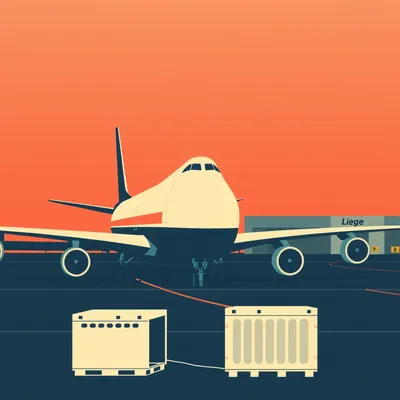
Daniel sent us this one, and it starts with a very specific kind of frustration. You ship a package with DHL in Tel Aviv — a global logistics giant, Swiss precision, German efficiency, all the branding — and what you get on the other end is classic Israeli customer service. The kind where nobody knows where your package is, the tracking hasn't updated in four days, and the person on the phone makes you feel like you've personally inconvenienced them by calling. The question is: why doesn't DHL global step in and fix it? And the answer, it turns out, isn't about one bad franchisee. It's about a structural gap in how international franchise agreements handle quality control in tiny markets.

The core mechanism here is deceptively simple. A franchise agreement gives a local operator the right to use the brand name, the systems, the trademarks — in exchange for upfront fees, ongoing royalties, and a contractual promise to adhere to brand standards. There's usually a thick manual, mystery shopping programs, regular audits written into the contract. On paper, the global brand has total control.
On paper being the operative phrase.
Because enforcement is expensive. Sending a quality control team to a market of nine million people, where the entire operation might generate a few million dollars in annual revenue for the parent company — the math stops making sense very quickly. For Deutsche Post DHL Group, the Israeli market contributes less than half a percent of global revenue. The cost of policing quality there can easily exceed whatever profit they're extracting.
The brand makes a calculated decision to look the other way.
Here's where the franchise veil comes in. The customer sees the DHL logo, the yellow and red, the global reputation — and assumes they're dealing with DHL the multinational. But legally, they're dealing with a local company that bought the right to use that logo. The parent company has structured the arrangement so that the franchisee is the legal entity. Complaints go to the franchisee. Liability stops at the franchisee. The brand gets the royalty check and the global brand presence without the operational headache.
The worst of both worlds, then. You pay for the global brand premium but you get local service that's worse than what a purely local competitor might offer, because at least the local competitor isn't charging you for a reputation it's not delivering on.
That's exactly the paradox. And it's not unique to DHL. This pattern repeats across sectors in Israel — and in other small markets. The structural question is: why do franchise agreements, which are designed to maintain consistency, fail so reliably in markets like this?
What's actually going on under the hood of these franchise agreements? Let's start with the basics.
A franchise agreement typically has several layers of quality control built in. There's the operations manual — sometimes hundreds of pages — specifying everything from uniform standards to customer response times to how the logo can be displayed. There's a royalty structure, usually a percentage of gross revenue, which in theory aligns incentives: the franchisee wants to maximize sales, the brand wants to protect the reputation that drives those sales.
Then there are mystery shopping programs — the brand hires third-party evaluators to pose as customers and score the franchisee on various metrics. And finally, there are termination clauses. If the franchisee consistently fails to meet standards, the brand can revoke the license.
If all of that is in the contract, what breaks?
First, the mystery shopping and audit programs are expensive to run in small markets. You need local evaluators who speak the language, understand the cultural context, and can produce reliable assessments. For a market generating maybe three or four million dollars in annual revenue, the brand isn't going to spend a hundred thousand dollars a year on quality audits. So they do them sporadically, or not at all.
Second is the termination clause problem. If you're DHL and you terminate your Israeli franchisee, what happens? You have to find another local operator willing to take on the franchise. In a market of nine million people, the pool of qualified candidates is small. Meanwhile, your brand presence in the country goes dark. Packages stop moving. Customers defect to competitors. The cost of termination is often higher than the cost of tolerating mediocrity.
The franchisee knows the brand is bluffing.
The franchisee knows exactly how much leverage they have. And that's where the mini-monopoly dynamic kicks in, which I think is the real insight here.
Walk me through that.
When a single franchisee controls the entire brand presence in a country — all the DHL service points, all the McDonald's locations, all the whatever — they face zero intra-brand competition. In a large market like the US or Germany, multiple franchisees operate in the same city. If one is terrible, customers can drive fifteen minutes to another franchisee of the same brand and get better service. The bad franchisee loses revenue, and the brand has comparative data to identify the problem.
In Israel, there's only one.
Alonyal Limited owns and operates every single McDonald's in Israel. If you have a bad experience at a McDonald's in Tel Aviv, you can't go to a different McDonald's franchisee in Jerusalem — because it's the same company. Your only option is to abandon McDonald's entirely and go to Burger King or a local chain. The franchisee has a captive market for anyone who wants that specific brand.
Which means the brand itself becomes the monopoly within its own niche. It's not a monopoly on hamburgers — it's a monopoly on McDonald's hamburgers.
That's a real thing people value. Brand loyalty is genuine. People want the specific taste, the specific experience, the specific reliability they associate with that logo. The franchisee captures all of that demand without having to compete on quality against another operator flying the same flag.
The incentive structure is completely inverted. Instead of competing to be the best franchisee, they're incentivized to be just good enough that customers don't abandon the brand entirely. The floor becomes the ceiling.
That's how you get the DHL Israel experience Daniel described. The tracking doesn't work, the customer service is abrasive, packages go missing — but the franchisee knows that for international shipping into and out of Israel, the alternatives are limited. FedEx and UPS have their own franchise arrangements with similar dynamics. The customer's choice isn't between a good DHL and a bad DHL. It's between a bad DHL and a bad FedEx.
The market for international shipping in Israel is essentially a competition to be the least terrible.
That's the mini-monopoly effect in a nutshell. And it's worth noting — this connects directly to something we explored before about why Israel's oligopolies keep prices high. The structural lack of competition isn't just about a few big companies dominating a sector. It's also about these nested monopolies within global brands, where the franchise arrangement itself eliminates the competitive pressure that's supposed to keep quality up.
Right, and that's the part most people don't see. They look at a street with three different shipping companies and think "competition." But if each of those three is a single franchisee with no intra-brand competition, you've got three mini-monopolies standing next to each other, not a competitive market.
Let me give you a concrete example of how this plays out. DHL Israel operates as a franchise of Deutsche Post DHL Group — it's not a company-owned subsidiary. The franchisee runs the service points, manages the logistics, handles customer service. When you call the DHL Israel number, you're not calling DHL. You're calling a local company that paid for the right to answer the phone as DHL.
If you complain to DHL global?
They route your complaint back to the franchisee. It's a circular accountability trap. The global brand says "we take customer satisfaction seriously" and forwards your email to the exact same people who lost your package in the first place. The franchisee knows there's no escalation path that actually threatens their license, because the global brand isn't going to terminate over a few dozen complaints from a market that represents a rounding error on their balance sheet.
The franchise veil isn't just a legal technicality — it's an active mechanism for deflecting accountability.
The franchisee capture dynamic makes it worse over time. Once the local operator realizes the brand won't enforce standards, they start cutting costs. Training budgets shrink. Staffing levels drop. Infrastructure investments get deferred. The franchisee is extracting maximum value from the brand while investing the minimum necessary to keep the operation running.
Which creates a race to the bottom that the brand is, at least on paper, supposed to prevent.
Here's the kicker: the brand often knows this is happening. They have the complaint data. They can see the mystery shopping scores, if they bother to collect them. But the calculus is cold. The Israeli market generates less than half a percent of global revenue for DHL. The reputational damage from bad service in Israel is contained — it doesn't spill over into the German or American or Japanese markets where the brand makes its real money. So the rational business decision is to do nothing.
That's the part Daniel flagged as unsurprising, and I think he's right. The global brand cares about global reputation. A few thousand frustrated Israelis doesn't move that needle.
It's not just DHL. Look at McDonald's Israel under Alonyal. The menu is heavily localized — which is fine, that's part of the franchise model — but there are persistent complaints about service inconsistency, cleanliness, and quality control that you don't see to the same degree in markets where McDonald's corporate has a direct ownership stake or multiple competing franchisees.
The localization becomes a cover for degradation. "We're adapting to local tastes" can mean anything from offering falafel to just not bothering to maintain the grill.
And the customer has no way to distinguish between legitimate localization and cost-cutting dressed up as cultural sensitivity.
Not every brand falls into this trap. Some have figured out how to maintain consistency even in tiny markets. Let's talk about the counterexamples.
Starbucks in Japan is the classic case study. They entered the market in the mid-nineties as a joint venture with a local partner — Sazaby League. But in twenty fourteen, Starbucks bought out the joint venture and converted the entire Japanese operation to company-owned stores.
Because Japan was too important to leave to a partner. It's Starbucks' second-largest market outside the US, and the brand realized that maintaining the consistency of the Starbucks experience — the store design, the training, the beverage quality — required direct control. They invested heavily in training programs, imported their store design standards, and built a management structure that reported directly to Seattle.
The difference is ownership structure, not just brand philosophy.
That's the single biggest determinant. Company-owned stores mean the parent company bears the capital costs and operational risks, but they also capture all the upside and — crucially — they control the customer experience end to end. The barista in Tokyo is trained to the same standards as the barista in Seattle because they both work for the same company.
IKEA takes this even further.
IKEA operates company-owned stores in every market. There's no IKEA franchise model for retail operations. The stores are owned and operated by INGKA Holding, which is part of the larger IKEA corporate structure. When you walk into an IKEA in Israel, you're walking into a store that's managed to the same operational standards as an IKEA in Sweden or China or the United States.
You can feel it. The layout, the cafeteria, the maze that traps you for three hours — it's identical.
That consistency is expensive to maintain. IKEA has to invest in training local staff, importing management talent, building supply chains that meet their specifications. But they've decided that the brand promise — affordable, well-designed furniture with a specific shopping experience — is worth protecting at any scale.
The trade-off is: franchises scale faster but sacrifice control. Company-owned preserves quality but costs more and grows slower.
In small markets, the math almost always favors franchising. If you're a global brand looking at Israel, you see nine million potential customers. The revenue opportunity might be a few hundred million dollars at best, spread across years of operation. Building company-owned stores means upfront capital investment, hiring local management, navigating Israeli bureaucracy and regulation — which, as we've discussed before, is notoriously burdensome.
Daniel mentioned that in his prompt — global financial firms have looked at doing business in Israel and concluded the regulatory burden isn't worth it for a market this size.
So the brand chooses the franchise model because the investment-to-return ratio doesn't justify company-owned operations. They collect royalties without putting skin in the game. The franchisee takes on the capital risk and the operational headaches. It's rational for the brand, at least in the short term.
Zara does something interesting in the middle.
Inditex, Zara's parent company, owns most of its stores directly — including in Israel. They're company-owned, not franchised. That gives them control over the retail experience, the store design, the inventory management. But they use local logistics partners for distribution and supply chain, which creates friction points.
Even when the store is company-owned, the customer experience can degrade at the edges.
The package might arrive late, the online ordering system might not sync properly with local inventory, the return process might be more complicated than in Spain. The brand controls the store but not the ecosystem around it.
Which means the franchise veil has a cousin — the logistics veil.
There's a regulatory dimension to all of this that doesn't get enough attention. Israeli consumer protection law is relatively weak when it comes to franchise accountability. The franchisee is the legal entity. The parent company is shielded. If you want to sue over a lost package or a bad experience, you're suing the local franchisee, not DHL or McDonald's corporate.
Compare that to Australia or the EU.
Australia's Franchising Code of Conduct imposes obligations on franchisors that go well beyond what Israeli law requires. There are good faith obligations, disclosure requirements, and dispute resolution mechanisms. The EU has been moving toward stronger franchise regulations, particularly around pre-contractual disclosure and the franchisor's responsibility for franchisee conduct in certain circumstances.
The regulatory environment enables the behavior we're describing. The brand isn't breaking any laws by ignoring service quality in Israel — because the laws don't ask them to care.
That's a policy choice. Israel could, in theory, pass legislation that makes franchisors jointly liable for franchisee conduct, or that requires minimum standards of customer service with enforcement mechanisms that cross borders. But there's no political momentum for that, and the brands themselves certainly aren't lobbying for it.
Why would they? The current arrangement is perfect for them. They collect royalties, maintain global brand presence, and offload all the messy operational problems onto a local company that absorbs the complaints.
Let me give you one more example that illustrates the contrast. Domino's Pizza in Israel — different franchisee, but same pattern. The menu is different from what you'd get in the US, the quality is inconsistent, and complaints to Domino's global go nowhere. Meanwhile, Domino's in the UK is largely company-owned or operated by large, professional franchisees with multiple locations who compete against each other. The experience is dramatically different.
The number of franchisees in a market matters almost as much as the ownership structure.
It's a spectrum. At one end, you've got IKEA: fully company-owned, maximum control, maximum consistency. Then you've got Starbucks in Japan: started as joint venture, converted to company-owned once the market proved itself. Then you've got Zara: company-owned stores with local logistics partners. Then you've got McDonald's in large markets: multiple franchisees competing against each other, with corporate oversight. Then you've got McDonald's in Israel: single franchisee, minimal oversight, mini-monopoly. Then you've got DHL Israel: single franchisee, minimal oversight, and the added complication of being a service business where quality is harder to measure than burger temperature.
It's almost a taxonomy of accountability. The more direct the ownership and the more internal competition, the better the customer experience.
There's a knock-on effect worth flagging. The franchise veil doesn't just harm customers in the small market — it creates an information asymmetry that distorts the brand's global reputation. An Israeli who has a terrible DHL experience at home might be in Berlin on business and need to ship something. They see the DHL logo and flinch.
DHL Germany is a completely different operation.
It's DHL's own operation — company-owned, German-managed, subject to German consumer protection law. The experience is night and day. But the brand damage has already been done. The Israeli customer doesn't know that DHL Germany is a different legal entity. They just know DHL lost their package and yelled at them on the phone.
The brand is essentially free-riding on its own reputation while simultaneously degrading it.
In a contained way. The degradation is geographically bounded. Most DHL customers worldwide will never interact with the Israeli franchisee. The brand can afford to let that small market rot because the reputational contagion is limited.
Until it isn't. Social media and review platforms have made it harder to contain bad experiences within national borders.
That's true, and it's one reason some brands are starting to pay more attention. A viral thread about DHL Israel losing a priceless family heirloom can show up in the feed of a potential corporate client in Singapore. The walls between markets are more porous than they used to be.
What do we do with this knowledge? Here are three practical takeaways.
First, for consumers: when you see a global brand in a small market, check whether it's a franchise or company-owned. It's not always easy to find out — brands don't exactly advertise this — but a little digging can tell you whether you're dealing with the actual company or a local operator wearing its logo. If it's a franchise, especially a single franchisee covering the whole country, adjust your expectations accordingly.
If you have a bad experience, complaining to the global brand is probably a dead end. Your leverage is with the local franchisee, limited as that may be.
Second, for entrepreneurs: the franchise model in small markets is a double-edged sword. You get instant brand recognition, established systems, and a customer base that already trusts the logo. But the parent company may abandon you when things go wrong — or worse, they may underinvest in the market while expecting you to maintain standards you can't afford to deliver. And you're locked in. Franchise agreements are notoriously difficult to exit.
You're buying a brand's name but not necessarily its commitment.
Third, the policy angle. Israel's regulatory gap on franchise accountability is a choice, not an inevitability. Australia's Franchising Code of Conduct, the EU's evolving franchise regulations, even some US state-level franchise laws — these all demonstrate that governments can require franchisors to take responsibility for what happens under their brand name. Israel could require joint liability for consumer complaints, mandatory disclosure of franchise relationships at point of sale, or minimum service standards with cross-border enforcement.
Given the broader regulatory environment Daniel's described — the burdensome regulation that drives companies away in the first place — adding more rules might just accelerate the exodus.
That's the tension. Heavier regulation might improve quality for the brands that stay, but it might also convince more brands that Israel isn't worth the headache. There's a balance to strike, and right now Israel is in a worst-of-both-worlds situation: enough regulation to deter entry, not enough to protect consumers who do engage.
Which brings us to the final thought. The "global experience" that brands sell in their marketing is, in most small markets, an illusion. The logo is the same, the colors are the same, the tagline is the same — but the operational reality underneath is entirely dependent on local ownership structures and incentives. The real question for any consumer is: does this brand have skin in the game here?
In most cases, the answer is no. They've got a royalty check and an arms-length legal arrangement. The person who actually employs the staff, maintains the facilities, and handles your complaint is a local businessperson who bought the right to pretend they're a multinational.
The next time you see a familiar logo in a foreign country, ask yourself: is this the brand, or just the brand's name?
Now: Hilbert's daily fun fact.

In the eighteen-tens, the Worshipful Company of Goldsmiths in London required apprentice pieces to be struck with a hallmarking punch that produced a specific acoustic ring when tapped — the pitch of the ring was used as a preliminary test of alloy purity before chemical assay, because adulterated metal dampened the resonance.
They were tuning forks with a bureaucracy attached.
I genuinely don't know what to do with that information.
This has been My Weird Prompts. Thanks to our producer Hilbert Flumingtop. If you enjoyed this episode, tell someone who's ever been disappointed by a global brand in a local market — which is basically everyone. Find us at my weird prompts dot com.
See you next time.