Daniel sent us this one — he's been watching the news about the potential US-Iran deal, and he's zeroed in on something technical that most coverage is skating right past. The fate of the highly enriched uranium stockpile reportedly buried at Isfahan. Apparently several options are on the table, including transferring the HEU to US custody for, quote, construction — whatever that means. He's asking whether HEU can be safely destroyed, maybe by controlled minute explosions, whether it can be safely transferred to a custodian state, and whether you can actually downgrade the enrichment level. And if so, wouldn't it just be easier to destroy it. He wants the mechanics and the physics of what an Iranian uranium surrender would actually look like.

This is the right question. Everyone's talking about the politics, the verification, the trust — nobody's talking about what you physically do with the stuff. And the answer to almost all of Daniel's questions is yes, but with asterisks the size of shipping containers.
Yes you can destroy it, yes you can move it, yes you can downgrade it — but.
The form it's in dictates everything. You can't understand any of this without knowing what physical form we're talking about. Highly enriched uranium isn't one thing. It could be uranium hexafluoride gas, it could be uranium metal, it could be oxide powder, it could be fabricated into fuel plates or weapon components. Each of those has completely different handling requirements, different transport rules, different destruction pathways.
When the media says Iran has a stockpile of highly enriched uranium, they're doing the equivalent of saying someone has a stockpile of metal. Technically true, tells you almost nothing.
And Iran's stockpile is mostly uranium hexafluoride — UF6 — which is a gas at slightly above room temperature but stored as a solid in cylinders. That's the form it takes when it comes out of centrifuges. They've also converted some into other forms, but the bulk of what we're talking about is UF6 in what are called 30B cylinders.
Thirty-B cylinders. That sounds like a branding decision that got out of hand.
It's an industry standard. A 30B cylinder holds about two point two metric tons of UF6, which contains roughly one point five metric tons of uranium. They're steel cylinders about thirty inches in diameter, about eighty inches long. They're not small, but they're not impossibly large either. You can move them with a forklift.
We're not talking about some glowing green sludge in a subterranean vault. We're talking about metal cylinders full of what is essentially a very specialized salt.
At room temperature UF6 is a white crystalline solid. It looks almost like powdered sugar, which is a terrifying sentence to say out loud. And here's where we get to Daniel's first question — can you destroy it with controlled minute explosions. The short answer is don't do that. Absolutely do not do that.
I feel like there's a longer answer coming.
UF6 is violently reactive with water. If you blow up a cylinder of UF6, you disperse uranium compounds into the air, where they react with atmospheric moisture to form hydrogen fluoride — which is hydrofluoric acid in gas form — and uranyl fluoride particles. You've now created a chemical disaster zone laced with radioactive material. It's the worst of both worlds. Chemical toxicity plus radiological contamination.
Controlled minute explosions give you uncontrolled maximum consequences.
That's the pithy version, yeah. The actual destruction pathway for HEU is not explosion. It's chemical conversion followed by blending. You take the UF6, you convert it to uranium oxide — U3O8, the stable form — or to uranium metal, and then you blend it with natural uranium, depleted uranium, or slightly enriched uranium to bring the enrichment level down.
This is the downblending process.
And it's been done at enormous scale. The United States downblended something like one hundred and forty metric tons of highly enriched uranium from the Russian weapons program after the Cold War. The Megatons to Megawatts program converted about five hundred metric tons of Russian weapons-grade HEU into low-enriched uranium for reactor fuel. That program ran from nineteen ninety-three to twenty thirteen.
Five hundred metric tons. So whatever Iran has, we've handled larger quantities before.
Orders of magnitude larger. Iran's total stockpile is estimated at something like four to six metric tons of enriched uranium at various levels, with maybe a few hundred kilograms near weapons-grade. The technical capacity to handle this exists. The question is logistics and politics.
Daniel's second question — can it be safely transferred. I assume the answer is also yes, with precedent.
Nineteen ninety-four. The United States airlifted about six hundred kilograms of weapons-grade HEU — not near-weapons-grade, actual weapons-grade — from Kazakhstan to the US. The material was at the Ulba Metallurgical Plant in Ust-Kamenogorsk. It was poorly secured, basically sitting in a warehouse. The US operation moved it in secret, flew it to Dover Air Force Base, and then transported it to Oak Ridge.
Six hundred kilos. That's roughly what Iran might have at the high end.
Similar order of magnitude. And that operation used standard transport casks certified by the IAEA. Those regulations haven't changed dramatically. The IAEA has detailed requirements for Type B packages — these are containers designed to survive a plane crash, a fire, immersion in water, all without releasing their contents. For UF6 cylinders specifically, there are overpacks and impact limiters.
The physical container problem is solved. Wrap it in the right steel and foam and it survives almost anything.
Solved is strong. The 30B cylinders themselves are not Type B packages — they need additional overpacking for transport. But the point is, the regulations exist, the hardware exists, and it's been done before. The bigger challenge with transfer is political. You need overflight permissions, you need to manage the risk of interdiction, you need a receiving facility that's prepared to handle the material.
You need the Iranians to actually hand it over, which is its own category of problem. But we're doing the mechanics here.
And the mechanics are the least problematic part. Now, Daniel's third question — and this is the one that made me sit up — he mentions media reports that the uranium would be unenriched, and says that doesn't sound plausible. He's right. It's not plausible. You cannot unenrich uranium.
That word is doing a lot of work that physics doesn't support.
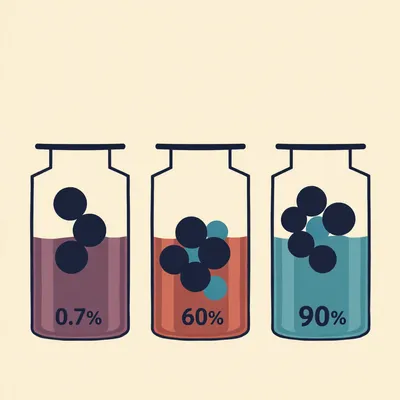
Enrichment is the process of increasing the concentration of uranium-235, the fissile isotope. Natural uranium is about zero point seven percent U-235. Reactor-grade low-enriched uranium is typically three to five percent. Weapons-grade is typically ninety percent or above. To go from high enrichment to low enrichment, you don't remove U-235 atoms. You can't pull them out one by one.
What are these media reports actually describing?
Almost certainly downblending, but the reporting is garbled. What you do is mix the HEU with material that has very low U-235 content — depleted uranium, which is mostly U-238, or natural uranium. The U-235 atoms from the HEU get distributed through the larger mass of blending material, and the average enrichment drops. The U-235 is still there. It's just diluted.
It's the nuclear equivalent of watering down whiskey. The alcohol molecules are still in the bottle, there are just more water molecules around them.
And just like watered-down whiskey, you can't easily reverse it. To re-enrich the blended material, you'd have to put it back through centrifuges and do all the work over again. That's the point. Downblending makes the material useless for weapons without a massive re-enrichment effort.
Which raises Daniel's follow-up — if you're going to downblend it, why not just destroy it outright?
Because destruction of uranium is not really a thing. You can't make uranium atoms disappear. You can convert them into different chemical compounds, you can disperse them — which is a terrible idea — or you can put them somewhere. The closest thing to destruction is downblending followed by disposal, or downblending followed by use as reactor fuel.
Burn it in a reactor.
Which actually does destroy some of the U-235 through fission. But even then, you're left with fission products and some remaining uranium. The material doesn't vanish.
Downblending is effectively the destruction pathway. You render the material non-weapons-usable, and then you either store it, dispose of it, or use it.
That's why the reported US proposal makes technical sense. Take the HEU, transfer it to US custody, downblend it at a DOE facility — probably Y-12 at Oak Ridge or the Savannah River Site — and the resulting low-enriched uranium can be used for reactor fuel or safely stored. The material is neutralized as a proliferation threat.
What about the Isfahan part of this? Daniel mentioned the stockpile is reportedly buried there.
Isfahan has a major nuclear technology center. They have a uranium conversion facility that produces UF6, they have fuel fabrication capabilities, and there are reportedly underground storage areas. The buried part is interesting. If the material is in underground hardened storage, it's protected from airstrikes but also harder to verify and harder to extract.
Verification becomes a major technical challenge even before you get to transfer.
You need to confirm that what they say they're handing over is actually the full stockpile. That means sampling, measurements, comparison to production records. The IAEA has protocols for this — they did it in South Africa when that country dismantled its weapons program, they did it in Libya after Gaddafi's disarmament. But Iran's situation is more complex because of the history of concealment.
Let's go back to the transport question for a minute. Project Sapphire moved six hundred kilos. What are we looking at logistically if Iran has, say, a few hundred kilos of near-weapons-grade material plus several tons of lower-level enriched material?
Multiple shipments, probably. A single C-17 can carry several 30B cylinders with the right overpacking and tie-downs. If you're moving the whole stockpile, you're probably looking at a dedicated airlift operation with multiple sorties, or a sea shipment if time is less critical and you can ensure security.
Sea shipment feels like a nightmare scenario. A ship carrying HEU through the Persian Gulf, the Strait of Hormuz, the Red Sea — you're basically creating a floating hostage situation.
That's why airlift is almost certainly the preferred option. Fast, fewer touch points, easier to secure. The Project Sapphire model. Fly it out of a secure airfield, direct to US territory or a trusted intermediary.
You need Iranian cooperation at every step. They have to let inspectors verify the material, they have to let it be packaged for transport, they have to let the planes land and take off.
Which is why the whole thing is a trust-dependent operation, regardless of the technical feasibility. But that's politics, not physics. The physics says this is straightforward. The engineering says it's manageable. The logistics say it's been done before.
Let's talk about the chemical conversion piece in more detail. You mentioned UF6 to U3O8. What does that process actually look like?
UF6 is converted to uranium oxide by reacting it with steam at high temperature. The UF6 hydrolyzes — it reacts with the water — to form uranyl fluoride and hydrogen fluoride. Then you process that further to get U3O8, which is a stable dark powder. That's the form uranium takes in nature. It's what comes out of mines. It's chemically inert, doesn't react with air or water, and it's the standard form for long-term storage or disposal.
You're basically turning it back into ore.
Chemically similar to ore, yes. The isotopic composition is still enriched, but once you blend it with depleted uranium, the resulting mixture is indistinguishable from natural uranium in terms of its proliferation risk. You could bury it in the desert and it would be about as dangerous as the rocks around it.
Which is not zero, but it's not weapons material.
Uranium is a heavy metal — it's chemically toxic, like lead. You don't want to eat it or breathe the dust. But from a radiological perspective, unenriched or downblended uranium is not a major hazard. The specific activity is low. You can hold a pellet of U3O8 in your hand safely.
I'm now imagining the photo op of someone holding a pellet of former Iranian HEU. Which I suspect is exactly the kind of thing that gets staged at the end of these operations.
It absolutely is. And the pellet would be completely unremarkable-looking. Dark gray or black ceramic. That's the whole point — the material is visually identical whether it's been through a centrifuge cascade or just came out of the ground. The danger is entirely in the isotopic composition, which you can't see.
Which brings us back to verification. How do you actually confirm the enrichment level of material you're being handed?
The standard approach is gamma spectroscopy — uranium-235 emits gamma rays at specific energies, and by measuring the intensity you can determine the enrichment. There are handheld devices that can do this in minutes. For more precise measurements, you take samples and run them through a mass spectrometer.
This works regardless of the chemical form?
It works best on samples that have been prepared properly — dissolved, purified — but you can get decent measurements on UF6 cylinders directly with the right equipment. The IAEA inspectors do this routinely. They'll measure every cylinder, take swipe samples, compare against declared inventories.
The technical verification is solved. The challenge is access.
If the Iranians won't let inspectors near certain cylinders, or certain storage areas, the whole thing falls apart. And that's where the deal-making gets into the details that never make the headlines. How many inspectors, from which countries, with what level of access, under what timeline.
Let's talk about the custodian state question. Daniel asked whether HEU can be transferred safely to a custodian state. The US is the obvious candidate, but are there others?
Russia has taken back HEU from Soviet-era clients in the past — they repatriated fuel from research reactors in several countries. The IAEA itself has a fuel bank in Kazakhstan that stores low-enriched uranium as a backup supply for countries that want nuclear power without enrichment capabilities. But for weapons-grade material, the US and Russia have been the primary recipients historically.
In this scenario, with the current geopolitical alignment, Russia is probably not the destination.
Almost certainly not. The US is the logical custodian. The facilities exist, the expertise exists, the legal framework exists. DOE has an entire office — the Office of Nuclear Material Removal — that does exactly this kind of work.
Office of Nuclear Material Removal. That's a very direct name. No euphemism, no branding exercise. Just we remove nuclear material.
Sometimes the government names things what they actually do. It's refreshing.
Like naming a dog Dog.
And they've been busy. Beyond Project Sapphire, they've removed HEU from dozens of countries — Serbia, Romania, Bulgaria, Poland, Chile, Vietnam. The Global Threat Reduction Initiative has secured something like five thousand kilograms of HEU and plutonium from more than forty countries since two thousand four.
Five thousand kilos. So again, whatever Iran has is within the envelope of operations that have been done repeatedly.
That's the thing I want to emphasize. From a purely technical standpoint, an Iranian HEU transfer and downblending operation is not unprecedented. It's not even particularly novel. The US has a playbook for this. The IAEA has protocols. The transport casks are designed and certified. The downblending facilities are operational.
The obstacles are entirely political and diplomatic. The physics doesn't care.
The physics is almost boring. UF6 goes in one end of the conversion plant, U3O8 comes out the other, you mix it with depleted uranium, done. The chemistry is well understood. The engineering is mature.
Which makes the media coverage all the more frustrating. You get headlines about unenriching uranium, which is a word that doesn't describe a real process.
It's a term that reveals the reporter doesn't understand what enrichment is. Enrichment is separation of isotopes. There's no reverse process. You can't unseparate them — you can only mix them back together with other material. The U-235 atoms don't go away.
Let's dig into the blending math for a minute. If Iran has, say, two hundred kilograms of uranium enriched to ninety percent, how much depleted uranium do you need to blend it down to reactor-grade — say four percent?
Two hundred kilos at ninety percent means one hundred eighty kilos of U-235. To get that down to four percent, you need a total uranium mass of one hundred eighty divided by zero point zero four, which is four thousand five hundred kilos. So you need to add about four thousand three hundred kilos of depleted uranium.
The blending material is more than twenty times the mass of the HEU.
That's fine. Depleted uranium is a waste product of enrichment. The US has something like seven hundred thousand metric tons of it sitting in cylinders at enrichment plants. It's a liability we're happy to put to use.
The US already has the blending stockpile. It's literally sitting around waiting for something to do.
It's one of the great ironies of the nuclear fuel cycle. Enrichment produces this enormous quantity of depleted uranium that nobody wants, and the best use anyone has found for it is diluting weapons material back to harmlessness. The solution to one problem is the waste product of another.
That's almost poetic. In a deeply industrial, unglamorous way.
The nuclear fuel cycle is full of these symmetries. The same centrifuges that enrich uranium for reactors can enrich it for bombs. The same conversion plants that make reactor fuel can make weapons components. The line between peaceful and military nuclear programs is entirely about intent and enrichment level.
Which is why verification regimes focus so heavily on enrichment. If you control the centrifuges, you control the proliferation risk.
That's the other half of any deal. Removing the HEU stockpile is one component. The other is dismantling or repurposing the enrichment capacity. Otherwise they just make more.
You take the existing HEU, and six months later they've run the centrifuges and produced new material. Unless you also address the production capability.
Which gets into the destruction or storage of centrifuges, the removal of centrifuge manufacturing capability, the ongoing inspection regime. The HEU is the most urgent proliferation threat because it's the closest to weapons-usable, but it's not the only one.
Let's go back to something Daniel said in his prompt that I want to pick up. He mentioned that the uranium would be transferred to US custody for construction. That's an odd word choice.
I think what's being described is downblending the HEU and then using the resulting low-enriched uranium to fabricate fuel for nuclear reactors. That would be the construction — fuel assembly construction. Or possibly using the downblended material in some kind of research reactor context.
It's not construction in the building sense. It's fabrication of fuel elements.
That would be my read. The alternative interpretation is that the word construction is being used as a diplomatic euphemism for something the parties don't want to describe in detail. Diplomatic language often uses deliberately vague terms to allow both sides to claim different things.
The MOU as Rorschach test.
The US can say the material is being used constructively. Iran can say it's being used for peaceful purposes. The technical reality is downblending and fuel fabrication, but construction sounds better in a joint statement.
Let's talk about the safety case for transport in more detail. You mentioned Type B packages. What does a crash actually look like for one of these?
The IAEA regulations require Type B packages to survive a sequence of tests. A nine-meter drop onto an unyielding surface — that simulates a transport accident. A one-meter drop onto a steel punch — that simulates puncture. A fully engulfing fire at eight hundred degrees Celsius for thirty minutes. And immersion in water at various depths.
You could crash the plane, have it catch fire, and the cylinder still holds.
That's the design basis. And it's been tested. Sandia National Laboratories has done full-scale crash tests of nuclear material transport casks. They put them on trucks and crash them into concrete walls. They put them on rocket sleds and slam them into things. The casks survive.
There's something darkly entertaining about the image of rocket-sledding a nuclear transport cask into a wall just to see what happens.
The engineers who get to do that work have the best stories. But the point is, the engineering is robust. The risk of a release during transport is extremely low. The bigger risk is security during transport — someone trying to steal the material, not an accident releasing it.
Which is why these operations are done in secrecy, with military escort, often at night, with decoy operations and all the tradecraft you'd expect.
Project Sapphire involved C-5 Galaxy transports, Air Force security teams, and a cover story about humanitarian aid. The Kazakh government didn't even tell its own military what was happening. The whole operation was executed in a matter of days from decision to completion.
That was thirty years ago. The operational playbook has only gotten more refined since then.
Though the world has changed. In nineteen ninety-four you didn't have the same drone threat, the same cyber threat, the same real-time satellite surveillance from commercial providers. Security for a modern operation would need to account for threats that didn't exist when Project Sapphire was planned.
The transport is physically safe but operationally complex in new ways.
You're not just worried about the cylinder surviving a crash. You're worried about the convoy being tracked, the flight path being leaked, the receiving facility being targeted. The physical safety and the operational security are two different problems.
Let's circle back to destruction versus downblending. Daniel asked, if downblending is the path, wouldn't it be easier to just destroy it. I think the answer we've arrived at is that downblending is destruction — it's destruction of the weapons-usability. But I want to press on something. Is there any scenario where actual physical destruction, like vitrification or deep borehole disposal, makes more sense?
Vitrification is mostly used for high-level waste — the fission products from reactors. For HEU, vitrification would be overkill and would actually make the material harder to account for. Once it's mixed into glass, you can't easily verify what's in there. Downblending produces a homogenous, measurable product. You can sample it, you can verify the enrichment, you can track it through the fuel cycle.
Downblending is actually better for verification than vitrification.
Vitrification is a black box. You pour the material into molten glass, it solidifies, and now you have a glass log that you can't easily assay. Downblended U3O8 is a powder. You can take a sample from any part of it and get a representative measurement.
Deep borehole disposal?
That's for material you never want to see again and don't need to verify. You drill a hole five kilometers deep, put the material at the bottom, seal it. It's permanent, but it's also irreversible and unverifiable after sealing. For a diplomatic agreement where both sides want ongoing confidence, that's a non-starter.
Downblending wins on multiple axes. It's verifiable, it produces a useful product, it doesn't create new waste streams, and it's irreversible without a massive re-enrichment effort.
It's genuinely the elegant solution. And it's worth noting that this is exactly what the US did with Soviet weapons material. The Megatons to Megawatts program downblended five hundred metric tons of HEU into reactor fuel that generated something like ten percent of US electricity over the life of the program.
Ten percent of US electricity came from Soviet bomb material.
The numbers are staggering when you look at them. Something like twenty thousand nuclear warheads' worth of material was turned into civilian reactor fuel. It's arguably the most successful nonproliferation program in history.
Nobody talks about it.
It's not visually dramatic. There are no explosions, no destroyed facilities, no dramatic footage. It's just cylinders moving through a chemical plant and coming out the other end as powder. The most important nuclear security operation of the last thirty years was a supply chain.
The banality of nonproliferation.
That should be a book title.
Claim it now before someone else does. So to pull together what we've covered — Daniel asked four questions. Can HEU be safely destroyed? Yes, through downblending, not through explosions. Can it be safely transferred? Yes, with Type B packaging and military escort, multiple precedents exist. Can enrichment be downgraded? Yes, through blending with depleted or natural uranium — not unenrichment, which isn't a thing. And wouldn't it be easier to destroy it? Downblending is the effective destruction pathway, and it's better for verification than alternatives.
That's the technical summary. And I want to add one thing that I think gets lost in these discussions. The material itself is not magical. It's not radioactive slime. It's a white crystalline powder or a dark ceramic powder or a metal billet, depending on form. It's dangerous because of what it enables, not because of what it is. Handling it is an industrial process, not a superhero operation.
Which is both reassuring and slightly unsettling. Reassuring because it means we know how to do this. Unsettling because it means the barriers to handling this material are lower than people imagine.
The hard barriers are political, not technical. The technical barriers were solved decades ago.
That's probably why the media coverage focuses on the politics and mangles the physics. The politics is where the drama is. The physics is just chemical engineering.
Chemical engineering with unusually high stakes.
Everything's higher stakes when the word weapons-grade is in the sentence.
Weapons-grade changes the tone of any conversation. Weapons-grade mayonnaise. Weapons-grade parking enforcement.
Weapons-grade bureaucracy. Which is actually what governs most of this process. The IAEA has weapons-grade paperwork requirements.
The cylinder tracking alone — every 30B cylinder has a unique identifier, a chain of custody that follows it from production through every transfer, every measurement, every conversion step. Lose track of a cylinder and it's an international incident.
Which is why the logistics of this hypothetical transfer would involve an almost absurd amount of documentation. Every cylinder weighed, measured, sampled, sealed, signed for, counter-signed, photographed, and tracked by satellite.
The documentation itself becomes part of the verification record. If the numbers don't add up — if the declared production history doesn't match the physical inventory — that's a red flag that triggers deeper investigation.
The paper trail is a verification tool in itself.
Material accountancy is the foundation of nuclear safeguards. It's not glamorous, but it's how you catch diversion. If the books don't balance, someone's been moving material.
Iran's books have not always balanced, historically.
Which is why any deal would require intrusive verification that goes well beyond what Iran has previously accepted. The technical capability exists. The question is whether the political will exists on both sides to make it happen.
That's where we leave it. The physics and engineering say this is doable, precedented, and well-understood. The rest is diplomacy.
Now: Hilbert's daily fun fact.
Hilbert: During the Cold War era, an expedition to the Simpson Desert in Australia uncovered a single surviving bullroarer — a carved wooden aerophone swung on a cord to produce a low roaring sound — used by the Wangkangurru people not for ritual, but as a long-distance communication device audible across more than five kilometers of open desert.
A five-kilometer bullroarer. That's weapons-grade acoustics.
This has been My Weird Prompts. Thanks to our producer Hilbert Flumingtop. You can find us at myweirdprompts dot com, and if you enjoyed this episode, tell someone who'd appreciate the physics of nuclear diplomacy — we'll be back next week.