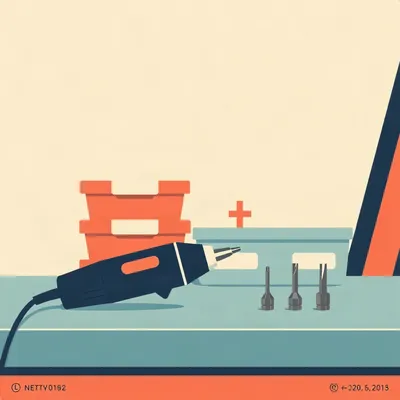
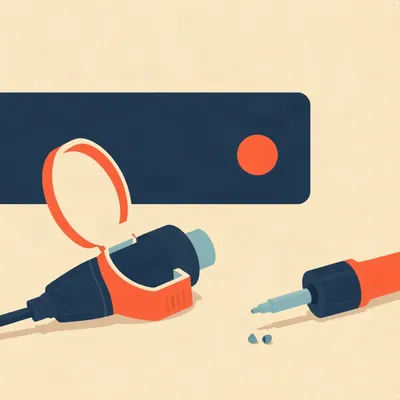
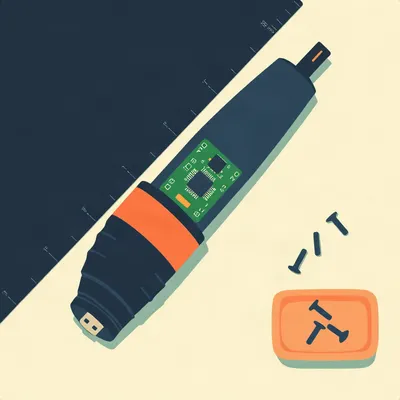
Daniel's Dremel 7760 stopped charging today. A tool he uses every day, bought a few months ago, and the retailer's answer is, bring it to the importer. In Israel that means a ninety minute drive each way. For a fifty dollar tool, the petrol alone eats the warranty. So he's doing the rational thing: buying a replacement, never shopping at that retailer again, and keeping the old one for a DIY repair. The 7760 has a micro USB port, and there's a known community mod to swap it for USB-C. His first step is opening the case and photographing the board to send to an AI tool. And he's got two specific asks. One, what jig or rigging system holds a phone steady enough for macro PCB photography at four or five times zoom. Two, where do you publish those photographs and whatever you diagnose so they're in the public domain, for other people and for AI agents.

So the tool is cheap, the warranty is impractical, and the repair is on him. The question is how you document the board well enough to get help. And that starts with the photograph.
Before we get to the photography, I want to sit with the economics for a second, because Daniel's decision is the whole episode in miniature. The warranty is technically valid. He's entitled to service. But the cost of claiming it exceeds the value of the item. That's not a broken warranty system, exactly. It's a warranty system that assumes the item is worth more than the trip. When the item is fifty dollars, the system quietly stops making sense.
And it's not just the petrol. It's the time. Three hours of driving, plus waiting at the depot, plus the return trip to pick it up. That's a full working day for most people. A fifty dollar tool isn't worth a full working day. The math collapses immediately. And it's worth saying that Daniel actually did the calculation before he made the decision. He didn't just get annoyed and give up. He looked at the drive time, the fuel cost, the lost work hours, and he compared it against the price of a new tool. That's the kind of cold arithmetic that the warranty system is betting most people won't do.
Right. The warranty is a promise that's only worth keeping if the item is expensive enough to justify the logistics. A thousand dollar laptop? Sure, drive it to the importer. A fifty dollar rotary tool? The warranty is a fiction. It's a piece of paper that says "we'll fix this" without acknowledging that the fixing costs more than the thing itself. And what's interesting is that Daniel didn't rage against the system. He just did the math and moved on. He's buying a replacement because that's the rational choice, and he's keeping the broken one because the repair knowledge exists. He's not stuck. He's got options.
And the failure mode here is the classic one for micro USB. The connector is rated for around ten thousand insertion cycles, but that's the data pins wearing out. What actually kills these ports is mechanical stress. The port is soldered to the board at a handful of points, and every time the cable gets lateral force, those joints flex. Eventually one cracks. The symptom is exactly what Daniel described: the cable only works at one angle. That's not a cable problem. That's a cracked solder joint on the port itself. Think about how a Dremel gets used. It's a rotary tool. It vibrates. It gets set down on a workbench, it gets picked up, the cable gets tugged. All of that stress goes straight into the four little solder points that hold the port to the board. It's not a matter of if they fail. It's when.
Which is why the USB-C swap exists. The USB-C connector has more anchor points and a more robust mechanical design. People have documented the 7760 board, identified the pinout, and posted step-by-step mods. That documentation only exists because somebody opened the tool, photographed the board, and published it.
And that's the through-line of the whole episode. You need good photographs to get good advice, and you need to publish those photographs for the advice to exist at all. Daniel's two questions are really one problem. The photography and the publishing are two halves of the same act. You can't have the repair community without the documentation, and you can't have the documentation without the photograph.
Let's start with the craft. How do you actually hold a phone steady enough to photograph a board at five times zoom?
The physics here is unforgiving. At four or five times zoom, the effective focal length magnifies hand tremor proportionally. A one millimeter movement at one times zoom becomes a five millimeter movement at five times. That's not a skill issue. That's angular magnification. It's why coffee makes it impossible. The caffeine tremor is a real physiological thing, and the phone optics are amplifying it fivefold. I've had moments where I thought I had a steady hand, took the shot, and the resulting image looked like it was taken from a moving car. It's humbling.
So stability is the binding constraint. Lighting can be solved with a ten dollar LED panel. Zoom is built into the phone. Stability is the one that requires hardware.
And there's a ladder of options. Cheapest: a phone clamp on a flexible gooseneck arm. Fifteen, twenty dollars. It works, but it sags. You set it, it drifts, you re-set it. Workable but annoying. It's the kind of thing that's fine for a quick video call but maddening when you're trying to hold a five-times zoom on a specific capacitor. Next step up: a copy stand with a phone adapter. This is the classic solution for flat subjects like PCBs. The phone points straight down at the board, the height is fixed, and the whole thing is rigid. You can get one for thirty to fifty dollars, and it's the right tool for this exact job.
I've used a copy stand for document scanning. It's the same principle. The board sits on the base, the phone is clamped above it, and nothing moves. There's something almost ceremonial about it. You set the board down, you adjust the height, you frame it up, and then you just wait for the timer. It's the opposite of the gooseneck arm in every way.
Then there's a small tripod with a horizontal arm. That's what a lot of people already own. You extend the arm out over the board, mount the phone holder, and shoot downward. It's less stable than a copy stand because the arm is a lever, but it works. If you're using a real camera, you'd add a macro rail, which lets you make fine focus adjustments by turning a knob. That's the serious setup. The macro rail is a game changer because at five times zoom, the difference between sharp and blurry is a fraction of a turn. You can't get that precision by nudging the phone with your finger.
And then there's the DIY route. A stack of books, a rubber band, and the timer delay.
The timer is the highest-leverage free technique in this entire conversation. Even with a jig, pressing the shutter button introduces vibration. Your finger touches the phone, the phone moves, the image blurs. A two or three second timer eliminates that completely. You press, you let go, the phone settles, and then it takes the shot. Or you use a Bluetooth shutter release, which is the same idea without the wait. I've seen people spend money on elaborate rigs and then completely undermine themselves by jabbing the shutter button. The timer is free and it fixes the problem instantly.
I've done the rubber band and books thing. It works better than people expect. The books give you height, the rubber band holds the phone against the stack, and the timer does the rest. The hardest part is finding books that are all the same height. I used a stack of paperbacks and a hardcover on top, and it was surprisingly solid. Not as good as a copy stand, but more than good enough for a first pass.
Now, once you've got a sharp single frame, there's a next level: focus stacking. At five times zoom, depth of field is measured in fractions of a millimeter. A PCB is not flat. Components sit at different heights. The port is one height, the capacitors next to it are another, the silkscreen is lower still. A single shot can only be sharp at one of those distances. Focus stacking means taking multiple shots at different focus points and combining them in software so everything is sharp. Apps like Helicon Focus do this, or Photoshop's auto-blend. It's more work, but for reading part numbers across a whole board, it's the difference between one legible chip and a fully readable board. And for Daniel's specific case, where he's photographing a cracked solder joint, focus stacking is what lets you see the crack in the joint and the part number on the adjacent chip in the same image. Without it, you're choosing which one to make sharp.
Let's talk lighting, because Daniel mentioned it and it's where people go wrong. A single on-axis light, like the phone's flash, washes out the very engravings you're trying to read. The light hits the chip flat and the text disappears in glare.
The fix is diffuse, angled light from two sides at roughly forty-five degrees. That rakes across the surface and reveals texture. Solder joints get shadows, silkscreen gets contrast, and the part number engravings become readable. A cheap diffuser, even a sheet of printer paper between the light and the board, transforms the result. You're not adding light. You're shaping it. I cannot overstate how much of a difference this makes. The same board, the same phone, the same zoom level. With the flash, the part numbers are invisible. With two angled lights and a paper diffuser, they're perfectly legible. It feels like cheating.
And now the part Daniel already knows works: the AI reading the part numbers. He's sent photos to an AI tool and had it read engravings that were basically impossible with the naked eye. What's actually happening there?
Modern multimodal models can resolve text at the limit of the sensor's resolution. But they're not magic. The AI reads what a careful human could read with a loupe. It's faster and it doesn't get eye strain, but it does not recover information that isn't in the pixels. If the photograph is blurry, the characters are smeared across multiple pixels, and the AI is guessing. Sometimes it guesses right, and sometimes it hallucinates a part number that looks plausible but doesn't exist. The photograph has to be sharp enough that the characters are distinguishable. That's the whole ballgame.
So the AI is a very fast, very patient reader. But it's only as good as the image.
And here's the bridge to the second half. When you ask an AI about a specific board, it may draw on published teardowns, forum posts, and repair logs. If nobody has published that board, the AI has nothing specific to work from. It can reason about micro USB ports in general. It can tell you the typical pinout. But it can't tell you what's on the other side of this particular Dremel 7760 board unless someone has photographed it and written it down. The AI's knowledge is downstream of the public documentation. It doesn't create the documentation. It consumes it.
So you've got a sharp photograph and the AI has read the part number. Now the question is where that photograph goes. And why it matters that it goes anywhere at all.
The clearinghouses. Let me name them, because Daniel asked specifically. Badcaps is the canonical one. It started as a capacitor and power-supply repair forum, and it's been running for over two decades. The archive of user-submitted board photographs is deep. You search a board number and you find photos, diagnoses, and repair logs. It's not the prettiest website, but it's the one that has the thing you need. There's a reason it keeps coming up in these conversations. It's not the best-looking forum, it's not the easiest to navigate, but the density of actual repair knowledge is unmatched. People post board photos with circled components and arrows pointing to the failed part. It's like a medical textbook for electronics.
Badcaps is the reference section of the library. It's not flashy, but it's where the actual knowledge lives.
Then there's EEVblog. Dave Jones's forum. It has a teardown section and a strong reverse-engineering culture. People post board photos, identify components, argue about design decisions. It's more general electronics than Badcaps, but the depth is real. If you've got a Dremel 7760 board and you post it there, someone will tell you things about it you didn't know to ask. The comment sections on EEVblog are a masterclass in collective diagnosis. One person spots a cold solder joint, another person identifies a capacitor value from the silkscreen, a third person links to a datasheet. It all happens in public, and it all gets archived.
And iFixit is the contrast. It's not forum-based. It's a repair guide wiki. User-submitted photos, step-by-step teardowns, structured guides. The format is different, but the function is the same: someone documents the board, and everyone after them benefits.
Hackaday is the fourth one. It's a blog and comment community, and it regularly features teardowns and reverse-engineering writeups. The comment section is where the real detail lives. Someone posts a teardown, and the comments fill in the gaps. It's a different kind of clearinghouse, but it feeds the same corpus. The Hackaday commentariat has a reputation for being pedantic, and in this context that's a feature. They will tell you exactly what you got wrong, and in doing so, they make the documentation more accurate.
Then there are the manufacturer-adjacent spaces. PCBWay and OSH Park have communities where board files and photos circulate. They're aimed at people who fabricate boards, but the documentation ends up in the same public pool.
Now, the paying it forward argument. Daniel stated it precisely. If everybody figured things out and kept the results to themselves, the open-source information wouldn't exist. And he's right. But there's a sharper version of this. When you publish a PCB photograph with a readable part number, you're not just helping the next person with the same tool. You're creating the training data that the next AI model will use to answer the next person's question. The public domain is the substrate for the AI advice Daniel relies on. That's the part I don't think most people have fully internalized. The AI isn't a separate thing from the public documentation. It's a distillation of it.
That's the new argument. The old open-source ethos was about altruism and reputation. This is about maintaining the shared resource that makes the AI useful. If everyone keeps their findings in private chats, the corpus doesn't grow. The AI gets dumber, or at least doesn't get smarter. And the thing is, the private chat is the path of least resistance. You ask the AI, you get an answer, you move on. Publishing means creating an account on a forum, writing a post, uploading photos. It's friction. And the friction is exactly what the AI is trained to eliminate.
There's an asymmetry problem. The person who benefits most from a published teardown is the person who finds it two years later, not the person who published it. The publisher gets nothing immediate. Maybe a thank-you comment. The incentive to publish is weak, even though the social value is high. The communities that work, Badcaps and EEVblog and iFixit, they work because they've built norms and reputations around contribution. Posting a good teardown earns you standing. That standing is the currency that keeps people posting. It's not altruism. It's a reputation economy. And reputation economies are fragile. They depend on people caring about the standing they have in the community. If the community disappears, the incentive disappears with it.
The community is the support network the retailer isn't. When warranty service is impractical for low-value goods, the repair knowledge becomes the de facto warranty. You can't drive to the importer, but you can search a forum and find someone who already fixed the exact problem. The forum is the warranty. It's just not issued by the manufacturer.
What does good documentation look like? It's not complicated. A clear photo of the whole board. Close-ups of the suspect area. The part number legible. The board revision silkscreened somewhere. A short note on what the symptom was and what you found. That's the minimum viable contribution. Five minutes of work, and it's the thing that makes the next repair possible. You don't need to write a novel. You don't need to be an expert. You just need to show what you saw and say what you did.
The Dremel 7760 USB-C mod is the perfect example. That repair only exists because someone documented the board. Someone opened the tool, photographed the micro USB port, traced the pins, and wrote it up. Without that, Daniel would be staring at a board with no idea where to start. With it, he's got a map.
The map gets better every time someone adds to it. Daniel's photos of his specific board, with his specific failure pattern, become part of the corpus. The next person with a 7760 that won't charge finds his post, sees the cracked solder joint, and knows exactly what to do. Maybe they notice something Daniel missed. Maybe they post a better photo. The map improves.
There's a version of this argument that's been made before, but from a different angle. Someone who's seen the inside of the warranty system.
Hilbert: He's right to skip it.
What?
Hilbert: The importer's repair depot. I worked at one. Eighteen months, early two thousands, Tel Aviv. Small shop, warranty work for imported consumer goods. My job was to receive the bring it to the importer cases and decide whether they were worth repairing or replacing. The authorized service label didn't mean much. It was a room with a soldering iron and a guy who'd been trained on one product line. Sometimes not even that.
The warranty path Daniel's avoiding wasn't necessarily a repair at all.
Hilbert: It was a triage desk. I saw a pallet of forty identical cordless drills, all failed the same way. The fix was a five cent capacitor. The importer replaced them all under warranty because it was cheaper than paying someone to diagnose them. Forty drills, forty new drills, because the capacitor cost less than the labor to find it.
That's the economics of the thing in one image. The repair was trivial, but the diagnosis was expensive. So the manufacturer ate the cost of forty replacements instead of paying someone to think.
Hilbert: I kept one of the failed drills. Fixed it myself in twenty minutes. Used it for eleven years. Still have it. The only reason I could fix it was a colleague had already photographed the board and posted it on a forum. I didn't diagnose anything. I read his post, saw the capacitor, swapped it.
You're the person Daniel's trying to help. The one who finds the post two years later.
Hilbert: I was. And the colleague who posted it, he never knew. He just put the photos up because someone told him to pay it forward. I found it on a Tuesday afternoon and had a working drill by dinner. That's the whole thing. The photograph outlived the warranty.
The warranty replaced forty drills. The photograph fixed one drill eleven years later. And the photograph cost nothing to publish.
Hilbert: It cost him ten minutes. And it saved me a hundred dollars. I don't know his name. Never met him. But I've still got the drill.
That's the asymmetry, but in reverse. The publisher got nothing, and you got a drill for eleven years. The value all flowed one way.
Hilbert: It did. And if he'd kept the photo to himself, I'd have bought a new drill. The importer would have sold one more unit. The system would have worked exactly as designed.
The system being designed to sell replacements, not to fix things.
Hilbert: That's what I learned. The warranty wasn't a repair service. It was a replacement pipeline. The repair knowledge lived somewhere else entirely. It lived in the forums, in the photographs, in the posts that people made for no immediate reward. The warranty was a business process. The repair knowledge was a gift economy.
The Dremel is a fifty dollar tool. The photograph of its board is worth more than the tool.
Because the tool breaks once and gets thrown away. The photograph keeps working. Every person who finds it, every AI model that trains on it, every repair that gets made because of it. That's the asset. The tool depreciates to zero. The photograph appreciates. It compounds.
Which leaves me with the open question. If AI tools become the primary way people diagnose repairs, and those tools depend on a public corpus that only grows when people publish, what happens to repair knowledge when the publishing stops? The AI doesn't go out and photograph boards itself. It only knows what we've told it.
Right now, the people publishing are the people who remember the old forum culture. The Badcaps regulars, the EEVblog contributors. What happens when they retire? Does the next generation publish, or do they just ask the AI in private and move on?
If they just ask in private, the corpus stops growing. The AI gets frozen at whatever it knew when the last teardown was posted. And then a new tool comes out, and the AI has no idea. It can't help you with a board it's never seen. And the board it's never seen is the one you're holding in your hand.
The fix is the one Daniel's proposing. Publish the photograph. Write the note. Put it where the next person will find it, whether that person is human or an AI agent. It's not altruism. It's maintaining the shared resource. It's the difference between taking from the corpus and contributing to it. And if everyone takes and no one contributes, the corpus dies. It's a commons problem, and the solution is the same as it's always been: people have to choose to put something back.
If you've done a repair and taken photos, the argument of this episode is that publishing them isn't a nice-to-have. It's the thing that keeps the whole system working. And if you want to leave us a review while you're at it, that also helps the system.
Thanks to our producer, Hilbert Flumingtop, for keeping the show running and for the drill story.
This has been My Weird Prompts. The human-AI collaboration podcast. Email us at show at my weird prompts dot com.
We'll be back soon.