This week Daniel's asking for a ranked list — the ten power tools a homeowner or DIY person should actually own, from most essential down to the ones you can defer. And for each one he wants the corded-versus-cordless call, the voltage if it matters, rough cost, safety, and what the tool actually buys you.

That's a real framework. Most of these lists online just say "here are ten tools" and leave you to guess which one to buy first. Daniel's asking for a purchasing sequence, which is a different question.
It's the difference between a wish list and a budget. So let's commit to the order and defend it. Number one is not controversial.
Drill driver. Nobody argues with that. It's the first tool because fastening is the first job — hanging things, assembling furniture, mounting brackets, driving screws into drywall anchors. Every other tool on this list either cuts material or finishes it. The drill attaches things to other things.
And the corded-versus-cordless question is already settled here. You buy cordless. A corded drill is a bench tool at this point, and a drill is the tool you carry to the thing you're fixing, not the thing you bring to the bench.
The voltage conversation is where people get confused, and it's mostly marketing. Eighteen volt and twenty volt platforms are the same thing. The cells are eighteen volts nominal, and the twenty volt label is just the startup voltage before load. Popular Science put it plainly — manufacturers chose which number to print, not which chemistry to use.
So if someone's standing in the aisle comparing an eighteen volt Ryobi to a twenty volt DeWalt and thinks the DeWalt has more power, that's the marketing working.
For a homeowner, the real decision is the platform, not the voltage. You're not buying a drill. You're buying into a battery ecosystem that's going to follow you through the next ten tools. Ryobi's connector has been unchanged since nineteen ninety-six. A battery you buy this week snaps into a drill from nineteen ninety-seven.
Which is either loyalty or a technical straitjacket depending on how you feel about it. They've sold a hundred million batteries off that connector.
The practical advice is this. If you're budget-conscious and want the widest cheap catalog, Ryobi ONE+ is the answer. If you want the best all-round value with availability everywhere, DeWalt twenty volt max. If you're going to beat on the tools daily, Milwaukee M18. Makita if you're a woodworker who cares about ergonomics, but they have two incompatible platforms which is annoying.
Cost on the drill. A DeWalt kit with two batteries and charger runs about a hundred dollars. That's the entry point. Safety is mostly about the bit slipping and your wrist — don't wear loose sleeves, and if the bit catches, let the drill stall rather than fighting it.
The capability is straightforward. It drills holes and drives screws. But that's also the entire foundation of home repair. Number two builds on it.
Impact driver.
And this is the one that confuses people who already own a drill. They look the same. They both spin a bit. But the impact driver has a hammer mechanism that delivers rotational impacts, which means it drives long screws and lag bolts without stripping the heads and without trying to twist your arm off.
The thing I always notice is the noise. It sounds like it's broken. Little bursts of clicking.
That's the hammer doing its job. For deck screws, structural screws, anything going into dense material, the impact driver is the tool. The drill is for holes and small fasteners. The impact driver is for serious fastening.
Cordless, same platform as the drill. That's the whole point — you buy the bare tool for maybe eighty dollars, and you already own the batteries.
Ryobi's impact driver kit with a battery runs about eighty dollars. DeWalt's bare tool is around a hundred and twenty. Safety consideration is the same wrist and bit discipline, plus hearing protection because the impact mechanism is loud.
And the capability it buys you is the difference between fighting a screw for twenty seconds and sinking it in two. Number three is where we start cutting.
Circular saw. And this is the first debatable corded-versus-cordless call on the list. A circular saw is a high-drain tool used in bursts, often in awkward places — cutting plywood on sawhorses, trimming a deck board, breaking down sheet goods in the driveway. Cordless has won that use case for a lot of people.
But the corded argument is price per unit of power. A corded Skil fifteen amp seven and a quarter inch saw is fifty-nine dollars. The cordless Ryobi equivalent is a hundred and thirty-four as a bare tool.
And the cordless ones often have smaller blades — six and a half inches instead of seven and a quarter — so you're paying more for less capacity. If you're doing framing or deck work, cordless is better. If you're cutting sheet goods in a garage with an outlet nearby, corded is half the price.
The safety story on circular saws is the blade guard. The injury data says the guard was damaged, removed, or broken off in about a third of stationary saw injuries, and the same instinct applies here. People wedge the guard open because it's inconvenient.
Never do that. The guard retracts on its own when the saw engages the wood. If you're holding it open, you've defeated the one mechanism between your fingers and the blade. Also, the saw kicks back toward you if the blade binds, so keep your body out of the line of the cut.
What it buys you is the straight cut. If you have to choose between a circular saw and a jigsaw, buy the circular saw first. Straight cuts are far more common than curved ones.
Number four is the reciprocating saw. The Sawzall.
The demolition tool.
It's the tool for when precision doesn't matter and access does. Cutting out old pipes, pruning branches, breaking down pallets, cutting nails between studs, hacking through drywall to find a leak. It's not a finish tool. It's the tool you reach for when the job is already ugly.
Cordless wins here almost categorically. You're using it in tight spaces, crawl spaces, up ladders, in the yard. A cord is actively in the way.
A DeWalt bare tool runs about a hundred and twenty-three dollars. The Milwaukee M18 Super Sawzall kit is four hundred plus, which is pro territory. A corded Bosch is about ninety-nine if you want to save money and you're always near an outlet.
Safety is about the blade. It cuts on the pull stroke, so the saw wants to yank material toward you. Keep the shoe pressed against the work, and don't put your free hand anywhere near the blade path.
The capability is aggressive material removal. It's the tool that saves you an hour of hand-sawing and a trip to the emergency room from using the wrong tool.
Number five is where the list gets interesting.
Oscillating multi-tool. And this is the one that sounds like a gimmick until you own one, then you can't imagine living without it. It's a small triangular blade that oscillates side to side a few degrees at high speed.
The flush cut. That's the thing it does that nothing else does.
Cutting a door jamb flush with the floor, trimming baseboard in place, cutting a pipe flush against a wall, plunge-cutting into drywall for an outlet box. It's the tool for cuts that start in the middle of a surface with no edge to enter from.
Cordless, no question. It's a precision tool used in awkward positions. A DeWalt kit with battery and charger is about a hundred and seventeen dollars. Ryobi's kit is ninety-nine.
Safety is mostly about the blade getting hot and the tool vibrating. Let the tool do the work, don't force it, and be aware that the blade can wander if you push too hard.
The capability is access. It buys you cuts that would otherwise require removing the thing you're cutting, which is usually the expensive part of the job.
Number six. Random orbit sander.
And this is the other debatable corded-versus-cordless call.
It's a low-drain tool, but it runs for a long time. Sanding a tabletop is twenty minutes of continuous operation. Sanding a deck is hours. That's where corded still wins — unlimited runtime and no battery to age out.
And the price difference is stark. A DeWalt corded random orbit sander is seventy-nine dollars, complete. The cordless version is ninety dollars as a bare tool — no battery, no charger. You're paying more for less.
If you already own a pile of batteries in your platform, the cordless convenience might be worth it. But if you don't, this is the one tool where staying corded costs you nothing.
Safety is dust. Sanding generates fine particulate that you don't want in your lungs. Hook it to a shop vac if you can, wear a mask if you can't.
The capability is surface preparation. Paint and finish adhere to a sanded surface. It's also the difference between a furniture restoration that looks professional and one that looks like you painted over the old finish.
Number seven. Jigsaw.
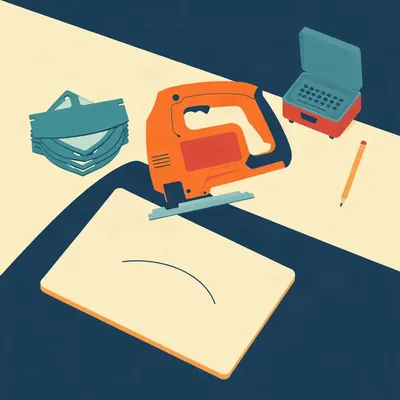
The curved-cut tool. If the circular saw does straight lines, the jigsaw does everything else — circles, arcs, cutouts for sinks, notches around pipes, scribing to an irregular wall.
Cordless has won here. It's a tool you carry to the workpiece, and the cuts are usually quick.
Voltage is the same platform conversation. Cost is roughly a hundred dollars for a decent cordless model. Safety is about the blade breaking — jigsaw blades are thin and brittle, and they snap if you force the cut or twist the saw mid-curve.
The capability is shape. It buys you the ability to cut a hole in the middle of a sheet, which neither a circular saw nor a miter saw can do without overcutting.
Number eight. Work light.
Now we're into the tools people forget to buy.
It's not glamorous, but a cordless work light on the same battery platform is the tool that makes every other tool usable. You're under a sink, the power's off, it's dark, and your phone flashlight is propped against a pipe. A proper work light with a magnetic base and a pivoting head changes the job.
Cordless, obviously. That's the entire point. It runs on the batteries you already own.
Cost is maybe forty to sixty dollars for a bare light. Safety is minimal — don't look directly at the LED, don't leave it against flammable material.
The capability is visibility. It's the cheapest multiplier on the list.
Number nine is where Daniel's framework gets tested, because we're now in deferrable territory.
Brad nailer.
And this is the sleeper safety story on the whole list. Nail guns send about thirty-seven thousand people to the emergency room every year, and forty percent of those are consumers, not tradespeople. Consumer injuries tripled between nineteen ninety-one and two thousand five.
Which says something about how the tool feels versus how it behaves. It feels like a staple gun. It fires a two-inch nail through wood.
The key safety point is the trigger type. Contact-trip triggers fire every time the nose touches the work while the trigger is held. Sequential-trip triggers require a deliberate sequence — nose down, then trigger. The CDC estimates sixty-five to sixty-nine percent of contact-trip injuries could be prevented with a sequential trigger.
So if you're buying one, buy the sequential trigger version and don't let anyone talk you into the bump-fire trigger for speed. You're not framing a house. You're installing baseboard.
Cordless is the right call for a homeowner. A Ridgid eighteen volt eighteen gauge nailer runs about a hundred and ninety-nine dollars. It's expensive for what it does, which is why it's number nine.
What it buys you is speed on trim work. Installing baseboard, crown molding, door casing — jobs where you're driving dozens or hundreds of brad nails. If you're doing one room, a hammer and nail set works. If you're doing a whole house, the nailer earns its keep.
Number ten. And this is where the list gets optional.
I'm going to say shop vacuum.
That's a defensible tenth. It's not a cutting or fastening tool, but it's the tool that keeps the others from destroying your house. Drywall dust, sawdust, the mess from the reciprocating saw demolition job — a shop vac is the cleanup infrastructure.
Corded. It runs for long periods, it's stationary while you work, and the cord is not a problem.
A Craftsman two and a half gallon runs about fifty-one dollars. Safety is mostly about not vacuuming up anything flammable or hot. The capability is containment. It's the difference between a project that ends with an hour of sweeping and one that ends when the tool stops.
So that's the list. Drill driver, impact driver, circular saw, reciprocating saw, oscillating multi-tool, random orbit sander, jigsaw, work light, brad nailer, shop vac.
And the thing I want to land is that the list is really a battery platform decision in disguise. The first purchase commits you. Every subsequent bare tool is twenty-five percent cheaper because you already own the batteries.
Consumer Reports put that number on it. Buying bare from a platform you own saves about a quarter.
And the platform question is more durable than the tool question. The drill will wear out. The batteries will age — they last three hundred to five hundred cycles, roughly two to three years. But the connector stays. Ryobi's been on the same connector for thirty years. Milwaukee since two thousand eight. DeWalt since twenty eleven.
Which is why the MakeUseOf piece framing it as "they're not selling you tools, they're selling you batteries" is exactly right. The drill in the starter kit is the gateway. The battery is the product.
And that's not a criticism. It's the reason the system works. You buy once, you commit once, and then every tool after that is cheaper and simpler.
The other thing worth saying is what's not on the list. Table saw. Miter saw. Router. Angle grinder.
Table saw is a shop tool. It needs floor space, dust management, and technique. A circular saw with a clamped straightedge does the same cut for ninety percent of homeowners. Miter saw is wonderful for trim work, but it's a three hundred dollar-plus tool that earns its keep only when you're doing a lot of angled cuts.
Angle grinder is the one people buy for a single job — sharpening a mower blade, cutting a bolt — and then it sits for three years.
The DIY Tool Review's order is "fasten first, cut second, finish last." Most people never need more than the first two or three tools. The rest of the list is for when the projects multiply.
And the injury data says the tools people defer are also the tools that hurt people. Stationary saws — table saws, miter saws — send about fifty-two thousand people to the ER every year. Table saws alone are thirty-eight thousand of those. Eighty-three percent of the injuries are to fingers.
The average victim is fifty-one years old, ninety-five percent male. These are experienced people who got comfortable.
Which is the trap with cordless tools generally. They feel domestic in a way corded tools don't. A corded circular saw announces itself. A cordless one feels like a kitchen appliance until it isn't.
The guard was damaged or removed in a third of the stationary saw injuries. That's the single most preventable thing on the list. Leave the guard alone.
And on the cordless side, the OSHA guidance is to remove the battery when changing blades or bits, not just trust the trigger lock. A trigger lock is a convenience. A removed battery is a guarantee.
Daniel's framework also forces the corded-versus-cordless question on every tool, and the honest answer is that cordless has won the middle but not the extremes. Anything you carry is cordless. Anything bolted to a bench is corded. The two arguable rows are the circular saw and the sander.
Circular saw because it's high-drain but used in bursts. Sander because it's low-drain but used for long runs. Everything else is settled.
The extension cord point matters for the corded holdouts. Match the wire gauge to the amp draw. Sixteen gauge is fine for light loads up to about thirteen amps at twenty-five to fifty feet. Twelve or ten gauge for the big stuff. Never run a cord through a wall or a doorway.
And a hot cord is a damaged cord. Stop using it.
The pricing across the list is also worth a summary. The drill and impact driver together can be had for under two hundred dollars if you buy a kit. The circular saw is sixty to a hundred and thirty depending on corded versus cordless. Reciprocating saw around a hundred and twenty. Multi-tool around a hundred. Sander eighty. Jigsaw a hundred. Light fifty. Nailer two hundred. Shop vac fifty.
So the whole list, if you're disciplined and stay on one platform, is somewhere around eight hundred to a thousand dollars spread over time. That's a real investment.
And the order matters because each tool unlocks the next set of projects. The drill lets you mount things. The impact driver lets you build things. The circular saw lets you cut sheet goods. The reciprocating saw lets you demolish. The multi-tool lets you do finish work. The sander lets you refinish. The jigsaw lets you do curves. The light lets you see all of it.
The nailer and the shop vac are the tools you buy when you realize you're doing this every weekend.
Hilbert: You said the circular saw corded Skil is fifty-nine dollars. It's sixty-two at the depot this week.
Sixty-two.
Hilbert: The seven and a quarter inch. Fifteen amp. They had it on an end cap.
That's still the cheapest tool on the list that cuts wood.
Hilbert: The thing about the list is nobody buys it in order. They buy the drill because the drill is on sale. Then they buy the circular saw because they need to cut something. Then they buy the sander because the wife wants the table refinished. The order is what you'd do if you were starting from nothing with a budget and a plan. Nobody starts from nothing with a budget and a plan.
That's the difference between a purchasing sequence and a purchasing reality.
Hilbert: I had a miter saw for eleven years before I owned an impact driver. The miter saw was a hundred and forty dollars at a lumberyard going out of business. The impact driver was a gift. So my order was wrong, and it didn't matter, because the jobs came in whatever order the house decided.
That's actually the strongest argument for the platform commitment. If you buy the drill first and commit to the battery, then whatever order the house imposes on you, you're buying bare tools at a discount.
Hilbert: The battery thing is real. I had a Ryobi drill from the nineties. The original battery died, I threw the drill in a box, forgot about it. Found it during a move, bought a new battery at Home Depot for forty dollars, and it ran. That drill is older than my nephew.
The connector is the product.
Hilbert: The connector is the product. The drill is just the thing that convinces you to buy the first battery.
And that's why the "which platform" question matters more than "which drill." The drill is a commodity. The platform is a thirty-year relationship.
Hilbert: I bought the Ryobi because it was on sale. I stayed with Ryobi because the batteries kept fitting. I've never once thought about whether the drill was the best drill. It's a drill. It drills.
That's the homeowner's entire decision process in three sentences.
Hilbert: The nail gun is the one I'd skip. I installed trim in two rooms with a hammer and a nail set. Took a weekend. The nailer would have saved me maybe four hours, and it costs two hundred dollars. That's fifty dollars an hour to save time on a job I wasn't getting paid for.
That's the deferrable logic in a nutshell. The nailer earns its keep when you're doing trim by the hundred feet. For one room, it's a luxury.
Hilbert: And the injury numbers on those things. My brother-in-law put a brad nail through his thumb installing baseboard. Contact trigger. Bumped the nose while he was holding the piece, and the thing fired. He said it felt like someone hit his thumb with a hammer, then he looked down and there was a nail sticking out of it.
Sequential trigger would have prevented that.
Hilbert: That's what the doctor said. He'd seen it before.
The CDC data says sixty-five to sixty-nine percent of those contact-trip injuries are preventable with the sequential trigger. Your brother-in-law is the statistic.
Hilbert: He's fine. The nail missed the bone. He finished the baseboard the next weekend with a hammer.
Of course he did.
Hilbert: The sander is the one I'd buy corded no matter what. I sanded a deck once with a cordless sander and went through three batteries. The fourth battery was on the charger, and I sat there for forty minutes waiting. Bought a corded one the next day for sixty dollars. Still have it.
That's exactly the long-run versus burst-use distinction. The sander is the one tool on the list where runtime beats portability.
Hilbert: The corded one is also lighter. No battery hanging off the back. You're sanding for hours, the weight matters.
That's a point the cordless marketing never mentions. Batteries are heavy.
Hilbert: Everything's a trade. The cordless drill changed my life. The cordless sander wasted an afternoon. Same battery, same platform, different tool, different answer.
And that's why Daniel's framework is worth doing. It forces the question on every tool instead of defaulting to "cordless everything."
Hilbert: The work light is the one people skip and then borrow. I've lent my work light to three neighbors. They all said the same thing — I didn't think I needed it until I was under the sink with my phone in my mouth.
The cheapest tool on the list and the one nobody buys.
Hilbert: Forty dollars. Magnetic base. Done.
So the list holds up even when the purchasing order is a fiction. The ranking is about essentialness, not chronology.
And the platform insight survives contact with reality. Buy the drill, commit to the battery, and let the house dictate the rest.
The one open question I'd leave listeners with is the circular saw. It's the tool where the corded-versus-cordless debate is alive, and the answer depends on whether your projects happen near an outlet or in the driveway.
That's the one to think hard about before you spend. The rest of the list is settled.
Thanks to our producer, Hilbert Flumingtop.
This has been My Weird Prompts.
If you want more episodes like this one, find us at my weird prompts dot com, or email us at show at my weird prompts dot com.
We'll be back soon.