Daniel's asking us to look at a vegetable that everyone's grandmother insisted was good for them, and that almost nobody got excited about — the Brussels sprout. He wants to know why it's been so overlooked, how closely related it is to cabbage, what the health benefits actually are, whether it can ever escape kale's cultural shadow, and how to cook it with some imagination.

And the weird thing is, the Brussels sprout we're talking about today is not the same vegetable your grandmother was forcing on you.
That's the hook. The thing has literally changed its chemical composition in the last thirty years. Most people's opinion of it is frozen in time from a version that no longer exists.
Which is rare, right? How many foods can you say that about — where the ingredient itself was redesigned while the cultural reputation stayed stuck?
Not many. So today we're giving this overlooked bud its day in the sun, and the story is stranger than you'd think.
The Brussels sprout occupies this bizarre cultural space. It's the vegetable equivalent of a fruitcake — universally recommended by grandmothers, historically the most mocked item on the dinner plate. Kids in cartoons would hide them in napkins. They were the punchline.
And yet something has shifted. Sweetgreen just launched this campaign — literally yesterday, September second — called "Fall's Best Dressed." They've got actors Jack Falahee and Maia Reficco doing a fashion-editorial spread, and the star of the campaign is maple-glazed Brussels sprouts.
They called it a "fall style icon." A Brussels sprout. As a style icon.
The chain has sold over one point four million Autumn Harvest Bowls across the last two seasons. That's their highest-volume limited-time offering ever.
And it's not just an American thing. In Australia, Brussels sprouts were the fastest-growing vegetable category in the twenty-two twenty-three season — a fifty-three percent sales surge. Hort Innovation, which tracks this stuff, called it "the comeback story of the vegetable aisle."
Fifty-three percent. For a vegetable people spent decades mocking.
So the tension is right there. This is a vegetable that was hated, and now it's having a moment, and most people don't realize the vegetable itself changed. The bitterness got bred out of it.
Let's start with the most mind-bending fact about this vegetable — one that completely rewires how you think about the produce aisle.
Brussels sprouts, cabbage, kale, broccoli, cauliflower, collard greens, kohlrabi, and gai lan are all the same biological species.
Wait.
Same species. Brassica oleracea. Eighteen chromosomes across every single one of them.
So the difference between a cabbage and a broccoli is... what, exactly?
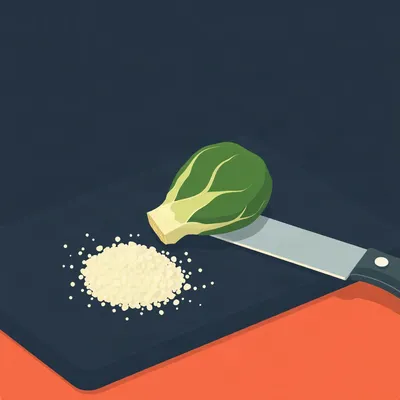
Which part of the plant humans decided to select for. That's it. One wild plant from the Eastern Mediterranean, and over centuries of artificial selection, we shaped it into radically different vegetables by favoring different bits. Leaves gave us kale and collard greens. The terminal bud — that tight ball of leaves at the top — gave us cabbage. The axillary buds, the little ones that form along the stem, gave us Brussels sprouts. The flowers gave us broccoli and cauliflower. The stem gave us kohlrabi.
So a Brussels sprout is literally a tiny cabbage growing on a stick. It's not a metaphor. It's the same plant, different part.
Exactly the same species, different cultivar. Brassica oleracea variety gemmifera for Brussels sprouts. This is one of the most dramatic examples of artificial selection in all of agriculture. A single wild plant turned into an entire produce aisle.
That's wild. And it makes the cultural hierarchy even weirder — kale gets to be the superstar, broccoli's the reliable workhorse, and the Brussels sprout is the unloved cousin, and they're all the same thing.
Which brings us to why the Brussels sprout specifically got such a bad reputation. And it's not one reason — it's three, and they compound each other.
Hit me.
Reason one is genetics, and this is the one I find fascinating. There's a gene on chromosome seven called TAS2R38. It encodes a taste receptor that's sensitive to compounds called glucosinolates — specifically sinigrin and progoitrin — which are abundant in Brussels sprouts and other cruciferous vegetables.
And some people taste those more than others.
About twenty-five percent of the population inherits two copies of what's called the PAV variant. These people are "supertasters." When they eat Brussels sprouts, they perceive a level of bitterness that one researcher at the University of Kentucky described as "a ruin-your-day level of bitter."
Ruin-your-day. That's not "I don't prefer this." That's a physiological reaction.
Right. And at the other end, people with two copies of the AVI variant barely notice the bitterness at all. The rest of us are somewhere in the middle with one of each. A twenty-nineteen study of a hundred and seventy-five people found that supertasters were two and a half times more likely to be among the lowest vegetable consumers overall.
So a quarter of the population is wired to hate this vegetable, and it's not a preference thing — their tongue is literally sending a different signal to their brain than mine is.
And that raises a uncomfortable question about food snobbery. When someone says they don't like Brussels sprouts, the standard response is some version of "you just haven't had them prepared properly." But for twenty-five percent of people, even perfectly roasted sprouts with bacon and maple glaze are going to taste intensely bitter. Is it fair to judge someone for that?
No. It's like judging someone for not being able to roll their tongue. It's biology.
And the thing is, the bitterness compounds — glucosinolates — those are the same compounds that give Brussels sprouts a lot of their health benefits. So you've got this weird trade-off built right into the plant. The thing that makes it good for you is the thing that makes a quarter of the population recoil.
Reason two?
Historical overcooking. For decades, the standard preparation was boiling. Dietitian Jemma O'Hanlon put it bluntly: "A lot of us grew up with over-boiled Brussels sprouts that looked grey and really unappetizing on the plate."
Grey vegetables. That's a culinary crime scene.
Boiling does two terrible things to a Brussels sprout. First, it breaks down the glucosinolates and releases hydrogen sulfide — that's the sulfurous smell people associate with overcooked cruciferous vegetables. Second, it leaches out the water-soluble vitamins, especially vitamin C. So you're left with something that smells bad, looks grey, and has lost a chunk of its nutritional value. It's the worst of all worlds.
My grandmother boiled everything. Carrots, peas, sprouts. The water came out green and the vegetables came out beige.
And that experience imprinted on a whole generation. If your formative Brussels sprout memory is a grey, sulfurous, mushy sphere on a plate next to an equally overcooked piece of meat, you're not going to seek them out as an adult.
Unless something changes. And that's reason three.
The Dutch breeding revolution of the nineteen nineties. Dutch scientists identified that sinigrin and progoitrin specifically were responsible for the bitter taste, and they started selectively breeding new varieties with significantly lower levels of those compounds.
So they just... removed the bitterness.
Not entirely, but dramatically. The vast majority of Brussels sprouts grown today are considerably less bitter than the ones millennials and older generations ate as kids. The vegetable literally changed. Paste Magazine put it well: "These days, Brussels sprouts actually taste much different than they once did."
So when someone my age says "I hated Brussels sprouts as a kid, but now I like them," it's not just that their palate matured. The food is different.
Both things are true. Palates do change — as we age, our sense of taste tends to dull, and we can train ourselves to like foods that are good for us. Alisa Lehman, a senior product scientist at twenty-three and Me, made that point explicitly. But on top of that, the Brussels sprout of twenty twenty-six is a less bitter vegetable than the Brussels sprout of nineteen eighty-six.
That's a rare case where "you just haven't tried them prepared properly" is backed by both agricultural science and culinary technique. The ingredient improved and the cooking methods improved at the same time.
And the cooking method that made the difference is roasting. High heat — four hundred to four hundred fifty degrees Fahrenheit — caramelizes the natural sugars in the sprout. You get a nutty, sweet flavor and a crispy exterior instead of a sulfurous mush. That's what drove the restaurant renaissance.
So we've established that the Brussels sprout has been unfairly maligned for reasons both genetic and culinary. But what about the other side of the ledger — what does it actually do for you?
This is where it gets embarrassing for kale.
Oh, I'm listening.
Raw Brussels sprouts contain eighty-five milligrams of vitamin C per hundred grams. Kale has forty-one. That's more than double.
So one serving of Brussels sprouts basically covers your vitamin C for the day.
Nearly a hundred percent of the daily recommended intake, yeah. Fiber: three point eight grams per hundred grams versus kale's two grams. Folate: sixty-one micrograms versus thirteen — nearly five times as much.
Five times?
Five times the folate. That's important for cell division, for pregnancy, for red blood cell formation. Protein: three point three eight grams versus one point nine. Iron: one point four milligrams versus zero point nine. Potassium: three hundred eighty-nine milligrams versus two hundred twenty-eight.
So Brussels sprouts are winning on vitamin C, fiber, folate, protein, iron, and potassium. What's kale got?
Vitamin K and vitamin A. Kale dominates on those — eight hundred seventeen micrograms of vitamin K versus a hundred seventy-seven, and six hundred eighty-one micrograms of vitamin A versus thirty-eight. Those are significant. Vitamin K is critical for blood clotting and bone health. But the idea that kale is nutritionally superior across the board is just wrong.
They're complementary, not competitive.
And the compounds that make them both so interesting from a health perspective are the glucosinolates — the same ones that cause the bitterness problem. When you chew a Brussels sprout, you break down glucoraphanin into sulforaphane, and sulforaphane is the subject of extensive research.
What kind of research?
A twenty twenty-five review in the journal Molecules highlighted that sulforaphane exhibits antioxidant, anticancer, antimicrobial, anti-inflammatory, anti-obesity, and antidiabetic effects. A twenty twenty-four study in Redox Biology found that glucoraphanin and sulforaphane mitigate gut inflammation and help maintain the intestinal barrier. And a twenty twenty-five paper in the Journal of the Science of Food and Agriculture reviewed Brassica oleracea as what they called a "functional crop" with protective effects against metabolic diseases including diabetes, stroke, myocardial infarction, and cancer.
So the bitterness compounds are the medicine.
That's the trade-off. And there's been a long-standing concern that these same compounds might interfere with thyroid function — that they're goitrogenic. But a twenty twenty-four systematic review in the International Journal of Molecular Sciences looked at a hundred and twenty-three articles and concluded that the vast majority of results cast doubt on the assumption that brassica plants have antithyroid effects in humans, provided iodine intake is adequate.
So that worry is largely overblown.
It seems to be, yes. As long as you're getting enough iodine, the thyroid concern doesn't hold up to scrutiny.
Okay, so the nutritional case is strong. Now the practical question Daniel asked — how do you actually cook these things with some imagination?
Roasting is the gateway. Four hundred to four hundred fifty degrees, halved or quartered, tossed with oil and salt, cut side down on the pan. The natural sugars caramelize, the edges get crispy, and you get something nutty and sweet instead of sulfurous and soft.
That's the method that changed the restaurant game.
And from there you can go in so many directions. Shaved raw in salads — thin ribbons of Brussels sprout with fennel, apple, and a honey mustard dressing. That's a completely different experience from a cooked sprout. It's fresh and crunchy and bright.
What about Sweetgreen's approach?
Maple-glazed with crumbled bacon and charred jalapeño ranch. Sweet, salty, smoky, spicy — all four corners covered. That's the Autumn Harvest Bowl that's sold over a million units.
A million bowls of Brussels sprouts. That sentence would have been absurd fifteen years ago.
There's a global angle too. Gochujang-miso sauce is incredible on roasted sprouts. Balsamic glaze with pancetta. You can crisp-fry them with parmesan. There's even a recipe for Brussels sprout baba ghanoush — you char them and blend them like eggplant. And in Australia, Hort Innovation developed chocolate-covered sprouts as a way to introduce the vegetable to children.
Chocolate-covered Brussels sprouts.
I'm not saying it's for everyone. But the point is, the range is enormous. This is not a vegetable that needs to be boiled into submission.
Which brings us to Daniel's last question — can the Brussels sprout ever step out of kale's shadow?
Nutritionally, it already has in several key categories. But culturally, the gap is narrowing, not closed. Kale had its moment — the smoothie bowls, the kale chip craze, the "eat more kale" bumper stickers. Brussels sprouts haven't reached that level of saturation. The Sweetgreen campaign is arguably the closest they've come to pop-cultural treatment.
A fashion campaign for a vegetable. That's a signal.
It is. And then there's the Kalettes hybrid, which is maybe the most interesting resolution to the whole kale-versus-sprout framing.
Kalettes?
A literal hybrid of kale and Brussels sprouts. Created by Tozer Seeds in the UK — they started in nineteen ninety-five, took fifteen years to develop, introduced to the US in fall twenty fourteen. They cook faster than Brussels sprouts, about ten minutes at four seventy-five, and they've got a sweeter, nuttier flavor. Available at select retailers like Kroger and H-E-B.
So breeders literally fused the two plants.
They did. It's a third path — neither kale nor sprout but something new. And in a way it makes the whole "which is better" debate obsolete. Why choose when you can have both in one plant?
That's the ultimate symbol of the convergence. The vegetable that was the punchline and the vegetable that was the superstar, blended into something that captures the best of both.
Still hard to find in most grocery stores, which is the tension between agricultural innovation and retail distribution. The thing exists, it's been around for over a decade, but most people have never seen one.
Which brings us to a perspective that neither the science papers nor the marketing campaigns can give you.

You're right about the bitterness.
Hilbert.
Worked two summers on a vegetable farm upstate New York, late nineties. Grew Brussels sprouts for a regional processor. I was the guy pulling them off the stalks by hand.
What was that like?
Cold. Your fingers go numb by about nine in the morning. But you get fast at it. The stalks are about three feet tall, and the sprouts spiral up them — you strip them bottom to top. A good picker can do about eighty pounds an hour.
This was when the Dutch low-bitterness varieties were coming in.
Yeah. The older farmers hated them. Said they didn't taste like real sprouts. They'd been growing the same variety since the sixties — bitter as anything, but that was the point to them. The bitterness was the character of the vegetable. They thought the new ones were bland.
The generational divide wasn't just among eaters. It was among growers too.
Same argument, different side of the plate. The younger guys liked the new varieties because they could actually sell them to people who weren't sixty years old. The old guys thought they were selling out.
Did the farm switch over eventually?
Had to. The processor wouldn't take the old varieties anymore. Market moved on. But I remember one of the old guys — Frank — he kept a row of the bitter ones for himself. Said he liked the taste. Probably a supertaster who'd just gotten used to it.
That's the detail that gets me — someone who tastes the ruin-your-day bitterness and prefers it.
People get attached to what they know. Frank would say the new sprouts tasted like "green nothing." He wasn't wrong, exactly — the bitterness was the defining feature, and they removed it. The vegetable got friendlier and lost some of what made it distinct.
There's a parallel to what happened with grapefruit, actually — the breeding programs that reduced bitterness in citrus. You gain mass appeal, you lose some character.
The other thing nobody mentions is the stalks.
The stalks?
The stalks the sprouts grow on. They're edible. Taste like a cross between a broccoli stem and a cabbage core — kind of sweet, kind of fibrous. We used to sell them to a local brewery that made a Brussels sprout stalk beer.
A what?
It was exactly as bad as it sounds. But people bought it because it was weird. Limited run every fall, sold out in a week. The brewer called it "Stalk Ale." Had a picture of a sad-looking sprout on the label.
Of course he did.
The stalks are actually good if you peel them and slice them thin. Stir-fry with garlic and soy sauce. Better than the beer, anyway.
I'm going to have to try that.
Most people throw the stalks away. It's probably forty percent of the plant by weight. There's a Tasmanian grower — Caitlin Radford — who's been saying the same thing, that there's enormous potential in what we typically consider waste. She's right.
The farm story adds another layer. The vegetable changed, the people who grew it resisted the change, and the part nobody eats might be the most interesting bit.
That's about the size of it.
Where does that leave us? Can a vegetable that a quarter of the population is wired to hate ever really have its moment?
I think the answer is that it already is having its moment, but it's a moment with a ceiling. Twenty-five percent of people are genetically predisposed to find it intensely bitter. No amount of roasting or maple glaze or fashion campaigns is going to change what their taste receptors do. So the Brussels sprout's destiny might be to be a beloved niche — deeply appreciated by the seventy-five percent, tolerated or avoided by the rest.
The Kalettes hybrid suggests a third path — breed the problem away entirely. But that raises its own question. At what point does a vegetable stop being itself? If you remove the bitterness, the compound that made it distinctive and also made it healthy, what are you left with?
Frank's "green nothing."
Right. There's a genuine tension between palatability and identity. The Dutch breeding program made Brussels sprouts accessible to millions of people who would have hated the older varieties. That's a win. But the older varieties had something the new ones don't, and some people — like Frank — noticed the loss.
The Brussels sprout's comeback is real, but it's a comeback built on three things that all had to align. Science — the genetics and the breeding program that reduced bitterness. Technique — roasting instead of boiling, which unlocked flavors that were always there but hidden. And marketing — Sweetgreen putting a vegetable on a fashion pedestal, which would have been unthinkable a generation ago.
It's a rare case where a food's redemption arc is multidimensional. Most food comebacks are just marketing. This one required the plant itself to change.
Thank you to our producer Hilbert Flumingtop.
This has been My Weird Prompts.
If you enjoyed this episode, tell someone about the show — especially someone who thinks they hate Brussels sprouts. They might be wrong about the version they're remembering.
Email us at show at my weird prompts dot com. We'll be back soon.