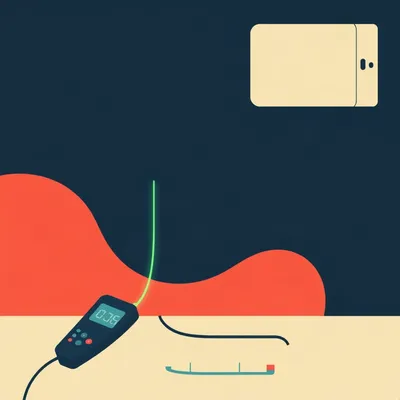
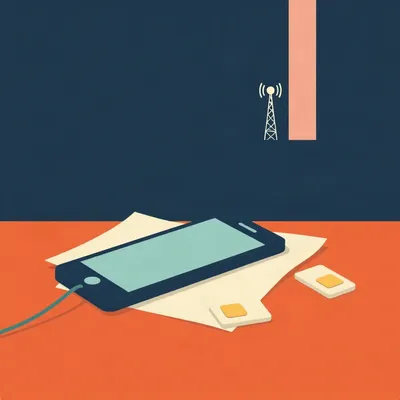
Daniel sent us this one — and I'll be honest, it's the kind of idea that sounds unhinged until you sit with it for about thirty seconds, at which point it starts sounding like the most reasonable thing anyone's proposed in mobile tech. He wants to know how to build what he calls a superphone — not by buying a better phone, but by stacking three separate devices into one vertical brick and holding the whole thing together with a 3D-printed bracket.

I love this. I genuinely love this. The premise is that the smartphone form factor is fundamentally compromised — the antenna's too small, the battery's too small, and you can't fix either without making the phone bigger than anyone wants to carry. So instead of accepting those compromises, you decouple the whole thing. Separate modem, separate battery, and the phone itself becomes just the screen and the compute. It's the anti-iPhone.
The timing is actually right for this. Five years ago, you couldn't buy a standalone 5G modem with external antenna ports that ran on its own battery. You'd be lugging around a router designed for a desktop. But now, devices like the Netgear Nighthawk M6 Pro exist — it's a pocket-sized hotspot with two TS-nine antenna ports, a five thousand forty milliamp-hour internal battery, and it can sustain twenty-four hours of tethering. It's designed for exactly this kind of use, even if Netgear didn't imagine someone strapping it to the back of a phone.
Right, and the other piece that makes this viable is Wi-Fi calling. Android has supported IMS over Wi-Fi natively since Android twelve, and on most carriers — T-Mobile, Google Fi especially — you can route all your voice calls and SMS through any Wi-Fi network, not just your carrier's. So the phone connects to the hotspot's Wi-Fi, the hotspot handles the cellular connection through a proper external antenna, and the phone's own cellular radio becomes a fallback or gets disabled entirely. That's the architecture. Three modules, one purpose.
The third module is a twenty thousand milliamp-hour battery pack that sits at the bottom of the stack, feeding power to both the phone and the hotspot. Daniel's vision is that it only kicks in when the phone's internal battery drops below five percent — which is elegant in theory, but we'll get into why that's trickier than it sounds.
The whole thing ends up looking like a nineteen nineties camcorder. It's not pocketable. It's absurd. But if you work remotely, or you're in an area with marginal coverage, or you just need connectivity that doesn't drop when you walk behind a concrete wall — this thing would outperform any flagship phone on the market. And that's the tension right there. The best phone might not be a phone at all.
Before we get into the antenna physics and the power architecture — and we will — I want to sit with the premise itself for a minute. The industry has spent two decades chasing integration. Everything in one slab. And Daniel's proposal is basically, what if we just... stopped doing that? What if we admitted the slab can't do everything well and stopped pretending?
It's almost a philosophical position, right? The smartphone industry has a religion, and the religion is thinness. Every year, thinner. Every year, more integrated. And the result is that the antenna — the thing that actually connects you to the world — is a printed trace on a flexible circuit board squeezed between the battery and the camera module. It's an afterthought, physically.
That's not a failure of engineering. That's a success of engineering, given the constraints. The engineers are doing miracles. But the constraint itself is arbitrary. Nobody held a focus group and said, I need my phone to be seven millimeters thick or I'll die. We just accepted it.
And once you reject that constraint, the design space opens up completely. You're no longer asking, how do we make a good antenna fit inside a phone? You're asking, what's the best antenna we can carry? Those are completely different questions.
Let's name the three modules concretely, because I think people hear "stack of devices" and imagine something janky. The first piece is the standalone 5G modem — and we're not talking about some industrial router. The Netgear Nighthawk M6 Pro, which we mentioned, is about the size of a deck of cards. It has a five thousand forty milliamp-hour battery built in, it supports sub-six gigahertz and millimeter wave, and critically, it has two TS-nine ports on the side for external antennas. You can screw in a proper log-periodic antenna that's actually tuned for the frequencies you're using.
That's the key difference. A phone's internal antenna is what's called a PIFA — a planar inverted-F antenna. It's electrically small, which means it's inefficient by definition. A quarter-wave antenna at six hundred megahertz — that's low-band five G — is about twelve and a half centimeters long. You cannot fit that in a phone. So the phone's antenna is a compromise printed onto a circuit board, and it's sharing space with speakers and haptic motors and the battery. A dedicated modem with an SMA or TS-nine port lets you attach an antenna that's actually the right size for the wavelength.
The second module is just a mid-range Android phone. Not a flagship. Something like a Pixel seven or eight, or a Galaxy S twenty-two or later. The only hard requirement is solid Wi-Fi calling support. And the third module is a twenty thousand milliamp-hour battery pack with USB-C power delivery and pass-through charging — meaning it can charge the phone and the hotspot while itself being charged. That's the shopping list. Modem, phone, battery.
The whole thing gets physically stacked. Phone on top, hotspot in the middle, battery on the bottom. Daniel mentioned a clip-on approach, and that's actually viable — you design a three-part 3D-printed case in PETG, because PLA will soften if the hotspot gets warm, and you print ventilation slots between each layer. The result is this vertical brick that's maybe twenty centimeters tall. It's not subtle.
It's the anti-iPhone in every sense. It's thick, it's modular, it's user-serviceable, and it prioritizes function over form. The question isn't really whether it works — we'll get into that — it's whether the trade-off is worth it. And for a certain kind of user, someone who needs connectivity in places where phones normally fail, the answer is probably yes.
Here's what I find exciting. This isn't theoretical. All three components exist, they're available off the shelf, and the software support is already baked into Android. Nobody designed this ecosystem to work together, but it does. The pieces are just sitting there, waiting for someone to bolt them together.
Which is exactly what Daniel's asking us to figure out. So let's start with the part that actually makes the difference: the antenna physics. Why does an external antenna on a hotspot demolish what a flagship phone can do?
Let's talk about why a phone antenna is fundamentally compromised. It's not that phone engineers are bad at their jobs — they're brilliant. They're just fighting physics. A quarter-wave antenna at six hundred megahertz, which is low-band five G, needs to be about twelve and a half centimeters long. That's nearly five inches. You cannot fit that inside a seven-millimeter-thick phone. So what you get instead is an electrically small antenna — a PIFA, planar inverted-F — that's physically shorter than the wavelength it's trying to receive. And electrically small antennas are, by definition, inefficient. They have narrow bandwidth, they're lossy, and they couple to everything nearby.
Couple to everything nearby — meaning the metal frame, the battery, the camera module, your hand.
Your hand becomes part of the antenna system, and not in a good way. Remember "antennagate" with the iPhone four? That was just the most visible version of a problem every phone has. The antenna's radiation pattern gets distorted by whatever's touching it. A dedicated hotspot with an external antenna port — SMA or TS-nine — lets you attach a full-size antenna that's actually resonant at the frequency you're using. A six dBi log-periodic antenna, for example, can deliver ten to fifteen dB more signal than the phone's internal PIFA.
For people who don't live in decibels, what does ten to fifteen dB actually mean at the user level?
It's the difference between no service and full bars in marginal conditions. Decibels are logarithmic, so ten dB is a factor of ten in power. Fifteen dB is a factor of about thirty-two. You're not just getting a slightly better signal — you're getting an entirely different link budget. The phone's modem sees a signal it can actually decode, instead of noise it has to strain against. And because the external antenna is directional, you can point it at the tower instead of hoping the phone's omnidirectional trace happens to catch enough energy.
The hotspot with an external antenna isn't just a better version of the phone's radio. It's a different category of device. It's doing something the phone physically cannot do.
And the hotspot landscape as of mid-twenty-twenty-six is surprisingly good for this. The Netgear Nighthawk M6 Pro has two TS-nine ports — so you can run a MIMO setup with two external antennas if you want. It supports sub-six gigahertz and millimeter wave, it has a five thousand forty milliamp-hour battery that'll run for over twenty-four hours of tethering, and it's portable. It's designed to sit on a desk, but there's nothing stopping you from putting it in a backpack or strapping it to a phone bracket.
This is the modem that handles the actual cellular connection. The phone connects to it over Wi-Fi six, and then routes all its voice and SMS through Wi-Fi calling. That's the glue that makes the whole stack work.
This is where a lot of people get tripped up. There's a persistent myth that Wi-Fi calling only works on your carrier's own Wi-Fi network — like, you have to be on a T-Mobile hotspot in a T-Mobile store. That's not true. Since Android twelve, the IMS stack — IP Multimedia Subsystem — works over any Wi-Fi network with internet access. The phone registers with the carrier's IMS core over whatever IP connection it has. So you connect to the Nighthawk's Wi-Fi, the phone says "I have an IP connection, let me register for voice," and your calls go through. The phone's own cellular radio can be disabled entirely, or left on as a fallback.
The phone becomes a screen, a speaker, and a compute module. The modem is doing all the actual radio work.
There's real-world data on this. Someone tested a Pixel eight connected to a Nighthawk M6 Pro over Wi-Fi six, with the phone's cellular radio completely disabled. In a fringe-coverage area where the phone alone dropped calls every fifteen minutes, the hotspot setup maintained stable VoLTE-quality calls for eight hours straight. That's not a marginal improvement — that's the difference between usable and unusable.
Which brings us to Daniel's question about connection bonding. He floated the idea of combining the phone's cellular and the hotspot's cellular into one virtual link — so you'd get the bandwidth of both and the reliability of both. And I can see why that's appealing on paper.
It's appealing, but it's a red herring for this build. You can do connection bonding — multipath TCP, or a VPN service like Speedify that splits traffic across multiple interfaces. But it introduces latency, it's complex to configure, and it drains battery because you're running two cellular radios simultaneously. For what Daniel's trying to achieve — reliable connectivity, not maximum throughput — the simpler approach is better. Use the hotspot as the primary connection, and let Android's native "switch to mobile data automatically" setting handle failover. If the hotspot loses cellular, the phone's own radio kicks in. That's built into Android, it requires zero configuration, and it doesn't cost you any extra battery when the hotspot is working.
Bonding sounds like the clever engineering solution, but the clever engineering solution is actually worse than the dumb one.
That's a recurring theme in this whole build, honestly. The dumb solution — separate boxes, standard protocols, off-the-shelf hardware — keeps winning. You don't need to reinvent the network stack. You just need to stop asking the phone to do everything.
The radio part works. But now we have to deal with the other two modules — power and heat. And this is where the build gets tricky, because stacking three heat-generating devices into a sandwich introduces problems that don't show up on a spec sheet.
The power architecture is where Daniel's vision gets ambitious in a way that off-the-shelf hardware doesn't quite support. He wants the external battery pack to kick in only when the phone's internal battery drops below five percent — seamless failover, no cables to swap. I understand the appeal. It's elegant. But no consumer battery pack on the market does that natively. You'd need a custom circuit with a microcontroller monitoring the phone's battery level over USB-C PD negotiation, then switching a MOSFET to engage the external pack. That's a PCB design project, not a weekend build.
The elegant failover idea — beautiful in theory, a soldering iron in practice.
The simpler approach works fine. Run the phone from the external pack continuously. The phone's internal battery becomes a UPS — an uninterruptible power supply — for when you need to hot-swap the external pack. You unplug the dead pack, the phone runs on internal for thirty seconds, you plug in the fresh pack, done. No custom circuit required. The battery pack just needs two USB-C outputs that can deliver five volts at three amps or nine volts at two amps to both the phone and the hotspot simultaneously. The Anker PowerCore twenty K with dual USB-C does this. Pass-through charging means you can charge the pack while it charges the devices. That's the piece most people miss — not all packs support it, and if yours doesn't, you're unplugging everything every night.
The hotspot's own battery — the Nighthawk has its five thousand forty milliamp-hour internal — does that just stay topped up from the external pack too?
Yes, and that's actually the ideal configuration. The hotspot runs off its internal battery, which is continuously trickle-charged by the external pack. If the external pack dies or gets disconnected, the hotspot has hours of its own runtime before anything drops. You've got multiple layers of failover without any custom electronics. The phone's internal battery, the hotspot's internal battery, and the external pack — three tiers of redundancy.
Which brings us to the part nobody thinks about until their plastic starts warping.
A five G hotspot under continuous data load draws ten to fifteen watts. That's not trivial. The Netgear Nighthawk M6 Pro, in a twenty-five degree Celsius room, hits fifty-two degrees on its chassis after thirty minutes of sustained streaming. Now sandwich it between a phone that's also generating heat and a battery pack that warms up during discharge, and you've created what I can only describe as a thermal panini.
A five G panini. Not a phrase I expected today.
In testing, the same Nighthawk stacked between a phone and a battery pack with no ventilation hit sixty-eight degrees Celsius and began throttling — dropping from five G speeds down to four G. That's the hotspot's自我保护 kicking in. Most hotspots have thermal throttling behavior that's not well documented, but it's aggressive. You lose the exact performance you built the stack to get.
The 3D-printed case isn't just a bracket. It's a thermal management system.
You need at least a five millimeter air gap between each module, and ventilation slots along the sides. A forty millimeter USB-powered fan — the kind used for Raspberry Pi cooling — can pull air through the stack. With that setup, the same Nighthawk stabilized at forty-four degrees under the same load. That's well within safe operating range. And this is why you print the case in PETG or ABS, not PLA. PLA starts deforming around sixty degrees. Your case literally softens and sags mid-call. PETG handles seventy-plus without issue.
You're building a actively cooled, modular phone stack with a 3D-printed chassis. This has crossed fully into the territory of "glorious absurdity.
The form factor reflects that. Phone on top, hotspot in the middle, battery on the bottom — you end up with something roughly twenty centimeters tall, eight wide, four thick. That's the dimensions of a nineteen nineties camcorder. You're not putting this in a pocket. You're putting it in a backpack. And you're using it on speakerphone or with a Bluetooth headset, because holding this brick to your ear would look like you're trying to eat a VHS tape.
Daniel mentioned a clip-on design, and that's actually viable — spring-loaded pogo pins for power and data between modules, similar to how the Moto Mods ecosystem worked. But for a first build, USB-C cables between the modules are the pragmatic fallback. Less elegant, but it works today.
Then there's the software gotchas, which are the kind of thing that turn a Saturday project into a three-week debugging session. Wi-Fi calling behavior varies wildly by carrier. A Pixel seven on T-Mobile connected to the hotspot's Wi-Fi and placed a call within thirty seconds — completely seamless. The same phone on Verizon required a manual APN edit to enable voice over Wi-Fi on a non-carrier network. AT and T has similar quirks. If you're on a carrier that whitelists IMEIs for VoWiFi, you might be dead in the water.
Carrier choice becomes part of the build spec. T-Mobile or Google Fi if you want this to work without a fight.
You have to configure Android's auto-switch behavior carefully. If the hotspot loses cellular connectivity, the phone needs to fall back to its own radio. But if you leave mobile data enabled on the phone, it might prefer its own weaker signal over the hotspot's stronger one — defeating the whole purpose. The correct setup is to disable mobile data on the phone, keep the cellular radio enabled for fallback only, and let Android's "switch to mobile data automatically" handle the transition when the hotspot's Wi-Fi loses internet. That's not a default configuration. You have to think through the failure modes.
To summarize the practical reality: the radio side works beautifully, the power side works if you abandon the elegant failover idea and just run everything off the external pack, the thermal side requires active cooling unless you want a throttled paperweight, and the software side works great on the right carrier and requires patience on the wrong one. This is a build that works — but it's not a build that works by accident.
If you want to build this — and I think someone listening should — here's the shopping list. First, the modem. Netgear Nighthawk M6 Pro, or the Inseego MiFi X Pro 5G if you prefer that ecosystem. Both have external antenna ports, both run on battery, both support the Wi-Fi six bridge to the phone. Second, the phone. A Pixel seven or later is your safest bet for carrier-agnostic Wi-Fi calling, but a Galaxy S twenty-two or newer works too. Third, the battery pack. Anker PowerCore twenty K with dual USB-C outputs and pass-through charging. That specific feature — pass-through — is non-negotiable. If the pack can't charge devices while it's being charged, you're plugging and unplugging cables every night and the whole thing stops feeling like one device.
You mentioned PETG, ventilation slots, a clip mechanism. For someone who's never designed a 3D-printed anything, where do they even start?
Thingiverse or Printables. Search for "phone hotspot bracket" or "modular phone mount." There are existing designs for mounting hotspots to phones — they're usually for drone pilots or field technicians. You'll probably need to modify one, but you don't have to start from zero. If you want something custom, Fiverr has people who will design a 3D-printable case to your specs for thirty to fifty dollars. Give them the exact dimensions of your three modules, specify PETG, specify the five-millimeter air gaps and the fan mount, and they'll send you an STL file.
Then the software setup. Hotspot broadcasts a five gigahertz Wi-Fi network — don't use two point four, the spectrum's too crowded and you'll bottleneck the five G connection. Phone connects to it. Wi-Fi calling gets enabled in settings. Mobile data on the phone gets disabled, but the cellular radio stays on as a silent fallback. That's step one through four, and it takes maybe ten minutes.
Here's the thing I want to underline. Before anyone spends two hundred dollars on a hotspot and another sixty on a battery pack and starts designing a case — do the cheap test first. If you already have a phone that supports Wi-Fi calling, buy or borrow a five G hotspot with an external antenna port. Get a thirty-dollar log-periodic antenna from Amazon. Screw it on. Connect your phone to the hotspot's Wi-Fi. Make some calls from the place where your signal normally dies. That alone will likely improve your connectivity more than upgrading to a thousand-dollar flagship phone ever would.
That's the sanity check. If the hotspot-plus-external-antenna combo doesn't meaningfully improve things in your specific location — maybe you're in a dense urban area where the limitation is tower congestion, not signal strength — then the full build probably isn't worth it for you. But if it does work, then you add the battery pack and the case and you've got something useful.
That gets to the real insight here. This build isn't about getting a better phone. It's about recognizing that the smartphone form factor is a set of compromises that most people don't need to accept. If you work remotely from places with spotty coverage, if you travel through rural areas, if you need connectivity for critical communications and can't afford dropped calls, decoupling the radio from the computer makes more sense than paying fifteen hundred dollars for an ultra-premium phone that still has a tiny antenna and a sealed battery.
The premium phone has a better camera and a faster processor. It does not have a better radio. The radio is the same class of compromised antenna that every phone has, because the physics don't care about your price tag.
That's the part the industry doesn't want you to think about. They'll sell you a titanium frame and a periscope zoom lens and an AI processor, but the antenna — the thing that makes it a phone — is still a printed trace squeezed into the same impossible space. Daniel's stack is a way of saying, I'm not paying for a better camera, I'm paying for a better connection. And the only way to get that is to break out of the slab entirely.
Where does this leave us? Is this a one-off experiment, or a sign of where phones are heading?
I keep thinking about the CAT S seventy-five — it's the closest thing to a commercial version of this idea. Rugged phone, five thousand milliamp-hour battery, built-in thermal camera. But it still has internal antennas. It's still a slab. And the modular phone concept — Project Ara, Fairphone — has never broken into the premium segment. The market for a stacked device is probably tiny. But the engineering lessons apply to anyone who needs reliable connectivity, which is a lot more people than the market thinks.
Here's what I think the industry is missing. As five G millimeter wave becomes more common, the antenna problem doesn't get better — it gets worse. Millimeter wave is easily blocked by your hand, by a pocket, by a leaf. You can't solve that with better internal antennas. You solve it by separating the radio from the thing you hold. External antennas and dedicated modems become more necessary, not less.
The slab design might finally break under the physical constraints of millimeter wave. When the wavelength is short enough that your thumb blocks the signal, the idea of putting the antenna inside the phone stops being a compromise and starts being a design error. We might look back at the slab era the way we look at phones with pull-out antennas — a transitional form factor that made sense until it didn't.
The best phone might not look like a phone. It might look like a sandwich.
Now: Hilbert's daily fun fact.
Hilbert: The largest hand saw ever produced for a specific trade was the late-Victorian-era pit saw used by shipwrights in Kiribati, measuring just over four meters from tip to tip and requiring two operators standing on opposite sides of a coconut palm trunk.
That's not a saw, that's a disagreement with a tree.
This has been My Weird Prompts. Thanks to our producer Hilbert Flumingtop, and thanks to Daniel for sending in a prompt that might actually get someone to build a thermal panini phone. If you want to send us your own weird prompt, email the show at show at my weird prompts dot com. I'm Herman Poppleberry.
I'm Corn. Don't build it out of PLA.