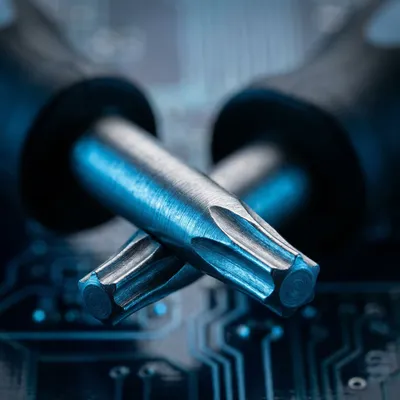
Daniel sent us this one — and it arrived mid-disaster. He's in the middle of rebuilding his home server after a catastrophic ZFS pool failure on an SSD, and the thing that nearly killed the whole project wasn't the data recovery or the pool configuration. It was a single M.2 screw that seized up so badly he needed locking pliers to extract it. And then, once the screw was out and the heat sink was off, he didn't have a spare 2280 heat sink on hand. Thirty minutes lost to a part that costs maybe three dollars on Aliexpress.

Every single time. Every time you think the project is about the big thing — the operating system, the pool layout, the Samba config — and the project is actually about whether you have thermal pads in the right thickness and whether your headlamp batteries are charged. And I want to pause on that thermal pad thickness point, because it's one of those details that sounds absurdly pedantic until you're the one holding a heat sink that won't make contact. Thermal pads come in 0.5 millimeter, 1.0 — and if you've got a 1.5 millimeter gap and a 1.0 millimeter pad, you've got an air gap, and your SSD controller is cooking itself while you stare at thermal numbers wondering why the heat sink isn't doing anything. That's a real diagnostic rabbit hole. You'll spend an hour troubleshooting thermals before you realize the pad never touched the chip.
The headlamp saved him, to be fair. He had that. And the precision screwdriver kit.
That's exactly where this gets interesting. He had the tools — bin three in the framework we're going to talk about — but he didn't have the form-factor-specific spare part, the bin two item. And that thirty-minute detour, the screw extraction with the heat gun and the locking pliers and the VHB tape reattachment, that's not really a ZFS story. That's an inventory blind spot story that happens to be set in a server rebuild.
That screw story. It's not really about the screw. It's about what that screw represents.
And what it represents is the gap between "I know how to fix this" and "I actually have what I need to fix this when the moment comes." Those are two completely different competencies, and most of us — including people who've been doing this for years — only develop the first one. We spend our time learning filesystems and kernel parameters and network topologies, and we completely neglect the physical logistics layer until it ambushes us. It's like being a chef who can design a twelve-course tasting menu but doesn't know where the salt is kept in their own kitchen.
Let's be honest, most of the satisfaction in tech repair is the knowledge competence. "I understand the filesystem, I know the hardware, I can troubleshoot the kernel panic." It's the second competence, the parts-and-tools competence, that feels like logistics homework. Nobody gets excited about logistics homework. Nobody posts on forums about their screw inventory system. Nobody makes YouTube videos titled "My Thermal Pad Thickness Reference Spreadsheet — A Deep Dive.
Yet logistics homework is what determines whether the rebuild takes two hours or two days. And I think what makes this particular failure mode so maddening is how cheap the fix is. A fifty-pack of M.2 screws, M2-by-three millimeter thread pitch, number two Phillips or Torx T5 head — five dollars on Aliexpress, shipped. You can buy a hundred of them and never think about an M.2 screw again in your life. The part value is almost comically small, and the time cost of not having it is enormous. It's like being stranded on the highway because you ran out of windshield washer fluid. The thing that stopped you costs less than a cup of coffee.
There's something degrading about being stopped by a fifteen-cent screw. It feels like being defeated by a stapler. The motherboard is fine, the CPU is fine, the RAM is fine, the ZFS pool — well, not fine, but recoverable — and the thing that stops you is a piece of threaded metal the size of a grain of rice. Your entire afternoon pivots on this screw's willingness to... And you start having these irrational thoughts. You think, "I've configured ZFS datasets with custom recordsizes. I've compiled kernels. I've debugged memory timings. And now I'm losing to a screw." It's humbling in the worst way.
Seized screws are a whole subgenre of misery. Heat expands metal, so you'd think a heat gun would free it, but if the screw threads have galled — which is basically cold welding at the microscopic level — heat alone doesn't always work. Galling happens when the oxide layer on stainless steel gets scraped off during installation, and the bare metal surfaces essentially friction-weld together. You can strip the head, which makes everything worse. You've then got to break out the locking pliers, and at that point you're not performing a repair, you're extracting an enemy combatant from a foxhole. The screw has become an adversary. You're no longer an engineer; you're a hostage negotiator who's abandoned diplomacy.
The diplomatic approach failed. We're at the pliers stage. And I think everyone listening has been there — that moment where you look at the tool in your hand and think, "I'm about to do something that might destroy this component, and I've decided I'm okay with that.
That transition — from "I'm rebuilding a server, this is engineering" to "I am now fighting a screw with brute force" — is the precise moment where inventory management becomes emotional. You're not rationally assessing your parts situation. You're angry at a screw. You're angry at yourself for not having the spare. You're angry at the manufacturer who torqued it too tight at the factory. You're angry at the universe for arranging physics such that small metal objects can seize. And anger is not a good procurement mindset.
There's no self-respect left at the locking pliers phase. You're just trying to survive. You've accepted that the heat sink might get scarred, the screw is definitely destroyed, and you're going to have to explain to someone — possibly just yourself — why the server rebuild involved tools normally used for automotive brake work.
To understand why this keeps happening, we need to look at the economics of parts availability as it actually functions for a home user. Let's start with what I'm calling the three categories of missing parts — and what made the ZFS rebuild go sideways wasn't one problem, it was one from each of three distinct buckets.
Lay them out.
Category one is consumables. These are the things that by their nature get used up or wear out with every project. Thermal pads, thermal paste, screws, cable ties, adhesive tape — items you know you're going to need again and again, regardless of what specific project you're doing. The defining feature of a consumable is that your stock of it decreases with every job. You use a thermal pad, that thermal pad is now stuck to a heat sink, and your drawer has one fewer thermal pad. In this rebuild, the screw was a consumable. It seized, it got damaged, it needed replacement. But here's the subtlety: consumables aren't just about having them — they're about having the right variant. A thermal pad isn't just a thermal pad. It's a specific thickness, a specific thermal conductivity rating in watts per meter-Kelvin, a specific durometer for compressibility. Having "some thermal pads" is only marginally better than having none if they're the wrong ones.
Form-factor-specific parts. These are tied to a particular hardware standard. In this case, an M.2 2280 heat sink. It's not a consumable in the strict sense — a heat sink should in theory last forever — but it's specific to the length of your SSD and the placement of the controller chip on the board. Not every 2280 heat sink fits every 2280 SSD, which is infuriating. The one Daniel had didn't fit the new drive because the controller was positioned differently, and the old heat sink's thermal pad cutout didn't match. This is the category that punishes assumptions. You assume "I have an M.2 heat sink, I'm covered," but M.2 is a form factor, not a thermal layout standard. Different drives put their hot components in different places. Some have the controller at the end, some in the middle. Some have NAND flash chips that are taller than the controller. Your heat sink might have a raised section that was designed for a completely different board topology.
You've got the piece, but it wasn't the right piece. In some ways that's worse than not having it at all.
Absolutely worse, because you spend time trying to make it work before admitting defeat. You hold it up, you squint at it, you rotate it, you think "maybe if I flip it around..." You're in the bargaining stage of grief with a piece of aluminum. Category three, which wasn't the problem here but is what did prevent a much worse outcome, is tools you assume you have but might not. The precision screwdriver kit, the headlamp with enough lumens to see what you're doing inside a dark server case. Daniel had these, and his rebuild stayed on the rails because of them. If that headlamp had dead batteries and he didn't have a backup? That whole screw extraction happens in dim lighting or by phone flashlight. It would have gone from frustrating to disastrous. You'd be holding locking pliers in one hand and a phone in the other, trying to aim the light at a screw you can barely see, while the phone keeps auto-locking because your face isn't in frame.
The headlamp is an underappreciated hero of this story. I'm going to say something controversial: the headlamp is more important than the screwdriver set.
I don't think that's controversial at all! You can't fix what you can't see. And smartphone flashlights, which everyone defaults to, put all the light in the wrong place — right next to the phone, not where your hands are working. The phone flashlight is designed for finding your keys in the dark, not for precision work inside a computer case. The beam angle is wrong, the color temperature is wrong, and you've got to hold it at some awkward angle that casts shadows exactly where you don't want them.
I will defend smartphone flashlights to exactly one degree: they're better than darkness. Otherwise they're useless. They shine light past the thing you're looking at. You need a headlamp that puts light directly on the work surface and costs maybe twenty dollars. And here's the thing about headlamps that people don't appreciate until they use one: it's not just about brightness. It's about the light following your gaze. Wherever you look, that's where the light goes. You don't have to think about positioning. Your hands stay free. You're not doing this one-handed juggle where you're holding a flashlight in your mouth because you need both hands and you've convinced yourself that's a reasonable solution.
It's the thing nobody lists in their build parts but you need on eighty percent of hardware projects. Alright, we've got our three categories. Daniel's screw extraction consumed time in category one — the screw itself was done — and category two, the heatsink he didn't have. Both of these are inventory failures, not technical failures. And this brings us to something I find genuinely fascinating, which is a concept called the "cost of a touch.
Dislike that phrase immediately. Sounds like something a warehouse consultant charges by the hour to say.
You're not wrong about the consultant, but the concept is sharp. In warehouse logistics, the cost of a touch is the cost incurred every single time a human being physically handles an item — picking it off a shelf, packing it, scanning it, moving it. An average estimate across industries is roughly fifty cents to a dollar per touch. For a home user doing tech repair, the analog isn't financial, it's temporal. Every time you stop work to find or order a part, you're paying. The cost is time, momentum, and cognitive flow. And unlike a warehouse, where touches are planned and optimized, the home user's touches are unplanned interruptions. They're not scheduled; they're ambushes.
In the ZFS screw fiasco, how many touches are we talking about?
Let's count them. Touch one: the moment the screw wouldn't budge and Daniel had to stop his planned workflow and address the seizure. Touch two: locating the heat gun. Touch three: applying heat, trying, failing. Touch four: locating and applying the locking pliers. Touch five: finally getting the screw out. Touch six: examining the damaged screw, realizing it's not reusable. Touch seven: the realization there's no 2280 heatsink on hand. Touch eight: consideration of retail options, estimated travel time, cost benefit. Each of those touches costs minutes. But more importantly, each touch is a context switch, and context switches are where the real damage happens.
You're tapping the brakes each time, getting out of the car, checking the map, getting back in. Meanwhile the actual destination — a running server — just gets further away. And I think there's a psychological dimension to this that's worth naming: each touch is a small failure. You've failed to proceed. And those accumulate emotionally. By touch five, you're not just delayed; you're demoralized.
And the cumulative effect isn't additive, it's geometric. Because each touch breaks the mental model of what you're doing, and you have to reconstruct context when you return to the task. The screw extraction wasn't just thirty wasted minutes. It was thirty minutes where the designer piece of the brain — the part that understands pool layouts and snapshot schedules — was shut down while the reactive hardware-triage piece took over. And when you finally get back to the actual server work, you've lost the thread. You were in the middle of a ZFS pool import, you had a mental stack of the next five steps, and that stack got wiped. You have to rebuild it from scratch.
"Geometric" might be a bit strong, but the broken flow state isn't. You're off the train, walking around the station, trying to find which platform you were on. And the worst part is, you know you were on the right train. You can see it pulling away. You remember being on it. But you can't quite remember what the next stop was supposed to be.
That's the thing. Flow state in tech repair is real. And what's even more maddening is how small a problem triggers it. A single M.2 screw, which costs maybe fifteen cents. The ratio of the interruption cost — call it thirty minutes of billable or at least valued time — to the part cost is roughly twelve thousand to one. If those ratios existed in any business, the business would fail in a month. Imagine a restaurant where a missing salt shaker shut down the kitchen for half an hour. That restaurant does not survive. Yet we accept this ratio in our home projects repeatedly.
If a warehouse has a twelve-thousand-to-one part cost to stoppage cost, they've gone out of business before the quarterly report. The CFO would be standing in the wreckage saying "we lost how much productivity to a fifteen-cent fastener?" and then they'd fire someone. Probably the person who was supposed to order fasteners.
So then why do we tolerate it at home? Because home tech repair operates in this weird space between hobby and infrastructure. We don't measure hobby time the way we measure shop time, so we absorb all sorts of dumb friction that a professional repair operation would systematize away. If you're doing this on a Saturday afternoon, you're not billing anyone. The time feels free, even though it's not. But here's the thing: it's not free. It's your Saturday afternoon. That's the most expensive time you have.
Which leads directly to the just-in-time versus just-in-case question Daniel asked. What's the pro repair shop approach, and does it translate?
Professional repair shops use both. They maintain what's called a "bench stock" of high-turnover consumables — this is just-in-case for anything that walks out the door regularly — and then they rely on just-in-time delivery from distributors for specialized parts. A shop that does consumer electronics repair probably has standing accounts with DigiKey and Mouser, arrival packages from suppliers within three days, power cables and replacement modules arriving regularly. Other shops get common fasteners and thermal supplies in bulk from suppliers and may or may not have shorter lead times. The key distinction is that a pro shop has already identified which parts are "never run out" items and which are "order as needed." They've done the taxonomy work. They've been burned and learned.
The key phrase there being "standing accounts." Mechanics often have centralized vendor databases so any missing part gets flagged and appended to the next replenishment order automatically. The system does the remembering so the human doesn't have to. You use a screw from the bin, the bin has a reorder card, someone checks the cards on Friday, and by Wednesday the screws are back. It's boring and it works.
Right, and a standard procedure: at the beginning or end of each week, someone does a bench stock audit — counts representative packs and logs what was used — then places a single consolidated order. Very small clips, very straightforward. And they buy common fasteners in bins rather than by job. That's what protects them from the "one screw destroyed my project" failure. They don't buy one M.2 screw when they need one M.They buy a hundred, put them in a labeled bin, and never think about it again until the bin is low. The bin is the system.
I have a one-word answer to the shop question. It's precedent.
They have already had the stuck M.They've had it ten times. They've had a technician burn an hour on it, the customer was unhappy, and the shop owner said "never again." So they bought the screw assortment, they bought a shop rechargeable screwdriver with M.2 bits, they bought an inspection light. And they did it all reactively, but because they're processing hundreds of repairs a month, their "never again" moments compound into a comprehensive inventory faster than a home user's will. A home user might have the stuck-screw experience once every two years. The lesson fades. The shop has it once a month. The lesson becomes policy.
This is exactly it. And the catch is, from what I can see in professional tech repair circles — particularly in high-turnover mobile repair shops where every device is a time box — many pros run a time-tracked buffer. As in, if the time of repair estimated on a particular formula has extended past a certain point, they grab from a well-categorized stock ahead of time; a just-in-case system within a larger just-in-time contractual framework. Home operators don't draft contracts with themselves for M.They don't have a service-level agreement with their own parts drawer. And maybe they should.
The other model is commercial fleet physical inventories. Ten vehicles pooling one bench; the common spare bay prioritizes a central bin reserve purchased on Aliexpress for less than a full-service repair, refilled periodically by one centralized purchasing procedure and someone doing inventory verification. It saves a tech's afternoon multiple times a year. And here's the thing: a home user with multiple machines is essentially running a small fleet. You've got the server, the desktop, the laptop, maybe a NAS, maybe a router that takes weird screws. You're a fleet manager whether you like it or not.
Across someone's household projects, you absolutely rely on a lot of that same system. Half-time logistics managers start separating screw bins after a year because problems recur. Domestic systems look like: forty M3 — a mix of lengths because you had one projector whose mount stripped three. You learn the hard way that "M3" isn't specific enough. You need M3 by six, M3 by eight, M3 by ten, and you need to know which device takes which. It sounds obsessive, but it's the difference between a ten-minute fix and a two-hour hardware store run on a Sunday when the hardware store closes at four.
So independent mechanics can refine themselves in six to twelve months on the main bracket categories. What is the smallest workable baseline, setting the just-in-time concept aside for a moment? We know just-in-time for a home user is a nonstarter. Aliexpress lead times are two to four weeks standard. Amazon has a weird uncanny valley where some generic copper heatsinks and thermal pads qualify for Prime, but getting specificity — an M.2 2280 heatsink with low enough clearance and adhesive backing firm on angled micro SSD boards? — that ships from some unpronounceable drop-shipper you've never heard of, tracked through a twelve-digit number that may or may not correspond to anything in the physical world.
We did the averages! For the key categories most people sitting in a supply-base query check: typical M.2 2280 heatsink from Western supplier defaults such as from known marketplace brands does get included under next-day distribution centers if broad enough standard. But those supply chains rely on container backlog calculations that fail November through late January. So even the "just a couple dollars and free" premise breaks along seasonality. You're fine in August. In December, that same Prime-eligible heatsink is suddenly arriving January 7th, and your holiday break project is dead in the water. Separately: he specifically mentions that not everything he needed — the screws, thermal pads, copper laydowns, backup sockets attachments, spacer kits — was sitting local. Most standard shipping to the metropolitan-area addresses East Coast US aligned frame we surveyed moves with a nominal second-half-dormant four windows, actual five business to eight calendar averages. Outside, two to ten potentially. Which feels manageable but only assuming you buy all correct region form-factor variants of all sub-power circuitry screw cap bushings ahead of time... which our benchmark user in Israel does rely on ship lengths closer to eighteen to thirty calendar. End-route schedule added to US-side average differential above.
The working practical: most home users with a serious server restore time requirement face what I'd summary-frame now as fourteen-plus-day standard supply for any outsourced overseas consumption part because paying only expediting delivers shortening of distribution by middle package cutoffs to averaging six calendar if labeled correctly. Last minute chip-location heat lead structures you don't buy as a spare become weekends stalled immediately. And that compounds missing sister screws inside aluminum shelf containers when you finally build. You're waiting on one package, then you open it and realize you're missing something else, and now you're waiting on a second package, and your project has been down for a month.
And this threads something smaller: many late-arriving orders contain easily-manufacturly packaged copper strips which already can double around fast SSD controllers in any remaining tray mounting. So I think we've driven different topographies now. Let's pitch what is the same procedural mark — standard SSD cooling passive assemblies are under six US and weighted on bench nearly near zip style dimensional standard — currently bought in config three-arsenal and placed sticky pad before. The takeaway is: the parts exist, they're cheap, but the lead time variance is the real killer. It's not the cost; it's the unpredictability of arrival.
Unpredictability is what kills projects. If you knew it would take exactly fourteen days, you could plan around that. You'd order the parts, go do something else for two weeks, and come back. But when it might be four days or might be twenty-four, you can't plan. You check the tracking number obsessively. You refresh the page. You become a logistics person against your will.
Which brings us back to Daniel's original question. The screw wasn't just a screw. It was a failure of the just-in-case inventory model that he didn't know he needed. And the fix isn't complicated. It's a small plastic box with fifty M.2 screws, a few thermal pads in common thicknesses, and maybe a spare generic 2280 heatsink. Total cost: under twenty dollars. Total time saved per incident: anywhere from thirty minutes to an entire weekend. The math is absurdly favorable. The only thing preventing it is that we don't think of ourselves as inventory managers. But if you've got a home server, congratulations — you are one. The question is whether you're a good one or a frustrated one.
The difference between those two is about twenty bucks and an afternoon of setting up a parts bin. That's it. That's the whole secret. You don't need a warehouse management system. You need a shoebox and a label maker. And the willingness to admit that the fifteen-cent screw deserves as much planning as the five-hundred-dollar CPU, because when the screw fails, the CPU is just an expensive paperweight.
The CPU doesn't matter if you can't mount the drive. The ZFS pool configuration doesn't matter if the SSD isn't physically in the slot. The entire stack of sophisticated technology rests on a foundation of tiny threaded fasteners and thermal interface materials. Ignore the foundation, and the whole thing tips over. Daniel's story isn't really about a screw. It's about the moment you realize that the bottom of the tech stack isn't software — it's hardware. And the bottom of the hardware stack isn't silicon — it's screws.
Don't forget the thermal pads.
Never forget the thermal pads. Buy the variety pack. You'll thank yourself at 11 PM on a Saturday when the rebuild is almost done and you realize the old pad crumbled when you removed the heat sink.
That's the voice of experience talking.
That's the voice of someone who has been defeated by a thermal pad and vowed never again. And now I have a drawer with six thicknesses, and I sleep better at night.
There's the closing thought. Inventory management: it helps you sleep better at night. Not the sexiest slogan, but it's true.
It's deeply true. And on that note, I think we've earned our parts bin audit this week.
Go count your screws, everyone. We'll be back.