What does it cost to honor a warranty on a fifty dollar tool? Apparently two weeks, a tank of petrol, and the will to drive to a warehouse that may or may not decide to look at it.

Daniel's Dremel died.
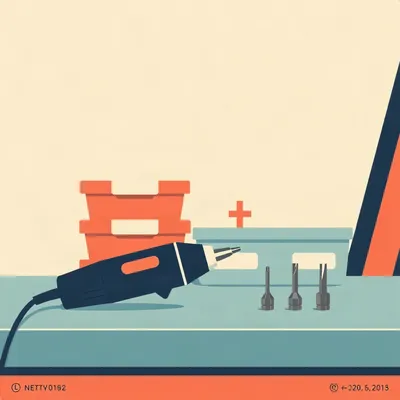
Daniel's Dremel died. The 7760, his trusty rotary tool. The micro USB port detached from the board, which is apparently a known failure mode for that model. And Daniel did what any reasonable person who lives in Jerusalem does when a fifty dollar tool breaks. He looked up the warranty process.
And found it wanting.
The authorized repair path involves driving out to some warehouse that wants two weeks just to assess whether they can fix it. For a fifty dollar part, the petrol costs more than the repair. Meanwhile, there are guides online for replacing the micro USB port with USB Type-C. It's a soldering job. A motivated hobbyist with a decent iron and a magnifier could do it in an afternoon.
So the right-to-repair movement collides with warranty bureaucracy, and the bureaucracy wins by default. Not because repair is illegal or impossible, but because the process is designed for a different scale of product and a different era of consumer expectations.
Daniel also went down a second rabbit hole. He's wanted for a while to place a small order from a real distributor, DigiKey or Mouser. So he went looking at their Israeli operations. And what he found is what he calls shadow presences. Local-looking websites, local subsidiaries, but the pricing tells the truth. A USB cable at fifteen dollars per unit isn't local distribution. It's international fulfillment wearing a local mask.
And he noticed the BOM upload feature on Mouser. Upload a bill of materials, get matches against inventory. He didn't use it because he doesn't have a BOM for a one-part repair. But it got him thinking about the integration surface between professional BOM management systems and distributor networks. How version control works at production scale. Whether AI is doing part matching when exact matches fail. What the document flow looks like when a vacuum manufacturer places a first order with DigiKey.
So that's the prompt. A broken tool, a frustrating warranty process, and a rabbit hole into how parts actually move around the world. Let's start with the repair that didn't happen.
The thing about the Dremel 7760 is that the micro USB port detaching from the PCB is not a fluke. It's a documented failure pattern. There are teardown videos and repair guides specifically for this. The port is surface-mounted, and over time the mechanical stress of plugging and unplugging the charging cable works the solder joints loose. Eventually the port lifts clean off the board, sometimes taking the pads with it.
And the repair community has already figured out that you can replace it with USB Type-C. There are guides. There are parts. The connector costs a couple of dollars. The knowledge is out there.
So the technical feasibility is not the problem. The problem is that the warranty system doesn't care about feasibility. It cares about process. You have to bring the tool to an authorized service center. The service center has to log it, assess it, determine whether the failure is covered, and then either repair it or replace it. That pipeline is built for products that cost hundreds or thousands of dollars, where two weeks of diagnostic time is a rounding error on the value of the item.
For a fifty dollar rotary tool, the process itself destroys the economics. Daniel said it plainly: the petrol costs more than the part. So the warranty becomes a tax on people who don't know how to solder.
And this is the thing that I think gets lost in a lot of right-to-repair coverage. The movement is framed as a legal battle. Can the manufacturer lock you out? Can they void your warranty for opening the case? Can they refuse to sell you parts? Those are real fights. But Daniel's situation isn't a legal problem. It's an economic one. Repair is technically feasible and legally permitted. It just doesn't make sense to pursue through the official channel, and the alternative channel requires skills and tools that most people don't have.
Which means the right-to-repair movement gets torn asunder, as Daniel put it, not by a court ruling but by a warehouse that wants two weeks to look at a broken USB port.
And the deeper frustration is that the manufacturer knows this. Dremel, Bosch, whoever owns the brand this week, they know the micro USB port is a weak point. They know the repair is cheap. The system isn't malicious. It's just indifferent. It was designed for a different scale of product and nobody bothered to adapt it.
Now the second thread. Daniel goes looking for a distributor that sells locally in Israel, and he finds these shadow presences. DigiKey and Mouser have local-looking websites, local subsidiaries, maybe even local phone numbers. But the pricing reveals what's actually going on.
Fifteen dollars for a USB cable. That's not a local price. That's an international price with shipping and import costs baked in, wearing a local jersey. The distributor isn't stocking inventory in Israel. They're fulfilling from a centralized warehouse somewhere in Europe or the US and routing it through a local legal entity for tax and customer-service purposes.
Which raises the question: what does local presence actually mean for a distributor?
It means a legal entity. A VAT registration. Maybe a sales rep who covers the region. A website in Hebrew or English that looks domestic. But it doesn't mean a warehouse with shelves and a forklift. The economics of stocking inventory in a small market like Israel don't work for distributors whose entire business model is built on volume. A local warehouse with local staff and local tax compliance can't compete with a centralized fulfillment center that ships internationally at scale.
So the shadow presence is a compromise. Enough local presence to satisfy legal requirements and customer-service expectations. Not enough to actually be a local distributor in the way Daniel wants one to be.
And the hobbyist gets caught in the gap. Daniel wants to buy one USB Type-C connector, or maybe a handful of components for a small project. The distributor wants to sell ten thousand units to a manufacturer who will reorder every quarter. The parametric search on DigiKey and Mouser is incredible, but it's built for engineers who know exactly what they need and can navigate a taxonomy of hundreds of thousands of parts. For a one-off repair, it's overwhelming. You don't want to filter by package type and temperature rating. You want a USB port that fits.
The parts are available. The guides exist. The will is there. But the procurement layer is designed for someone ordering ten thousand units, not one.
And that's the hobbyist's dilemma in a sentence. Now let's zoom out, because Daniel's question about the BOM upload feature is where this gets interesting.
He noticed Mouser lets you upload a BOM. He didn't use it because he doesn't have a BOM for a one-part project. But the feature exists because at production scale, it's the difference between a procurement team spending weeks on manual quotes and a system that responds in hours.
Let's be concrete about what a BOM actually is. A bill of materials is a structured list of every component, quantity, and specification needed to build something. At the hobbyist level, it's a spreadsheet with maybe twenty to fifty lines for an ESP32 project. At production scale, it's a completely different animal.
Daniel asked how detailed and how many line items a production BOM might have. Give us the scale.
A car engine BOM can run into thousands of line items. Not hundreds. Thousands. Every fastener, every gasket, every sensor, every casting. And each line item carries metadata: the manufacturer part number, the approved vendor list, the lead time, the lifecycle status, regulatory compliance flags. A television is smaller but still substantial, hundreds to low thousands of lines. And here's the thing: at that scale, a BOM is not a spreadsheet. It's a version-controlled, structured document that lives inside an ERP or PLM system.
Because version control at that scale isn't optional. It's the difference between building the right product and building a recalled product.
If you're manufacturing a run of ten thousand vacuums and your BOM says revision three of the motor controller uses a specific capacitor, but revision four swapped it for a different one, and the procurement team orders against the wrong revision, you've just built ten thousand vacuums with the wrong part. That's a recall. That's a regulatory problem. That's a liability problem. So the BOM has to carry revision history, approval workflows, and change management.
And the format is often proprietary. Not a spreadsheet. Something inside SAP or Oracle or a PLM tool like Arena or Propel, where the BOM is a data structure with relationships, not just rows and columns.
Right. And that's where the integration surface with distributors gets interesting. When a professional BOM management system talks to a distributor network, the distributor's system can parse the structured BOM, match line items against inventory, and return availability and pricing. But it can also do more. It can suggest substitutions when a part is unavailable. It can flag compatibility issues. It can generate a quote against the current revision of the BOM.
Daniel speculated about AI agents doing this matching when keyword or semantic search fails. How plausible is that?
Very plausible. Distributors have every incentive to automate the workflow where they say, we don't have this exact part, but here's a compatible alternative. The question is whether the compatibility checking is rule-based or machine-learning driven. Rule-based matching means parametric comparison: same package, same pinout, same voltage rating, same tolerance. That's been around for a long time. The newer layer is ML-driven, where the system learns from historical substitutions and design intent. If a thousand engineers accepted part B as a substitute for part A, the system starts suggesting it automatically.
But there's a trust problem there. A parametric match tells you the specs line up. An ML suggestion tells you other people did this and it worked out. Those are different kinds of confidence.
And at production scale, the stakes are higher. If you're building a vacuum and the suggested substitute has a slightly different inrush current, you might not notice until the motors start failing in the field. So the integration layer has to carry not just the suggestion but the evidence for why it's compatible. Approved manufacturer lists matter. Some BOMs will specify that only parts from an approved vendor list are acceptable, no substitutions. Others will allow equivalents if they meet a parametric threshold.
So the BOM isn't just a list. It's a contract. It says what you can buy, from whom, and under what conditions.
And when a manufacturer sends that BOM to a distributor for the first time, what comes back is not a sales order. It's a quote.
Let's do the vacuum manufacturer scenario. Daniel set it up: a vacuum manufacturer places a first order with DigiKey. They send a BOM. What happens?
DigiKey's system parses the BOM. It matches each line item against inventory. For parts that are in stock, it returns pricing and availability. For parts that aren't, it returns alternatives or flags them as unavailable. The output is a structured quote document with line-item pricing, lead times, and suggested substitutions. That quote goes back to the manufacturer's ERP, which ingests it, compares it against quotes from other distributors, and runs its own approval workflow.
The quote is the handoff point between two ERPs. The distributor's system generates it. The manufacturer's system consumes it.
Only after the manufacturer approves the quote does the purchase order get generated. The PO goes back to the distributor, who then converts it into a sales order. Then comes the invoice, the shipping notification, the receiving document. The whole chain is BOM to quote to purchase order to sales order to invoice. Each step is a synchronization event between two systems that don't natively talk to each other.
Which is where the friction lives. The integration between the two ERPs is never as clean as the marketing materials suggest. Formats don't line up. Part numbers have different conventions. Unit pricing gets recalculated differently. Someone has to reconcile the quote against the PO and catch the discrepancies.
This is where I have a war story, actually. SKU formatting mismatches causing silent data corruption. You think you're ordering a hundred units of a specific capacitor, but the distributor's system interpreted your part number differently, and you get a hundred units of something that looks right but isn't. The boxes arrive, the receiving clerk scans them, the inventory system says they're correct, and the problem doesn't surface until the production line starts pulling parts and the boards don't work.
That's the nightmare scenario. And it's why version control and structured formats matter so much. The BOM is the anchor. Everything downstream references it.
This is also why the trial relationship matters. A vacuum manufacturer placing a first order with DigiKey isn't going to get the same treatment as a customer who's been ordering for ten years. The first order is a test. The manufacturer is evaluating whether DigiKey can handle their volume, their lead times, their quality requirements. DigiKey is evaluating whether the manufacturer is a good credit risk and whether the BOM is stable enough to quote accurately.
The quote is a courtship document. It says, here's what we can do for you, here's what it will cost, here's how long it will take. Now let's see if you're serious.
The manufacturer's ERP is doing the same thing in reverse. It's comparing DigiKey's quote against Mouser's quote and Arrow's quote. It's checking lead times, landed costs, payment terms. The BOM is the same document, but each distributor sees it through their own lens and prices it differently.
The BOM is the constant. The quotes are the variables.
The accounting layer sits on top of all of this. Once the PO is issued and the sales order is confirmed, the manufacturer's ERP has to track the liability, the receiving, the invoice matching, the payment. The distributor's ERP has to track the receivable, the shipping, the revenue recognition. Two ERPs, two accounting systems, one transaction.
Daniel asked whether the BOM, inventory, and accounting layers are integrated across the two ERPs. The answer is yes, but not in the way you'd hope. It's not one seamless pipe. It's a series of handoffs, each with its own format and its own failure pattern.
That's the industrial plumbing that moves parts around the world. It's not glamorous. It's not even particularly efficient. But it works well enough to keep factories running.
We've gone from a broken Dremel to a vacuum manufacturer's first order with DigiKey. The same BOM concept, but the scale changes everything.
The hobbyist experience remains fragmented because the hobbyist is not the customer the system was built for. The system was built for the vacuum manufacturer. The hobbyist is an afterthought, and the shadow presences are the evidence.
Hilbert: We had a substitution book.
A what?
Hilbert: At the warehouse. Physical binder. Every time a customer accepted a substitute for a part we didn't have, someone wrote it down. The original part number, the substitute, the customer's name, the date. Six months I worked that will-call counter, late nineties, regional distributor. Smaller operation. We served the local electronics shops.
The website said in stock based on a nightly batch update. The warehouse knew the truth.
Hilbert: The website was always wrong by morning. Inventory system never synced with the web store. We'd get an order for forty units of something, the website said forty in stock, and the shelf had three. The customer would show up at the counter and I'd have to tell them. Then I'd open the binder and see what we'd substituted before.
The substitution book was the pre-digital version of AI part matching.
Hilbert: It was more accurate than the website. The website was a snapshot. The binder was updated by the people who actually talked to customers. If a guy came in looking for a specific transistor and we didn't have it, and he walked out with a different one that worked, that went in the binder. Next time someone asked for the first transistor, I'd check the binder and say, here's what worked for the last guy.
That's the historical substitution data that modern ML systems are trained on. Except now it's digital and the binder is a database.
Hilbert: The shadow presence isn't new either. Distributors have been doing that since the catalog era. The difference is the website looks local now. Back then, a local distributor was a guy with a garage and a fax machine, and the parts came from a bigger distributor two states away. The layer of indirection was always there. It's just been digitized.
What Daniel found with the fifteen dollar USB cable is the same indirection, just with a better website.
Hilbert: The website is the front end. The fulfillment is the same as it ever was. Centralized warehouse, international shipping, local legal entity for the paperwork. Nothing about that is new. What's new is that the website makes it look like there's a warehouse down the road when there isn't.
The binder is the ancestor of the compatibility checking built into modern BOM tools. The difference is the binder was curated by humans who had actually seen the parts and talked to the customers. The digital version is curated by algorithms that have never held a transistor.
Hilbert: The algorithms are faster. The binder was smarter.
That's a good reminder that none of this is as new as it feels. The indirection, the substitution matching, the gap between what the website says and what the warehouse knows. It's all been there for decades. It's just got better interfaces now.
Which brings us back to the Dremel. The system that makes a fifty dollar repair feel impossible is the same system that moves millions of parts around the world every day. Both things are true at once.
Here's the question I'm left with. If the integration surface between BOM systems and distributor networks is already this sophisticated, why does the hobbyist experience remain so fragmented? Is it a market failure, or just a different market?
I think it's a different market. The hobbyist wants one part, maybe two, at a price that makes sense for a fifty dollar tool. The distributor wants a customer who will order ten thousand units and reorder every quarter. The hobbyist doesn't need version control or compatibility checking or ERP integration. They need a local shop with a knowledgeable clerk and a bin of USB ports. And that local shop mostly doesn't exist anymore, because the economics that killed it are the same economics that created the shadow presences.
As AI matching improves, the line between we have this part and we have something that works just as well will blur. That's good for the hobbyist in some ways. More substitutions available. More chances to find something that fits. But it raises questions about traceability and liability. If an algorithm suggests a substitute and the substitute fails, who's responsible?
At production scale, that question gets answered in contracts and approved vendor lists. At hobbyist scale, it gets answered in forum posts and YouTube comments. The Dremel might get fixed with a two dollar USB port and a soldering iron. The system that made that repair feel impossible is still there, still moving parts around the world, still indifferent to the guy with the broken tool.
Both are true. That's the thing to hold onto.
If you take one thing from this episode, it's that the gap between the hobbyist and the industrial procurement system isn't a bug. It's the shape of the market. The system was built for the vacuum manufacturer, not the guy with the broken Dremel. And the shadow presences, the fifteen dollar USB cables, the warranty warehouses that want two weeks to look at a fifty dollar tool, they're all just the same gap wearing different clothes.
The binder knew more than the website. That's the other thing.
Thanks to Hilbert Flumingtop for producing, as always. This has been My Weird Prompts, the human-AI collaboration podcast. If you enjoyed this episode, leave us a review wherever you listen. We'll be back soon.