A few months ago Daniel and Hannah moved apartments. Not a planned move, the kind where you find out and then you're carrying boxes. And once the boxes were down, Daniel did nearly all of it himself. Assembly, drilling, mounting, the lot. One electrician came in for a single cable pull and that was the only outside help.

Which, having priced a handyman lately, was probably the correct call.
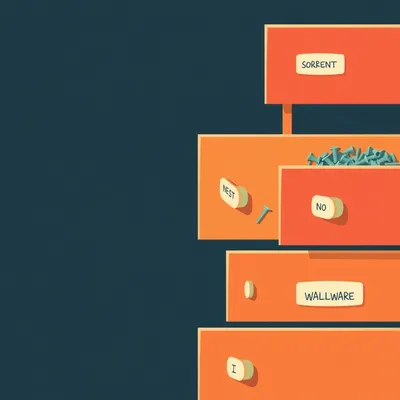
Here's what Daniel wrote in this week. He's been building out a small parts inventory, and the cornerstone of it is a sixty-four drawer parts bin. He's populating that bin from ten years of his own accumulated hardware plus whatever Hannah had lying around. And while doing it he noticed something. He'd bought the same few sizes of washer, screw, and nut over and over again, and had almost no horizontal depth. His phrase. Which is invisible when your hardware is spread across random shelves, and becomes extremely obvious the moment it all goes into one box.
That's the interesting part. The bin didn't create the problem, it just made it legible.
Right. And he's explicit that the goal isn't a live-in hardware store. Nobody has space for every washer on the market. It's a minimal viable inventory that covers ninety percent of needs and stops ninety-five percent of small furniture installations from grinding to a halt because you didn't think to buy that one type of screw.
Which is a much sharper target than "be organized."
So the ask. Fifteen small parts that home DIYers are most liable to forget even when they're otherwise well stocked. For each one, a short description, a recommended purchase quantity for a home user, and when and why it comes in handy.
Fifteen is a lot. And before we list anything, there's a mechanism we need to name, because the list doesn't make sense without it.
Then name it.
Churn. Hardware is not something you buy to hold on to. You buy a set of screws or anchors for one particular project, and you almost always have leftovers. The leftovers go in a jar. The jar outlives the project. Then the supply runs out, you buy a different set for the next job, and the container you labeled no longer matches what's in it. Do that for ten years and you get exactly what Daniel found.
So the duplication isn't carelessness. It's the natural output of the system.
It's the default output. Buying hardware is always a side effect of buying a solution to a specific problem. Nobody goes to the store to buy "assorted fasteners." They go to buy the thing that fixes the shelf.
Which means the inventory is a fossil record of every problem you've ever had, in the order you had them.
And a fossil record is not a plan.
Let's set the scope, because "minimal viable" is doing real work in that sentence. What are we actually describing?
One drawer. One small organizer. The test is coverage of the fasteners you reach for repeatedly, not a hardware store in miniature. And there's a number that captures the failure better than any argument. A five hundred piece assortment with forty sizes looks like coverage and behaves like clutter. Ten sizes in useful quantities beat forty sizes in useless ones.
Forty sizes sounds like abundance until you need a second one of something.
You get one of each. That's the trap. You have the size, you don't have the quantity. So you're still driving to the store, except now you also own four hundred pieces of hardware you'll never touch.
What does a missing fastener actually cost? Because I suspect people underrate this.
On the order of six to ten dollars in shipping if you order it, on a part that costs cents. Thirty to sixty minutes round trip if you drive. And if it's a dealer or OEM part rather than aftermarket, you can be looking at ten times the price.
Ten times. For a screw.
For a screw that is functionally identical to the one at the hardware store.
There's a tension I want to flag before we get anywhere near the list, because it's the honest part of this whole exercise. The standard advice for buying fasteners is to buy both sizes. One above your estimate, one below. Because you never know the exact length until the part is in your hand.
That's real advice and it's good advice.
It is also the opposite of minimalism. You're deliberately buying things you might not need, to avoid a second order.
It is. And I don't think that tension resolves cleanly. The extra handful costs a dollar or two. The second order costs six to ten in shipping and two days. So on pure economics you over-buy. But over-buying is the exact behavior that produced the crate of despair in the first place.
So the minimal viable inventory is not actually minimal. It's minimal in variety and generous in quantity.
That's the resolution, if there is one. Fewer sizes, more of each. Not fewer pieces.
Good. One more thing before the list. Is there a canonical fifteen? Because I want to be honest with listeners about where this comes from.
There isn't. There's no published "fifteen forgotten parts" list anywhere. What exists is a starter inventory table with five categories, a couple of DIY experts naming their two or three essentials, and a long forum thread where practitioners crowd-source their own lists. The fifteen is our synthesis. It's built from what people who actually do this keep reaching for.
So the number is ours, the parts aren't.
The parts are extremely not ours. Every one of them shows up in multiple independent lists.
Then let's get to the mechanism that produces the problem, because I want to understand why the bin reveals it and a shelf doesn't.
Distributed storage hides duplication. If you have screws in a kitchen drawer, a garage shelf, a toolbox, and a jar in the hall closet, you have no way to perceive that four of those five locations contain the same three sizes. The information exists, it's just not co-located.
And consolidation makes it co-located.
Instantly. The moment it's in one bin, you can see the shape of your own history. Which is why Daniel's discovery isn't really about hardware. It's about what happens when you finally put all the evidence in one room.
There's a phrase from someone who went through this. She described her pre-fix state as a crate of despair.
Baggies in a plastic crate. And the specific failure she names is that it became impossible to find what was needed mid-project, amidst the clutter, which ultimately led to purchasing more of items she already had.
That's the loop. You own it, you can't find it, you buy it again, and now you own two of it in two places you can't find.
And the second purchase is not a mistake in the moment. It's the rational response to a system that has failed you. You need the part now. The crate cannot tell you whether you have it. So you go buy it.
The crate lied by omission.
The crate didn't lie. The crate had no way to speak.
There's a generational version of this that keeps coming up. The coffee can.
Multiple people describe inheriting coffee cans of half-rusty mixed screws from a father or a grandfather. Unsorted, unlabeled, and functionally unusable, but nobody throws them out, because there might be something in there.
There is never something in there. There is a can of rust and three screws that fit a hinge nobody makes anymore.
One person's version of the fix is literally titled "Death to the Coffee Can."
That's a manifesto.
It's a manifesto about a can. And the shift it marks is real. The coffee can is inherited accretion. It's what happens when hardware accumulates with no decision attached. The parts bin is the first time anybody decides anything.
So the bin is a decision, and the coffee can is the absence of one.
Which is why the bin feels like progress even before you've filled it.
Here's the paradox I want to put on the table, because it's the thing that makes this hard. Too few types and you're making store runs. Too many types and you can't find anything.
Someone on a forum put it almost exactly that way. If you don't have many types, you need to make a run to the hardware store. If you have a lot of types, it may be easier to make a run to the hardware store.
So the store is the attractor at both ends.
It's a circular path. And the minimal viable inventory is the proposed exit, but I want to be honest that it's a trade-off, not a clean win. You are choosing which failures you'd rather have.
You're choosing to fail on the rare part instead of the common one.
You accept that the weird thing will send you to the store. You refuse to accept that the ordinary thing will.
There's a structural problem with the bin itself that I want to raise, because it cuts against Daniel's setup. Any system with fixed compartments or permanent labels goes obsolete.
Because the stock churns. The label says "number eight wood screws" and then you use all of them and refill that drawer with something else, and now the label is a lie. The system degrades from the inside.
Which is a problem for a sixty-four drawer cabinet if the drawers are fixed.
It is, if they are. The counter-design is adjustable dividers and wet-erase labels. The person with the hundred-plus compartment caddies writes the label in wet-erase marker precisely so she can rewrite it when the contents change. The label is treated as temporary by design.
So the bin has to be as fluid as the stock.
Otherwise you've built a very tidy version of the coffee can. You've organized the mess, you haven't solved it.
There's a related principle that I think is the best single line in all of this.
Unlabeled hardware is invisible hardware.
That's it. That's the whole thing. If you can't see it, it doesn't exist, and if it doesn't exist you buy it again.
And there's a sub-case worth naming. The hardware that comes with assembled furniture. The leftover cam locks, the spare shelf pins, the two extra bolts from a flat-pack. That stuff should not go in with the bulk stock.
Why not?
Because it's not inventory. It's a one-off. It fits nothing else you own. If you mix it in, you're adding noise to the signal. Keep it in a separate spare parts tote, clearly apart from the stuff you actually stock.
So the spare parts tote is the coffee can, but with a lid and a label.
The coffee can with a job. Which is different from the coffee can.
Alright. So that's why the bin reveals it. Now, what's actually in the bin.
Fifteen parts, grouped by what they do rather than as a flat list. Group one is wall and hanging.
Start with anchors, because everybody says anchors.
Drywall anchors are the single most-named household fastener. Number eight and number ten go fastest, and the advice is buy them by the box of a hundred. Because you will use them, and buying ten at a time means you're back at the store in a month.
How many styles?
More than you'd think. There is no single anchor that works for everything. People who do this seriously keep a dozen different styles and use all of them, from togglers down to the cheap plastic pound-in ones. For a home kit, ten each of the common sizes is a reasonable floor.
And the rest of the hanging group?
Picture hangers and picture-hanging hardware as a dedicated kit, because that's a recurring job with its own specific parts. And felt pads and furniture bumpers, which are not fasteners at all but belong in the same drawer because they solve the same class of problem.
Group two.
Machine screws in the electrical sizes. Six thirty-two, eight thirty-two, ten thirty-two.
Six thirty-two being the one that matters.
Six thirty-two is the standard machine screw for most electrical work. If you're replacing an outlet or a switch plate or a fixture, that's the thread you're dealing with. Twenty each in three-eighths and half inch is the recommended stock.
And their mates?
Nuts and washers at thirty each. And the washers are the ones people underrate, because you're almost always needing one as a spacer or a shim rather than as a locking device. The washer is the part that makes the screw fit the hole it wasn't designed for.
Group three, wood screws.
Three-quarter inch, one and a quarter, two inch, and three inch. Fifty each of the common combinations. Number six by one inch, number eight by one and a quarter, number eight by two.
And drive type, which I suspect is where you have opinions.
Star or Torx or square drive over Phillips, every time. They're far easier to drive and far less likely to strip. Phillips was designed to cam out under torque, which is a feature if you're a 1930s assembly line and a defect if you're a person with a drill.
Phillips is a screw that's designed to fail politely.
It's designed to fail predictably. Which is not the same as not failing.
And exterior screws?
Coated deck screws, for corrosion. And they're smart indoors too, in bathrooms and under sinks, anywhere there's moisture. A lot of people standardize on GRK Torx-head screws and never look back.
Group four is the trap items, and I want to spend time here.
Drywall screws.
The canonical mistake.
Drywall screws are meant to hold drywall. Not to hold things to drywall. They're too brittle, and they're too likely to strip the head. People use them for everything because they're cheap and they're everywhere, and then they snap inside a stud and the project stops.
So the screw that's in every hardware aisle is the one you shouldn't be reaching for.
It's the most available wrong answer in the store.
What should people use instead?
Self-tapping or sheet metal screws, number eight and number ten, short and long, thirty each. And there's a more radical version of this that one practitioner swears by. He gave up on traditional wood screws entirely and uses hex-headed sheet metal screws, driven with a socket, bought a hundred of each in a couple of lengths.
Why a socket?
Because you can't strip a hex head with a socket. The tool can't slip. It's the same logic as Torx, taken further. He's removed the failure mode by removing the interface that fails.
Group five, plumbing and sealing.
Rubber hose washers, keep ten, because they flatten and crack and they cost nothing. O-rings as an assortment box. And gasket sheet in two thicknesses, because cutting a gasket to fit beats hunting for the exact pre-cut part that may not exist anymore.
The gasket sheet is interesting because it's not a part, it's a material.
It's the difference between stocking an answer and stocking the ability to make one.
Group six, clips and furniture hardware.
Push-pin and tree clips and retainer clips. These cause most of the shortages, because they're vehicle-specific and trim-specific and there's no generic version. Five of the common size is the floor. Then wire nuts in orange, yellow, and red.
And then the furniture stuff, which is where Daniel's world and this list actually collide.
Cam locks, cam dowels, cross dowels, barrel nuts, shelf pins. This is a chronic missing-part category, and you can tell because there's an entire economy around it. IKEA ships replacement shelf pins and hardware free through its self-serve spare parts page. Third-party sellers move four-packs of IKEA-compatible cam locks and cam dowels for three forty-nine to eight dollars.
Three forty-nine for four pieces of hardware that cost IKEA pennies.
That's the markup on being stuck. You're not buying the part, you're buying not having to drive anywhere.
Group seven, the odds and ends.
Door hinge screws in number nine, one inch and two and a quarter. Those are difficult to find sold separately in stores, especially in nickel and brass, which is exactly when you need them, because the door is visible.
The screw you need is always the one that has to match.
Always. Then Tapcons and concrete anchors. Pop rivets in eighth and three-sixteenths. And quarter-twenty bolts, nuts, and washers, plus a stick of quarter-twenty threaded rod for making oddball parts.
Threaded rod is the one that feels like cheating.
It's the one that turns "I need a bolt this exact length" into "I need a hacksaw."
So that's fifteen, give or take, depending on how you count the groups.
That's the list. And now the part that matters more than the list.
The buy both sizes rule.
You rarely know the exact fastener length until the part is in your hand. So you buy one size above and one size below your estimate, plus matching nuts, washers, and lock washers, in a single pass. The extra handful costs a dollar or two. The second order costs six to ten in shipping and two days of your project sitting on the floor.
And that is directly in tension with everything we said about minimalism.
It is. And I don't think it resolves. The honest version is that you over-buy on the sizes you know you use, and you stay disciplined on the sizes you don't.
There's a second-order move here that I think reframes the whole exercise.
Standardization.
Rental property operators figured this out decades ago. They standardize everything they can. Same faucet, same cabinets, same fixtures, across every unit. So they only need spares for one of each.
It's a completely different strategy. Instead of stocking a wider inventory, you shrink the number of things that can break.
The deepest fix may not be a better parts bin. It may be installing the same faucet in every bathroom so the parts bin only has to know about one faucet.
Which is a much harder thing to do if you didn't build the place.
And most people didn't.
Most people inherit a house with four different faucets from four different decades, and the standardization option was closed before they arrived.
There's a genuine disagreement in the sources I want to air, because it's not settled.
The big-box assortments.
The thousand-piece nut and bolt case. The twenty-two hundred piece, sixty-two size kit.
Avoid them like the plague. Absolute garbage. That's a direct quote. And the reasoning is the one we already gave. Sixty-two sizes means one of each, and one of each is not inventory, it's a display.
But the same forum recommends the Harbor Freight O-ring cases.
Which is a real contradiction, and I think it's actually consistent. An O-ring assortment works because O-rings are sized by a small number of standard dimensions and you do need one of each. A nut and bolt assortment fails because fasteners are sized by length and thread and drive, and one of each is useless.
So the assortment kit is fine when the part is fungible and bad when it isn't.
That's the distinction. Assortments work for consumables and fail for structural parts.
Last thing, and it cuts against the instinct to buy the biggest cheapest box.
Cheap bulk screws strip easily, snap under pressure, and make simple projects harder than they need to be.
So the savings are real and the cost is real, and the cost lands at the worst moment.
It lands mid-project, with the screw half in, and now you're extracting a stripped screw instead of hanging a shelf.
The list is the easy part. What it implies is harder.
Hilbert: You keep saying "minimal." That's not what a hardware store does.
Go on.
Hilbert: I worked a counter at a small independent place for a stretch. Sliding wooden drawers, the bins you scoop from with the little metal scoop. And I spent most of that job doing one thing, which was sorting and refilling the loose fastener aisle.
That's a job that would teach you the whole problem in a month.
Hilbert: It teaches you what people come in for. That's the part you can't see from the bin. The store wasn't organized by what existed. It was organized by what people walked in and asked for. The slow drawers were at the back, and the slow drawers were the ones that mattered most.
Why the slow ones?
Hilbert: Because when somebody needs a number nine hinge screw in nickel, they need it that afternoon. They'll pay anything. They're not comparison shopping. They already tried everywhere else. The fast-moving drawers are a convenience. The slow drawers are the business.
So the store's inventory was shaped by demand, not by completeness.
Hilbert: It was shaped by what people couldn't get anywhere else. Which is the opposite of a minimal inventory. The store stocked the rare thing because the rare thing was the reason to come in at all.
That's a different theory of what a parts collection is for.
Hilbert: I can still tell what a person is building from what they set on the counter. You get good at it. You see the handful of fasteners and you know if it's a shelf or a fence or a repair on a screen door.
What's the tell for a first-timer?
Hilbert: Cam locks with no cam dowels. Every time. They buy the lock and not the dowel, because the lock is the part that looks like the mechanism. They get home and the dowel is the part that actually holds it.
That's the whole episode in one purchase.
Hilbert: It's the whole thing. They had everything except the part they needed, and the part they needed was the boring one.
I need to let somebody in somewhere. I've got the only key.
Which is the problem with stocking your way out of it. If the deepest fix is standardizing what you install, that only works for the person who chose what got installed.
And most people are living in a place somebody else standardized, or didn't.
So the question we haven't answered is what the minimal inventory looks like when you can't shrink the number of things that can break. You can only shrink what you keep on hand.
Which leaves the tension exactly where we found it. Buy both sizes pulls one way. Minimal viable pulls the other.
And the bin doesn't settle it. The bin just tells you what you keep buying.
Which is a different question from what you have. And I suspect it's the more useful one.
Thanks to Hilbert Flumingtop for producing. This has been My Weird Prompts.
If you want to send us a prompt, email us at show at my weird prompts dot com. We'll be back soon.