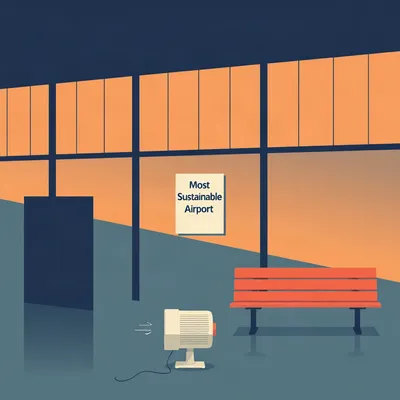
Today's prompt comes from Hannah. She's been thinking about air conditioning — not just the usual complaints about it, but a whole tangle of questions about aesthetics, planning regulations, physics, and whether we can ever be cold without feeling guilty about it. Here's what she wrote.
She says: I want to speak today about air conditioning, a few different aspects of it. First, planning regulations in Paris say AC units can't be on building facades. At the same time, they're apparently not allowed on the roofs because the roofs are Haussmannian or something and they're protected, whereas the facades aren't — which seems very strange. In any case, the big question is where to put the external units. What is a city to do when it wants to be beautiful, and AC units really ruin facades? Can they all just be moved up to roofs? Is efficiency lost when they get farther from the internal units? That's question one: what's the secret to the aesthetics of air conditioning?
Then the bigger question. The world's getting warmer, cities are getting hotter, we're going to rely more on AC, but AC adds to global warming. What are we to do? Are there new solutions? As an architect, she's heard about passive cooling, but other than earthship-in-the-desert stuff, are there solutions that really work in a big dense city? And she's not talking about something that cools a little bit, like a swamp cooler. She wants indoor igloo temperatures in the middle of a Middle Eastern or Texas summer. Is there any way to achieve that without typical wasteful air conditioning?
And on top of that, cities are loud and dusty. If you open the windows, it's unbearable — construction noise, honking, dust. Here in Israel, even without construction, everything gets covered in dirt because we're near the desert. Every city has its own reasons you wouldn't want the windows open. So is there a way to approach cooling that doesn't involve some other type of suffering, whether it's noise or dirt, for the sake of being cool? What innovations or old technologies are people talking about that could solve these problems?
That's a lot of ground to cover. So today we're going to untangle all of it — the aesthetics, the physics, the urban planning, and the real innovations that might actually let us stay cool without cooking the planet.

And the Paris thing is a great place to start because it's got this surface-level absurdity that, once you actually look at it, makes a surprising amount of sense. But before we get to the roof paradox, let me frame what we're really dealing with here. This episode is really three nested problems. One: where do we put the ugly boxes? Two: how do we cool without warming the planet? And three: what do we do when opening the window isn't an option?
And the tension running through all three is that air conditioning is both a lifesaver and a climate accelerant. The IEA projects global energy demand for AC could triple by twenty-fifty. And the refrigerants themselves — the stuff inside the pipes — are some of the most potent greenhouse gases we've ever manufactured.
Right. So we'll look at Paris as a case study for the aesthetics problem, then dive into the physics of passive cooling and mechanical alternatives for everything else. And I should say upfront — there are real answers here. They're not all cheap, and they're not all easy, but they exist.
So let's start with the Paris facade question, because Hannah's right that it seems illogical. You can't put units on the facade, you can't put them on the roof — so where do they go?
The first thing to clarify is that the regulation isn't an outright ban. Since twenty-fifteen, Paris has required that AC units on building facades be hidden behind grilles or integrated into the architecture. They can be there, they just can't be visible. Enforcement is spotty — you'll see plenty of units that have just been painted to match the stonework, which is... a gesture.
A gesture that says "I acknowledge your law and I have purchased beige paint."
But the roof thing is where it gets interesting. The zinc roofs of Haussmann buildings are protected as part of the city's heritage — they're on the UNESCO-adjacent list, the roofscape is considered a unified visual plane. So you can't break the roof line with condenser units. The facades, meanwhile, are individually regulated — each building has rules, but the facades as a category aren't protected the way the roofscape is. So you actually can put units on the facade, you just have to hide them. It seems backwards if you're thinking street-level, but if you're looking down from the Eiffel Tower or from a high floor across the city, the roofscape is the thing that reads as continuous.
So the logic is: the roof is a shared visual resource, the facade is your problem.
That's it. And the real answer for Paris — the thing that makes most of this aesthetic debate moot — is district cooling. Paris has one of Europe's largest district cooling networks, operated by a company called Fraîcheur de Paris, formerly Climespace. It's got more than eighty kilometers of chilled water pipes running under the city, serving over seven hundred buildings, including the Louvre and the Eiffel Tower. They pull cold water from the Seine and run it through centralized refrigeration plants, then pipe the chilled water to buildings. No individual external units needed at all.
Wait — they're using river water for cooling?
Partially, yes. The Seine provides free cooling for part of the year. When the river water is cold enough, they just run it through heat exchangers. When it's warmer, they use electric chillers to bring the temperature down further. The whole system eliminates the need for individual condensers on every building. It's the aesthetic gold standard because there's nothing to see — all the ugly machinery is centralized and underground or in utility buildings.
And the efficiency?
District cooling is substantially more efficient than individual units. A central plant can run at much higher efficiency than a thousand window units. Singapore's Marina Bay district cooling system reduces energy use by forty percent compared to individual AC units. The physics is straightforward — bigger compressors, better maintenance, economies of scale, and the ability to use things like thermal storage that don't make sense at the individual building level.
But most cities don't have eighty kilometers of chilled water pipes under the streets. So for the rest of the world, the question Hannah asked still stands — can we just move all the units to the roof?
This is where the refrigerant line length physics comes in, and it's one of those things that seems like it should be simple but isn't. For a typical split system, the maximum recommended line set — that's the copper tubing connecting the indoor unit to the outdoor condenser — is about fifty to seventy-five feet, fifteen to twenty-three meters. Beyond that, you start losing significant efficiency.
Why?
Two main reasons. First, pressure drop. The compressor is in the outdoor unit, and it's pushing refrigerant gas through those lines. The longer the line, the more friction the gas encounters, and the more pressure it loses. Lower pressure means lower cooling capacity at the indoor coil. Second, oil return. The compressor lubricating oil circulates with the refrigerant, and in a long vertical run — say, from a ground-floor apartment to a roof six stories up — the oil has to fight gravity to get back to the compressor. If it doesn't make it, the compressor runs dry and dies.
So a ground-floor apartment in a ten-story building can't just run its lines to the roof.
Not without a major efficiency penalty, and not without risking the equipment. You can go longer with special design — larger diameter suction lines, oil traps at intervals, additional refrigerant charge — but you're fighting physics the whole way. For a top-floor apartment, roof mounting is fine. For the fifth floor of ten, it's marginal. For the ground floor, it's a non-starter.
Which means the roof-only solution only works if you're willing to sacrifice cooling for the bottom half of the building.
Right. The alternative for existing buildings is centralized VRF systems — variable refrigerant flow. You put one large condenser on the roof, and it serves multiple indoor units throughout the building. The refrigerant lines still have length limits, but they're longer than for individual splits, and you can design the system to handle the oil return issues. It's more expensive upfront, but it solves the aesthetic problem and improves efficiency.
And if you're building new, you can go even further with ground-source heat pumps. The external unit is buried in the ground, where the temperature is stable year-round. Nothing visible at all.
Or you can do what Singapore does and mandate green facades and integrated infrastructure from the start. Their so-called supertrees — those giant vertical gardens — are partly about hiding mechanical systems. The aesthetic problem is really a retrofit problem. New construction can design around it.
So the secret to the aesthetics of air conditioning is... spend money on infrastructure.
Basically, yes. District cooling where you can, VRF where you can't, ground-source where you're building new, and for everyone else — paint the unit beige and hope nobody looks too closely.
Which brings us to the bigger question. Even if we solve the aesthetics, we've still got the climate problem. Hannah wants igloo temperatures without climate guilt. Is that even possible?
Let me start with the hard truth about passive cooling, because this is where a lot of the coverage gets it wrong. No passive system can deliver eighteen degrees Celsius — sixty-five Fahrenheit — when it's forty-plus outside in a dense urban environment. Passive cooling is about reducing the peak temperature, not achieving deep cold. Anyone who tells you otherwise is selling something.
So Hannah's instinct is right. The earthship-in-the-desert stuff doesn't translate to a city.
It doesn't. But passive cooling still matters enormously, because if you can knock five to eight degrees off the peak indoor temperature, the active cooling system you do need is much smaller and uses much less energy. The best results come from combining several techniques. Phase-change materials in walls and ceilings absorb heat during the day as they melt, then release it at night as they re-solidify. Radiative cooling panels — these are a genuinely exciting technology — emit infrared heat directly into space, even during the day under clear skies, because the atmosphere is transparent at certain infrared wavelengths. And night-flush ventilation, where you open vents at night and let cool air flow through a building with high thermal mass, can lower indoor temperatures substantially in dry climates.
You said dry climates twice now. That's the swamp cooler problem, isn't it?
Evaporative coolers work great in dry climates — Arizona, Israel's Negev — because adding moisture to dry air cools it. But in humid cities like Tel Aviv or Houston, the air is already saturated. You can't evaporate more water into it, so the cooling effect is negligible. And you're adding humidity to indoor air, which makes it feel even more uncomfortable. Plus, evaporative coolers require open windows to work properly, which brings us right back to Hannah's dust and noise problem.
So for a humid coastal city, swamp coolers are worse than useless.
They're a mold delivery system. Now, the real innovation that solves the dust and noise problem — and this is something Hannah should know about as an architect — is mechanical ventilation with heat recovery, MVHR, combined with a heat pump. This is the answer to "what do I do when I can't open my windows?"
Explain how that works.
MVHR systems continuously bring in fresh outdoor air and exhaust stale indoor air, but they pass both streams through a heat exchanger. In summer, the cool exhaust air pre-cools the hot incoming air. In winter, the warm exhaust air pre-heats the cold incoming air. The heat recovery efficiency can be eighty to ninety percent. And critically, the incoming air passes through filters — HEPA or MERV-thirteen — that remove dust, pollen, particulates, everything. You get fresh air without opening a window.
So the dust problem is solved by the filter, the noise problem is solved by keeping the windows closed, and the cooling is...
Handled by a heat pump integrated into the system. The MVHR unit can include a small heat pump coil that actively cools the supply air. It's not a massive AC system — it's sized for ventilation air, not for the full cooling load of the building — but combined with good insulation and some of those passive techniques, it can handle a significant portion of the cooling demand. And the windows stay sealed.
This is becoming standard in new Israeli apartments, isn't it?
Increasingly, yes. New construction in Israel now often includes MVHR as standard. There are also retrofit units that fit into a single window frame — not as efficient as a whole-building system, but they solve the dust and noise problem for individual rooms. The filters catch the desert dust, the heat exchanger recovers energy, and you can run a small cooling coil for active temperature control.
But we're still using refrigerants. And this is where the climate guilt comes back in.
This is the refrigerant problem, and it's a big one. The most common refrigerant in residential heat pumps and AC units is R-four-ten-A. Its global warming potential is two thousand eighty-eight. That means one kilogram of R-four-ten-A released into the atmosphere does as much warming as two thousand eighty-eight kilograms of carbon dioxide. If your system develops a leak — and they all leak eventually — you've just undone a lot of the efficiency gains.
Two thousand eighty-eight. That's not a typo.
It's not. And R-thirty-two, which is the newer, "better" refrigerant being phased in, has a GWP of six hundred seventy-five. Better, but still substantial. The real solution is propane-based refrigerants like R-two-ninety. It has a GWP of three. Three. It's also more efficient thermodynamically, so the systems use less electricity. The catch is that propane is flammable, which makes building codes and safety regulations complicated. Europe is moving toward R-two-ninety for small split systems. The US is slower, but it's coming.
So the refrigerant problem is solvable. But even if every AC unit used R-two-ninety and ran at perfect efficiency, we'd still have the grid problem. The sheer number of units in a warming world would overwhelm electrical grids.
And this is where thermal energy storage gets interesting. The idea is beautifully simple: freeze water at night when electricity is cheap and clean, then use that ice to provide cooling during the day when the grid is stressed. Companies like Nostromo Energy and Ice Energy are deploying these commercially. Nostromo installed their IceBrick system at a hotel in Tel Aviv — one point two megawatt-hours of thermal storage, reducing peak AC energy use by forty percent. The system freezes water in insulated tanks overnight, then circulates chilled water through the building's cooling system during the day. The compressors barely run during peak hours.
You're shifting the energy consumption to when the grid has capacity and when renewables are more available.
Because thermal storage is just frozen water, there's no rare earth metals, no toxic chemicals, no degradation over time. It's about as environmentally benign as energy storage gets. The limitation is space — you need room for the ice tanks — but for commercial buildings and larger residential complexes, it's completely viable.
This is all promising, but I want to come back to Hannah's core question. Can she get igloo temperatures without climate guilt? Are we actually there yet?
The honest answer is: not with passive cooling alone, and not without spending more money upfront than a standard AC installation. But the combination of a high-efficiency heat pump using R-two-ninety or R-thirty-two, good insulation, MVHR for ventilation, and possibly thermal storage — that system can deliver cold indoor temperatures with a fraction of the climate impact of a conventional setup. The guilt doesn't go to zero, but it drops dramatically.
The dust and noise problem is solved by MVHR. That's not theoretical — it's a product you can buy and install.
Right. The MVHR plus heat pump combo is the actionable solution for the person who can't open their windows. It filters the air, recovers energy, and provides active cooling. It's not cheap — retrofit costs run three thousand to eight thousand dollars depending on the size of the space — but it addresses all three problems at once: noise, dust, and cooling.
The picture is complicated. Passive cooling helps but doesn't get you to igloo temperatures. The best active systems still use problematic refrigerants, though that's changing. District cooling is the gold standard for cities but requires infrastructure most places don't have. But there are concrete things we can do right now, and they start with how we think about the building as a system.
That's the mindset shift I think is most important. We need to stop thinking of AC as a box that blows cold air and start thinking of it as part of an integrated building system — envelope, insulation, ventilation, thermal mass, and active cooling all working together. If you treat them as separate problems, you get suboptimal solutions. If you treat them as one system, the solutions start to reinforce each other.
Let me pull this together into something practical. For cities, district cooling is the aesthetic and efficiency gold standard, but it requires upfront infrastructure investment. For existing buildings in cities without district cooling, VRF systems with rooftop condensers are the best compromise — they hide most of the ugliness and improve efficiency.
For individuals in noisy, dusty cities — and this is the Hannah scenario — a heat pump with MVHR is the solution. It filters air, recovers energy, keeps windows closed, and provides active cooling. It's an investment, but it solves the noise, dust, and cooling problems simultaneously.
For the climate, push for propane-based refrigerants like R-two-ninety and thermal energy storage. If you're building or renovating, specify a heat pump that uses R-thirty-two or R-two-ninety, not R-four-ten-A. The GWP difference is the difference between a problem and a catastrophe.
The passive cooling techniques — phase-change materials, radiative cooling panels, night-flush ventilation — they're not a replacement for active cooling, but they reduce the load so dramatically that the active system you do install can be much smaller and more efficient. They're force multipliers, not standalone solutions.
The Paris facade problem turns out to be a metaphor for the whole challenge. We want the benefits of modernity without the visual and environmental ugliness. The solutions exist, but they require us to think at the building and city scale, not just the window-unit scale.
Hilbert: But if district cooling and MVHR and ice batteries are all so great, why is every new apartment building still just getting regular split units slapped on the wall?
Cost and inertia. Developers don't pay the electricity bills, so they have no incentive to spend more on efficient systems. And the supply chain for conventional split systems is massive and optimized — you can buy a unit for a few hundred dollars and install it in an afternoon. The better systems require design, integration, and upfront capital. Until building codes require them or energy prices make them pay back faster, the default will stay the default.
The answer is regulation, basically. Which brings us right back to Paris.
It does. Thanks, Hilbert.
Here's the open question I keep coming back to: will we ever get to igloo temperatures without climate guilt? I think the answer is maybe — if we combine super-efficient heat pumps running on propane-based refrigerants with renewable-powered grids and thermal storage, we can get close. The technology exists. What's missing is the will to deploy it at scale.
The Paris facade problem is the perfect illustration of why this is hard. We want the outcome without the visible machinery that produces it. We want cold air without condenser units, without greenhouse gases, without grid strain. The good news is that we know how to do all of that. The less good news is that it costs more and requires coordinated action. But every piece of the solution — district cooling, MVHR, heat pumps, ice storage, low-GWP refrigerants — is real and deployed and working somewhere. It's not science fiction. It's just not yet the default.
If you have a weird prompt about urban cooling, passive building design, or the future of HVAC, send it to show at my weird prompts dot com. We read every one.
Thanks to our producer Hilbert Flumingtop. This has been My Weird Prompts.
We'll be back soon.