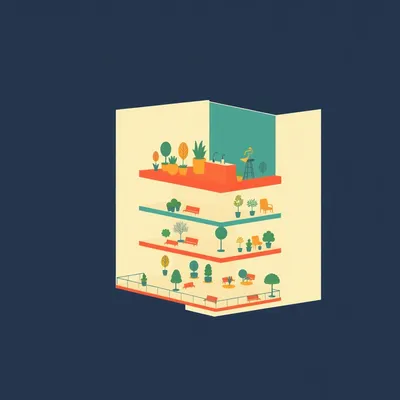
Daniel sent us this one — he's been thinking about a vision of high-rise living that sounds like something out of a sci-fi concept book. The idea is a city where skyscrapers don't just stack housing, they also pack in commercial space, bars, restaurants, gyms, supermarkets, even urban farms. And here's where it gets interesting — instead of everyone riding elevators down to street level and back up again, the buildings would be connected by walkways at different heights. The tenth floor of one building links to the tenth floor of the next, same at twenty, thirty, forty, and so on. You'd essentially have vertical streets in the sky, maybe even lined with shops and residential units along them. The question is whether anyone has actually thought this through or built anything close to it — a real city in the sky, not just a render.

This is one of those ideas that sounds like it was born in a nineteen-sixties architectural manifesto and then spent sixty years being rediscovered by every generation. And the thing is, it has been built. Parts of it, anyway. The term you want is "sky city" or "vertical urbanism," and the connecting walkways are skybridges. They're not theoretical.
I was going to say, this feels like the sort of thing that would exist in Singapore and nowhere else.
Singapore is absolutely one of the answers, but it's not the only one. The most famous example is actually the Linked Hybrid complex in Beijing, completed in two thousand nine by Steven Holl Architects. Eight residential towers and a hotel, all connected by a ring of skybridges between the twelfth and eighteenth floors. The bridges aren't just corridors — they contain a swimming pool, a fitness center, a café, a gallery. The idea was explicitly to create a three-dimensional urban space where the public realm continues upward.
Someone did build the thing Daniel's describing. But eight towers is a complex, not a city. What about the bigger vision, where entire neighborhoods are connected this way?
That's where you get into the more ambitious and often failed projects. The one that really tried to do this at urban scale was the Sky City concept in the eighties and nineties, particularly in Asian megacities. The idea was that in places like Hong Kong or Tokyo, where land is impossibly scarce, you'd build podium levels — essentially artificial ground planes twenty or thirty meters above the actual street — and then connect multiple towers across those podiums. Hong Kong actually did this, not as a single master-planned vision, but organically.
Hong Kong's always the answer to "what if we just stacked everything?
It really is. Hong Kong's Central district has an entire elevated pedestrian network that connects office towers, shopping malls, hotels, and transit stations. You can walk from one end of Central to the other without ever touching the ground. It's not exactly the stratified-by-floor vision Daniel described, but it's the same principle — the pedestrian realm exists on multiple levels, and the ground floor isn't the only "street.
That's still office and retail, right? Daniel's asking about residential high-rises where you could live your entire life fifty stories up and never need to go down.
Right, and that's where the vision gets harder. The closest built example of genuinely mixed-use vertical urbanism is probably the Pinnacle at Duxton in Singapore. Completed in two thousand nine, seven connected towers at fifty stories each. There are sky gardens at the twenty-sixth and fiftieth floors that link all seven buildings, and those sky gardens are essentially public parks in the air. They've got seating, landscaping, exercise areas. But they don't have shops or restaurants up there. The commercial activity is still at ground level.
Even the best example still funnels you downward for daily needs. Why hasn't anyone put a supermarket on floor forty?
Because the economics are brutal. Think about what a supermarket requires. All of that gets exponentially more expensive and complicated when you're not at grade. A supermarket on the fortieth floor needs dedicated freight elevators, which eat into leasable floor area. It needs loading docks that don't exist in the sky. Every pallet of produce has to be lifted hundreds of feet vertically before it reaches the shelf. That's not just a one-time cost — it's a permanent operational expense.
The elevator problem Daniel mentioned as the inefficiency of skyscrapers, that same problem hits the commercial tenants even harder.
The thing about ground-level retail is that the street is a free distribution network. Trucks pull up, unload, and leave. Customers walk in off the sidewalk. If you move retail to floor forty, you've just added a vertical logistics chain to every transaction. The customer has to ride an elevator to get there. The delivery driver has to navigate a service elevator. The plumber who fixes the sink has to go through building security. Every single thing that touches that business now involves vertical transportation.
There's a version of this that works in malls, though. You've got multi-story retail where people happily go up escalators to shop. Why doesn't that translate?
Because malls are contiguous. The vertical movement is gradual and integrated — you drift upward floor by floor as you browse. The skybridge vision is different. You're asking someone to take an elevator to a specific floor, walk across a bridge to a different building, and then shop there. That's not browsing, that's a destination trip. And destination retail at height only works if the destination is compelling enough to justify the journey.
Which is why the only things that survive up high are observation decks, fancy restaurants with views, and hotel amenities.
Even those struggle. There was a famous failure in the seventies — the John Hancock Center in Chicago tried to create a vertical retail concourse on the forty-fourth floor, called the Sky Lobby. Shops, a post office, a barber. It never worked as a retail destination because foot traffic was entirely dependent on people who already had a reason to be in the building. Nobody from the street wandered in.
The organic discovery that makes street-level retail work just doesn't exist up there.
And this connects to a deeper urban design principle. Jane Jacobs wrote about this in the sixties — the "sidewalk ballet," the spontaneous interactions that make neighborhoods feel alive. Those depend on unpredictability, on people passing by for unrelated reasons and serendipitously stopping in. A vertical street, especially one that's enclosed and climate-controlled, is fundamentally a controlled environment. You only go there if you're going there.
The sky city vision solves the wrong problem. It tries to fix the inefficiency of vertical travel by adding more vertical travel.
That's the paradox at the heart of this. Daniel's insight about elevators being the bottleneck is correct — in a traditional skyscraper, every trip starts with a descent to the lobby and ends with an ascent back home. The skybridge idea says, what if you could walk horizontally at height instead? But that only works if enough of your destinations are also at height. And creating those destinations at height is so expensive and logistically difficult that almost nobody does it.
There's a structural challenge too, isn't there? Connecting two skyscrapers with a rigid bridge is an engineering nightmare.
It's incredibly difficult. Tall buildings sway. The Burj Khalifa can move about two meters at its top under wind loads. If you rigidly connect two towers that are swaying at different frequencies, you create stress concentrations that can damage both structures. Skybridges need to be engineered with expansion joints and flexible connections that allow independent movement. That's expensive, and it gets more expensive the higher you go.
The bridges Daniel's imagining at the tenth, twentieth, thirtieth floors — each one is a bespoke engineering challenge.
The cost scales nonlinearly with height. A skybridge at the tenth floor is relatively straightforward. At the fortieth floor, you're dealing with much larger movement ranges, higher wind loads, and more complex fire safety requirements. Which building's fire suppression system covers the bridge? What happens if one tower is evacuated and the other isn't? These aren't unsolvable problems, but they add cost and complexity that developers are generally unwilling to absorb for what amounts to a pedestrian amenity.
Unless there's a regulatory requirement. I'm thinking of places like Singapore, where the government can essentially mandate that developers include public space at height.
That's exactly what happened with the Pinnacle at Duxton. It was a public housing project by the Housing and Development Board, so the government could prioritize social outcomes over pure cost efficiency. The sky gardens weren't a profit center, they were a public good. And they're successful as public spaces — residents use them, they've become community gathering points. But they didn't spontaneously generate a retail ecosystem.
There's a version of this that Daniel might not have considered, which is the arcology concept. Paolo Soleri's work.
Arcosanti in Arizona. Soleri started building it in nineteen seventy, and it's still not finished. The idea was a single massive structure that contained all aspects of human life — housing, work, agriculture, culture — in a compact three-dimensional form that minimized land use. It was supposed to house five thousand people. It's never held more than a few hundred, and it functions more as an educational center and tourist attraction than a real city.
The renderings were beautiful, though. These enormous terraced structures that looked like they'd been carved out of a canyon.
That's the thing about this whole category of ideas — they render beautifully. The visual of interconnected towers with green skybridges and bustling elevated streets is compelling. It's appeared in everything from Fritz Lang's Metropolis to Blade Runner to a thousand architecture student thesis projects. But the gap between the render and the reality is enormous, and it's not primarily a technology gap.
What is it, then?
It's a gap between how we imagine cities working and how they actually work. Cities are messy, organic, unplanned in their finest details. The best urban spaces emerge from thousands of individual decisions over decades. A sky city, by contrast, has to be planned in totality before a single foundation is poured. You can't incrementally add a skybridge between two existing towers that weren't designed for it. You can't organically grow retail at height when the customer base doesn't exist yet. The whole thing has to be built at once, on spec, and then you hope people show up.
That's the mega-project trap. You're betting everything on a single vision being correct.
When mega-projects fail, they fail spectacularly. There's a whole graveyard of planned cities and futuristic urban schemes that never attracted the population they were designed for. The sky city concept adds an extra layer of risk because you're not just betting on a new city, you're betting on a new type of urban form that has no proven market.
Let me push back on behalf of Daniel's question, though. He mentioned urban farms. If you're growing food in the building anyway, doesn't that change the logistics equation for a supermarket up there?
It helps at the margins, but urban farming at scale is its own set of hard problems. The weight of soil, the water requirements, the lighting — you're essentially putting a farm inside a building that was designed for human occupancy. There's a reason vertical farming companies have mostly built dedicated facilities rather than retrofitting residential towers. The structural loads for a hydroponic tomato operation are completely different from what a residential floor is designed to carry.
The urban farm is more likely to be in a separate building at ground level, which defeats the vertical integration.
Or it's a small-scale amenity — a rooftop garden, a hydroponic herb wall in the lobby. Which is nice, but it's not feeding thousands of residents. The vision of a self-contained vertical ecosystem where food is grown, sold, and consumed entirely within the building envelope is, at current technology and economics, not viable at any meaningful scale.
There's something else I want to pick at. Daniel mentioned the efficiency gain of not having to go down to street level and back up. But that assumes people want to stay in the sky. Is there evidence that residents of high-rise buildings actually resent going to ground level?
That's a fascinating question. The research is mixed. Some studies of high-rise residents in dense cities show that they do spend significant time at height, especially in buildings with good amenities. But the desire to go to ground level isn't just about logistics — it's psychological. People want to be part of the street life, to see and be seen, to experience the city as a shared space. The skybridge vision, taken to its extreme, creates a kind of vertical gated community where you could theoretically never leave the elevated realm.
Which sounds dystopian the moment you say it.
It does, and it's been explored in fiction extensively. High-Rise, the J.Ballard novel from nineteen seventy-five, is exactly about this — a luxury tower where residents become so self-contained that they descend into tribal warfare, floor against floor. The building has a supermarket, a school, a pool, everything you need, and the result is not utopia.
I was thinking of the movie too. Tom Hiddleston eating dog food on a balcony. Not the aspirational vision Daniel's going for.
But Ballard was making a point that's relevant here. When you create a self-contained vertical world, you're also creating a closed social system. The stratification by floor that Daniel describes as an efficiency could easily become stratification by class. The higher floors get the better views, the better amenities, the more exclusive skybridges. The lower floors get the noise, the shadows, the service entrances.
That already happens in regular high-rises, though. The penthouse premium is real.
Sure, but in a traditional building, everyone still shares the same lobby, the same street entrance. In a fully realized sky city, you could have entirely separate circulation systems. The wealthy residents on floors forty through sixty might never share an elevator or a walkway with the residents on floors ten through twenty. You'd have literal vertical segregation.
The thing that sounds like an efficiency is also a mechanism for sorting people by income in a way that's more rigid than anything possible at street level.
That's where the utopian vision tends to break against reality. The architects who design these concepts are usually thinking about community, connection, sustainability. But the developers who would actually build them are thinking about monetizing the vertical stratification. The skybridge between two luxury towers isn't going to be a public street — it's going to be an amenity for residents, with access control and a maintenance fee.
Let's talk about the one place where something like this actually works at scale, even if it's not exactly what Daniel described. The Minneapolis Skyway System.
This is the largest contiguous skyway network in the world — over eleven miles of enclosed pedestrian bridges connecting more than eighty city blocks in downtown Minneapolis. You can walk from your apartment to your office to a restaurant to a movie theater without ever going outside. It's climate-controlled, which in Minnesota winters is not a luxury, it's a survival mechanism.
It's the closest real-world analogue to the vertical street network Daniel's imagining.
It is, with one crucial difference. The Minneapolis skyways are almost entirely on the second floor. They're not stratified by height — they're a single elevated layer that functions as an alternative ground plane. And even then, they've been controversial for decades. Critics argue that they've killed street-level retail, drained pedestrian life from the sidewalks, and created a privatized public realm where building owners can restrict access.
The street dies so the skyway can live.
That's the zero-sum version of it. Minneapolis has struggled with this for forty years. The skyways are useful, especially in winter, but they've created a two-level city where the ground floor is for tourists and the skyway level is for office workers, and the two populations barely interact.
That's just one elevated level. Daniel's vision has multiple stacked levels, each with its own ecosystem. The complexity scales up dramatically.
Each additional level fragments the public realm further. If you've got sky streets at the tenth, twentieth, and thirtieth floors, which one gets the good coffee shop? Which one gets the pharmacy? You're not creating more urban space, you're just slicing the existing demand into thinner and thinner vertical layers.
Unless the density is high enough to support all of them. Daniel's premise is that with enough people stacked vertically, each level could sustain its own commercial ecosystem.
That's the theoretical promise. The math is brutal, though. A typical ground-floor retail strip might draw from a catchment area of several thousand residents within a five-minute walk. To replicate that at height, you need several thousand residents within a five-minute horizontal walk on that specific level. That means the towers need to be enormous, the bridges need to be wide enough to feel like streets, and the residential density needs to be off the charts.
We're talking Kowloon Walled City levels of density, but vertical and planned.
Kowloon Walled City is actually the perfect counterexample. It was incredibly dense, organically grown, and had commercial activity on multiple levels. Butchers on the ground floor, dentists on the second, factories on the third. It worked because there were no elevators, no zoning, no fire codes, and no master plan. It was a vertical slum that emerged from complete regulatory absence.
Not the sales pitch Daniel was looking for.
But it demonstrates that the organic version of vertical urbanism is possible — it just requires conditions that no modern city would tolerate. The planned version, the clean futuristic sky city, has to solve all the same problems of density and circulation and commercial viability while also complying with building codes, fire safety, accessibility requirements, and market expectations.
What about the newer projects? I feel like there's been a wave of ambitious mixed-use towers in the last decade.
There have been, and some of them are impressive. The Raffles City projects in China, particularly the one in Chongqing by Moshe Safdie, have horizontal skybridges connecting multiple towers at height. The Chongqing project has a three-hundred-meter-long enclosed conservatory called the Crystal that spans four towers at the forty-second floor. It's got gardens, viewing decks, a gallery. It's spectacular.
It's an attraction, not a street.
It's a destination that you visit, not a neighborhood where you live your daily life. Nobody's buying groceries there or dropping off dry cleaning. The commercial spaces in these skybridges are almost always F&B and retail that cater to visitors and office workers, not a resident population doing their daily errands.
The vision keeps scaling down. Daniel's fully realized city in the sky becomes a single connected complex, which becomes a skybridge with a café and a gym, which becomes a nice rendering that the developer uses to sell units and then value-engineers out of the final build.
That is the arc of this idea over the last fifty years. Every generation of architects rediscovers it, produces gorgeous renderings of interconnected towers with lush sky gardens and bustling elevated plazas, and then the developers say "we can keep the bridge but it'll just be a corridor, and the retail won't pencil out, and the garden adds too much structural load.
The render-to-reality ratio on sky cities might be the worst in all of architecture.
It's up there with flying cars and underwater cities. The images are intoxicating, but the physics and economics are unforgiving.
There is one version of this that I think might actually work, and it's not the futuristic version. It's the incremental one. You mentioned Hong Kong's elevated walkways — those weren't master-planned. They grew over decades as individual developers connected their buildings to the network because it increased foot traffic and property values.
That's the organic path. You start with one bridge between two buildings that share an owner or a business relationship. Then a third building wants in. Then the city realizes it's becoming a network and starts requiring new developments to include connection points. Over thirty or forty years, you get something that functions like a second-level street grid without anyone having to design the whole thing upfront.
That requires a specific set of conditions — extreme density, high land values, a climate that makes elevated walkways appealing, and a regulatory environment that allows piecemeal connections.
Even then, you don't get the stratified-by-floor vision. You get one or two elevated levels, not ten. The vertical street at the fortieth floor remains a rendering.
What's the honest answer to Daniel's question? Has anyone implemented this?
Parts of it, yes. The interconnected towers exist. The skybridges with amenities exist. The elevated pedestrian networks exist. But the full vision — a city in the sky where you can live your entire life at height, moving horizontally between towers at multiple stratified levels, with commercial streets and residential units lining those skyways — that has never been built at urban scale. The closest attempts are either much smaller than the vision, much less mixed-use than the vision, or much more dystopian than the vision.
The render is always better than the reality, and the reality is always more expensive than the budget.
That's the epitaph for about half of twentieth-century urban planning, honestly.
Here's what I keep coming back to. Daniel's prompt identifies a real problem — vertical transportation is inefficient, and the ground-level-centric model of skyscraper design forces everyone through the same bottleneck. The skybridge solution is elegant in theory. But the deeper question is whether the skyscraper itself is the right form for the kind of urban life Daniel's describing.
That's the contrarian take. Maybe the city in the sky doesn't work because the sky is the wrong place for a city. Cities work because of density at ground level, because of the friction and serendipity of people bumping into each other on sidewalks. The more you elevate and separate and stratify, the more you lose the very thing that makes urban life valuable.
The inefficiency is the feature, not the bug.
The fact that you have to go down to street level is what puts you in contact with your neighbors, with the coffee vendor, with the stray cat, with the street musician, with the protest march, with the city itself. The skybridge vision promises efficiency, but efficiency in human interaction is not always desirable.
Daniel's going to hate that answer.
But I think he'd also appreciate that the question is worth asking. The fact that nobody has successfully built the full vision doesn't mean it's a bad idea. It means it's a hard idea, and understanding why it's hard tells you something real about how cities work.
The renderings will keep coming, because they're beautiful, and because every generation needs its own version of the future to aspire to.
The future we imagine versus the future we build. That's the whole history of architecture in one sentence.
And now: Hilbert's daily fun fact.
Hilbert: In the nineteen sixties, a slime mould discovered in Australia's Simpson Desert was named Fuligo septica variety laevis — but the "laevis" part was a misnomer. The researcher who named it later admitted he'd been looking at a dried-out dog vomit slime mould that had blown in from a campsite two hundred kilometers away, not a new desert-adapted variety.
A slime mould taxonomy error based on airborne dog vomit. In the Simpson Desert.
Two hundred kilometers. That's some dedicated wind.
So where does this leave us? I think the honest takeaway is that the sky city Daniel's imagining is one of those ideas that's more valuable as a thought experiment than as a construction project. It forces you to think about why cities work the way they do, why ground level matters, and what you lose when you try to engineer around it. The parts that have been built are interesting — the skybridges, the elevated networks, the mixed-use towers — but they function best when they complement the street rather than trying to replace it. The full vision of a stratified vertical city remains, for now, in the renders. Thanks to our producer Hilbert Flumingtop. This has been My Weird Prompts. If you've got a question about a futuristic idea that may or may not exist, email the show at show at my weird prompts dot com. We'll be here.