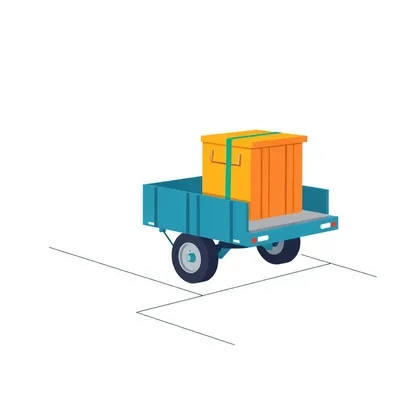
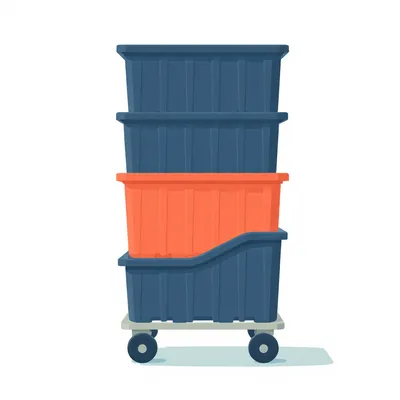
Daniel sent us this one — he's picked up a metal hand truck with pneumatic tires, which is a great piece of kit, but it's got the standard toe plate, and he's moving Euroboxes in a forty-by-sixty configuration. That's forty centimeters deep, sixty across. The toe plate doesn't match the footprint, and on an urban move with curbs and cobblestones, that mismatch is where things go wrong. His question is really two questions. First, when you're strapping a stack of four boxes, do you need a lateral ratchet strap in addition to the vertical one, or is a single wrap enough? And second, how do you actually fabricate and attach a custom-sized platform to an aluminum hand truck frame — what materials, what drill bits, what sourcing in Israel?

This is exactly the kind of problem that separates a smooth move from a sidewalk catastrophe. And I love that Daniel's thinking about it before the boxes hit the pavement, because most people don't.
Most people discover the problem when their stack is sliding off the toe plate halfway down Rehov Yafo.
So let's break this into the two things you need to get right — how you strap the boxes, and how you modify the hand truck. Because the best platform in the world won't save you if the load shifts, and the best strapping job won't help if the boxes are teetering on a toe plate that's too small.
There's a clock on this. Moving day is imminent. So we're not doing theoretical engineering here — we're doing what works, what's available, and what won't fail when you hit a five-centimeter curb with four loaded Euroboxes.
Let's start with the strapping, because that's where the physics gets interesting and where most of the conventional wisdom is wrong.
Conventional wisdom being "just crank a strap around the whole stack and call it done.
And that feels stable when you're standing in the room loading the truck. You tighten the ratchet, the boxes compress, nothing moves when you wiggle it by hand. So you think you're good.
Then you're not.
Then you're not. Here's why. A single vertical ratchet strap around the entire stack does one thing really well — it resists vertical separation. It clamps the boxes down against the toe plate, creating friction at the base. That friction resists sliding, but only up to a point. The problem is that on pneumatic tires, the hand truck isn't a rigid platform. Those tires deform and rebound with every bump and turn. That introduces lateral wobble, and lateral wobble is what causes a stacked load to rack.
Define rack for people who haven't watched their belongings slide into traffic.
Racking is when the top of the stack shifts sideways relative to the bottom. Think of a parallelogram — the boxes stay stacked, but they're no longer aligned vertically. A single vertical strap runs through the center of the stack, and when the load racks, that strap can actually pivot at the contact points between boxes. It doesn't resist shear forces at all. The strap is in tension along the vertical axis, but it's not doing anything to prevent the top box from sliding ten centimeters to the left when you take a sharp turn.
The single wrap gives you compression and base friction, but zero lateral containment.
And on a hand truck with pneumatic tires hitting a typical Jerusalem curb — let's say five centimeters — the lateral force on that top box is substantial. There's a reason you see movers do a double wrap on anything that's going over uneven ground. The vertical strap handles compression, and a lateral strap — wrapped around the entire stack horizontally, about two-thirds of the way up — prevents the boxes from shifting sideways.
That lateral strap, where exactly are you placing it?
Not at the very top, because then the boxes below can still shift. You want it roughly at the junction between the second and third box in a four-box stack. That way it's constraining the middle of the load, where the leverage is worst. If the stack starts to lean, the lateral strap catches the boxes that are trying to escape sideways.
The tradeoff, I assume, is time. A single wrap is thirty seconds. A double wrap is a couple of minutes, and you're doing this multiple times per move.
That's the real-world calculus. If you're moving boxes across a smooth parking lot in a straight line, single wrap is fine. If you're doing what Daniel's doing — urban distance, curbs, cobblestones, sharp turns, maybe a downhill section where you're fighting gravity — you need the lateral strap. The question isn't whether the single wrap will fail every time. It's that when it does fail, the failure mode is sudden and catastrophic. You don't get a warning. The stack racks, the center of gravity shifts past the edge of the toe plate, and the whole thing goes over.
Now you're picking up your belongings off the sidewalk while a bus honks at you.
Which is a very specific Jerusalem experience.
What's the actual strap spec Daniel should be using?
For a four-box Eurobox stack, you want a two-inch ratchet strap with a breaking strength of at least five hundred pounds. That's about two hundred twenty-five kilos. The working load limit on a strap like that is typically one-third of the breaking strength, so you're looking at roughly seventy-five kilos of safe working load per strap. A stack of four loaded Euroboxes can easily hit sixty or seventy kilos, so you're right at the edge of what a lighter strap can handle. Don't use those thin one-inch straps you see for securing luggage — those have breaking strengths in the hundred-pound range and they'll fail when you need them most.
Daniel mentioned the stack is stable when strapped. He said you can achieve a very stable cord. Which is true, in static conditions.
That's the trap. Static stability and dynamic stability are completely different animals. In your living room, the load isn't experiencing lateral acceleration, vibration, or the gyroscopic weirdness of pneumatic tires deforming under load. The moment you start moving, everything changes. It's like the difference between standing on a balance board versus standing on concrete. You feel stable until the board moves.
There's also the box deformation factor. Euroboxes have rims, and those rims can bite into the strap under tension.
The edges of a Eurobox — especially if they're the heavy-duty black ones with reinforced rims — can abrade a ratchet strap over multiple moves. You'll see fraying at the contact points. The fix is corner guards, those little plastic edge protectors that clip onto the box rim. They distribute the strap tension over a curved surface instead of a sharp edge. In Israel, you can find them at Ace or any hardware store that sells moving supplies. KSP has them online too. They cost almost nothing and they'll save your straps from getting chewed up.
They prevent the strap from deforming the box itself. A ratchet strap under high tension can actually bow the sides of a Eurobox inward if it's not reinforced.
Which reduces the clamping force and creates exactly the kind of slack that lets the load shift. It's a cascade failure — the box deforms, the strap loosens, the load racks, and then you're chasing boxes down the street.
The protocol is: corner guards on the box rims, vertical ratchet strap around the full stack, lateral strap at the two-three box junction, both straps rated for at least five hundred pounds breaking strength.
Check the tension after the first fifty meters of movement. The boxes settle. A quick re-tension can be the difference between a secure load and a developing problem.
That's the strapping side. Now the platform — because even with perfect strapping, if the toe plate is undersized, you're fighting physics from the start.
Let's talk about what Daniel's actually working with. A standard hand truck toe plate is typically around twenty-five by thirty-five centimeters. Daniel's Euroboxes are forty by sixty. That means the toe plate is covering less than half the footprint of the box. The box is cantilevered out over the front and sides of the plate. When the load is perfectly balanced and the ground is perfectly flat, that's manageable. But add a curb, a tilt, or a lateral shift from those pneumatic tires, and suddenly you've got a lever arm working against you.
The box isn't sitting on the plate — it's balancing on it.
The center of gravity of a forty-by-sixty box is thirty centimeters from the front edge and twenty from the side. If the toe plate only extends fifteen centimeters forward, the front half of the box is unsupported. When the hand truck tilts back for transport, the load shifts rearward, which helps — but on pneumatic tires, the tilt angle isn't constant. Every bump changes the angle, and every change in angle shifts the load distribution. A platform that matches the box footprint eliminates that variable entirely.
Daniel's instinct is right — fabricate a platform at exactly forty by sixty, add anti-slip matting, and attach it to the existing toe plate. The question is how.
The "how" depends on material choice, which depends on what's available and what tools Daniel has access to. Let's talk wood first, because it's the easier path.
Daniel specifically mentioned getting a piece of wood cut and drilling into the metal.
Which is a completely viable approach. The material I'd recommend is twelve-millimeter marine-grade plywood — Okoume or Birch. Marine ply is lightweight, it's strong, it doesn't delaminate when it gets wet, and it's easy to work with. A forty-by-sixty piece of twelve-millimeter marine ply weighs about two and a half kilos. That's negligible added weight on the hand truck.
Sourcing in Israel?
Any decent lumber yard. Keren Kayemet, Mifal Ha'etz — they'll cut to size on the spot. Ace Hardware also carries plywood sheets and will do cuts, though their selection of marine grade specifically can be hit or miss. If Daniel wants to go the plywood route, he can walk into an Ace, buy a piece, have it cut to sixty by forty centimeters, and walk out with the platform ready to drill. Cost is maybe thirty shekels.
Thirty shekels and it's done. That's hard to argue with.
It really is. The downside is that plywood, even marine grade, will eventually wear. The edges can chip, water can seep in if the seal is compromised, and after a couple of years of heavy use it might need replacing. But for a moving-day solution that you can fabricate in an afternoon, it's perfect.
The alternative is metal.
Metal is the permanent solution. Three-millimeter aluminum sheet, specifically five-zero-five-two alloy. It's corrosion-resistant, it's strong, and at three millimeters it's rigid enough to support a heavy load without flexing. A forty-by-sixty piece of three-millimeter aluminum weighs about two kilos — actually lighter than the plywood.
Harder to source and harder to work with.
You're not cutting three-millimeter aluminum with a jigsaw in your apartment. You need either a metal-cutting circular saw with the right blade, or you go to a laser cutting service. In Israel, there are shops like Laser Cut Israel and Plasma Cut that will take a DXF file or even just the dimensions and cut a forty-by-sixty piece from aluminum sheet. Cost is roughly fifty to a hundred shekels for a single piece, depending on the shop and the alloy.
If you don't want to go the custom laser cutting route, are there off-the-shelf options?
Metal suppliers like Metalink or Tzomet Metalim sometimes carry pre-cut sheets in standard sizes. Forty by sixty isn't a standard sheet size, but they might have offcuts or be willing to do a single cut. It's worth calling and asking. The phrase in Hebrew is "gilyon aluminiyum arba'im al shishim" — aluminum sheet forty by sixty. If they have it, you're paying for the material and maybe a small cutting fee.
Now you've got your platform — plywood or aluminum. How do you attach it to the existing toe plate?
This is where the drilling comes in, and this is where people get into trouble with aluminum. The hand truck frame is aluminum, and drilling aluminum is not the same as drilling wood or steel.
What's the specific problem?
Aluminum is soft and sticky. When a drill bit heats up — and it heats up fast — aluminum can adhere to the cutting edge of the bit. The bit gums up, stops cutting, and then grabs. When it grabs, it can yank the workpiece out of your hand or snap the bit. The fix is three things: the right bit, the right speed, and cutting oil.
Walk me through the bits.
Cobalt or titanium-coated drill bits are what you want for aluminum. Cobalt bits — specifically M35 or M42 cobalt steel — hold their hardness at high temperatures and resist the galling problem. Titanium-coated high-speed steel bits also work well and they're easier to find. A step bit — something like the Irwin Unibit — is particularly good for thin aluminum because it doesn't grab the way a twist drill can. The stepped profile means it's cutting a gradually enlarging hole rather than punching through all at once.
Five hundred to a thousand RPM. If you're using a cordless drill, that's roughly the low speed setting with the trigger pulled about halfway. The instinct with metal is to go fast, and that's exactly wrong for aluminum. High speed generates heat, heat causes galling, galling ruins the hole and potentially the bit. Slow and lubricated.
The cutting oil — what are we using?
Any cutting oil will work. WD-40 in a pinch — it's not ideal but it's better than nothing. The point is to keep the cutting edge cool and prevent the aluminum from welding itself to the bit. Apply it liberally, reapply as you go, and don't rush.
The process is: clamp the platform to the toe plate, mark four hole positions — probably one in each corner — and drill through both the platform and the existing toe plate in one go.
That's the cleanest method. Drill through the wood or aluminum platform first, then continue through the hand truck's toe plate. If the toe plate is thicker aluminum, the step bit will handle the transition without grabbing. Once the holes are drilled, you bolt it together.
The bolt spec?
M6 stainless steel bolts, about twenty to twenty-five millimeters long depending on the combined thickness of your platform and the toe plate. Use a flat washer under the bolt head, a lock washer, and a nylon-insert lock nut on the underside. The nylon insert prevents the nut from vibrating loose over time, which is important because a hand truck on urban pavement is basically a vibration machine. Four bolts, one in each corner, torqued down evenly.
Then the anti-slip matting on top.
Rubber drawer liner works — the kind you can buy at any hardware store or even a supermarket. Cut it to size and either glue it down or just let the weight of the boxes hold it in place. If you want something more permanent, commercial grip tape — the kind used on stairs and ramps — is available at Ace or online. It's essentially sandpaper with an adhesive backing. It won't shift, and it provides serious friction even when the platform is tilted.
Now, Daniel raised an alternative — what about adhesive instead of drilling? Just bond the platform to the toe plate.
He mentioned that possibility, and I understand the appeal. Drilling into a brand-new hand truck feels wrong. But for loads over fifty kilos — and a four-box Eurobox stack is easily in that range — bolting is significantly more reliable. Adhesives like 3M VHB tape are impressive. They're used in construction and automotive applications. But they're sensitive to surface preparation, temperature, and peel forces. A hand truck platform experiences exactly the kind of peel forces that adhesives are weakest against — the edge of the platform gets levered upward every time the load shifts or the truck goes over a bump. Over time, that peeling action can propagate and the bond fails without warning.
Whereas a bolt fails visibly — you'll see it loosen before it gives way.
With bolting, you can inspect it. You can re-torque it. You can see if a lock washer has compressed. Adhesive failure is invisible until it's catastrophic. For a permanent modification that's going to carry heavy loads over uneven terrain, I'd bolt every time.
The recommendation is: marine plywood for speed and cost, aluminum for permanence, bolt it with M6 stainless hardware using a step bit and cutting oil, and don't trust adhesive for this application.
That's the core of it. And the sourcing in Israel is straightforward — Ace for plywood and hardware, Metalink or a laser cutting service for aluminum, and any hardware store for the bolts, washers, and cutting oil.
There's one more thing Daniel asked about — whether you can find pre-cut, smooth, angled forty-by-sixty pieces suitable for this purpose. Something off the shelf.
Angled pieces — meaning something with a lip or a bend — that's harder. Standard aluminum sheet comes flat. If you want a bent edge for rigidity or to create a lip that prevents boxes from sliding forward, you'd need a press brake, which is a metalworking tool that most people don't have access to. Some laser cutting shops offer bending services as well — you'd send them the file, they'd cut the sheet and put a ninety-degree bend along the front edge. That adds cost and complexity. For a moving application, I'd argue a flat platform with anti-slip matting does the job without the need for a lip. The matting provides the friction, and the lateral strap prevents forward shift.
The angled piece is probably over-engineering it.
For this use case, yes. If Daniel were building a permanent fixture for a warehouse where boxes are being slid on and off hundreds of times a day, the lip would make sense. For a DIY moving solution, flat with grip tape is the sweet spot.
That brings us to the practical checklist. Before moving day, you're sourcing the platform material, getting it cut, drilling four holes through the platform and the toe plate, bolting it together, applying anti-slip matting, and then on moving day itself, you're using corner guards, a vertical strap, and a lateral strap on every load.
Re-tensioning after the first fifty meters. Don't skip that step.
It's remarkable how much engineering goes into what looks like a simple thing — moving boxes from one place to another.
That's what I love about this kind of problem. It's not glamorous. Nobody's going to write a think piece about ratchet strap configurations. But when you're the person on the sidewalk with four Euroboxes and a hand truck, and everything holds, and the move goes smoothly — that's real satisfaction.
The quiet dignity of a load that doesn't shift.
To wrap up the strapping side — and we'll dig into the platform fabrication in more detail — the physics here is straightforward once you see it. A vertical strap resists vertical separation. A lateral strap resists shear. You need both when the ground isn't perfect and the tires aren't rigid. And the failure pattern isn't gradual — it's sudden, it's messy, and it happens at the worst possible moment.
The platform side, the key decisions are material and attachment. Plywood is cheap, fast, and replaceable. Aluminum is permanent and weatherproof. Either way, you're bolting it, not gluing it, and you're using the right bits and technique for aluminum because galling is real and it will ruin your afternoon.
Daniel's instinct to modify the hand truck rather than live with the mismatch is the right one. Most people just accept the limitation and deal with the instability. A custom platform and proper strapping turn a generic hand truck into a purpose-built tool for the exact load you're moving.
That's the difference between a move where you're fighting your equipment and a move where the equipment disappears and you just get the job done.
We've established the strapping protocol and the platform concept. But let's step back and look at the problem Daniel's actually solving here, because it's bigger than one move.
The standard hand truck toe plate — and I pulled the specs on this — is typically around twenty-five by thirty-five centimeters. That's the industry default. A forty-by-sixty Eurobox has a footprint of two thousand four hundred square centimeters. The toe plate covers less than nine hundred of that. You're supporting maybe a third of the box's base.
Which means two-thirds of the box is floating.
And when you tilt the hand truck back for transport, the load shifts toward the frame, which helps — but only if the tilt angle stays constant. On pneumatic tires over uneven ground, the angle is constantly changing. Every time the tire compresses and rebounds, the load distribution shifts. That unsupported front edge of the box is seesawing.
The real risk isn't just that the box might tip forward. It's that the instability compounds with every bump.
Think of a stack of four boxes on an undersized plate. The bottom box is partially supported. The three boxes above it are supported only by the box beneath them. If the bottom box shifts even a few centimeters — because the plate doesn't extend far enough to catch it — the entire stack's center of gravity moves. Now you've got roughly sixty or seventy kilos of load whose balance point is wandering around on a platform that was too small to begin with.
That's before we even get to the strapping question. The platform problem and the strapping problem are connected.
They're completely connected. A properly sized platform gives the straps a stable base to work against. Without it, you're asking the straps to compensate for a fundamental geometry problem. Straps can prevent boxes from separating or sliding sideways, but they can't fix the fact that the entire load is teetering on an undersized plate.
This isn't a convenience upgrade. This is the difference between the equipment working as a system and the equipment fighting itself.
That's the right way to frame it. A hand truck with pneumatic tires, a custom platform, and a two-strap configuration is a system where each part does its job. The tires absorb shock. The platform provides a full-footprint base. The vertical strap maintains compression. The lateral strap prevents shear. Take any one of those away and the others have to compensate in ways they weren't designed for.
Daniel's situation makes this particularly acute because he's doing an urban move. Curbs, cobblestones, uneven sidewalks, maybe a stretch of asphalt with potholes. This isn't a warehouse floor.
In a warehouse with smooth concrete and no curbs, you could get away with the stock toe plate and a single vertical strap. The forces are predictable. But the moment you're on a Jerusalem sidewalk — and I've walked enough of them to know — you're dealing with surfaces that were laid decades ago, tree roots pushing up through the pavers, sudden drops at crosswalks. The load is getting jostled in three dimensions.
What Daniel's really asking is: how do I retrofit a general-purpose tool into a purpose-built tool for this specific job, in this specific environment, on a timeline?
That's why the two-part approach makes sense. Part one is the strapping — that's the immediate moving-day protocol. You can implement it with gear you buy off the shelf. Part two is the platform — that's the hardware modification that makes the hand truck fit the boxes rather than the other way around.
We'll get into the step-by-step for that platform fabrication. The material choices, the drilling technique, where to source everything in Israel.
The sourcing piece is important because it's easy to describe a perfect solution that requires tools or materials nobody can actually find. Daniel's asking a practical question. He needs answers that work with what's available locally.
Which is why we're going to walk through both paths — the plywood route and the aluminum route — with specific suppliers and specific techniques for each.
The attachment method. Because bolting through an aluminum frame is not the same as bolting through wood, and getting that wrong means a ruined hand truck or a platform that fails under load.
Let's get into the details.
Let's start with the strapping, because even the best platform won't save you if the load shifts mid-move.
Daniel's already discovered that a single vertical wrap feels solid when you're standing still. The boxes compress, nothing budges. You think you're done.
That's the trap. Static stability versus dynamic stability. In your living room, the load isn't experiencing lateral acceleration. The moment those pneumatic tires hit uneven ground, everything changes. The tires deform and rebound, the hand truck tilts and corrects, and suddenly the stack is experiencing shear forces that the vertical strap was never designed to resist.
Walk me through what actually happens. I've got four Euroboxes, one ratchet strap wrapped vertically around the whole stack, cranked down tight. I hit a curb.
The failure pattern is called racking. Picture the stack from the side. The bottom box is pressed against the toe plate — friction is holding it in place. But the boxes above it? They're only held by the compression from the strap and whatever friction exists between the box surfaces. When you hit a five-centimeter curb at an angle, the hand truck jolts sideways. The pneumatic tire compresses on one side, the frame tilts, and the top box — which has the most leverage — starts sliding laterally relative to the one beneath it.
The vertical strap doesn't stop this because it's running through the center.
The strap is in tension along the vertical axis. It resists the boxes pulling apart upward. But when the top box shifts sideways, the strap can actually pivot at the contact points between boxes. It's not resisting shear at all. The top box can slide ten centimeters to the left while the strap stays perfectly tight vertically. The stack becomes a parallelogram, the center of gravity shifts past the edge of the toe plate, and the whole thing goes over.
The single wrap gives you compression and base friction, but zero lateral containment.
And on a Jerusalem sidewalk with tree roots pushing up through the pavers, that lateral force hits repeatedly. It's not one big jolt — it's death by a thousand tiny shifts. Each bump nudges the top box a few millimeters. After twenty meters, you've got a stack that's visibly leaning.
The fix is a second strap wrapped horizontally.
A lateral strap, wrapped around the entire stack horizontally. Placement matters here — you don't want it at the very top, because then the boxes below can still shift independently. The sweet spot is roughly at the junction between the second and third box in a four-box stack, so about two-thirds of the way up. That constrains the middle of the load where the leverage is worst.
Why not just do two lateral straps — one at the midpoint and one near the top?
You could, and for a really precarious route I wouldn't argue against it. But each additional strap adds time, and on moving day you're doing this at both ends of every trip. The single lateral strap at the two-three junction catches the boxes that are trying to escape sideways while the vertical strap maintains compression. It's the minimum viable configuration that actually works.
The time difference is real. A single wrap is thirty seconds. A double wrap is maybe two minutes once you're practiced. Over twenty trips, that's the difference between finishing at three in the afternoon and finishing at four.
Which is why I'd say: if you're moving across a smooth parking lot in a straight line, single wrap is fine. The forces are predictable and the tires aren't getting hammered. But Daniel's doing an urban move — curbs, cobblestones, sharp turns, probably a downhill stretch where you're fighting gravity and the load wants to surge forward. That's double-wrap territory. The question isn't whether the single wrap will fail every time. It's that when it does fail, the failure is sudden and catastrophic.
The stack racks, the center of gravity crosses the tipping point, and now your boxes are on the pavement.
The worst part is, it usually happens at the worst possible moment — crossing a street, navigating a narrow gap, anywhere you can't just stop and reset. You're committed to the move, the load is shifting, and you're trying to muscle it back to stability while a bus honks at you.
Which is a very specific Jerusalem experience.
So what's the actual strap spec? For a four-box Eurobox stack, you want a two-inch ratchet strap with a breaking strength of at least five hundred pounds — that's about two hundred twenty-five kilos. The working load limit on a strap like that is typically one-third of the breaking strength, so roughly seventy-five kilos of safe working load. A stack of four loaded Euroboxes can easily hit sixty or seventy kilos. You're right at the edge of what a lighter strap can handle.
Don't use those thin one-inch straps meant for luggage.
Those have breaking strengths in the hundred-pound range. They'll fail when you need them most, and the failure pattern on an overloaded ratchet strap is violent — the webbing tears, the ratchet mechanism can shatter, and suddenly you've got zero containment on a moving load.
There's another failure point you mentioned earlier — the box rims chewing up the strap.
Euroboxes, especially the heavy-duty black ones with reinforced rims, have sharp edges. Under tension, those edges act like a knife against the strap webbing. Over multiple moves, you'll see fraying exactly where the strap crosses the box corners. The fix is corner guards — little plastic edge protectors that clip onto the rim and provide a curved surface for the strap to ride against. They distribute the tension over a wider area and prevent both strap abrasion and box deformation.
Box deformation matters because?
Because a ratchet strap under high tension can actually bow the sides of a Eurobox inward. When the box deforms, the strap loses tension. And slack is what lets the load start shifting in the first place. It's a cascade — the box bows, the strap loosens, the load racks, and then you're chasing boxes down the street.
Corner guards aren't optional if you're doing this repeatedly.
They cost almost nothing and they save your straps. In Israel, Ace carries them in the moving supplies section. KSP has them online. You can also find them at any hardware store that sells packing materials. Get a set of eight — four for the vertical strap contact points, four for the lateral.
One more thing about the strapping protocol — you said re-tension after the first fifty meters.
Critical step that everyone skips. The boxes settle. The webbing stretches slightly under load. After you've moved fifty meters, stop and check the tension. You'll usually get another half-click or full click on the ratchet. That re-tension can be the difference between a secure load and a developing problem that you won't notice until it's too late.
The full protocol: corner guards on the box rims, vertical strap around the full stack, lateral strap at the two-three box junction, both straps rated for five hundred pounds breaking strength minimum, re-tension after fifty meters.
If you're doing a move with multiple trips, check the straps between trips too. The webbing can relax as it cools down if it's been sitting in the sun. This isn't set-and-forget. It's active load management.
Which sounds fussy until you've watched a stack of boxes slide off a hand truck in slow motion.
Then it sounds like the most reasonable thing in the world.
Now let's talk about the platform itself. Daniel's got the right instinct — a forty-by-sixty platform that matches the box footprint, attached to the existing toe plate. The question is what to make it from and how to attach it.
He mentioned wood as the starting point. Cut a piece, drill through it into the metal frame.
Which is the path I'd recommend for most people, especially on a timeline. Twelve-millimeter marine-grade plywood — Okoume or Birch. Marine ply doesn't delaminate when it gets wet, it's strong, and a forty-by-sixty piece weighs about two and a half kilos. Negligible on the hand truck.
Sourcing this in Israel isn't complicated.
Not at all. Any lumber yard — Keren Kayemet, Mifal Ha'etz — they'll cut to size on the spot. Ace Hardware carries plywood sheets too and they'll do cuts, though their marine-grade selection can be hit or miss. You walk in, buy the piece, have it cut to sixty by forty, walk out. Cost is maybe thirty shekels. You're done in twenty minutes.
Thirty shekels and it's a finished platform, ready for drilling.
The downside is longevity. Even marine ply will eventually chip at the edges, and if the seal gets compromised, water works its way in. After a couple of years of heavy use, you might need to replace it. But for a moving-day solution you can fabricate in an afternoon, it's hard to beat.
The metal alternative?
Three-millimeter aluminum sheet, five-zero-five-two alloy. Corrosion-resistant, rigid enough for heavy loads, and surprisingly light — a forty-by-sixty piece of three-millimeter aluminum actually weighs less than the plywood, about two kilos. But you're not cutting this with a jigsaw in your apartment. You need a metal-cutting circular saw with the right blade, or you go to a laser cutting service.
Which exist in Israel for small jobs like this?
Shops like Laser Cut Israel and Plasma Cut will take a DXF file or even just the dimensions and cut a forty-by-sixty piece from aluminum sheet. Cost runs roughly fifty to a hundred shekels for a single piece, depending on the shop and the alloy. You email them the specs, they cut it, you pick it up or they ship it.
If you don't want to go the custom route, are there off-the-shelf options?
Metal suppliers like Metalink or Tzomet Metalim sometimes carry pre-cut sheets and offcuts. Forty by sixty isn't a standard sheet size, but they might have something close or be willing to do a single cut. The phrase you'd use is "gilyon aluminiyum arba'im al shishim" — aluminum sheet forty by sixty. Worth calling and asking. If they've got it, you're paying for the material and maybe a small cutting fee.
Now you've got your platform — wood or aluminum. The attachment is where people get into trouble, because the hand truck frame is aluminum, and drilling aluminum is not the same as drilling wood or steel.
The problem is galling. Aluminum is soft and sticky. When a drill bit heats up — and it heats up fast — aluminum can weld itself to the cutting edge. The bit gums up, stops cutting, and then grabs. When it grabs, it can yank the workpiece out of your hand or snap the bit. The fix is three things: the right bit, the right speed, and cutting oil.
Walk me through the bits specifically.
Cobalt or titanium-coated drill bits are what you want. Cobalt bits — M35 or M42 cobalt steel — hold their hardness at high temperatures and resist galling. Titanium-coated high-speed steel bits also work well and they're easier to find at any hardware store. But the real star here is a step bit — something like the Irwin Unibit. A step bit doesn't grab the way a twist drill can because it's cutting a gradually enlarging hole rather than punching through all at once. For thin aluminum like a toe plate, it's almost foolproof.
Five hundred to a thousand RPM. On a cordless drill, that's the low speed setting with the trigger pulled about halfway. The instinct with metal is to go fast, and that's exactly wrong for aluminum. High speed generates heat, heat causes galling, galling ruins the hole and potentially the bit. Slow and lubricated.
The cutting oil — what are we actually using?
Any proper cutting oil works. WD-40 in a pinch — it's not ideal but it's better than nothing. The point is to keep the cutting edge cool and prevent aluminum from adhering to the bit. Apply it liberally, reapply as you go, and don't rush the cut.
The process: clamp the platform to the toe plate, mark four hole positions — one in each corner — and drill through both in one pass.
That's the cleanest method. Drill through the platform material first, then continue through the aluminum toe plate. If you're using a step bit, it'll handle the transition without grabbing. Once the holes are drilled, you bolt it together with M6 stainless steel bolts, about twenty to twenty-five millimeters long depending on combined thickness. Flat washer under the bolt head, lock washer, and a nylon-insert lock nut on the underside. The nylon insert prevents the nut from vibrating loose — and a hand truck on urban pavement is basically a vibration machine.
Four bolts, one in each corner, torqued down evenly.
Then the anti-slip matting on top. Rubber drawer liner works — the kind you can buy at any hardware store or even a supermarket. Cut it to size and either glue it down or let the weight of the boxes hold it. If you want something more permanent, commercial grip tape — the kind used on stairs and ramps — is available at Ace. It's essentially sandpaper with adhesive backing. It won't shift, and it provides serious friction even when the platform is tilted.
Daniel floated an alternative — adhesive instead of drilling. Just bond the platform to the toe plate.
I understand the appeal. Drilling into a brand-new hand truck feels wrong. But for loads over fifty kilos — and a four-box Eurobox stack is easily in that range — bolting is significantly more reliable. Adhesives like 3M VHB tape are impressive stuff. They're used in construction and automotive applications. But they're sensitive to surface preparation, temperature, and peel forces. A hand truck platform experiences exactly the kind of peel forces that adhesives are weakest against — the edge of the platform gets levered upward every time the load shifts or the truck goes over a bump. Over time, that peeling action propagates and the bond fails without warning.
Whereas a bolt fails visibly. You'll see it loosen before it gives way.
You can inspect it. You can re-torque it. Adhesive failure is invisible until it's catastrophic. For a permanent modification carrying heavy loads over uneven terrain, I'd bolt every time.
Daniel also asked about pre-cut, smooth, angled forty-by-sixty pieces — something with a lip or a bend already in it.
That's harder to find off the shelf. Standard aluminum sheet comes flat. If you want a bent edge — say a ninety-degree lip along the front to prevent boxes from sliding forward — you'd need a press brake, which most people don't have access to. Some laser cutting shops offer bending services too, but it adds cost and complexity. For a moving application, a flat platform with anti-slip matting does the job without the lip. The matting provides the friction, and the lateral strap prevents forward shift.
The angled piece is probably over-engineering it for this use case.
For a DIY move, yes. If Daniel were building a permanent warehouse fixture where boxes slide on and off hundreds of times a day, the lip would make sense. For this, flat with grip tape is the sweet spot.
The recommendation is: marine plywood for speed and cost, aluminum for permanence, bolt it with M6 stainless hardware using a step bit and cutting oil, and don't trust adhesive for this application.
The sourcing in Israel is straightforward — Ace for plywood and hardware, Metalink or a laser cutting service for aluminum, any hardware store for the bolts, washers, and cutting oil. None of this requires special connections or industrial accounts.
To wrap it all up, here are the three things you should do before your next move. One: always use a lateral ratchet strap in addition to the vertical one when you're moving stacked Euroboxes on pneumatic tires over urban terrain. The lateral strap prevents racking, and racking is the failure pattern that catches everyone off guard because the load feels stable when you're standing still.
The single wrap is the "looks fine in the driveway" solution. It's not fine at the first curb.
Two: for the DIY platform, start with twelve-millimeter marine plywood. It's cheap — thirty shekels — it's easy to cut, and if it gets damaged after a couple of years, you replace it. Upgrade to three-millimeter aluminum only if you need a permanent, weatherproof solution that'll live on the truck forever.
Plywood is the sensible default. Aluminum is the long-game move.
Three: when you're drilling into that aluminum frame, use a step bit with cutting oil and keep the speed low — five hundred to a thousand RPM. Cobalt or titanium-coated bits resist galling. Don't rush the cut, don't skip the lubrication, and bolt the platform with M6 stainless hardware and nylon-insert lock nuts. Adhesive alone is not your friend above fifty kilos.
Sourcing-wise, you're not hunting for exotic materials. Ace or a lumber yard for plywood. Metalink or a laser cutting service for aluminum. Any hardware store for the bolts and bits. This is all available locally without special orders.
The through-line across all three of these is that the failure pattern are invisible until they're not. A single strap feels tight. A small toe plate looks manageable. An adhesive bond seems solid. And then the curb hits, the load shifts, and you're on the sidewalk reassessing your life choices.
The quiet dignity of a load that doesn't shift. That's what we're after.
One thing I keep turning over — Daniel's modifying a hand truck for a specific load size. But what about the next move, when the boxes are a different dimension? You've now got a forty-by-sixty platform bolted on, and suddenly you're moving something narrower.
That's the tradeoff with a fixed platform. You optimize for the load you have, and you lose flexibility for everything else. Which is why I wonder whether a hinged or foldable platform would be the better long-term solution — something that can expand to forty-by-sixty when you need it and fold down to the stock toe plate size when you don't.
A fold-out wing on each side, essentially. Deploy them for Euroboxes, tuck them away for everything else.
The engineering gets more complicated — you need hinges rated for the load, a locking mechanism that won't rattle loose, and the folded configuration has to be flat enough that it doesn't snag on things. But it's not impossible. Marine-grade stainless piano hinge along the sides of the existing toe plate, with fold-out aluminum wings that lock into place with spring-loaded pins. When they're folded in, they sit flush against the frame.
Somebody's already thinking about this, I'd bet. The aftermarket for hand truck accessories is surprisingly thin for how many people use them.
It really is. And as urban DIY moving becomes more common — people doing their own moves in dense cities where hiring a truck and crew is expensive or logistically painful — I think we'll see more of these aftermarket solutions. Custom toe plates in standard Eurobox dimensions. Modular strap systems with quick-release buckles designed specifically for stacked containers. Anti-slip mats pre-cut to common load footprints.
The hand truck equivalent of peak bag accessories — everyone finds the gaps and fills them.
Somebody's going to start selling a bolt-on platform kit with pre-drilled aluminum sheet, stainless hardware, and grip tape, and they'll clean up. The demand is there. Daniel's not the only person in Jerusalem staring at a mismatched toe plate and thinking "there has to be a better way.
If any listeners have built their own modifications — custom platforms, strap configurations, fold-out designs — send them in. We want to see what you've come up with. Show at my weird prompts dot com.
Now: Hilbert's daily fun fact.
Hilbert: In the late Victorian period, the French botanist Gaston Bonnier claimed to have discovered a vast subterranean fungal network spanning the entire Lake Chad basin. He published detailed maps of what he called the "Chadian mycelial superorganism." Forty years later, a British expedition discovered Bonnier had actually mapped the root systems of several thousand unconnected acacia trees and simply drawn lines between them on paper.
That's one way to get published.
Cartography by wishful thinking.
This has been My Weird Prompts. I'm Corn.
I'm Herman Poppleberry. You can find every episode at my weird prompts dot com, and if you've built something that solves a problem like this one, we want to hear about it.
Don't let the toe plate be the boss of you.