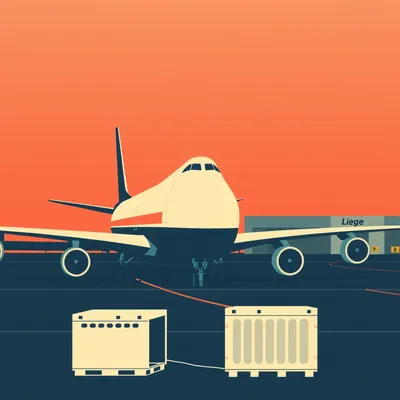
Daniel sent us this one — he's been thinking about the parallels between physical data couriers, which we've touched on before, and the world of emergency organ transplant logistics. When a donor match happens across borders, or even across a country, someone has to physically get that organ from point A to point B. Police escorts, commercial flights, the whole thing. He wants to talk about how that emergency logistics machine actually works, and the medical couriers who make it happen — the unsung heroes of the operation.

Oh, this is one of those systems where the more you learn about it, the more it feels like the entire thing shouldn't work — and yet it does, every single day, with lives literally hanging on the clock.
The clock being the part that makes my stomach drop. Organs don't exactly have a long shelf life.
They absolutely do not. And that's really the central tension of this entire field. Every organ has what's called cold ischemia time — the window between when blood flow stops in the donor and when it's restored in the recipient. For a heart, you're looking at four to six hours. Lungs, about the same. Liver, maybe eight to twelve. Kidneys are the champions here — they can push to twenty-four, sometimes thirty-six hours with the right preservation techniques. But every minute that ticks by, the organ is degrading at a cellular level. This isn't a package that can sit in a warehouse.
Four to six hours for a heart. That's a dinner party, not a shipping window.
That's exactly why the courier system exists the way it does. You can't FedEx a heart. Well, technically you can — and sometimes they do use commercial cargo — but the point is, someone has to hand-carry it through every checkpoint, every security line, every boarding gate. The courier is the logistics system. They're not just carrying a cooler. They're the human decision layer that adapts when the flight gets delayed, when the connecting gate changes, when the GPS route to the hospital is blocked by construction.
Walk me through what actually happens. A donor match is confirmed. What's the sequence?
Alright, so it starts with an organ procurement organization — an OPO. In the United States, there are fifty-seven of them, each covering a designated region. When a donor becomes available, the OPO coordinates with the United Network for Organ Sharing, UNOS, which runs the national matching algorithm. The moment a match is confirmed, the procurement surgical team mobilizes. Meanwhile, a transplant coordinator is simultaneously activating a courier. Sometimes that courier is already on standby. Sometimes they're getting a call at two in the morning and have to be at the airport in forty-five minutes.
Who are these people? Are they surgeons? Someone with a very specific LinkedIn profile?
It varies, and that's actually part of what makes the system fascinatingly ad hoc. Some are specialized medical couriers who do nothing but this — they work for companies like STAT Courier or Medical Courier Services. Some are transplant coordinators themselves, often nurses or physician assistants who've been trained in organ preservation and transport protocols. And in certain cases, particularly for international transports, you'll see perfusionists — these are the specialists who can actually maintain the organ on a perfusion pump during transit, keeping it oxygenated and metabolically active.
A perfusion pump. So instead of just keeping it cold in a cooler, you're essentially keeping the organ alive?
This is one of the biggest advances in the last decade. Traditional cold storage means flushing the organ with a preservation solution, packing it in sterile ice, and racing the clock. But ex vivo perfusion — literally "out of the body" perfusion — connects the organ to a device that pumps oxygenated blood or a blood substitute through it. The organ keeps functioning. For hearts, there's the TransMedics Organ Care System, which got FDA approval in 2021. You can actually see the heart beating inside this sterile box while it's being wheeled through an airport. For lungs, there's the XVIVO perfusion system. For livers, there are several competing devices. These systems can extend preservation time significantly — sometimes doubling the window.
You've got a beating heart in a box going through TSA.
This is where it gets genuinely surreal. The courier has to navigate airport security with a device that contains human tissue, sometimes a visibly functioning organ, with strict temperature and sterility requirements. The Transportation Security Administration actually has protocols for this. The courier carries documentation — UNOS authorization forms, a letter of medical necessity, certification that the container is sterile and sealed. The organ cooler or perfusion device cannot go through the X-ray machine. It gets a manual visual inspection. And TSA agents are trained — theoretically — to recognize these situations and expedite the process.
I've read reports from couriers who've had to argue with security personnel who wanted to open the sterile container. One courier described standing at a checkpoint explaining to a TSA agent that no, you cannot swab the inside of a heart transport box for explosive residue, because that would contaminate a human organ destined for a patient currently in an operating room with their chest open.
That's the kind of stress that would turn me into a permanent nap situation.
The courier has to remain calm, because any delay cascades. If they miss their flight because of a twenty-minute security argument, the recipient might die. There's no backup organ. The match was specific — blood type, tissue typing, antibody crossmatching, body size, geographic proximity, medical urgency. The algorithm calculated all of this. The surgical teams on both ends are scrubbed and waiting. The courier is the single point of failure in a multimillion-dollar life-or-death chain.
What happens when the flight gets delayed? Because flights get delayed all the time.
This is where the system reveals its redundancies — and its gaps. If the courier is on a commercial flight, they're typically booked on the earliest available direct route. But weather happens. Mechanical issues happen. In those cases, the transplant coordinator back at the OPO is working the phones in real time. They might rebook the courier onto a different airline. They might coordinate with the airline's operations center to hold a connecting flight — and yes, airlines do hold flights for organs, though it's not guaranteed and it's entirely at the airline's discretion. There's no federal mandate requiring them to do so.
There should be.
I agree, and it's been proposed multiple times. The Organ Transport Act was introduced in Congress in 2023, which would have required commercial airlines to prioritize organ shipments and create standardized protocols. It didn't pass. As of now, it's still a patchwork of airline-specific policies and goodwill. Some airlines are excellent about it — Delta and United have dedicated transplant desks. Others are less reliable. Couriers learn which airlines to trust and which to avoid.
The courier has to be part logistics coordinator, part medical professional, part negotiator.
Part just plain lucky. I read a case study from 2019 where a kidney was being transported from California to New York. The courier's flight got diverted to Chicago due to a storm. They landed at O'Hare with no connecting flight available for hours. The transplant coordinator ended up contacting the Illinois State Police, who provided a ground escort from O'Hare to a regional airport where a private charter was arranged. The kidney arrived with less than an hour to spare on its cold ischemia window. The transplant was successful.
That's a movie. A stressful, extremely bureaucratic movie.
It's not even the most dramatic one. There's a well-known case from 2018 where a heart was being transported from Alaska to Seattle. The flight encountered mechanical trouble and had to return to Anchorage. The courier and the heart — which was on a perfusion device — sat on the tarmac for two hours while a replacement aircraft was scrambled. The recipient's surgical team in Seattle was updated minute by minute. They had already opened the recipient's chest. They were waiting. The heart arrived after nearly seven hours of total preservation time, which at that point was pushing the absolute limit even with perfusion. The transplant went forward, and it worked, but the surgeon later said they were about fifteen minutes from calling it.
What's the protocol when time runs out? Does someone make the call to abort?
The transplant surgeon makes that call, in consultation with the team and the recipient — if the recipient is conscious and able to consent. If the organ arrives and the surgeon determines that the ischemic damage is too severe, they will decline the organ. The recipient is closed back up and goes back on the waiting list. It's devastating. The courier, by the way, is often the one who has to hand over the cooler knowing the outcome is uncertain. There's a psychological weight to this job that doesn't get discussed enough.
I was about to ask about that. What's the emotional toll on someone who does this regularly?
From what I've read and from interviews with couriers, it's a mix of intense purpose and constant low-grade trauma. These are people who understand, with absolute clarity, that their performance on any given day determines whether someone lives or dies. Most couriers I've read about describe a kind of hyperfocus that kicks in — they're not thinking about the stakes in the moment, they're thinking about gate numbers and traffic patterns and whether the ice is holding temperature. But afterwards, there's a crash. Some couriers attend the transplant surgeries when they can, or meet recipients afterwards. Others keep strict emotional distance because the losses are too hard.
These aren't necessarily surgeons or highly credentialed medical professionals. Some are just people who happened to get trained for this.
The certification requirements vary by organization. Some require a clinical background — paramedic, nurse, perfusionist. Others will train anyone with a clean background check, a valid passport, and the right temperament. The training covers organ handling, sterile technique, temperature monitoring, documentation, emergency protocols, and — crucially — how to navigate airports and border crossings with human tissue. International transports add another layer entirely. You're dealing with customs declarations for human organs, which are classified differently than medical devices or pharmaceuticals. Some countries require import permits for human tissue. The courier has to know all of this in advance, because you cannot have a customs agent impounding a liver at the border.
Of course not. Although I'm sure it's happened.
There was an incident in 2017 where a kidney being transported from India to the Philippines was held up in customs in Manila for six hours because the paperwork listed it as "human tissue" rather than specifying "organ for transplant." The recipient died waiting. That case led to protocol reforms in several Southeast Asian countries, but the point stands — the legal and bureaucratic infrastructure is just as critical as the medical infrastructure, and it's often the weaker link.
We've got commercial flights, police escorts, private charters. What about military transport? Does that ever come into play?
It does, though it's less common and usually reserved for high-profile or national-interest cases. In the United States, the Department of Defense has occasionally provided transport for organs when the recipient is a service member or a veteran, or when the transplant is part of a research protocol with military applications. There's also the Civil Air Patrol, which is a volunteer civilian auxiliary of the Air Force — they've been used for organ transport in rural areas where commercial flights aren't available. And in Israel, where we're sitting right now, the system is fascinatingly compact.
Israel's always an interesting case for emergency logistics.
Because the country is so small geographically, you'd think organ transport would be simple — just drive it. And often that's exactly what happens. Magen David Adom, the national emergency medical service, coordinates with the National Transplant Center. An ambulance or a MDA motorcycle unit transports the organ. Police escorts are routine for time-critical transports, especially through Tel Aviv traffic. But Israel also participates in international organ exchange networks, particularly for hard-to-match recipients. So you'll have Israeli couriers flying to Cyprus, to Germany, to the United States, and vice versa.
The motorcycle unit is a nice touch. Very action-movie.
It's practical. A motorcycle can split lanes in Tel Aviv traffic in a way an ambulance can't. And the courier on the motorcycle is often a trained paramedic who's carrying the organ in a specialized backpack cooler. There's something almost absurdly simple about it — the most advanced transplant surgery in the world, and the critical transport link is a guy on a bike with a cooler strapped to his back.
The glockenspiel of corporate approachability.
I don't know what that means in this context but I'm choosing to accept it.
Let's talk about the international piece more. You mentioned organ exchange networks. How does that work when you're crossing borders with a human liver?
There are several international organ exchange organizations. Eurotransplant covers eight European countries — Austria, Belgium, Croatia, Germany, Hungary, Luxembourg, the Netherlands, and Slovenia. They operate a shared waiting list and allocation system. If a donor in Austria matches a recipient in the Netherlands, the organ crosses borders. Scandiatransplant does the same for the Nordic countries. In the Middle East, there's an emerging network, though political tensions obviously complicate things. In North America, the US and Canada have separate systems but occasionally share organs through UNOS and the Canadian Blood Services.
A courier from Eurotransplant might be on a train from Vienna to Amsterdam with a kidney.
Or on a short-haul flight. The distances are smaller in Europe, which helps. But you still have the customs issue, even within the Schengen Area. Human organs are not ordinary goods. They require specific documentation under EU Directive 2010/53, which sets standards for the quality and safety of human organs intended for transplantation. The courier has to carry traceability documentation that tracks the organ from donor to recipient, and this documentation has to be preserved for thirty years.
It's a regulatory requirement. If there's ever a disease transmission or a quality issue traced back to a transplant from 2026, the documentation has to be retrievable in 2056. The courier is the physical custodian of that paper trail during the most vulnerable phase of the organ's journey.
That's a lot of responsibility for someone who might be making thirty-five thousand dollars a year.
The compensation question is actually a sore point in this industry. Medical couriers are not uniformly well-paid. Some are salaried employees of transplant centers or OPOs, making maybe forty to sixty thousand dollars annually. Others are independent contractors paid per transport — a few hundred dollars per trip, with no benefits, no overtime, and the expectation that they'll be available at any hour. The specialized perfusionists who operate the Organ Care System or similar devices command higher rates, but the rank-and-file courier is often undercompensated relative to the stakes of the work.
That feels like a systemic failure. You're trusting someone with a human heart, and you're paying them like a delivery driver.
It's one of those situations where the mission attracts people who are motivated by something other than money. Many couriers describe it as a calling. They know they're saving lives. But that's also how you get burnout. The irregular hours, the constant travel, the emotional weight, the adversarial interactions with airport security and airline staff who don't always understand the urgency — it grinds people down. Average tenure for a full-time organ courier is something like three to five years.
The system is running on adrenaline and moral obligation.
It mostly works. That's the thing that amazes me. Despite the underfunding, despite the bureaucratic friction, despite the fact that the entire enterprise depends on individual couriers making good decisions under pressure, the vast majority of organs arrive on time and the transplants succeed. The UNOS data shows that organ loss during transport — meaning the organ arrives but is deemed non-viable — is under two percent. That's an extraordinary success rate for a system with so many potential failure points.
What about the cases where the courier themselves becomes the story? I'm thinking of the ones who've gone above and beyond in some way that made the news.
There's a courier named Bill Couch who's become something of a legend in transplant circles. He's been doing this for over twenty years. He once transported a liver from Florida to Texas during a hurricane — the flight was one of the last to leave before the airport closed. Another courier, a woman named Maria Hernandez, delivered a kidney to a hospital in Los Angeles after her flight was canceled — she rented a car and drove six hours through the night, monitoring the cooler temperature the entire way. These stories don't usually make national news because the transplant community is relatively small and the work is deliberately low-profile. The courier's job is to be invisible. The attention should be on the surgeons and the recipient.
The invisible infrastructure, again.
And that's what makes this such a perfect parallel to the data courier discussion. In both cases, you have a physical transport system that exists because digital or virtual alternatives are insufficient. For data, the bottleneck was bandwidth — when you need to move exabytes, physical hard drives on a plane are faster than any fiber connection. For organs, the bottleneck is biology — you cannot digitize a kidney. You cannot transmit it. It has to be physically moved, under precise conditions, within a merciless time window. The courier is the solution to an irreducibly physical problem.
In both cases, the system is more fragile than it looks from the outside.
Much more fragile. With data couriers, a lost drive means lost information — bad, but recoverable. With organ couriers, a lost organ means a lost life. The stakes are absolute. And yet the system relies on commercial airlines that aren't obligated to help, on TSA agents who may or may not know the protocol, on customs officials who may or may not accept the paperwork, on traffic and weather and mechanical reliability and human endurance. It's a miracle of distributed coordination.
Are there efforts to make it less fragile? Drones, autonomous vehicles, something like that?
Drones are being actively explored for organ transport. In 2019, the University of Maryland Medical Center partnered with a drone logistics company to transport a kidney for transplant — it was a short flight, about three miles, but it was the first time a drone-delivered organ was successfully transplanted into a human. Since then, there have been several other test flights. The potential is obvious — drones avoid traffic, they're not subject to flight delays, they can operate in weather conditions that would ground a helicopter. But the regulatory framework is still immature. The FAA has been cautious about beyond-visual-line-of-sight operations, which is what you'd need for any meaningful organ transport distance.
You still need someone to receive the drone on the other end, verify the organ, get it to the OR.
Right, it's not fully autonomous in practice. But it removes the single biggest variable — the courier getting stuck in traffic or missing a connection. For short and medium distances, I think drone transport will become standard within the next decade. For long distances, commercial aviation is still the only option, and that means couriers on planes for the foreseeable future.
What about the ethical dimension? We're talking about a scarce resource — organs — being allocated by algorithm and then physically transported by a system that is, as you've described, unevenly funded and variably reliable. Does geography still determine outcomes?
It absolutely does, and it's one of the most uncomfortable truths in transplant medicine. If you live in a major metropolitan area with a transplant center, your odds of receiving an organ are significantly higher than if you live in a rural area, even if your medical urgency score is the same. Part of that is simply logistics — it's harder to get an organ to a remote hospital within the cold ischemia window. Part of it is that rural hospitals are less likely to have transplant programs, so patients have to travel to urban centers anyway. And part of it is the allocation algorithm itself, which prioritizes geographic proximity to reduce transport time. The 2014 changes to the UNOS allocation system tried to address this by broadening sharing regions, but the fundamental tension remains — every hour of transport time is an hour of organ degradation, so you can't just ignore geography.
We're making triage decisions based partly on where someone happens to live.
And it's not just a US problem. In Canada, the vast distances between population centers make organ transport extraordinarily challenging. In Australia, the Royal Flying Doctor Service occasionally transports organs to remote communities. In Brazil, the public health system coordinates organ transport across the Amazon basin using a combination of commercial flights, military aircraft, and river boats. The logistics vary wildly by geography, but the underlying principle is the same — your access to a transplant is mediated by the transport infrastructure between you and the donor.
A river boat carrying a cooler with a liver in it.
On the Amazon, that's exactly what happens. The courier is on a boat for eight hours, monitoring the cooler, while the surgical team at the recipient hospital waits. The constraints are the same — cold ischemia time — but the transport medium is completely different. It's a reminder that "logistics" isn't an abstraction. It's boats and planes and motorcycles and human beings making decisions under pressure.
If someone listening wanted to become a medical courier, what would that path look like?
The most direct route is through an organ procurement organization or a transplant center. They typically list openings for transplant coordinators or organ recovery coordinators, and courier duties are often part of that role. Some specialized courier companies hire directly — you'd need a clinical background for the perfusionist-level roles, but for standard courier work, a high school diploma, a clean driving record, and relevant experience in logistics or emergency services can be enough. Certification through the American Board of Transplant Certification is available and increasingly expected. The key traits they look for are reliability, calm under pressure, and the ability to navigate complex systems quickly. It's not a job you stumble into — it's a job you seek out.
You'd better be okay with irregular sleep.
Organs don't respect business hours. Donors become available at all times of day and night. The call comes when it comes, and you go.
I can respect a profession built around that kind of urgency, even if I personally would be the worst candidate imaginable. I'd need a nap before the security checkpoint.
You'd be explaining to TSA that the cooler needs to stay sterile while simultaneously looking for a quiet corner to curl up in.
The heart wouldn't make it. But someone else's would.
That's the system. It works because the people in it are not like you.
Rude but fair.
I do think there's something worth reflecting on here about how we value — or undervalue — the people who do this work. We celebrate the surgeons. We tell the recipient's story. The courier is a footnote, if they're mentioned at all. And yet without them, the entire edifice of transplant medicine collapses. The surgeon can't do anything with an organ that's still in another city.
The unsung heroes, exactly as the prompt framed it. And I think there's a broader point about how modern medicine has created these extraordinary capabilities — we can take a heart out of one human being and put it into another and have both survive — but the capability is only as good as the supply chain that supports it. We've built miracles, and then we've had to build the boring, unglamorous systems to deliver those miracles.
The boring, unglamorous systems that involve police escorts and motorcycle paramedics and perfusion pumps and thirty-year document retention requirements. It's boring until you look at it closely, and then it's one of the most intense human endeavors imaginable.
Like adopting a feral cat. Seems straightforward until you're in it.
I don't think that's the same thing at all.
It's exactly the same.
And now: Hilbert's daily fun fact.
Hilbert: In the 1970s, researchers in Vanuatu discovered that certain moss species on the islands reflect ultraviolet light in patterns visible only to insects — essentially using optical bright spots invisible to the human eye to attract pollinators across the forest floor.
Moss was doing UV marketing before nightclubs figured it out.
That's unsettling and I need to know more but I also don't.
This has been My Weird Prompts. Thanks to our producer Hilbert Flumingtop for keeping the lights on and the fact files weirder than expected. You can find every episode at myweirdprompts.com or wherever you get your podcasts — and if you enjoyed this one, leave us a review. It helps more than you'd think.
Until next time.