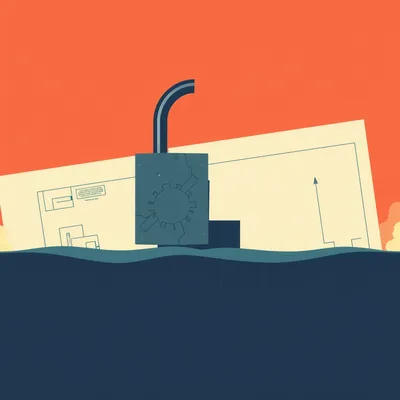
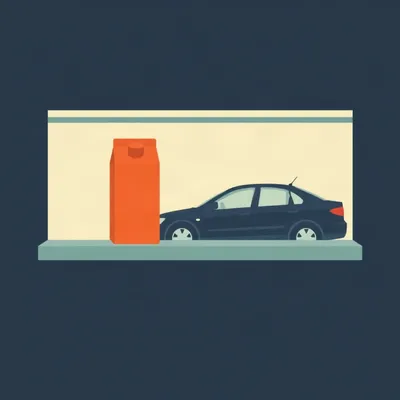
What does a nuclear warhead actually look like, and where is one sitting right now?
That's the question underneath everything Daniel sent in this week, and it's a better question than it sounds, because most of us are carrying around a picture in our heads that turns out to be wrong.
Here's his setup. We talked recently about Israel taking delivery of a new submarine, and the formal position that Israel has no nuclear capability. We've done non-proliferation episodes before, especially around Iran. But Daniel's point is that the discourse stays abstract. He wants something he can hold as a mental picture.
So he came across a video on X. Someone opening a door onto a room where a warhead was supposedly stored. Community notes flagged it. It was a mock. Completely inert. But it looked credible in a way he found unnerving, and that got him thinking about what the real thing looks like.
He describes what the video showed. A series of reinforced blast doors, each one leading down to another floor. And at the bottom, a room with what looks like an ordinary missile head propped up in the center.
He's careful to say he doesn't assume that's accurate. He's saying it might map onto what a lot of people picture. His own prior image was ballistic missiles sitting preloaded somewhere.
So, four questions. What do real warheads actually look like, physically? How are they stored by the countries that have them? What's actually known publicly about the storage facilities and the security around them? And how does the real picture compare to that mental image of blast doors and a warhead propped in a room?
He also asks the bigger one. Why does this discourse feel so abstract, and does knowing the physical reality change how you think about the threat?

Let's start with the object itself, because the video Daniel saw got the object wrong in a specific and interesting way.
There's a distinction that does most of the work here. The physics package is the actual nuclear explosive. The fissile pit, the explosive lenses, the tamper and reflector, the neutron generator. That's the part that goes bang.
The weapon is the physics package plus everything around it. Casing, fuzing, arming and safety electronics, parachute, tail kit. The bomb is a delivery container for the physics package.
So when people say "warhead," they're usually pointing at the casing.
Usually, yes. Take the B61, which is the American workhorse gravity bomb and the one you're most likely to see in a photograph. Eleven feet eight inches long. Thirteen inches in diameter. Seven hundred to eight hundred twenty-five pounds depending on the mod.
That's a torpedo.
It's a fat pipe. A streamlined cylinder built to be carried externally by supersonic aircraft. If you saw one on a rack you would not think "bomb." You'd think "industrial equipment that belongs to somebody with a forklift license."
Now shrink it down. The physics package inside a B61 is a silver cylinder roughly the size of a small wastebasket. There are declassified photographs of B61 components laid out on a table, and that's what you see.
And inside that?
The pit. A modern plutonium pit holds three and a half to four and a half kilograms of plutonium and produces somewhere in the range of five to ten kilotons. The Fat Man pit was nine point one centimeters across. Three point six inches. The size of a softball.
The thing that leveled a city was softball-sized.
The nuclear material is the small part. The bulk of a bomb is the implosion system. Concentric layers of uranium, aluminum, high explosive, all machined to tolerances that would embarrass a Swiss watchmaker.
Two details that stick with people. Pits are warm to the touch. A five kilogram mass puts out about nine point seven watts of heat, so the weapon needs aluminum parts to wick that away. And pits are plated with an inert metal. Historically gold. Sometimes vanadium now, for fire resistance.
So the most dangerous object most people will never see is warm, gold-plated, and the size of a piece of fruit.
And visually boring. That's the point. A real warhead is not dramatic. It looks like precision industrial equipment. The nuclear-ness is invisible.
Which is exactly why the video worked on Daniel. It substituted a cinematic object for a bureaucratic one.
The video gave him a missile head propped in a room. The reality is a cylinder that looks like it came out of a machine shop. The fake was more unnerving than the truth because the fake was designed to be.
So if that's the object, where does it actually sit?
The single best public answer is a system called WS3. Weapons Storage and Security System.
It's a vault built into the concrete floor of a Protective Aircraft Shelter. Not a deep underground bunker. A floor vault.
Under the aircraft.
Under the aircraft that would carry it. One vault holds up to four nuclear weapons. The vault sits lowered into the floor, and in the lowered position it gives ballistic protection through a hardened lid and reinforced sidewalls.
To load, you raise the vault. The weapons come up and go directly into the aircraft parked above. It takes minutes. A few armorers. No vehicles.
Why build it that way?
Because the old way was a problem. Under the previous system, weapons sat mounted on alert aircraft or got trucked in from bunkers. That took several hours and a large coordinated team.
Which meant Soviet satellites could watch the activity and read it as pre-attack mobilization. You're trying to load a bomb and the other side sees a ballet of trucks and thinks you're about to launch.
So the vault is an operational security device as much as a storage device.
It solves the visibility problem and the time problem at once. The scale is worth hearing. Two hundred fifteen WS3 vaults built for United States Air Forces in Europe. Thirteen sites, seven countries. Plus thirty-four for the Royal Air Force. Ten at RAF Brüggen, twenty-four at RAF Marham.
Authorized when?
Nineteen eighty-eight. Widespread by the mid-nineties.
And the security on the vault itself?
Classified sensors, video, motion detectors, CCTV, thermal imaging. Twenty-four seven electronic surveillance. But notice what that is. It's not a portcullis. It's a sensor suite.
What did the older system look like? Because that's closer to what people picture.
Weapon Storage Areas. Special Ammunition Storage. Earth-covered igloo bunkers. Arched, grass-topped concrete magazines. Usually inside the perimeter of an army barracks or an air base. Occasionally deep in woods miles from any base.
Grass on the roof.
A low grassy mound. That's the closest thing to a real image of nuclear storage most people have ever seen, and it looks like landscaping.
There's a photograph from Savanna Army Depot that's the canonical version of this. Rows of them. They look like a golf course with doors.
Largely obsolete now, replaced by WS3. But the takeaway holds either way. Real storage is distributed, mundane, and integrated into ordinary military infrastructure. Weapons sit under aircraft shelters, in floor vaults, in earth-covered igloos.
There's no Fortress of Doom.
The security is electronic and procedural. Not architectural spectacle.
But the physical arrangement is only half the story. The real control lives inside the weapon.
Right. And this is where it gets clever, because the thing that actually secures a nuclear weapon is not the vault. It's a device inside the physics package called a Permissive Action Link.
The Department of Energy definition is worth having. A device included in or attached to a nuclear weapon system to preclude arming or launching until the insertion of a prescribed discrete code or combination.
A lock.
A lock with a few unusual properties. The elements are located deep within the nuclear device. It's a black box designed to limit information leakage. And it's powered by radioisotope generators. Plutonium-238 decay heat, rather than batteries.
Why not batteries?
Because batteries can be attacked. You can cut a power line. You can drain a cell. Decay heat runs for decades and doesn't care what you do to the building.
How long are the codes?
They grew over generations. Three to four digits at the earliest. Then four, then six, then twelve digits in the later categories. The twelve-digit version also disables the weapon after failed attempts and controls yield. Dial-a-yield.
Twelve digits is a lot of entropy.
And there's a retry limit. After a set number of wrong codes the weapon locks out, and to get it back you have to return it to Pantex for rebuilding.
So the failure mode of a stolen weapon is that it becomes a very heavy paperweight.
There's also non-violent disablement. Internal components can be destroyed to render the weapon unusable without any nuclear detonation. You don't have to blow it up to kill it.
Give me the quote you're clearly holding.
Peter Zimmerman, nuclear physicist and weapons inspector. "Bypassing a PAL should be, as one weapons designer graphically put it, about as complex as performing a tonsillectomy while entering the patient from the wrong end."
That's a sentence that stays with you.
It's meant to. The point is that the difficulty isn't the door. It's the geometry.
What about the human side? Because a code is only as good as the people entering it.
The two-man rule. On ballistic missile submarines, the commanding officer and the executive officer both have to agree the launch order is valid and mutually authorize.
On Minuteman, both operators compare the order's code against something called a sealed authenticator, stored in a safe with two separate locks. Both operators turn four launch keys simultaneously. And a second launch control center has to do the same thing.
Two crews, two safes, eight keys.
And then there's the part I find most elegant. Environmental Sensing Devices.
Explain.
The weapon senses whether it's in its combat environment. On an intercontinental ballistic missile, that means strong acceleration, then free fall, then re-entry acceleration. And it only arms when those are sensed in the correct order.
So a warhead sitting in a vault doesn't arm.
A warhead sitting in a vault, or dropped, or in a fire, will not arm. It has to go through the sequence. The weapon knows where it is.
There's a design philosophy underneath that, isn't there? Stronglinks and weaklinks.
Yes. In an accident, weaklinks are designed to fail before stronglinks, so the weapon fails safe rather than failing armed. The default state of the object is inert. You have to actively walk it toward being dangerous.
Which brings us to the historical bombshell.
Bruce Blair, the nuclear safety expert, reported that Strategic Air Command worried launch codes wouldn't be available in a crisis. So they set the Minuteman codes to eight zeroes. In all launch control centers. And checklists confirmed it until nineteen seventy-seven.
The most consequential weapons in human history had a combination of eight zeroes.
For years. And here's the detail that makes it worse and better at the same time. The Air Force told Congress in twenty fourteen that a code consisting of eight zeroes has never been used to enable a Minuteman ICBM.
Which doesn't contradict Blair.
It doesn't. Blair said it was the code for doing so. Not that it was used. Those are different claims, and the Air Force answered the narrower one.
The lock was a zero. The door was never opened.
That's the honest reading.
Bring this to Israel, because that's where Daniel started.
Israel is widely believed to possess nuclear weapons. Estimates run from ninety to four hundred warheads, and it's believed to have a full triad. Air, land, sea.
The policy is deliberate ambiguity. Amimut.
Neither confirm nor deny. The only line they repeat is that Israel will not be the first country to introduce nuclear weapons to the Middle East. And they interpret "introduce" to mean they won't test and won't formally acknowledge.
The submarines.
Five Dolphin-class boats. Twenty launch tubes total for the Popeye Turbo submarine-launched cruise missile. That's the sea leg, and the presumed second-strike capability.
Launch authorization?
Believed to require joint agreement of the Prime Minister and the Minister of Defense. And Israel is believed to use PALs on its warheads.
The Vanunu case is the closest the public has come to seeing Israeli warhead components.
Nineteen eighty-six. Mordechai Vanunu was a technician at Dimona. He leaked about sixty photographs of the complex, including a glove box containing nuclear materials in a model bomb assembly. He was kidnapped by Mossad from Italy and imprisoned for eighteen years.
And Ted Taylor looked at those photographs.
Ted Taylor, the physicist, reviewed the leaked photos of disassembled components and concluded Israel possessed boosted weapons. He also judged that advancing to full two-stage megaton weapons without testing would require era-appropriate supercomputers.
So the public picture of Israeli warheads rests on sixty photographs taken by one man forty years ago.
That's about the shape of it.
Which brings us to Daniel's real question. Why does all this feel so abstract?
Four reasons, and they compound. Classification is the first. The details that would make it concrete are the most tightly held secrets in any nuclear state. What's public is a shell of dimensions and acronyms.
Second.
The weapons are designed to be invisible. A PAL is a black box inside a black box. An ESD is a sensor. The nuclear-ness is deliberately unobservable.
Third.
Deterrence is a psychological phenomenon, not a physical one. The threat lives in the belief that the weapon works and would be used. So the discourse naturally drifts toward signaling and credibility and doctrine, because that's where the action actually is.
Fourth.
Cinema fills the vacuum. Because the real thing is boring-looking and hidden, popular culture supplies the blast doors and the propped-up warhead. And that imagery is more unnerving than the truth, precisely because it was designed to be.
Which is what happened to Daniel. He got the designed-to-be-unnerving version, and it left him with a picture that's wrong in a way he couldn't have known.
So what changes when you know the physical reality?
The threat stops being a place.
It stops being a vault or a silo and becomes a system. A chain of codes, sensors, procedures, and human agreements. The vault lid is concrete. The real lock is a twelve-digit code and a two-man rule.
And the distribution is the sobering part. Under aircraft shelters. In floor vaults. In grassy igloos. Woven into ordinary military life.
Which is more unsettling than a fortress, in a way. A fortress is somewhere else. A floor vault is under the building where somebody parks a fighter jet.
And the most dangerous moments in history were human and organizational, not physical. The eight-zero codes. The near-misses.
The hardware is engineered to fail safe. The risk is in the people and the procedures.
Hilbert: How many of them do you think are actually loaded?
What?
Hilbert: The vaults. You said two hundred fifteen for the Air Force in Europe, thirty-four for the British. I'm asking how many of them had something in them on a given Tuesday.
That I don't know. The public numbers are about the vaults, not the fill.
Hilbert: I spent about nine months on a site where we were responsible for counting things that came in crates and went out on aircraft. Test equipment, mostly, and some of it was sensitive enough that we had a two-man rule of our own. Two signatures to open, two signatures to close.
Hilbert: And the thing I learned is that the count is never the problem. The count is easy. The problem is that after a few months, a crate stops being a crate. It becomes the thing you sign for on the way to lunch.
The object becomes furniture.
Hilbert: It becomes furniture. We had a mock-up on a stand in the corner of the shop, a training piece, and it looked like a piece of plumbing. A cylinder with fittings. If you set it on a bench next to a pump you couldn't tell which one was which. I walked past it for months.
That matches what the declassified photographs show. The physics package looks like a wastebasket.
Hilbert: The one that looked least like a weapon was the one everybody was most careful around, because the paperwork on it was the worst. You couldn't move it without three people knowing. And the stuff that looked scary, the stuff with the fins and the stencils, people handled that like it was luggage.
So the visual signal was inverted.
Hilbert: Completely inverted. And I think that's the thing you two skipped past. You said the enemy's satellites are looking for the dramatic. That's true. But the people inside the fence are looking at the same thing. A weapon that doesn't look like a weapon is easy to stop seeing.
That's the complacency problem, and it's real. The Air Force has had incidents where crews lost track of what they were handling precisely because the handling was routine.
Hilbert: I had a supervisor who used to make us say the item out loud before we touched it. The item. What it was. He said the day you stop saying it is the day you stop knowing it.
Did it work?
Hilbert: It worked on me. I still remember what was in those crates and I haven't seen one in thirty years.
That's the human layer of the security story, and it doesn't show up in any of the diagrams.
Hilbert: The diagrams are the easy part. The hard part is a man on a Tuesday afternoon who has signed for the same thing four hundred times and is thinking about his lunch.
So the most secure nuclear weapon is the one that looks least like a weapon.
Hilbert: And that's on purpose. It's not an accident. Somebody decided that.
Which puts the risk somewhere the architecture can't reach.
Hilbert: The lock is fine. The lock has always been fine. The lock is not the thing that worries me.
If the real threat is procedural and human rather than architectural, what does that do to how we talk about non-proliferation? Because the entire public conversation is built on counting things. Warhead counts, missile counts, enrichment percentages.
And counting is the part that's knowable. It's why the discourse gravitates there. You can put a number on a stockpile. You can't put a number on whether the crew on the Tuesday shift still says the item out loud before they touch it.
Which means the thing that actually keeps these weapons from being used is the thing least visible to anybody outside.
The hardware is engineered to fail safe. The people are not engineered at all. They're trained, and training decays, and the decay is invisible until it isn't.
As arsenals modernize, does any of that change? Do the mundane storage and the invisible security systems get replaced with something more legible?
I don't think legibility is the goal. The vault is designed to be unremarkable on a satellite photograph. The lock is designed to be unremarkable to anybody holding the weapon. The whole system optimizes for not being noticed.
The most unnerving thing about nuclear weapons isn't the blast doors or the warhead propped in a room. It's how ordinary they look. And how much of their danger lives in the people and procedures around them, which is the part nobody can photograph.
That's the piece Daniel was reaching for. The mental picture matters, and the accurate one is quieter than the fake.
If you found this useful, a review helps other listeners find the show.
Thanks to our producer, Hilbert Flumingtop.
This has been My Weird Prompts.
We'll be back soon.