Twenty-one. That's the number that should reframe how you hear a shofar. Not one blast on Rosh Hashanah, not the final long note at Neilah. Twenty-one, minimum, every single ordinary day in the Temple.

And that's the floor, not the ceiling. The Mishnah says forty-eight is the max.
Right. So Daniel wrote in this week. His framing is that the shofar we know today, the one that means Rosh Hashanah and the end of Yom Kippur, is a drastic narrowing of something much bigger. In the Temple period, horns and trumpets were a regular part of the soundscape of Jewish worship, not an annual event. He wants us to actually go into the Mishnah and Talmud and work out how the shofar functioned in the Second Temple. When it sounded. What the different blasts signified. How its role differed from the silver trumpets, the chatzotzrot. He's especially interested in Sukkot and Simchat Beit HaShoeva, where the Mishnah describes this extraordinary sequence of blasts accompanying the festivities and the water-drawing ceremony. And then the harder question: reconstruct what this would have sounded like to someone standing in the Temple, or anywhere else in Jerusalem. And explain how much broader the role of these instruments was than the limited ceremonial use most Jews today are familiar with.
That's a lot of question in one prompt.
He does that.
He does. But it's a good one, because the answer changes how you read the sources. The shofar we know is a survivor. It's what's left of a system that was much larger.
So let's start with the number that reframes everything. Twenty-one.
The Mishnah in Sukkah, chapter five, mishnah five. "One sounds no fewer than twenty-one trumpet blasts in the Temple, and one sounds no more than forty-eight." That's the frame. Twenty-one is the baseline for an ordinary weekday. Forty-eight is the annual maximum, and we'll get to when that happens.
And the first thing to say, before we get into the breakdown, is that shofar and trumpet are not the same instrument. That's the confusion that makes the modern picture so narrow.
The Hebrew text maintains the distinction carefully. Psalm 98, verse 6, has them side by side. First Chronicles 15, verse 28, same thing. The chatzotzrot are the two beaten-silver trumpets ordered in Numbers 10, verse 1. The shofar is an animal horn. Two different instruments, two different materials, two different roles.
And the Jewish Encyclopedia makes the point that the confusion is post-destruction. There's a line in Shabbat 36a, and the encyclopedia cites it directly: "since the destruction of the Temple the names for the shofar and the trumpet had been confused." That's the whole story in one sentence. The names collapsed because the system that kept them distinct collapsed.
Which is why the modern Rosh Hashanah shofar feels like the whole thing. It's not. It's the fragment that survived.
So the daily twenty-one. Break it down.
Three for the opening of the gates in the morning. Nine for the daily morning offering, the tamid shel shachar. Nine for the daily afternoon offering, the tamid shel bein ha'arbayim. Three plus nine plus nine. Twenty-one.
Nine is a strange number for a single offering. Where does nine come from?
This is where the Bartenura does the work. The Levites sang while the daily libations were being offered. During that song there were three pauses. At each pause the kohanim sounded tekiah, teruah, tekiah, and the people prostrated themselves. Three blasts per set, three sets, nine. So the nine isn't nine arbitrary toots. It's a choreography. Song, pause, blast, prostration. Song, pause, blast, prostration. Three times through.
So the blast is punctuation inside a song.
It's punctuation inside a song that the entire assembled crowd is responding to physically. They're not just hearing it. They're going down at each set. That's a whole-body liturgy.
And then you add layers on top.
On days with additional offerings, musaf, like the New Moon, you add nine more. On Shabbat eve you add six more. Three to stop the people from working, three to demarcate between sacred and profane. So the number isn't fixed. It scales with what the day requires.
The Shabbat eve sequence is the part that I think would land hardest for a modern listener. Because that's not liturgy. That's a public utility.
The Bartenura describes it in completely practical terms. First tekiah, the people working in the fields stop. Second tekiah, the shutters are removed and the stores are locked. At the third tekiah, quote, "he removed what had to be removed and hid what had to be hidden, what had been warmed, and they kindled the candles."
Fields. Shops. Ovens. Candles. That's a checklist.
It's a checklist that everybody in the city is running off the same three sounds. And then there's this detail I love, which is that after the first soundings, quote, "he delayed in order to roast a small fish." Then he sounded tekiah, teruah, tekiah to announce that the day was sanctified.
He paused to roast a fish.
That's the last window before Shabbat, and the Bartenura is telling you the man with the horn used it.
So the horn is the clock. And the clock is also the PA system. It's telling you when to stop working, when to close the shop, when to light the candles, and then it's telling you the day has started.
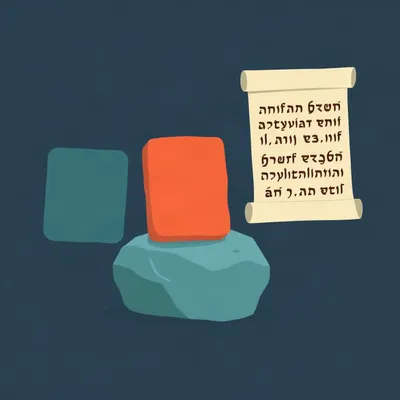
And there's a physical trace of it. A stone from the Temple ruins found in Jerusalem, inscribed "bet hatekiah lehav." The house of blasting to distinguish. That's almost certainly referring to this practice. The Mishnah's abstract blast count has a piece of carved stone behind it.
That's the thing about this material. You read twenty-one, forty-eight, nine, and it sounds like a spreadsheet. Then you find out there's a building with that name on a plaque.
The building had a job. It was where the blasts that divided the week from Shabbat came from.
So to answer Daniel's first question directly. When was the shofar sounded in the Temple? Constantly. Every day. Three times minimum before the morning offering even starts. And what did the blasts signify? Different things depending on which blast. The tekiah is a long, unbroken note. The teruah is a broken, trembling sound. The two together, tekiah teruah tekiah, is a unit. And in the daily cycle, that unit is what marks the pauses in the Levites' song and cues the people to prostrate.
Which is the mechanism Daniel was asking about. The nine at each tamid is not nine separate events. It's three events, each of which is a three-part phrase.
And that phrase, tekiah teruah tekiah, is the same phrase that shows up in the water-drawing procession, which is where this gets spectacular.
Sukkot. This is the payload.
Give me the maximum first.
Forty-eight blasts. On the eve of Shabbat during Sukkot. That's the annual maximum in the Mishnah's count. And the breakdown is worth walking through, because it shows you how many different things were being marked.
Go.
Three at the opening of the gates. Three at the upper gate. Three at the lower gate. Three for the filling of the vessel with water. Three when pouring the water libation on the altar. Nine for the morning tamid. Nine for the afternoon tamid. Nine for the additional offerings. Three to stop the people from work. Three to demarcate sacred and profane.
That's the whole city's day, top to bottom, in one count.
And the Bartenura adds a caveat, which is that forty-eight isn't exact. When the eve of Passover falls on Shabbat, the count can reach fifty-seven.
Fifty-seven.
Fifty-seven. So the number in the Mishnah is a working figure, not a hard cap.
Now the water-drawing. Simchat Beit HaShoeva. This is what Daniel specifically asked about, and it's the part where the blasts stop being a clock and start being a procession.
Mishnah Sukkah 5:4. Two priests stood at the Upper Gate, the one descending from the Israelites' courtyard to the Women's Courtyard, holding two trumpets. And then: "When the rooster crowed at dawn, they sounded a tekiah, and sounded a teruah, and sounded a tekiah."
The rooster crows and the trumpets answer.
And then the blasts mark stages. When the people drawing water reached the tenth stair, the trumpeters sounded tekiah teruah tekiah, to signal the time to draw from the Siloam pool. Again when they reached the Women's Courtyard with basins of water. Again when they reached the ground of the Women's Courtyard. And the mishnah says they continued sounding the trumpets until they reached the gate through which one exits to the east.
So the procession is being paced by the horns. Every stage has a sound.
Every stage has a sound, and the sound is the same three-part phrase, and everybody in the courtyard knows exactly where in the route that phrase means they are.
And then the eastern gate moment, which is the part I'd put on a wall.
They turn. They're facing east, and they turn to face west, toward the Holy of Holies. And they say: "Our ancestors who were in this place during the First Temple period stood with their backs toward the Sanctuary of the Lord, and their faces toward the east, and they worshipped the sun toward the east." That's Ezekiel 8:16. "And we, our eyes are to God."
So the horns are framing a pivot away from sun worship.
The blast sequence is the frame around a declaration of where the community is looking. Literally which way they're facing.
And this goes on all night.
All night. Mishnah Sukkah 5:1: "One who did not see the Celebration of the Place of the Drawing of the Water never saw rejoicing in his life." That's the line. The flute, the chalil, played on Sukkot for five or six days, depending on where Shabbat falls.
Five or six days of flute. That's not a ceremony. That's a festival season.
And the arc, as Peninei Halakha lays it out, is this. The celebration began after the afternoon tamid and continued all night. As dawn approached, an official made a declaration, and two kohanim at the upper gate blew tekiah teruah tekiah on trumpets. They led a procession descending from the upper gate. At the tenth step they blew again. At the Women's Courtyard again. Continuing until the gate exiting east. Then down to the Shiloah spring to draw water for the libation that accompanies the morning tamid. And coming back via the Water Gate, the kohanim blew again.
So the night ends and the morning begins with the same phrase, at every station.
And the celebration itself is not quiet. The pious and the men of action danced with flaming torches they juggled. Talmud Sukkah 53a. Rabbi Shimon ben Gamaliel juggled eight lighted torches and did a handstand on two fingers. Others juggled eight knives, eight glasses of wine, or eight eggs.
Eight eggs.
Eight eggs.
The rabbi doing a handstand on two fingers is the detail that gets quoted, but the eggs are the one that gets me. Somebody stood in the Temple courtyard and juggled eight eggs and it went into the record.
And the light. The Talmud describes immense candelabra in the Temple courtyard, each holding gallons of oil, with wicks made from the priests' worn-out vestments. The light was so intense it illuminated every courtyard in Jerusalem.
So you have horns, trumpets, flute, lyres, harps, cymbals, torches, juggling, and a light that reaches across the whole city. This is the acoustically and visually maximal moment of the year.
And it's Sukkot. Not Rosh Hashanah.
That's the correction Daniel's prompt is pushing toward. Rosh Hashanah is the day we associate with the shofar. But in the Temple calendar, the loudest day was Sukkot.
There's a line from an article on shofar symbolism that puts it plainly: the shofar was performed at all the major festivals, notably Sukkot, in the water libation ceremony, and at the beginning of each month. It was one of the privileged instruments in regular use by the Levites in the Temple.
Regular use. That's the phrase that should sit next to the modern picture. Once a year versus regular use.
Now, the distinction between shofar and chatzotzrot deserves its own pass, because Daniel asked specifically, and because the sources are actually quite precise about it.
Go.
The chatzotzrot are the priestly instrument. Two trumpets of beaten silver, ordered in Numbers 10, verse 1. In Solomon's Temple, Second Chronicles 5:12, they're increased to a hundred and twenty. In the Herodian Temple they're back to two, judging from the Arch of Titus, which shows two.
Josephus describes them.
Josephus, Antiquities, book three, chapter twelve. Nearly a yard long. A little wider than a flute. A slight expansion near the mouthpiece and a bell-shaped end.
A yard. That's a serious piece of metal.
The Jewish Encyclopedia is blunt about what it was for. Quote: the trumpet was "not so much an instrument of music as one of teru'ah, noise, of alarm and for signaling." And it was "almost exclusively a priestly instrument."
Signaling. That's the word. Not melody. Signal.
Which is why the distinction matters. The shofar is an animal horn, and it's the instrument of Rosh Hashanah. The trumpet is a silver signaling device, and it's the instrument of the daily ritual and of fast days.
The Mishnah actually stages them together, which is the clearest way to see the difference.
Mishnah Rosh Hashanah 3:3. On Rosh Hashanah, the shofar was of an antelope's horn and straight, with its mouth overlaid with gold. Two trumpets flanked it, one on each side. And here's the key line: the shofar gave a long blast and the trumpets a short one, "since the proper ceremony of the day was with the shofar."
On Rosh Hashanah, the shofar leads and the trumpets follow.
Then Mishnah Rosh Hashanah 3:4 flips it. On public fast days, the shofarot were curved rams' horns with silver-plated mouths, and two trumpets stood in the middle. And there the shofar sounded a short blast and the trumpets a long one, "for the mitzva of the day is with the trumpets."
Same two instruments, opposite hierarchy, depending on the day.
The Bartenura explains the logic via Numbers 10:9, which is the verse about sounding short blasts on the trumpets. And his conclusion is: "specifically in the Temple they do this, but in the country, when there is a shofar, there are no trumpets, and when there are trumpets, there is no shofar." He cites Psalm 98:6 to back it.
Outside the Temple, you get one or the other, not both. The pairing is a Temple privilege.
Which tells you the Temple was the only place the full sonic system operated. Anywhere else, you're hearing a fraction of it.
Now, the honest part. What does this actually sound like? Because Daniel asked us to reconstruct it, and I want to be straight with the listener about how far the evidence takes us.
There's a real gap here. No dedicated acoustic or archaeo-musicological reconstruction of the Jerusalem soundscape turned up in the research. The closest thing is Moshe Piamenta's work. His 2019 doctoral thesis is described as the first study to focus exclusively on the trumpet in ancient Jewish history, integrating textual analysis, archaeology, and musicology. And his 2022 article in Hebrew Union College Annual looks at the War Scroll, where priests use different trumpet types to direct fighting forces and Levites and the people sound shofarot to instill fear in the enemy. He calls that description rare and rich, unmatched in any ancient work, Jewish, Hellenistic, or Roman.
Piamenta's own line about the state of the field?
"The study of ancient Jewish music is largely uncharted territory. Many musical terms are not fully understood."
That's the honest frame. We can reconstruct the schedule with real precision. We can't reconstruct the sound with the same confidence.
We know the instrument shapes. We know the length of the trumpet from Josephus. We know the material. We know when each blast happened and what it cued. What we don't have is a recording, or a model, or even a settled answer on what a teruah actually sounded like.
Which is strange, given how much of this city's life was organized around sound.
Piamenta's thesis also has a detail that's worth flagging, because it shows how differently the two instruments were read in some circles. In the Dead Sea Scrolls, the shofar symbolizes the Torah, and the trumpet represents what he calls the Second Torah, identified with the Book of Jubilees.
Even the symbolism splits. Horn equals one thing, silver equals another.
There's a sectarian edge to the whole Sukkot complex that we shouldn't skip. The water libation wasn't in the Torah. That's the point. And the high priest Alexander Jannaeus, in the first century BCE, spilled the water at his feet in contempt during the ceremony. The worshippers responded by pelting him with citrons.
With citrons.
With citrons. The blasts and the ceremony were a battleground, not just a celebration. The Sadducees and the Pharisees were fighting over whether the rite was legitimate at all.
The horns are marking the procession, and the procession is the thing some people in the room think shouldn't be happening.
The sound is the sound of an argument as well as a festival.
Let me pull the threads together for Daniel, because he asked four things and I want to make sure we answered all of them.
Go.
When was the shofar sounded in the Temple? Twenty-one times minimum on an ordinary day. Three at the gates, nine at the morning tamid, nine at the afternoon tamid. More on musaf days. Six more on Shabbat eve. Forty-eight on the Shabbat eve of Sukkot. Fifty-seven in the edge case.
What did the different blasts signify? The tekiah is the long unbroken note. The teruah is the broken, trembling one. Together they form a unit, and that unit marks pauses in the Levites' song, cues prostration, signals stages of a procession, and demarcates sacred from profane.
How did the shofar's role differ from the chatzotzrot? The trumpet was the priestly silver signaling instrument, the daily workhorse, the alarm, the thing that told the city what to do. The shofar was the animal horn, the instrument of Rosh Hashanah, and in the Temple it appeared alongside the trumpets rather than replacing them.
What would it have sounded like? A city where the horn and the trumpet were the clock, the alarm, the liturgical cue, and the festival's exclamation point. With Sukkot, not Rosh Hashanah, as the loudest moment of the year.
How much broader was the role than what we know today? The shofar we hear once a year in synagogue is a fragment of a daily, city-wide signaling infrastructure. That's the answer. What we hear once a year is what's left of what Jerusalem heard every day.
There's one detail about the teruah itself that we've been dancing around.
Hilbert: You're right. I never got it right either.
Sorry, what?
Hilbert: The teruah. I was a ba'al tekiah's understudy one season, at a small synagogue. The regular blower had a lung condition and they needed a backup. I bought a ram's horn mail-order and spent weeks on it.
Mail-order.
Hilbert: Mail-order. The tekiah I could do. The shevarim I could do. The teruah, I could not. It kept collapsing into a stutter. It's supposed to be a tremolo and mine came out like somebody shaking a jar of coins. I still have the horn. It's in a box.
The thing you never got right is the thing the sources never settled.
Hilbert: That's it. The rabbis in Sukkah 55b argued about whether tekiah teruah tekiah is one unit or three. Rabbi Judah says minimum seven blasts, maximum sixteen. The Rabbis count tekiah and teruah separately. And underneath that argument is a question nobody answers, which is whether a blast is a sound or a sentence.
A sound or a sentence.
Hilbert: If it's a sound, you count it. If it's a sentence, you count the words. The whole dispute is about which one you're doing. And the teruah itself, whether it's a tremolo or a staccato, is still not settled. I read everything I could find that year. Nobody knows.
The thing you couldn't play is the thing nobody can define.
Hilbert: Right. Maybe nobody ever could. I've got a call I'm expecting. I won't take it in here.
Understood.
Which brings us back to the stone.
Bet hatekiah lehav. The house of blasting to distinguish. A carved inscription from the Temple ruins, sitting in Jerusalem, naming a building that existed to make a sound that told a city when to stop working.
The horn was the clock. The clock is gone. The stone remains.
The open questions are real ones. The exact musical character of tekiah versus teruah is still contested. Whether the daily gate-opening blasts were shofar or trumpet is disputed, the Rishonim disagree on it, some saying trumpets only, others saying the shofar was possible. And no dedicated acoustic reconstruction of the Jerusalem soundscape exists.
Which is the thing I'd want somebody to go do. We can map the schedule down to the individual blast. We can't hear it.
The shofar we know is a survivor of a much larger sonic system. A daily, city-wide signaling infrastructure that Sukkot pushed to its annual maximum. What we hear once a year in synagogue is a fragment of what Jerusalem heard every day.
Thanks as always to Daniel for the prompt, and to Hilbert Flumingtop for producing. This has been My Weird Prompts.
The human-AI collaboration podcast. You can find us at my weird prompts dot com, or email us at show at my weird prompts dot com.
We'll be back soon.
See you tomorrow.