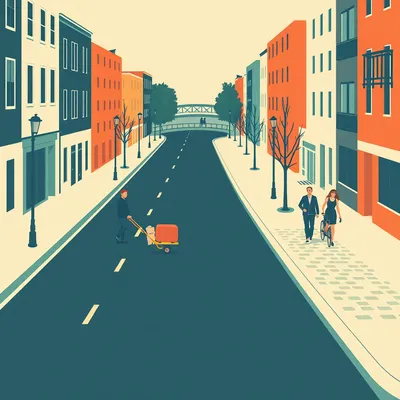
You know the scene. You're walking down King George Street in Jerusalem and the sidewalk narrows to about a meter wide, metal barriers on both sides, and below you there's this open trench maybe four meters deep. Inside it, workers are guiding these enormous concrete pipe sections into place, and off to the side there are cable spools so tall they block the view of the shopfronts behind them — I'm talking ten meters, twelve meters, the kind of spool you'd need a crane just to rotate.

Everyone walking past thinks the same thing — they're laying fiber optic cable, right? Maybe upgrading the water mains. Something like that.
And you glance down the street and see the sign about the future light rail station, and you think okay, this is the train station construction. Except the station won't open for years. So what are they actually doing down there every day?
That's the question Daniel sent us. He's been watching this exact construction site on King George Street — the giant spools, the concrete pipe sections being lowered into the ground — and he wants to know what the operation actually entails. Is it fiber? Is it all the infrastructure at once? And why does this phase happen before they even start building the station?
Which is one of those questions where the real answer is so much stranger and more interesting than what you'd guess from the sidewalk.
It really is. Because what's happening in that trench right now is not station construction. It's not even track-laying. It's something that every major urban rail project in the world has to do first, and it's almost always the longest and most expensive phase.
King George Street is basically the spine of Jerusalem's entire light rail expansion — the Red Line extension and the new Green Line both converge there. So this one stretch of dug-up asphalt is the most visible part of a multi-year underground coordination problem that most people walk past without understanding.
That's what we want to unpack. Because once you understand what those spools and pipes are actually doing down there, you'll never look at a construction site the same way again.
Let's start with what you're actually looking at when you peer into that trench. Those concrete pipe sections Daniel described — they're typically stormwater drainage or sewage pipes, anywhere from one to two meters in diameter. And they're being laid at the very bottom of the trench, which is your first clue about how this works.
Deepest stuff goes in first.
The underground has a strict layering order. Drainage at the bottom, then water mains above that, then gas lines, then electric cables, and finally telecom and fiber at the shallowest level, maybe half a meter below the surface. Each layer has its own depth requirements and safety clearances from the others. You cannot just bundle everything together in one neat package.
Which is probably the first thing that surprises people. You see the trench open and think, well, while they're down there, why not do everything at once? And the answer is they are doing everything — but in sequence, not simultaneously. The trench is open for months because they're working through the layers.
Those enormous cable spools — the ten-meter ones Daniel mentioned — those are almost certainly high-voltage electric cables. We're talking thirty-three kilovolt or even one hundred sixty-one kilovolt feeder cables. The light rail needs dedicated traction power substations along the route, and those substations need to be fed by cables that run between junction points without any splices, because every splice is a potential failure point. The spool is that size because it contains a single continuous cable run, sometimes hundreds of meters long.
The spool size isn't just theater. It's a functional requirement — you can't splice high-voltage feeder cable underground and expect it to be reliable for the next forty years.
And here's the key thing Daniel was circling around: none of this is the train station. The station box — that's the term for the underground structure that will actually house the platforms and tracks — hasn't even begun excavation. What's happening now is utility relocation. Every single pipe, cable, and conduit that currently runs through the footprint of that future station has to be physically moved out of the way before anyone can start digging the station itself.
Because you can't exactly pour a concrete foundation over an active water main that serves forty thousand people.
And you especially cannot excavate a station box — which might go down twenty or thirty meters — through a tangle of live gas lines and high-voltage cables. So the entire underground landscape of that block has to be remapped, rerouted, and in many cases temporarily bypassed before a single shovel of station excavation happens.
This is the deconfliction phase. Which is a wonderfully clinical term for what amounts to untangling a century of ad-hoc underground development so that everything has a clear corridor that won't interfere with the future station structure.
That's why it looks like they're just moving pipes around for months — because that is literally what they're doing. Day to day, the work is: identify an existing utility, plan a new route around the station footprint, dig a trench for the new route, lay the new pipe or duct, switch service over, then remove or abandon the old line. Repeat for every utility on the block. Water, sewage, gas, electric, telecom, fiber, sometimes district heating or cooling. Each one owned by a different entity with its own schedule and its own contractors.
When Daniel asks whether they do fiber and all the existing infrastructure at once, the answer is yes in the big-picture sense — this phase covers everything — but no in the literal sense of lowering all the pipes into the same trench on the same Tuesday. Each utility has to be sequenced, and the sequencing itself is a logistical puzzle that takes months just to plan.
Here's a concrete example of what that coordination looks like. At the intersection of King George and Jaffa Street — right where the future station box will go — they had to move a one-point-two-meter water main that served about forty thousand residents. That single pipe relocation took three months of planning and two weeks of continuous work. Not because the digging was hard, but because you can't just shut off water to forty thousand people.
You have to build the new section first, pressurize it, test it, switch the flow, and only then remove the old one. All while keeping water running to every apartment and shop along the route.
And that's one pipe. Now multiply that by every utility crossing that intersection. Tel Aviv's Red Line — which is the closest comparison — spent eighteen months on utility deconfliction before any tunneling began, and that involved fourteen different utility companies. Fourteen separate entities, each with their own shutdown windows and service guarantees.
Which gets at something Daniel was wondering about — why this stage happens before the station construction. And the answer is almost absurdly straightforward when you think about it. You can't dig a thirty-meter hole through active infrastructure.
You really can't. The station box excavation for an underground light rail station is massive — we're talking about removing thousands of cubic meters of earth. The machinery involved, the sheet piling, the concrete pours — all of it requires a completely clear underground corridor. If there's a live thirty-three kilovolt feeder cable running through your excavation zone, you are not excavating that day.
Or ever, unless you move it first.
And there's a sequencing reason too. Once the station box is excavated and the concrete structure is poured, you've essentially created a permanent underground obstruction. Anything you didn't relocate beforehand is now trapped — you'd have to tunnel under or around your own station to fix it later.
The relocation phase isn't just practical, it's permanent. The utility corridor being built right now under King George Street will be the arrangement for the next fifty to a hundred years. Which is why they're not just shoving things aside — they're laying new ducts, upgrading pipe diameters, building in spare capacity.
That's actually what some of those concrete pipe sections Daniel sees are for. Urban rail projects almost always upgrade drainage capacity as part of the work, because the station roof and the new track bed create large impermeable surfaces. Rain that used to soak into the ground now runs off, and you need bigger stormwater pipes to handle it. Those one-to-two-meter concrete sections aren't just replacements — they're often upsized.
Which loops back to the spools. The high-voltage feeder cables on those ten-meter spools aren't just being moved — they're being laid in new dedicated ducts with proper separation from everything else. The old arrangement might have been a tangle under the street. The new one is a engineered corridor with each utility at its specified depth and clearance.
This is where the temporary versus permanent thing gets mind-bending. Some of what's being laid right now is actually temporary bypass infrastructure. They run a water bypass above ground — you can see it on King George, these pipes running along the sidewalk on temporary supports — and that keeps service going while they dig up and replace the permanent main underneath. Once the permanent line is connected, the bypass gets dismantled.
They're effectively building the same utility twice. Once as a temporary workaround, once as the permanent solution. And pedestrians just see pipes everywhere and assume nothing is happening.
Which is perfectly reasonable from the sidewalk. But the amount of work happening in that trench is enormous — it's just invisible in the sense that the output looks like pipes in the ground, same as before. The difference is that now those pipes are arranged in a planned corridor that won't interfere with the station box when excavation finally begins.
That's the basic mechanism — but Jerusalem adds two complications that make this project especially slow, and especially interesting. The first one is archaeology.
You can't stick a shovel in the ground in Jerusalem without someone from the Antiquities Authority wanting to look at what came up.
They have to. Israeli law requires archaeological supervision on any excavation in declared antiquities zones, which covers most of the historic city center. Every trench dug for utility relocation on King George has an archaeologist on call. If they hit something — and they almost always do — work stops.
How long are we talking?
In twenty twenty-four, during the utility relocation for this exact project, workers uncovered a Mamluk-era aqueduct maybe three meters down. Fully intact stone channel, fourteenth century. That find alone required six weeks of archaeological documentation before anyone could touch a pipe again.
Six weeks for one aqueduct. And that's not the only thing down there.
Jerusalem's subsurface is one of the most archaeologically dense in the world. You've got layers from the Ottoman period, Mamluk, Crusader, Byzantine, Roman, all stacked on top of each other. A trench for a new drainage pipe can become an active dig site in about four seconds. And the archaeologists aren't being difficult — this is genuinely irreplaceable history. But it means the visible surface work seems to drag for reasons that have nothing to do with the engineering.
Which explains a lot of the "why is this taking so long" frustration. People see a trench open for weeks with no apparent progress, but what's actually happening is someone is down there with a brush cataloguing a Byzantine wall.
And that's just one of the second-order delays. The other one is the temporary versus permanent paradox we touched on. Some of what Daniel sees being laid in that trench will be removed after the station is built.
As in, they're installing infrastructure now that they plan to dig up later?
The temporary water bypass for the King George station required four hundred meters of above-ground pipe running along the sidewalk — visible to anyone walking past — and that whole system gets dismantled once the permanent connection is built. Below ground, it's the same logic. They lay temporary electric ducts to route power around the construction zone, then after the station box is complete, they come back and install the permanent feeders in their final alignment.
They're effectively doing the work twice. Once to get everything out of the way so they can build the station, and once to put everything back where it actually belongs.
Which doubles the duration and the cost. And from the sidewalk, it looks like nothing is happening because the output at the end of phase one is pipes in the ground, and the output at the end of phase two is also pipes in the ground, just in slightly different positions.
Meanwhile the businesses along King George are watching their foot traffic evaporate. I've seen the metal barriers shrink the sidewalk to where you can barely walk single file past a falafel shop.
It's become a genuine political issue. Business owners have been vocal about lost revenue, and there's constant pressure on the municipality and the contractors to compress the timeline. But that pressure has its own cost — when you rush the coordination between fourteen different utility owners, you get mistakes. A gas line gets marked wrong on the map, someone digs in the wrong spot, and suddenly you've got a shutdown and rework that costs more time than the rushing was supposed to save.
The irony being that the pressure to speed up actually slows things down.
That's the coordination failure loop in a nutshell. And it's not unique to Jerusalem. London's Crossrail spent four years on utility diversions before any tunneling began. Four years of just moving pipes and cables out of the way.
Four years of what looks from the street like not building a train line.
New York's Second Avenue Subway spent three years relocating utilities for just eight blocks. Eight blocks, three years. And that's Manhattan, not a city built on three thousand years of accumulated archaeology.
Which puts Jerusalem's timeline in perspective. It's not that the work is unusually slow — it's that this phase of urban rail construction is always slow, everywhere, and Jerusalem has the added layers of history and the added complexity of coordinating infrastructure that in some cases dates back to the British Mandate.
The Ottoman period before that. Some of those water lines under King George were laid before the state of Israel existed. The records for what's down there are incomplete at best. So part of the work is just discovery — they dig carefully and find out what's actually in the ground, because the maps from nineteen twenty don't always match reality.
Which is the real answer to Daniel's question about why this takes so long if they're just moving pipes. They're not just moving pipes. They're untangling a century of ad-hoc underground development in one of the most archaeologically sensitive cities on earth, while keeping water and power and gas flowing to tens of thousands of people, while coordinating fourteen different utility owners, while building temporary bypasses that will later be removed, all before the actual station construction can even begin.
The train station itself — the excavation, the concrete, the platforms, the tracks — that's straightforward by comparison. It's a hole in the ground with a structure inside it. The hard part is everything that has to move out of that hole's way first.
When you walk past that trench on King George and see the spools and the pipe sections and the workers guiding things into place, you're not watching the slow start of a train station project. You're watching the most complex phase of the entire thing. The phase where a hundred years of underground chaos gets reorganized into a single planned corridor.
That corridor, once it's done, will serve the city for the next fifty to a hundred years. The chaos today is the price of order tomorrow.
What can you actually learn from watching a construction site? Let me give you a framework, because once you know what to look for, the trench becomes almost readable.
This is the part I love. Next time you see a dug-up street with cable spools and pipe sections, look at the depth of the trench. The deepest stuff at the bottom — that's drainage and stormwater. Above that, water mains. Then telecom and fiber at the very top, maybe half a meter down.
It's like a geological core sample of the city, except instead of rock strata it's infrastructure strata. And the order isn't arbitrary — it's driven by safety clearances and maintenance access. Gas leaks rise, so gas lines need separation from electric conduits. Water mains are heavy and need stable bedding, so they go deep. Fiber is fragile and accessed frequently, so it sits shallow.
Here's something that surprised me when I started looking into this: the duration of the surface disruption is inversely proportional to the quality of the underground records. Cities with good utility mapping relocate fast. Tokyo, for example — they have a comprehensive three-dimensional utility map, so when they dig, they know exactly what's down there and where. Cities with poor records, which is most historic cities, spend months just finding out what's in the ground.
Jerusalem is basically the extreme end of that spectrum. You've got British Mandate water lines, Ottoman drainage channels, and the maps from the nineteen twenties don't always match what the backhoe uncovers. So every meter of trench is part construction, part archaeology, part detective work.
That's actually actionable if you're a business owner or resident dealing with this construction. The question everyone asks is "when will the station open," but that's the wrong milestone. What you want to ask the municipality is the utility relocation completion date. That's the date when the deconfliction phase ends and the station box excavation actually begins.
Because once they start digging the station box, the disruption profile changes entirely. The temporary bypasses come down, the sidewalk barriers get reconfigured, and the work shifts from horizontal trenching along the street to vertical excavation in a contained footprint.
That utility relocation completion date is a much more predictable milestone than the station opening. The relocation phase has a defined scope — move these specific pipes and cables out of this specific footprint. Once that's done, it's done. The station excavation and fit-out have their own uncertainties, but the relocation phase has a fixed end.
Which means if you're trying to plan your business around this, you want that date, not the ribbon-cutting date that's three years out and subject to every possible delay.
The broader takeaway here is something that's stayed with me since we started digging into this. Urban infrastructure is a palimpsest. Each generation writes over the last, but the old layers never fully disappear — they're still down there, still sometimes in use, still shaping what the next generation can build.
A palimpsest — that's the word for a manuscript where the old text was scraped off and new text written over it, but you can still see traces of the original underneath.
And that's King George Street. The chaos visible from the sidewalk isn't dysfunction — it's the visible cost of a hundred years of uncoordinated underground development finally being organized into a single planned corridor. Every pipe being moved, every cable being rerouted, every temporary bypass snaking along the sidewalk — that's the city untangling its own history so it can build the next layer.
The thing is, once that corridor is locked in, it'll serve the city for the next fifty to a hundred years. What looks like a mess today is actually the moment when the mess gets resolved.
Which leaves one big question for the future of cities like Jerusalem.
As cities get denser and the underground gets more crowded, do we eventually need something like a subsurface zoning code? I mean, above ground we have zoning — this block is residential, this one commercial, height limits, setbacks. Below ground it's still basically first-come-first-served with a handshake agreement between utility owners.
That's the question I keep coming back to. Because right now, the underground is governed by a patchwork of easements and utility permits that accumulated over decades, and nobody has a comprehensive map of what's where. Jerusalem's light rail is forcing that coordination for one corridor, but the rest of the city — the rest of most cities — is still a free-for-all.
The cost of that free-for-all gets paid every time someone digs. A backhoe hits an unmarked gas line, a fiber cable gets severed because the as-built drawings were wrong, a water main that nobody knew was there gets punctured.
There's a concept that's been floating around in urban planning circles called "subsurface urbanism" — the idea that the space below the street should be planned and zoned the same way the space above it is. Designate corridors for different utility types, set depth allocations, require as-built documentation in a shared three-dimensional model. Singapore has started doing this. Helsinki has a master plan for underground space that goes down a hundred meters.
A hundred meters. That's not just pipes and cables — that's tunnels, storage, data centers, even swimming pools in some cases.
And the argument is that once you've dug up a street for a project like the light rail, you've created a once-in-a-century opportunity to organize everything below it into a rational arrangement. That's what's happening under King George right now — it's a de facto subsurface zoning exercise, forced by the station footprint.
The corridor they're building will outlast everyone watching it from the sidewalk. Fifty to a hundred years from now, when someone digs on King George for whatever comes after light rail, they'll find a clean, documented, engineered utility corridor instead of the spaghetti tangle that was there before.
Which is worth the disruption. I know that's cold comfort to the shop owner who's lost half their foot traffic for eighteen months, but the alternative is kicking the problem down the road and making it worse for the next generation.
The chaos today really is the price of order tomorrow. Not a slogan — it's literally what's happening in that trench.
If Daniel's prompt has taught me anything, it's that most of us walk past this stuff every day without understanding what we're looking at. Which is kind of the whole premise of this show.
And on that note — if you have a weird prompt about something you see every day and don't understand, send it to us. We'll dig into it. Literally, in this case.
That was terrible.
I stand by it.
Now: Hilbert's daily fun fact.
Hilbert: In the nineteen forties, a geological survey in Guyana's Rupununi region unearthed clay deposits whose mineral composition matched the alumina-rich binders used in early Islamic cartographic inks, suggesting that ninth-century Abbasid mapmakers sourced their pigment precursors from South American laterite soils centuries before any documented transatlantic contact.
I have so many questions and I'm not sure I want the answers to any of them.
This has been My Weird Prompts. If you enjoyed this episode, leave us a review wherever you listen — it helps. We're at my weird prompts dot com, and you can email the show at show at my weird prompts dot com. I'm Herman Poppleberry.
I'm Corn. Talk to you next time.