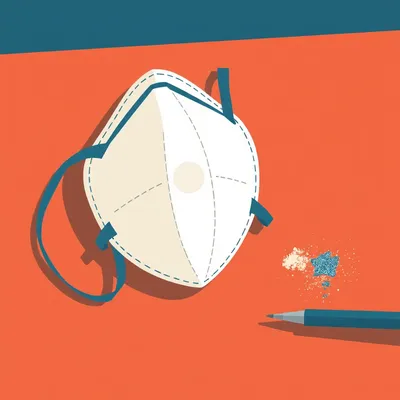
Daniel spent a few afternoons this summer in his in-laws' Connecticut basement, clearing cobwebs with a 3M respirator and a P100 filter strapped to his face. He's got asthma, the mask made the work possible, and it got him thinking about something most of us never think about until we need one. PPE is everywhere — hospitals, construction sites, hazmat labs, the guy sanding drywall in your kitchen — and yet it's almost completely invisible. COVID shoved it onto the front page for about six months, and then it vanished again. Daniel wants to know the history, how 3M came to dominate, whether the engineering is actually solved, and if not, where the innovation still needs to happen.

This is one of those topics where the more you look, the stranger it gets. PPE is simultaneously one of the most successful engineering stories of the last century and a field where the biggest remaining problems have almost nothing to do with engineering.
That's the tension, isn't it. The filters are brilliant and the masks are miserable.
And that gap — between what the technology can do and what humans will actually tolerate — that's where everything interesting lives. Let's pull this apart from the beginning.
Before 3M, before N95s, before anyone knew what a particulate filter was, people were still trying to not die from the air they breathed. Where does this actually start?
The earliest examples are practical, not medical. Roman miners — we're talking first century — used animal bladders tied over their faces to block dust. Pliny the Elder wrote about it. They'd poke holes for the eyes and breathe through the bladder membrane. It wasn't filtering anything in the modern sense, but it was keeping the largest particles out of their lungs.
So the first respirator was essentially a pig's stomach with eyeholes.
Roughly, yes. And it stayed at roughly that level for about sixteen hundred years. The plague doctors in the seventeenth century — the iconic beaked masks — those were an early attempt at filtration, but they were working from miasma theory. The beak was stuffed with herbs and spices, lavender, mint, camphor. The idea was that bad smells caused disease, so if you filtered out the smell, you filtered out the disease.
Which is wrong in its premise but not entirely wrong in its mechanism. Some of those aromatic compounds do have mild antimicrobial properties.
Right, and the physical barrier of the fabric and stuffing would have blocked some droplets. But they weren't filtering particulates in any engineered way. The real shift happens in the Industrial Revolution. By the 1850s, you've got coal mines, chemical plants, factories — and workers are dying in large numbers from inhaled hazards. John Stenhouse, a Scottish chemist, invented the first practical charcoal respirator in 1854. He'd been studying the absorptive properties of charcoal and realized you could pack it into a mask to capture toxic gases.
Charcoal's surface area is enormous. Gram for gram, it's still one of the best absorbents we have.
And Stenhouse demonstrated it by walking into a room filled with chlorine gas wearing his mask and walking out fine. That got attention. His design was refined over the next few decades — cotton wool filters, chemical absorbents layered into canisters — and the primary driver was mining. By 1900, thousands of coal miners were dying annually from black lung. There was real economic pressure to solve it.
But the thing that forced the technology from niche industrial gear into a standardized mass-produced product was the First World War.
Chemical warfare changed everything. Chlorine gas at Ypres in 1915, then phosgene, then mustard gas. Suddenly you needed to equip hundreds of thousands of soldiers with something that would actually work against gases that could kill you in seconds. The early response was improvised — cotton pads soaked in urine, which sounds absurd but the ammonia did neutralize chlorine to some degree.
The bar for "better than nothing" was on the floor.
It was. But by 1916, the British had the Small Box Respirator — a rubberized facepiece connected by a hose to a metal canister containing charcoal and chemical absorbents. Replaceable filters, standardized fit, mass-producible. The Germans had their Gummimaske. And the design lineage from those masks leads directly to every modern military and industrial respirator. The fundamental architecture — facepiece, seal, replaceable canister — was locked in by 1918.
Which brings us to 3M. And here's the part of the story I didn't know — they weren't a safety company. They started as a failed mining venture.
Minnesota Mining and Manufacturing, 1902. Five investors bought what they thought was a corundum deposit for making abrasives. It wasn't corundum. It was a low-grade mineral that was essentially useless. They pivoted to sandpaper, then to adhesives, then to tape. Scotch tape, masking tape — that's what built 3M. They didn't touch respirators until the 1960s.
So how does a tape company become the dominant force in respiratory protection?
Non-woven synthetic fibers. 3M had developed this technology for their tape and filtration products, and in the late 1960s, they realized you could use it to make a disposable respirator. The breakthrough was electrostatic charging of the fibers. Here's the key engineering insight: a traditional filter works by mechanical sieving — particles are physically too large to pass through the gaps between fibers. But that means you need very dense fibers, which makes breathing hard. What 3M figured out was that if you charge the fibers electrostatically, they attract and capture particles via electrostatic attraction, not just size exclusion. You can have a much more open, breathable structure that still captures particles because they're drawn to the fibers like a magnet.
So the particle doesn't need to physically hit a fiber. It just needs to get close enough to be pulled in.
And that's the difference between a respirator you can wear for an eight-hour shift and one that feels like you're breathing through a pillow. In 1972, 3M launched the model 8710 — the first NIOSH-approved disposable respirator. That's the direct ancestor of the N95. Same fundamental technology: electrostatically charged non-woven polypropylene fibers.
And NIOSH approval matters because that's when respirators stopped being just "here's a mask, trust us" and became a regulated, tested, standardized product.
The National Institute for Occupational Safety and Health. They test respirators against specific particle sizes at specific flow rates, and they certify them for specific hazards. The standard Daniel was using — P100 — that's the top of the particulate protection ladder.
Walk me through the ratings. Most people have heard N95, but the full system is more interesting than that.
The letter tells you about oil resistance. N means not resistant to oil — oil-based particles can degrade the filter. R means resistant, P means oil-proof. The number is the filtration efficiency. N95 filters ninety-five percent of airborne particles. N99 is ninety-nine percent. P100 is ninety-nine point nine seven percent — essentially HEPA-level filtration. And the testing is done at the most penetrating particle size, which is about zero point three microns.
Why is that the hardest size to filter? You'd think smaller particles would be harder to catch.
This is the counterintuitive part of particle physics. Particles larger than zero point three microns are captured mostly by interception and impaction — they're heavy enough that they can't follow the airstream around a fiber and they crash into it. Particles much smaller than zero point three microns are so small that Brownian motion — random molecular bombardment — makes them jitter around and they're likely to hit a fiber by chance. Zero point three microns is the sweet spot where neither mechanism works well. It's the particle size that's hardest to capture. So if your filter catches ninety-nine point nine seven percent at that size, it's catching even more at every other size.
So the rating is conservative by design. It's tested at the worst-case particle size.
And that's why P100 filters are used for things like asbestos, lead, mold remediation — hazards where you cannot afford any breakthrough. Daniel was clearing cobwebs in a basement. A P100 for that is overkill in the best possible way. He was breathing air cleaner than what's outside.
He mentioned his asthma, and that's where overkill becomes the right call. If your lungs are already reactive, you don't want to find out the hard way that an N95 wasn't quite enough for whatever's in that hundred-year-old Connecticut dust.
And here's where the 3M dominance becomes structural. They don't just make the respirator. They make the filter media. They make the machines that make the filter media. They've got decades of manufacturing optimization. When COVID hit and global N95 demand went from roughly seven billion units a year to an estimated fifty-plus billion, 3M was the only company that could scale fast enough to matter. They doubled production, but even that wasn't enough — and the shortage exposed how fragile the just-in-time supply chain really was.
The entire world's respiratory protection depended on a handful of factories running at capacity, and when demand spiked by a factor of seven, the system broke.
And it broke in a way that revealed something the engineering specs never capture. A P100 filter sitting in a warehouse is perfect. A P100 filter strapped to a face it doesn't fit is useless.
This is the fit testing problem.
It's the single biggest gap between what PPE can do on paper and what it does in the real world. NIOSH certifies the filter. But the seal between the mask and your face — that's on you. A perfect filter with a poor seal can leak fifty percent or more of the particles around the edges. And most people never get properly fit-tested. During COVID, hospitals were doing fit testing as fast as they could, but in construction, in manufacturing, in the kind of industrial settings where respirators are used every day — compliance is spotty at best.
Facial hair makes it worse.
Dramatically worse. A beard creates channels where air can flow around the filter entirely. OSHA's position is that any facial hair that comes between the sealing surface and the skin is a violation. Some workplaces have a beard policy — if you've got facial hair, you can't be assigned to jobs requiring a tight-fitting respirator. But enforcement is inconsistent.
And even without a beard, faces are different shapes. A mask that seals perfectly on one person leaks on another. The fit test involves spraying a saccharin or Bitrex aerosol around the seal while the wearer does a series of movements — talking, turning their head, bending over. If they can taste it, the seal is compromised.
And how many people wearing respirators in attics and basements and workshops have ever done that test?
Approximately zero.
So the engineering is brilliant and the deployment is broken. That's the story of PPE in two sentences.
Let's talk about who else is in this space. 3M has maybe thirty to forty percent of the global respirator market. Who's fighting for the rest?
Honeywell is the biggest competitor. They got serious about PPE in 2010 when they acquired Sperian Protection — a French company that had itself been assembled from a bunch of legacy safety brands. Honeywell now has a full portfolio: respirators, gas detection, fall protection, hard hats. They've been pushing hard into what they call connected worker platforms — integrating sensors into PPE that monitor exposure levels, filter saturation, the wearer's vital signs.
So the respirator becomes a data collection point.
That's the vision. A mask that tells you — and your safety manager — when the filter is approaching breakthrough, when your respiration rate is elevated, when you've been in a hazardous area too long. MSA Safety is doing similar work, though they're more focused on firefighting and mining — self-contained breathing apparatus, the kind where you're carrying your own air supply, not filtering ambient air.
And Dräger. German company, been at this since 1889.
Dräger is the gold standard for gas detection and supplied-air systems. They built the first modern SCBA for mining rescue. If you see a firefighter walking into a burning building with a tank on their back, there's a good chance it's a Dräger or an MSA unit. They've also got a huge industrial gas detection business — fixed sensors in refineries and chemical plants.
Moldex is the smaller player I find interesting. They're not trying to out-scale 3M. They're competing on comfort and breathing resistance.
Moldex-Metric. Their whole pitch is ergonomics. Lower breathing resistance, softer facepieces, designs that don't fog up your safety glasses. They've got a patent on a vented exhalation valve that directs your breath downward instead of straight out, which sounds minor until you're wearing safety glasses and every exhale fogs them up.
Which brings us to the question Daniel actually asked. Is this a solved engineering problem?
For particulate filtration, the answer is mostly yes. The physics of capturing particles from an airstream is well understood. Electrostatic media, mechanical filtration, the penetration curve — we know how to make a filter that captures essentially everything. The P100 standard was set decades ago and we can meet it reliably and cheaply. A P100 filter costs what, eight to twelve dollars?
Something like that. The respirator body is maybe thirty dollars. For forty bucks you've got HEPA-level protection on your face.
The unsolved problems are in three areas. One: comfort and wearability. Current respirators are hot, they're uncomfortable after an hour, they muffle speech, they hide facial expressions. Anyone who's worn one for a full shift knows this. New materials research is looking at breathable membranes that still filter — electrospun nanofibers, things like that — but nobody's cracked the comfort problem in a way that scales.
Two?
Decontamination and reuse. During COVID, researchers at Duke and other institutions showed that N95s could be safely decontaminated with vaporized hydrogen peroxide or UV light without degrading the filter media. But the infrastructure to do this at scale doesn't exist outside crisis mode. We're still treating respirators as single-use disposables in a world where supply chains can break overnight.
Three is the one we've been circling. Human factors.
Compliance, comfort, culture. Workers pull masks down when the supervisor leaves. They don't get fit-tested. They reuse filters long past the point where they should be replaced because nobody's tracking filter life. The best filter in the world is useless if it's sitting on someone's chin.
That's not an engineering problem. That's a sociology problem with a materials science budget.
It's harder. You can solve a particle physics problem with math and materials. You can't solve "this thing is uncomfortable and I hate wearing it" with a better electrostatic charge.
The regulatory landscape doesn't help either. NIOSH approval for a new respirator design takes two to three years. It's expensive. That creates a barrier to entry that entrenches the incumbents — 3M, Honeywell, MSA, Dräger. They can afford the approval process. A startup with a innovative design has to survive years of regulatory review before they can sell a single unit.
The EU's CE marking system is faster but less rigorous. So you get this asymmetry where European companies can iterate faster but with less validation, and American companies move slowly but with a higher confidence floor. Neither system is optimized for rapid innovation in a crisis.
The COVID moment proved that. When the world needed new respirator designs immediately, the regulatory apparatus couldn't move at the speed of the problem. Emergency use authorizations patched the gap, but that's not a long-term solution.
Here's what I think is the uncomfortable truth about PPE. For most industrial applications — construction, manufacturing, mining — the current technology is good enough. The filters work. The standards are rigorous. The remaining failures are human: people don't wear them, don't fit them, don't maintain them. The next frontier isn't better filtration. It's better adoption.
Which means the innovation that matters might not look like a better mask. It might look like a mask that people don't hate wearing. Or a mask that monitors its own seal and tells you when it's leaking. Or a supply chain that doesn't collapse when demand spikes by a factor of seven.
Smart PPE is the area where I think real change is coming. Sensors embedded in the respirator that track filter saturation, exposure dose, respiration rate. Honeywell and MSA are already shipping products in this category. The idea is that instead of replacing filters on a schedule — which is wasteful and often wrong — you replace them when the sensor says they're done. Instead of guessing whether a worker was overexposed, you have a record.
The privacy implications are interesting. A respirator that logs your location and exposure data is also a surveillance device. In a unionized workplace, that data could be used in ways workers don't love.
That tension is already playing out. Some unions have pushed back on connected PPE precisely because of the monitoring concern. The technology exists to track not just exposure but productivity — how long someone's been in a particular area, whether they're moving or stationary. The line between safety monitoring and worker surveillance gets thin fast.
The engineering story of PPE is mostly complete — brilliant filters, rigorous standards, a handful of dominant companies that know how to manufacture at scale. And the next chapter is about everything the engineering can't solve. Comfort. Trust. Compliance. Supply chains. The gap between what a P100 can do in a lab and what it does on a face in a dusty basement in Connecticut.
That basement is where the whole thing comes full circle. Daniel put on a respirator, did his work, didn't have an asthma attack. The technology did exactly what it was supposed to do. That's a quiet victory. Nobody writes articles about the guy who didn't get silicosis because his mask worked.
Silent success breeds neglect. PPE only becomes visible when it fails.
Hilbert: Nineteen ninety-seven. I was a safety inspector at a chemical plant in Linden, New Jersey. Walked the floor eight hours a day checking respirators. Hated every minute of it.
Because of the chemicals?
Hilbert: Because of the people. Nobody wanted to wear them. They were hot, they fogged up the glasses, they made it hard to breathe after an hour. I'd walk through a bay, see fifteen respirators hanging around chins. The moment I turned the corner, they'd pull them back down. I was the bad guy. The mask police.
That's the compliance problem in a nutshell. The engineering is perfect and the humans are not.
Hilbert: We had a beard policy. Anyone with facial hair couldn't get a seal, so they got assigned to jobs that didn't require respirators. Except the policy was enforced when someone remembered. I once had to write up a foreman — three-day stubble, insisted his mask was fine. I held a smoke test up to his face. The vapor poured in through the gaps around his jaw. You could see it curling in. He looked at it and said the test must be wrong.
Because admitting the mask didn't fit meant admitting he'd been breathing unfiltered air for years.
Hilbert: That's the thing. You tell a man his mask doesn't work, you're also telling him he's been exposed. Nobody wants to hear that. So they argue. They get angry. They tell you the smoke test is defective. I had a guy tell me his beard was special — it was soft, it would seal. Soft beards don't seal. No beards seal.
The physics doesn't care about your feelings about your beard.
Hilbert: The physics does not care. I kept a log. Over two years, I found maybe forty percent of the respirators on that floor weren't being worn correctly. Either the seal was bad, or the filters were overdue for replacement, or the mask was the wrong size. These were people working around solvents, acids, things that will hurt you. And the equipment was fine. The equipment was excellent. They just wouldn't use it.
What happened to the foreman?
Hilbert: He got written up. He was angry. Six months later he transferred to a different unit that didn't require respirators. I don't know if he ever admitted the mask was leaking. I doubt it.
That story is the entire PPE industry in microcosm. Billions of dollars in R and D, decades of materials science, and the whole thing comes down to whether a guy with a three-day beard will admit his mask doesn't fit.
Hilbert: The best filter in the world is a decoration if it's on your chin. That's not an insight. That's just what I saw every day.
Nobody's solved it. The filters got better, the standards got stricter, and the human at the end of the chain is still the same human who doesn't want to wear an uncomfortable mask for eight hours.
Hilbert: I still have the smoke test kit. It's in a box somewhere.
Of course you do.
Where does that leave us? The filters are brilliant. The masks are uncomfortable. And the next crisis is probably coming. The question is whether we'll have learned anything from the last one about supply chains and fit testing and the gap between what the engineering can do and what people will actually tolerate. The technology is ready. The sociology is not. And that's a harder problem than electrostatic fiber charging ever was.
This has been My Weird Prompts. Thanks to our producer Hilbert Flumingtop, who has apparently been sitting on that smoke test story for twenty-seven years.
If you've got a prompt you want us to dig into — or a basement full of cobwebs and a respirator recommendation — email the show at show at my weird prompts dot com.
We'll be back soon.