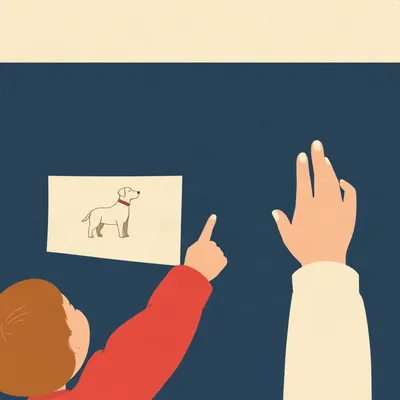
Daniel sent us this one — he's asking about how babies actually acquire their first words and sentences. But the real question underneath is about Ezra, who's growing up hearing English from him and Hannah at home, and Hebrew from people around them in Jerusalem. Which language has the higher chance of producing his first words? And when a child learns two languages at a native level, do they effectively have two mother tongues, or is one more deeply embedded than the other? There's a lot to unpack here.

The starting point that surprises most people is how early the vocabulary acquisition process actually begins. We tend to think it starts when the baby says something recognizable, but by the time that first word comes out — usually somewhere between ten and fourteen months — the child has been building receptive vocabulary for months. They understand words long before they can produce them.
The silence isn't empty. It's more like a hard drive spinning up.
And here's the concrete number: by twelve months, the average monolingual child understands about fifty words but might only say two or three. The comprehension-production gap is enormous. It's not that they don't know the words. The motor planning for speech just hasn't caught up to the comprehension system.
Which makes the whole "say mama" thing at family gatherings kind of cruel, if you think about it. The kid knows exactly who mama is. The tongue just won't cooperate yet.
The first words themselves follow a remarkably consistent pattern cross-culturally. There was a really elegant study that looked at over nine hundred children across ten languages. The first fifty words are dominated by the same categories: people's names, animals, food, body parts, clothing, vehicles, toys, household items, and social routines. It's not random at all.
Social routines meaning what, exactly? "Bye-bye" and "thank you"?
Yes, and "night-night," "peekaboo," those kinds of interactional scripts. They're among the earliest acquired because they're paired with consistent physical actions and emotional contexts. The word and the situation are fused. The child isn't abstracting yet.
The first vocabulary is basically a map of what's physically present and emotionally charged in the child's world. Mama, dada, the family dog, the bottle, the blanket. Whatever they can touch and whoever touches them.
That's where the bilingual question gets genuinely interesting. In a household like Daniel and Hannah's, Ezra is getting English from his parents and Hebrew from the environment — the street, the playground, eventually other caregivers. The dominant factor in which language produces first words isn't the language itself. It's who the child spends the most emotionally intense time with.
If both parents are speaking English, and the primary caregiver relationships are in English, the first words are almost certainly going to be in English.
The research on this is pretty clear. First words tend to come from the language of the primary attachment figures. There's a reason "mama" and "dada" are first-word candidates across every language studied. They're the people who show up when you're hungry or uncomfortable. The emotional salience is off the charts.
Which makes sense. A baby isn't doing a linguistic census of their environment. They're not calculating that sixty percent of the ambient speech is Hebrew so they should lead with "shalom." They're zeroing in on the voices that matter most.
And there's a deeper layer here that I find fascinating. With simultaneous bilinguals — children exposed to two languages from birth — the brain doesn't treat them as two separate systems at first. There's a period, roughly the first two years, where the child is essentially building one fused lexical system. They might know the word for "dog" in both languages but treat them as synonyms rather than as belonging to separate language buckets.
The separation comes later. The fusion is the default.
By around age two and a half to three, most simultaneous bilinguals start differentiating the two systems, but early on, it's more like one big vocabulary with internal duplicates. And this is where the exposure question gets nuanced. If Ezra hears "kelev" from someone at the park and "dog" from his parents, both words get stored. But the one with higher emotional repetition — the one said while pointing at an actual dog with excitement and eye contact — has a much stronger encoding.
It's not just raw frequency. It's frequency plus emotional weight plus joint attention.
Joint attention is the secret ingredient. When a caregiver and child are both focused on the same object and the caregiver names it, that's the optimal learning moment. It's been studied extensively. Children who get more episodes of joint attention acquire vocabulary faster, regardless of how many words are simply spoken around them. Passive overhearing doesn't do much.
That explains why putting a baby in front of a screen doesn't work for language learning. No joint attention. The television doesn't care whether the kid is looking at the dog or the ceiling.
There's actually a well-known study on this. Nine-month-olds exposed to Mandarin through in-person interaction versus through video. The in-person group learned to discriminate Mandarin phonemes. The video group showed no learning at all. The social context isn't a nice-to-have. It's the mechanism.
For Ezra, English at home with two engaged parents doing joint attention constantly versus Hebrew heard on the street or from more casual interactions — English dominates the early vocabulary almost by default.
That's exactly what the bilingual acquisition literature predicts. The home language, when it's the language of both parents, almost always produces the first words and the first multi-word combinations. The community language catches up later, sometimes explosively, once the child enters peer social environments.
Let's talk about that catch-up. When does it happen, and does it fully equalize?
The timeline varies, but the typical pattern for a child in Ezra's situation — two parents speaking English in a Hebrew-dominant environment — goes something like this. First words in English, around twelve to fourteen months. First two-word combinations in English, around eighteen to twenty months. Hebrew comprehension is building the whole time, but Hebrew production lags. Then somewhere between age two and three, when the child starts interacting with Hebrew-speaking peers regularly, you get a burst of Hebrew production. By age four or five, many kids in this configuration are functionally balanced, though they often still have a slight dominance in one language.
The dominance can shift depending on context.
It can shift even within a single day. There's a phenomenon called language mode. A bilingual child who's been at Hebrew-speaking preschool all morning might be in Hebrew mode and struggle to switch to English for the first few minutes at pickup. The languages aren't equally accessible at every moment. It's not like flipping a switch. It's more like warming up an engine.
The question of whether a simultaneous bilingual has two mother tongues or one that's more deeply embedded — what does the research actually say about that?
This is where the terminology gets tricky, and honestly, where a lot of popular discussion gets it wrong. The term "mother tongue" is itself a bit of a mess. Originally it referred to the language of the mother, literally. But in bilingualism research, the more useful concept is "dominant language" versus "balanced bilingual." And here's the uncomfortable truth that a lot of bilingual advocacy glosses over: truly balanced bilinguals, with perfectly equal proficiency across all domains, are actually quite rare.
Rare even among kids raised with two languages from birth?
What's much more common is what researchers call "dominance with functional bilingualism." One language is stronger, especially in certain domains. The child might be equally comfortable chatting about everyday topics in both languages but have academic vocabulary only in the school language. Or emotional vocabulary primarily in the home language. The languages specialize.
That's fascinating. So it's not that one language is weaker overall. It's that they divvy up the terrain.
And this is a feature, not a bug. The brain is optimizing. If you always talk about science in Hebrew at school, why would your brain bother maintaining a full parallel science vocabulary in English? It's efficient. But it means that when you test a bilingual across all domains, you almost always find asymmetries.
For Ezra, the likely outcome is English dominance in emotional and intimate domains, Hebrew dominance in academic and public domains, and both available for everyday conversation.
That's the most probable trajectory, yes. But there's a huge caveat here, and I want to be careful about it. Bilingual development is extraordinarily sensitive to input conditions. If Hannah and Daniel consistently speak only English at home, and Ezra attends Hebrew-speaking school, and his peer relationships are in Hebrew, that's one outcome. If they move to a different country, or if one parent starts speaking Hebrew at home, or if he consumes mostly English-language media as a teenager — any of those shifts can rebalance the system.
The "two mother tongues" framing is almost never literally true in the sense of perfect equality. But maybe that's not the right question.
I think the better question is: does the child have full native-like command of both languages in the domains where they actually use them? And for most simultaneous bilinguals in supportive environments, the answer is yes. They sound native in both. They don't have an accent in either. They don't translate in their heads. Both languages are "native" in the sense that neither was learned through explicit instruction. But they're not identical twins. They're more like siblings with different strengths.
Let's go back to first sentences for a moment. The prompt asks about both first words and first sentences. What's the typical trajectory from one to the other?
The first multi-word combinations usually appear around eighteen to twenty-four months, and they follow a pattern that's remarkably consistent across languages. The first combinations are what linguists call "telegraphic speech." Content words only, no function words.
No articles, no prepositions, no auxiliary verbs.
And this pattern holds across English, Hebrew, Japanese, you name it. The child is extracting the highest-information words and stringing them together. Function words come later, usually after the two-word stage consolidates.
What about Hebrew specifically? Hebrew has grammatical gender, verb conjugations that encode person and tense, and a root system that's quite different from English. Does that affect the acquisition timeline?
It does, and this is where the bilingual Hebrew-English case gets especially interesting. Hebrew morphology is much richer than English. Every noun has gender, every verb agrees with its subject in gender and number, and the verb system encodes tense, person, and sometimes object pronouns all within a single word. An English-speaking child can say "I want it" with three separate words. A Hebrew-speaking child has to produce a single inflected verb form.
The cognitive load per word is higher in Hebrew.
And the research bears this out. Hebrew-acquiring children tend to produce their first word combinations slightly later than English-acquiring children, on average, because each word carries more grammatical information. But once they crack the morphological system, they accelerate rapidly.
If Ezra's first sentences are in English, part of that might simply be that English makes it easier to combine words early. Lower barrier to entry.
That's a real factor. English has almost no inflectional morphology compared to Hebrew. You can build a perfectly communicative sentence with just bare words in English. "Me go park." In Hebrew, even the simplest verb requires you to commit to a tense, a person, a gender, and a number. The combinatorial freedom of English is higher for a two-year-old.
Which means the first-sentence advantage for English in a bilingual English-Hebrew child isn't just about exposure. It's also about structural simplicity.
That's a point I don't think gets enough attention in bilingual parenting discussions. People often attribute language delays or advances entirely to exposure quantity, but the structural properties of the languages matter too. A child exposed to two languages with very different morphological complexity might show different timelines in each, and that's not a sign of a problem. It's just the brain dealing with different engineering challenges.
Let's talk about code-switching, because that's going to show up in Ezra's speech pretty early if it hasn't already.
Code-switching — mixing languages within a sentence or conversation — is one of the most misunderstood phenomena in bilingual development. Parents often worry about it. They think it means the child is confused, that the languages are getting tangled up. The research says exactly the opposite.
It's a sign of competence, not confusion.
Children who code-switch are demonstrating that they understand the grammatical rules of both languages well enough to navigate the boundaries between them. They don't randomly insert words. They follow systematic patterns. For example, a Hebrew-English bilingual child might insert an English noun into a Hebrew sentence but preserve Hebrew word order and Hebrew morphological marking on the verb. That requires knowing which parts of each language's grammar are active at the switch point.
It's like a jazz musician modulating between keys. You can only do it well if you know both keys deeply.
There's another layer. Children also code-switch for pragmatic reasons. They'll use the word that's most accessible in the moment, or the word that carries the right emotional weight, or they'll switch to match the language their conversation partner prefers. By age three or four, many bilingual children are already sensitive to which language to use with whom.
The classic "speaks English to mom and Hebrew to the neighbor" thing.
They're remarkably consistent about it. Even very young bilingual children rarely use the wrong language with a known interlocutor. They've mapped language to person.
The picture for Ezra is something like: first words and first sentences most likely in English, driven by the emotional density of the parent relationship. Hebrew comprehension building steadily in the background. Then a Hebrew production surge once peer interactions kick in. Code-switching as a sign of growing competence, not confusion. And by school age, something like balanced functional bilingualism with domain-specific strengths.
That's the central scenario. But I want to add one more dimension that I think is important, especially given that Daniel and Hannah are raising Ezra in Jerusalem. There's a distinction in bilingualism research between additive and subtractive bilingualism.
Additive bilingualism is when a child learns a second language without any threat to the first language. Both are valued, both are maintained, and the child ends up with two fully developed systems. Subtractive bilingualism is when the second language comes at the expense of the first — the child gradually loses the home language because the community language is more prestigious or more practically useful.
That's the classic immigrant story in a lot of places. First generation speaks the old language at home, second generation understands it but responds in the new language, third generation doesn't speak it at all.
And in Ezra's case, English is a high-prestige global language. It's not at risk of being devalued in the same way a minority language might be. But the subtractive dynamic can still operate if the child starts preferring Hebrew with his parents because that's what he uses all day at school. Maintaining the home language requires active effort, even when that language is English.
The "two mother tongues" outcome isn't automatic just because the child hears both from birth. It requires maintenance.
It requires what researchers call "rich input" in both languages across a wide range of contexts. Not just conversation, but storytelling, explaining, arguing, joking — all the complex uses of language that build depth. A child who only uses English for "what's for dinner" and Hebrew for everything else isn't going to develop equivalent depth in both.
Which brings us to bedtime stories, family conversations, the whole texture of language use at home.
This is where I think Daniel and Hannah are actually in a strong position. Two English-speaking parents in the home means English gets used for the full range of domestic communication. It's not just transactional. It's relational. That's the kind of input that builds deep linguistic roots.
Let me ask about something that's been in the back of my mind. The prompt mentions that Ezra hears Hebrew "from some people and on the street." That's a pretty wide range of input quality. From intimate conversations to overheard fragments. Does the brain weight these differently?
And this is one of the most robust findings in language acquisition research. Not all input is equal. Child-directed speech — the kind where an adult is speaking directly to the child, with simplified grammar, exaggerated intonation, and shared attention — is vastly more effective for language learning than overheard speech. The effect size is large. Some studies suggest that the quantity of child-directed speech, not total speech in the environment, is the primary predictor of vocabulary growth.
"hearing Hebrew on the street" is doing something, but it's doing a lot less than a Hebrew-speaking caregiver would.
It's building phonetic categories. It's helping the child learn what Hebrew sounds like, where word boundaries fall, what the prosodic patterns are. That's valuable. But it's not building vocabulary the way direct interaction would. For vocabulary, the child needs joint attention and semantic mapping — connecting a word to its referent in a shared context. Overhearing doesn't provide that.
Which reinforces the prediction that English vocabulary will lead early, even if the total hours of Hebrew exposure in the environment are high. It's the quality of the exposure, not just the quantity.
I should add, this isn't a problem. It's just the natural trajectory for this configuration. The Hebrew will come. In fact, once Ezra starts spending significant time with Hebrew-speaking peers, the peer interaction becomes an incredibly powerful engine for language learning. Children learn language from other children differently than they learn from adults, and in some ways more efficiently.
Peer speech is simpler, more repetitive, more embedded in play routines. It's easier to parse. And there's a strong social motivation to communicate with peers that doesn't exist in the same way with adults. A three-year-old wants to play with the other three-year-olds. If the other three-year-olds speak Hebrew, that's a powerful incentive.
The sequence is: parents provide the emotional-linguistic foundation in English, peers provide the social-linguistic bridge into Hebrew. Both are necessary. They just operate on different timelines.
That's why the "two mother tongues" framing might be less useful than thinking about it as a layered system. The languages aren't competing. They're specializing. And the specialization changes over time as the child's social world expands.
I want to circle back to something you mentioned earlier about first words being similar across cultures. Are there any interesting differences in what Hebrew-acquiring children tend to say first, versus English-acquiring children?
The broad categories are the same. People, food, animals, body parts, routines. But there are some culturally specific patterns. Hebrew-acquiring children tend to acquire certain religious or cultural terms early if they're part of the family's practice — words like "Shabbat" or "chag" for holiday. And there's an interesting pattern with the word "aba" for father and "ima" for mother, which are among the earliest words for Hebrew-acquiring children, just like "dada" and "mama" are in English.
The words for parents are phonetically simple across languages. "Mama," "papa," "dada," "ima," "aba." Almost always reduplicated syllables with easy consonants.
That's not an accident. Those sounds — "m," "b," "p," "d" — are among the first consonants babies can produce reliably. The words for parents are shaped by the infant vocal tract, not the other way around. Parents across cultures have, over generations, adopted the sounds their babies can already make as the names for themselves.
Babies didn't learn to say "mama" because we taught them. We started calling ourselves "mama" because that's what babies could say.
That's essentially the theory, and it has a lot of cross-linguistic evidence behind it. The words for mother and father in unrelated languages show remarkable phonetic similarity. It's one of the few near-universals in language.
Which means Ezra's first word is statistically likely to be some variant of mama, dada, ima, or aba, regardless of which language it's in.
Given that Hannah and Daniel are his primary caregivers and they speak English, "mama" or "dada" is the smart bet. But here's a wrinkle. If Ezra hears "ima" and "aba" from Hebrew speakers regularly and those words also have high emotional salience, they could enter his early vocabulary alongside the English terms. He might have both "mama" and "ima" in his first fifty words.
He'd have duplicates for the same referent. Which goes back to what you said about the early fused system.
He wouldn't necessarily know they're from different languages. They're just two ways to refer to the same person. The language boundary gets drawn later.
Let's talk about what happens after the early vocabulary burst. There's a phenomenon people talk about called the vocabulary explosion. Is that real, or is it one of those developmental psychology myths?
It's real, but it's more gradual than the term "explosion" suggests. Around eighteen months, most children show a noticeable acceleration in word learning. They go from acquiring maybe one or two new words per week to acquiring several per day. By twenty-four months, the average child has about two hundred to three hundred words, and by thirty months, it's closer to five hundred.
This is where you have to be careful with the numbers. If you count total vocabulary across both languages, bilingual children typically have comparable total vocabulary to monolinguals. But if you test them in only one language, they'll appear to have fewer words. This has led to a lot of misguided concern about bilingualism causing language delay. It doesn't. The vocabulary is just distributed across two systems.
The pediatrician who says "your bilingual child only has fifty words in English at twenty months, that's below average" is making a measurement error, not identifying a real deficit.
A serious measurement error, and one that's been documented in the literature extensively. The proper assessment counts words in both languages, and it counts conceptual vocabulary — if the child knows "dog" in English and "kelev" in Hebrew, that's one concept, not two words, for the purpose of assessing whether the child has a delay. But for total lexical inventory, you count both.
What's the conceptual vocabulary versus total vocabulary distinction matter for, practically?
Conceptual vocabulary tells you whether the child has the underlying cognitive categories. If a child knows the word for "dog" in one language but not the other, they still have the concept. The concept is what matters for cognitive development. The specific lexical item in each language is a surface realization. Most bilingual children have conceptual vocabularies well within the normal range, even when their single-language vocabularies look small.
If Daniel and Hannah are tracking Ezra's development, they should be counting words across both languages and not panicking if his English-only count looks low compared to monolingual norms.
And they should also be aware that bilingual children sometimes go through a "silent period" in the community language, where they understand a lot but don't produce much. That's normal and typically resolves once they feel comfortable.
The silent period. That must be nerve-wracking for parents who don't know it's normal.
It can last months. The child is building comprehension, internalizing the sound system, practicing internally. Then one day they just start speaking. It's one of those developmental phenomena that looks like a problem but is actually a sign that the brain is doing exactly what it should.
Like a software install that looks frozen but is actually running a massive background process.
Don't reboot the child.
So what about the question of whether the two languages are equally embedded? We've talked about dominance and domain specialization, but is there a neurological sense in which one language is more "native" than the other?
The neuroimaging research on this is fascinating. In highly proficient simultaneous bilinguals, both languages activate overlapping brain regions. There's no separate "English area" and "Hebrew area." The same language networks handle both. But — and this is the crucial finding — the first language, or the more dominant language, often shows slightly more efficient processing. Less neural effort for the same task.
Even when both are native, one is running at lower computational cost.
And this can shift over the lifespan. A simultaneous bilingual who moves to the country of their second language and uses it predominantly for decades might see the efficiency advantage flip. The brain is plastic. Dominance isn't fixed.
Which means "mother tongue" is less a permanent neurological status and more a snapshot of current usage patterns.
I think that's the right way to think about it. The term "mother tongue" captures something real about emotional and developmental primacy, but it's not a fixed property of the brain. It's a relationship between a person and a language, and relationships change.
Let's bring this back to Ezra for a moment. Given everything we've discussed, what would you actually predict for his first word and first sentence?
If I had to put money on it, I'd say his first word is "dada" or "mama" in English, produced somewhere between eleven and fourteen months. First sentence, something like "more milk" or "daddy go," in English, around eighteen to twenty months. Hebrew words will be in his receptive vocabulary early, and he'll start producing them more actively once he has regular Hebrew-speaking playmates. By age three, I'd expect him to be code-switching comfortably and using Hebrew for peer interaction and English for family interaction.
The equal embedding question?
He'll likely be English-dominant in the early years and move toward balance as he enters the school system. Whether he achieves perfect balance depends on a thousand variables — which school, which friends, which media he consumes, whether the family stays in Jerusalem long-term. But he'll be a native speaker of both in every way that matters. The question of which is "more" native is probably the wrong question. They'll both be his.
The fact that they're not perfectly equal in every domain isn't a deficit. It's just how bilingual brains work.
It's how all brains work, really. Even monolinguals have domain-specific vocabulary strengths. A monolingual English-speaking physicist and a monolingual English-speaking poet have very different Englishes. The bilingual case just makes the domain specialization more visible because it maps onto different languages.
That's a lovely point. The bilingual brain isn't doing something strange. It's just doing what all brains do, but across two systems instead of one.
Doing it remarkably well, given the complexity of the task. Language acquisition in any configuration is one of the most impressive things the human brain accomplishes. Bilingual acquisition is that, squared.
The short answer to the prompt is: English for the early milestones, Hebrew catching up later, both native, neither perfectly equal, and that's exactly how it should be.
The slightly longer answer is: don't worry about which language comes first. Worry about rich, emotionally engaged input in whatever languages you want the child to keep. The order of first words is a footnote. The quality of the linguistic environment is the whole story.
That seems like a good place to land. One thing I keep thinking about, though — we've talked about the mechanics of vocabulary acquisition, but there's something almost miraculous about the whole thing. A child goes from zero words to several hundred in about a year and a half. That's a learning rate that would make any AI researcher weep with envy.
It's staggering. If you do the math, between eighteen months and six years, children acquire about one new word for every waking hour. And they're not just memorizing sound sequences. They're inferring grammatical categories, semantic relationships, and pragmatic constraints simultaneously. No machine does anything close to this.
One new word per waking hour. That's a full-time job with unpaid overtime.
They do it while also learning to walk, developing theory of mind, figuring out object permanence, and mastering the social rules of their culture. Early childhood is basically a cognitive boot camp.
Which makes you wonder why we spend so much time as adults worrying about whether we're optimizing our learning. We already did the hardest learning we'll ever do, and we did it in diapers.
While napping two hours a day.
The sloth in me appreciates that detail.
I knew you'd find a way to make this about napping.
Everything is about napping if you're paying attention.
And now: Hilbert's daily fun fact.
Hilbert: In the nineteen seventies, a French radio engineer stationed in Niger discovered that a colony of weaver birds had built a nest directly on top of a military antenna array, and the birds had somehow learned to modulate their chirping to match the frequency of the transmitter, effectively turning the entire base's radio output into an accidental birdsong broadcast that could be picked up as far as Chad. The birds were not, as initially suspected, Soviet espionage assets.
I have so many questions and I'm going to ask none of them.
"Accidental birdsong broadcast" is going to be my next DJ name.
Please don't.
This has been My Weird Prompts, with me, Corn, and my brother Herman Poppleberry. Produced by Hilbert Flumingtop. If you enjoyed this episode, leave us a review wherever you listen — it helps other people find the show. Until next time.