Daniel sent us this one, and it's a problem I think a lot of people have slammed into headfirst. You're on Alibaba, you find exactly the parts you need — five hundred dollars for a batch of electronics components, incredible price. Then the seller sends the shipping quote and it's four thousand dollars. The deal's dead. Daniel's question is basically, how do you get around that? Specifically, if you're importing small volumes — a few pallets, not a full container — are there providers that consolidate your stuff into shared containers so the shipping math actually works? And if the answer is "use a freight forwarder," how does that transaction actually look, start to finish, including which Incoterm you'd use on the Alibaba side and which one for the forwarding leg?

This is one of those areas where the platform design and what the platform lets you do are two completely different things. Alibaba the marketplace gives you enormous flexibility — you can negotiate any Incoterm, buy goods to any handoff point. But Alibaba the logistics experience, for B2B, does not give you the seamless consolidation that AliExpress buyers take for granted. And that gap is where the four thousand dollar shipping quote lives.
Before we get to the fix, let's name the disease. Why is shipping from Alibaba so punishing for small volumes?
Because Alibaba is built for container-load orders. FCL — full container load. The seller's logistics partners, the default shipping quotes, the whole mental model — it assumes you're buying twenty cubic meters of goods, not two. When you ask for a door-to-door quote on three pallets, what you're actually getting is a price for a full container that you're only using a fraction of. You're paying for empty space. Or worse, you're paying for a premium courier service that's priced for speed, not efficiency. The platform doesn't automatically consolidate your three pallets with someone else's five pallets into a shared container. That's not what the B2B marketplace does.
AliExpress does exactly that.
And this is where people get confused, because both platforms have the word "Ali" in them and both ship from China. Cainiao, which is Alibaba's logistics arm, runs this incredibly effective parcel-level consolidation network for AliExpress. They aggregate millions of small packages at origin warehouses, stuff them into containers by destination region, clear customs in bulk, and hand off to local last-mile carriers. It's why you can buy a two-dollar phone case with free shipping from China and it shows up in twelve days.
Why doesn't Cainiao just do the same thing for Alibaba B2B orders? It's the same parent company.
Different infrastructure, different customer expectations, different everything. Cainiao's AliExpress network is built for parcels — individual items under two kilos, standard packaging, high automation. A B2B shipment is pallets. Maybe it's three pallets of custom-machined aluminum parts on oversized skids. You can't run that through the same sorting belt as a phone case. More importantly, B2B buyers need different things — they need customs documentation for commercial imports, they need to specify Incoterms, they need cargo insurance that covers palletized freight, not lost envelopes. As of right now, mid-2026, Cainiao does not offer LCL container consolidation for Alibaba's B2B marketplace. It's just not the business they're in.
The platform leaves a hole, and the hole is exactly where Daniel's question lives. You need someone else to do the consolidation. That's the freight forwarder.
That's the freight forwarder. And the reason this works is that freight forwarders don't think in terms of "your shipment." They think in terms of container optimization. They're aggregating cargo from dozens of small importers, and their entire business model is filling containers efficiently. Your three pallets from Shenzhen get combined with four pallets of textiles from Guangzhou and two pallets of injection-molded parts from Dongguan. Everyone pays for their share of the container, and the per-unit shipping cost drops through the floor.
Okay, so let's walk through how this actually works on a transaction level. Daniel asked specifically about Incoterms — what you'd use on the Alibaba purchase and what happens on the forwarding leg. And I think the Incoterm choice is where most first-timers step on the landmine.
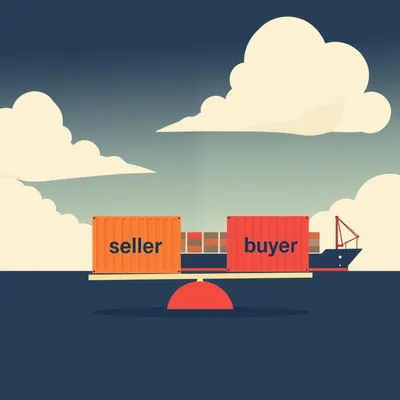
It's the single most important decision in the whole process, and the default is a trap. So let's talk about the three Incoterms that matter here, under the Incoterms 2020 rules. EXW — Ex Works. FOB — Free on Board. And CIF — Cost, Insurance, and Freight. EXW is the one that looks cheapest on the Alibaba product page because the seller's price only covers the goods sitting at their factory gate. That's it. The seller's responsibility ends the moment the goods are available for pickup. Everything after that — domestic trucking to the port, export customs clearance, loading, ocean freight, destination customs, destination trucking — that's all on you, the buyer.
That's where the surprise six hundred dollar trucking bill comes from.
Imagine you're buying from a supplier whose factory is in some rural industrial zone in Hubei province, four hours from the nearest major port. Under EXW, you're arranging and paying for that truck. The seller doesn't care. They quote you a low EXW price, you think you're getting a deal, and then you find out that getting three pallets from a factory in the middle of nowhere to Shanghai port costs six hundred dollars. And that's before the goods even touch saltwater.
EXW is the "looks great until you actually have to move the thing" Incoterm.
It's the Incoterm equivalent of a restaurant with no prices on the menu. The base cost is low, the extras destroy you. Now, FOB — Free on Board — is what most small importers should be negotiating for on the Alibaba side. Under FOB, the seller handles everything up to and including loading the goods onto the vessel at the named port. They arrange domestic trucking, they handle export customs clearance, they pay the terminal handling charges at origin. Their responsibility — and their cost — ends when the goods are on the ship. The handoff is clean. The goods cross the ship's rail, and now they're yours.
That clean handoff is what makes it work with a freight forwarder.
Because the freight forwarder's job starts at exactly that point. They take ownership of the ocean freight leg, the destination port handling, customs clearance, and final delivery. So the transaction splits into two clean legs. Leg one, your Alibaba purchase under FOB to Shanghai or Shenzhen or Ningbo port. Leg two, your freight forwarder takes over from the vessel loading onward. There's no ambiguity about who's responsible for what at any point in the journey.
What about CIF? Cost, Insurance, and Freight — seller pays for shipping and insurance to the destination port. Sounds even easier.
It sounds easier, and that's the trap. Under CIF, the seller arranges and pays for ocean freight and insurance to, say, the port of Los Angeles. But here's the problem — the seller controls the shipping. They choose the carrier, the routing, the transit time. And they have every incentive to choose the cheapest, slowest option. Your three pallets might sit at a transshipment port for two weeks waiting for consolidation because the seller booked the budget carrier. Meanwhile, if you'd used FOB and your own forwarder, you'd have visibility and control over the routing. CIF also doesn't include destination charges — customs clearance, duties, destination trucking — those are still on you. So you've paid a premium for the seller to handle shipping, but you've ceded control without actually solving the door-to-door problem.
FOB is the sweet spot. Seller handles the China-side complexity, you handle the ocean and destination side through someone you've chosen.
There's another reason FOB matters on Alibaba specifically — Trade Assurance. Alibaba's buyer protection program covers transactions up to the Incoterm handoff point. Under FOB, that means Trade Assurance covers the goods until they're loaded onto the vessel. If the goods never make it to the ship, or they arrive at the port damaged before loading, you're covered. Under EXW, Trade Assurance coverage ends at the factory gate. If the truck you hired crashes on the way to the port, that's your problem.
That's a pretty compelling reason to push for FOB even if the seller initially quotes EXW. So let's make this concrete. Walk me through a real scenario. I'm in Chicago, I've ordered three pallets of electronics components from a supplier in Shenzhen. I've negotiated FOB Shenzhen. What actually happens?
Step one, you've already found and vetted a freight forwarder before you even finalize the Alibaba order. You've gotten quotes, you know roughly what the ocean freight and destination charges will be. Step two, you place the Alibaba order under FOB Shenzhen. The supplier manufactures your components, palletizes them, arranges a truck to Shenzhen port, handles export clearance, and delivers the pallets to the terminal. Step three, you provide your freight forwarder's details to the supplier — specifically, the forwarder's consolidation warehouse or the vessel booking reference. Step four, the supplier loads the goods onto the vessel. At that moment, ownership transfers to you, and your forwarder takes over. Step five, your forwarder consolidates your three pallets with shipments from four other buyers into a single twenty-foot container. That container sails to the Port of Los Angeles. Step six, at LA, the forwarder deconsolidates — splits the container back into individual shipments — clears your three pallets through US customs, and arranges trucking to your warehouse in Chicago.
The consolidation step — the combining of my pallets with four other buyers' shipments — that's the secret sauce that makes the shipping cost work.
That's the whole game. Without consolidation, you're paying for a full container that's mostly empty. With consolidation, you're paying for roughly two or three cubic meters of space in a shared container. And the per-unit cost difference is enormous. Ocean freight for a full twenty-foot container from Shenzhen to LA might run somewhere between two thousand and three thousand dollars depending on the season and fuel surcharges. If you're only using a tenth of that container, your effective rate is still two to three thousand. But under LCL consolidation, you pay for your actual volume, and the forwarder spreads the container cost across multiple shippers. Your share might be three hundred to six hundred dollars for the ocean leg.
Let's talk about who these forwarders actually are. Daniel asked for names — who works with small importers?
There's a range. On the digital-first end, you've got Flexport. They built their platform around visibility and ease of use — you can track shipments in real time, manage documentation online, and they're comfortable with small and medium importers. They don't have the massive minimum volume requirements that traditional forwarders sometimes impose. Then you've got the established giants — DHL Global Forwarding, Kuehne plus Nagel. DHL Global Forwarding is a different entity from DHL Express, by the way — different networks, different pricing. Kuehne plus Nagel has enormous scale, which means they can offer competitive rates, but they're really optimized for regular shippers moving consistent volumes. If you're doing one shipment every six months, you might not be their priority.
What about the marketplace approach?
Freightos is worth knowing about. It's a digital marketplace where you can get quotes from multiple forwarders for your specific shipment. You enter the origin, destination, dimensions, weight, and you get comparable quotes. It's useful for price discovery — you can see what the market rate actually is before committing. For smaller importers, there are also specialized consolidators like ShipBob, though ShipBob is more on the fulfillment side — they're better if you're importing goods that you then need to store and ship to end customers. If you're importing components for your own manufacturing, a traditional forwarder or Flexport is probably more appropriate.
The forwarder landscape isn't one-size-fits-all. But regardless of who you pick, there's a cost structure you need to understand. Let's break down a real shipment.
Let's take that Chicago example — three pallets of electronics from Shenzhen, roughly two cubic meters, maybe four hundred kilos. Under FOB Shenzhen, the Alibaba seller handles everything to the vessel. Your costs start with the forwarder. Ocean freight from Shenzhen to LA for two CBM of LCL — you're looking at roughly one hundred to three hundred dollars per CBM, so let's call it two hundred to six hundred for the ocean leg. Then you've got destination charges at the Port of LA — terminal handling, documentation, customs brokerage — that's probably another hundred to two hundred fifty dollars. Then US customs clearance, which is a separate fee, maybe fifty to a hundred fifty dollars depending on the broker. Then domestic trucking from LA to Chicago — for three pallets, you're probably looking at two hundred to four hundred dollars. Total forwarder-side costs, roughly eight hundred fifty to eighteen hundred dollars.
Compare that to the direct quote from the Alibaba seller's preferred carrier.
The door-to-door quote from the seller's carrier for the same three pallets might run three thousand to five thousand dollars. Same goods, same ports, same truck. The difference is the seller's carrier is quoting you a dedicated service — effectively a premium courier model — rather than consolidated LCL. They're not aggregating your shipment with others. You're paying for the convenience of not thinking about it. The consolidation approach saves you somewhere between fifty and seventy percent on shipping.
Which turns a deal-killer into a viable business. But there are traps, right? Costs that show up even when you think you've accounted for everything.
The first one is the minimum billable volume. Most LCL forwarders round up to one cubic meter. If your shipment is actually zero point three CBM, you're still paying for one CBM of space. That's just how the economics work — the forwarder needs to cover their costs. So if your shipment is genuinely tiny — under half a CBM or under a hundred kilos — you're often better off using an express courier like DHL Express or FedEx. The consolidation overhead eats the savings at very small volumes.
There's a minimum viable shipment threshold below which ocean LCL doesn't make sense.
Roughly half a CBM or a hundred kilos. Below that, the air courier networks are actually more cost-effective because they're optimized for small parcels. Above that, ocean LCL starts to win. The second trap is demurrage and detention. Demurrage is what you pay when your container sits at the port too long before being picked up. Detention is what you pay when you hold the container too long after pickup before returning it. For LCL, you're not directly responsible for the container itself — the forwarder is — but delays in customs clearance can still generate storage charges at the consolidation warehouse. And those add up fast.
What about port congestion surcharges? I remember that being a nightmare a few years back.
Still a factor. Post-COVID, the ports have mostly normalized, but you still get congestion surcharges during peak season — August through October, when everyone's importing for the holiday retail season. And geopolitical disruptions can spike rates overnight. If there's suddenly tension in the South China Sea or a canal gets blocked, your forwarder will pass through surcharges. A good forwarder will warn you about these, but they're not always avoidable.
How do you vet a forwarder before you trust them with a shipment?
First thing, check for an NVOCC license — Non-Vessel Operating Common Carrier. In the US, NVOCCs are regulated by the Federal Maritime Commission. If your forwarder has an FMC license, they're subject to oversight, bonding requirements, and tariff filing obligations. That's your baseline. Second, look for membership in FIATA — the International Federation of Freight Forwarders Associations — or your local forwarding association. Third, ask for references from other small importers. There are forums and communities where people share forwarder experiences — find someone who's shipped similar volumes on similar routes. And fourth, always test with a small shipment first. Don't make your first shipment with a new forwarder a full container of high-value goods. Send a pallet or two, see how they handle communication, documentation, and problem-solving.
The test shipment idea seems obvious but I bet almost nobody does it.
Because everyone's in a hurry. They've got a production deadline or a customer waiting, and they want to go straight to the full order. But the forwarder relationship is like any other supplier relationship — you need to validate it before you scale it.
Let's talk about something Daniel hinted at in his question — the Incoterm on the second leg. The forwarding leg from the Chinese port to your door. What Incoterm governs that relationship?
This is where it gets slightly conceptual, because the Incoterms are designed for seller-buyer transactions, not for the relationship between you and your service provider. Your freight forwarder isn't selling you goods — they're selling you a logistics service. So you don't technically have an Incoterm with your forwarder. What you have is a service contract that specifies what's included. But if you want to map it to Incoterm logic, what you're effectively getting from the forwarder is something like CIF to the destination port plus destination services — customs clearance, duty payment, and final delivery. The forwarder's quote should be "all-in" — ocean freight, destination terminal charges, customs brokerage, and trucking to your door. If a forwarder quotes you a low ocean freight rate but doesn't mention the destination charges, that's a red flag.
Because the destination charges can be as much as the ocean freight itself.
I've seen quotes where the ocean freight is three hundred dollars and the destination charges are another four hundred. If you only looked at the ocean rate, you'd think you were getting a deal. Ask for all-in pricing. Every legitimate forwarder understands what that means.
We've covered the mechanics, the Incoterms, the forwarders, the costs, the traps. What's the Monday morning checklist? Someone listening who's about to place their first Alibaba order — what do they do?
One, always negotiate FOB on the Alibaba side. If the seller insists on EXW, push back. Most sellers will agree to FOB — it's a standard Incoterm and they're familiar with it. Two, get quotes from at least three freight forwarders before you commit to the Alibaba order. You need to know your total landed cost before you buy the goods, not after. Three, ask for all-in pricing from every forwarder — ocean freight plus all destination charges, including customs brokerage and trucking to your door. Four, start with a small test shipment to validate the forwarder. Even if it delays your full order by a few weeks, it's worth it. Five, build a buffer into your timeline. LCL consolidation adds time — the forwarder needs to fill the container before it sails. That can add one to three weeks compared to a dedicated shipment. If your production schedule is tight, account for that.
What about the platform itself? Is Alibaba doing anything to close this gap?
Alibaba Logistics has been improving. They now offer some LCL services directly through the platform, but the destination coverage is still limited — it works well for major ports in North America and Europe, less so for secondary destinations. And the pricing isn't always competitive with what you can get from an independent forwarder. There are also alternative B2B platforms — Made in China dot com, Global Sources — that have stronger freight integration for small buyers. They've invested in logistics partnerships specifically because they know the shipping cost problem is what kills deals.
The landscape is shifting, but for now, the freight forwarder route is still the main path for small importers.
I think that raises an interesting question about where this is all heading. Cainiao has proven they can do consolidation at massive scale for parcels. The technology exists. The question is whether Alibaba sees enough margin in B2B LCL consolidation to build out that infrastructure, or whether the fragmentation of B2B — different pallet sizes, different packaging, different customs requirements — makes it inherently harder to automate than parcel-level e-commerce.
That's the open question. If Alibaba cracks that, the four thousand dollar shipping quote becomes a relic. Until then, knowing how to navigate FOB and freight forwarders is the difference between a viable import business and a dead deal.
We'd love to hear from listeners who've done this. What forwarder did you use? What Incoterm worked for you? Did you get burned by an EXW quote? Send us your war stories — show at my weird prompts dot com.
Next time, we're going deeper into the hidden costs of importing — tariffs, duties, and the de minimis loophole that's been in the news. That's a whole other layer of math that can make or break your landed cost.
Now: Hilbert's daily fun fact.

In the 1980s, researchers in French Guiana estimated that lightning strikes produce enough fulgurite glass globally each year to encircle the Earth's equator roughly zero point zero two times — a tube of fused sand about eight hundred kilometers long, if you laid every formation end to end.
I don't know what to do with the image of a glass tube wrapped point zero two times around the planet.
That's going to sit in my brain all day.
This has been My Weird Prompts. If you enjoyed this episode, leave us a review wherever you listen — it helps other people find the show. I'm Corn.
I'm Herman Poppleberry. We'll catch you next time.