Daniel sent us this one — he's asking about the Armenian community in Jerusalem. You know, the one that most tourists walk right past without realizing they're missing an entire civilization. How did Armenians end up here in the first place? How many are actually left? And where do they sit politically in a city where neutrality is basically a fantasy?

This is one of those stories where the deeper you dig, the more it rearranges how you see the whole city. Most people think of Jerusalem as a three-ring circus — Jews, Muslims, Christians. But the Armenian Quarter is a fourth ring that doesn't fit neatly into any of those categories, and it's been there longer than almost anything else.
Walk me through it. How does a community from the Caucasus end up anchored in Jerusalem for seventeen centuries?
The pivot moment is 301 CE. Armenia becomes the first nation on earth to adopt Christianity as its state religion, under King Tiridates the Third. That's more than a decade before Constantine even legalizes Christianity in Rome. And once you're officially Christian, Jerusalem becomes the magnetic center of your spiritual universe. Armenian pilgrims start arriving almost immediately.
Right, because if your entire national identity is now built around being the first Christian kingdom, you need a physical toehold in the place where it all happened.
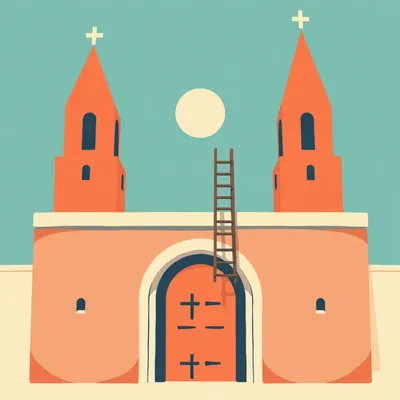
And they didn't just visit — they stayed. By the fifth century, the Armenian Apostolic Church had established a formal presence. The anchor was the St. James Monastery complex, which is still there today. It's essentially a walled city within the walled city. You walk through these massive iron doors on Armenian Patriarchate Road and suddenly you're in a different world — cobblestone courtyards, the cathedral, a seminary, a library with four thousand illuminated manuscripts.
Four thousand manuscripts. Just sitting there.
Just sitting there. And here's something that blew my mind when I first learned it — they established a printing press at St. James in 1833. The first printing press in the entire Middle East. Not Cairo, not Istanbul, not Damascus. A small Armenian monastery in Jerusalem.
That's the kind of detail that makes you realize this isn't some peripheral outpost. This was a center of gravity.
And the community grew steadily for centuries. But the real demographic explosion came from catastrophe. The 1915 Armenian Genocide — roughly one and a half million Armenians killed by the Ottoman Empire. Survivors fled in every direction, and a significant wave washed up in Jerusalem. The British Mandate recognized the Armenians as a distinct millet — basically a self-governing religious community — and by the nineteen forties, the Armenian population in Jerusalem was somewhere between fifteen and twenty thousand people.
Fifteen to twenty thousand.
Estimates range from fifteen hundred to twenty-five hundred. Some say even fewer. The Armenian school in the quarter had over four hundred students in the nineteen sixties. As of last year, it has fewer than a hundred. That's not a decline — that's a collapse.
Because that's not just natural attrition.
Nineteen forty-eight is the first fracture. During the Arab-Israeli war, the Old City falls under Jordanian control. The Armenian Quarter is physically cut off from West Jerusalem. Some families are displaced, others flee. The community that had been growing for decades suddenly contracts. But the real gut punch comes after nineteen sixty-seven.
When Israel captures East Jerusalem.
And you'd think, okay, now the city is reunified, things should stabilize. But for the Armenians, it had the opposite effect. Economic pressure intensified. There were fears about military conscription. And perhaps most powerfully, the diaspora in the United States and Europe started pulling. If you're a young Armenian in Jerusalem in the nineteen seventies or eighties, and you look at your prospects — limited housing, limited jobs, political instability — and then you hear from cousins in Los Angeles or Paris who have opportunities and safety, the math is pretty stark.
It's the classic brain drain problem, except the pool is already tiny. Every person who leaves isn't just a number — they're a piece of institutional memory walking out the door.
That's what makes this different from, say, the Christian Quarter's decline. The Armenian community isn't just a religious congregation. It's an ethnic community with its own language, its own liturgy, its own patriarchate. When an Armenian family leaves Jerusalem, they're not just leaving a church — they're leaving the physical space where Armenian identity has been continuously practiced for sixteen hundred years.
Let me push on something. You mentioned the Armenian Apostolic Church. Most people hear "Christian Quarter" and assume all Christians in Jerusalem are basically the same. But the Armenians are distinct, right?
The Armenian Apostolic Church is Oriental Orthodox, not Eastern Orthodox and not Catholic. They split from the rest of Christendom at the Council of Chalcedon in 451 CE — a theological dispute over the nature of Christ that most people today couldn't explain, but it created a permanent fault line. The Armenians have their own pope-like figure, the Catholicos, based in Etchmiadzin, Armenia. Their liturgy is in classical Armenian. Their Christmas is on January sixth. They are, culturally and theologically, their own thing.
Which means they don't really fit in anyone's coalition. Too Eastern for Western Christians, too Christian for some Muslim neighbors, too ethnically distinct for the Greek Orthodox or the Catholics.
That's the squeeze in a nutshell. And it shapes their entire political posture. The Armenian Quarter sits physically between the Jewish Quarter and the Muslim Quarter. You can walk from the Western Wall to the Damascus Gate and pass right through Armenian territory. They're surrounded by two sides that have been in conflict for decades, and their survival strategy has been, essentially, to be invisible.
The Switzerland approach. Don't pick fights, don't take sides, keep your head down.
Here's the problem — in Jerusalem, every square meter is contested. You can't opt out. The land under your feet is someone's claim, someone's grievance, someone's future development plan. Neutrality sounds noble, but it's increasingly impossible to maintain.
This is where the Cow Garden comes in.
The Cow Garden. That's the name everyone uses, which sounds almost pastoral — but it's a four-hectare plot, about ten acres, in the buffer zone just outside the Old City walls. It's been Armenian church property for generations. Currently it's a parking lot and some green space. But in twenty twenty-four, the Israeli government advanced a plan to expropriate it for a luxury hotel development.
That's a heavy word.
The state's argument is that the land was leased improperly — that the Armenian Patriarchate didn't have the authority to sign the deal it signed. The Patriarchate says, no, this is church land, we've held it for centuries, and the lease was valid. The case is now before the Israeli Supreme Court.
This isn't happening in a vacuum. There's a broader context of church properties in Jerusalem being sold off or seized, often under murky circumstances.
The Greek Orthodox Patriarchate is the cautionary tale. In the two thousands, it sold large parcels of church land in West Jerusalem to private developers — land that had been leased to the Jewish National Fund for decades. When the leases expired, the church sold the freehold. The result was a massive internal scandal, accusations of corruption, and the effective loss of some of the church's most valuable assets. The Armenian community looks at that and sees a preview of their own future if they're not careful.
In March twenty twenty-five, this boiled over into actual protest.
Armenian activists and international supporters formed a human chain around the Cow Garden plot, chanting in Armenian and English. The police dispersed it and made twelve arrests. It was a rare moment of public visibility for a community that has spent generations perfecting the art of being overlooked.
Visibility cuts both ways. Once you're in the streets, you're a political actor. You've chosen a side, or at least you've chosen to be seen as choosing a side.
That's the fracture inside the community itself. There's a deep split between what you might call the pragmatists and the hardliners. The pragmatists say, look, we have to engage with Israeli authorities. We live under Israeli sovereignty. The municipality controls our permits, our infrastructure, our zoning. If we don't have a working relationship with the government, we can't protect our interests.
The hardliners say that any engagement legitimizes the occupation.
And for them, the Armenian cause is tied to the broader Palestinian cause. They see Israeli sovereignty over East Jerusalem as illegal under international law, and they believe the community should align itself with Palestinian nationalism. Some of them would rather lose the Cow Garden than be seen as collaborating with the Israeli state.
Then there's a third group that doesn't care about either position and just wants to get out.
The silent majority, probably. Young Armenians who look at this fight and think, why am I here? There are no jobs in the quarter. Housing is nearly impossible to find — most of the residential properties inside St. James are owned by the church and allocated to families who have been there for generations. If you're a young couple trying to start a life, your options are basically zero. So you leave for LA, for Paris, for Yerevan. And every departure makes the community a little less viable.
The school numbers tell that story pretty starkly. Fewer than a hundred students.
That's the canary in the coal mine. When a community's school empties out, you're not looking at a temporary dip. You're looking at the demographic future. In twenty years, those hundred students become the entire working-age population of the quarter. Some of them will stay. Many won't. And the cycle continues.
Let me pull on a thread you mentioned earlier — the ceramic tile industry. Because that's a piece of this story that feels almost like a metaphor for the whole community.
It really is. When the Genocide refugees arrived in Jerusalem in the nineteen twenties, some of them were master ceramicists from the town of Kütahya in western Anatolia. They brought a tradition of hand-painted tiles that was centuries old. And they basically created a new industry in Jerusalem from scratch. Today, Armenian ceramic tiles adorn some of the most iconic buildings in the city — the Dome of the Rock, the King David Hotel, the American Colony Hotel. That distinctive blue-and-white floral pattern you see everywhere? That's Armenian.
A craft born in Anatolia, preserved through genocide, transplanted to Jerusalem, and now it's one of the visual signatures of the city. That's a remarkable arc.
It's also a fragile one. There are only a handful of ceramic workshops left in the quarter. The Balian family, the Karakashian family — these are names that have been doing this for a century. But if the community continues to shrink, who carries that forward? You can't export a tile tradition. It lives in the place or it dies.
The larger question underneath all of this is whether the Armenian Quarter is becoming a living museum — still there for tourists to visit, still producing beautiful objects, but hollowed out as an actual community. A heritage site rather than a home.
That's where the Cow Garden case becomes so consequential. If the Israeli Supreme Court rules that the state can expropriate Armenian church land, it sets a precedent for every other church property in the country. The Greek Orthodox, the Catholics, the Copts — they're all watching this case. If the Armenians lose, what stops the state from going after the next plot, and the next?
The argument from the state's perspective, I assume, is that this isn't about religious persecution. It's about proper legal process. The lease was flawed, the development serves the public interest, the courts will sort it out.
That's the argument. And to be fair, Israel has a functioning judiciary that has ruled against the government in property cases before. But the broader context matters. East Jerusalem is occupied territory under international law. The annexation isn't recognized by most countries. So when the state expropriates land in East Jerusalem, it's not just a property dispute — it's a sovereignty play. And the Armenians are caught in the middle of a much bigger game.
Which brings us back to the political positioning question. Where do the Armenians actually sit on the spectrum of Jerusalem politics?
It's messy. The official position of the Armenian Patriarchate is neutrality. They maintain diplomatic relations with Israel, the Palestinian Authority, and Jordan — which, by the way, still has a formal role as custodian of Christian and Muslim holy sites under the 1994 peace treaty. The Patriarchate issues carefully worded statements that avoid taking sides on the big questions.
The Patriarchate itself is divided. You mentioned the contested election.
The election for Armenian Patriarch of Jerusalem has been in dispute since twenty thirteen, actually. Archbishop Nourhan Manougian was elected, but there have been challenges to his authority from within the church, from the Armenian diaspora, and from the broader Armenian Apostolic hierarchy. The patriarch is supposed to be the community's unified voice, but he's been operating from a weakened position for years. And when your leadership is internally fractured, your ability to negotiate with external powers is severely compromised.
You've got a shrinking population, an internally divided church, a land dispute that could go badly, and a political environment where staying neutral is getting harder by the day. That's not a great hand.
It's a terrible hand. And what makes it worse is that the Armenian diaspora — which is large, wealthy, and politically influential, especially in the United States — hasn't always been effective in supporting the Jerusalem community. There have been efforts. The Armenian National Committee of America has lobbied on the Cow Garden issue. Diaspora donors fund some of the community's institutions. But the Jerusalem Armenians I've spoken to describe a feeling of abandonment. They're too small to matter to the big players, and too distant to mobilize their own diaspora consistently.
There's something almost tragic about that. You have a community that survived genocide, built a new life in Jerusalem, created genuine cultural treasures, and maintained a continuous presence for sixteen centuries — and now they're watching it slip away because they're not politically convenient to anyone.
The broader context makes it even starker. Christians in the Middle East have gone from about twenty percent of the population in nineteen fourteen to less than two percent today. The Armenian Quarter isn't just a local story — it's a microcosm of the Christian exodus from the entire region. Iraq's Christian population has collapsed. Syria's is fleeing. Egypt's Copts face persistent pressure. The Jerusalem Armenians are part of a much larger pattern, and their fate is tied to whether the region can find a way to sustain religious minorities at all.
What does survival actually look like for them? What's the best-case scenario?
The best case is that the Cow Garden case is resolved in a way that respects the Patriarchate's property rights, that the community finds a modus vivendi with Israeli authorities without being seen as collaborators, and that the diaspora ramps up investment — not just donations, but real economic development. Tourism is the obvious lever. The Armenian Quarter is one of the most extraordinary places in Jerusalem, and most visitors don't even know it exists. If you can turn that into a sustainable economic base, you buy time.
Tourism is a double-edged sword. You bring in money, but you also turn your home into a product. The community becomes a performance for outsiders.
That's the tension. And it's not unique to the Armenians — it's the tension of every small, ancient community in the modern world. How do you stay authentic while also staying solvent? How do you preserve a living culture without turning it into a theme park version of itself? The Armenians have been navigating versions of this question for centuries. They've survived empires — Ottoman, British, Jordanian, Israeli. The question now is whether they can survive peace, or whatever passes for peace in Jerusalem.
I want to circle back to something you said about the St. You described it as a walled city within a walled city. That's a powerful image, but it also feels like a metaphor for the community's whole strategy. Build walls, stay inside, protect what's yours.
That strategy worked for a very long time. The walls of St. James kept the community intact through wars, occupations, and upheavals. But walls can also become traps. When you seal yourself off, you make it harder for the outside world to understand you — and harder for your own young people to see a future inside.
The young people who stay — what keeps them there?
From what I've read and heard, it's a mix of deep religious commitment and deep family obligation. The Armenian Apostolic faith is not something you practice casually. If you're a seminarian at St. James, you're part of a tradition that goes back to the fourth century. That's a powerful anchor. And for some families, leaving feels like a betrayal — not just of relatives, but of the ancestors who survived the Genocide and built a life here against all odds.
That's a heavy weight to carry.
And it's not sustainable as a community-wide strategy. You can't guilt people into staying forever. Eventually, the economic and social realities win. Which is why the Cow Garden case matters so much — it's not just about ten acres of land. It's about whether the community has a future as something more than a historical footnote.
Let's talk about what someone visiting Jerusalem should actually do if they want to engage with this. You mentioned the ceramics.
If you're in Jerusalem, the Armenian Quarter is the one most visitors skip. They do the Western Wall, the Church of the Holy Sepulchre, the Via Dolorosa, maybe the souk — and they miss the Armenian Quarter entirely. It's quieter, less commercial, and that's part of its charm. Go to St. The liturgy is in classical Armenian, and it's been celebrated there continuously for over a thousand years. Visit the Mardigian Museum, which tells the story of the community and the Genocide. Walk into one of the ceramic workshops — the Balian studio on Armenian Patriarchate Road is still operating — and buy a tile. Talk to the shopkeeper.
Buy a tile. That's surprisingly concrete.
The ceramic tradition is one of the community's few remaining economic lifelines. When you buy a tile from an Armenian workshop, you're not just getting a souvenir — you're directly supporting a craft that has survived genocide, displacement, and decades of political pressure. That's a better investment than most of what you'll find in the tourist markets.
The broader lesson for understanding Jerusalem?
The Armenian Quarter is the best lens I know for understanding how sovereignty actually works in Jerusalem. It's not a clean map with clear borders. It's a layered, contested, ambiguous mess where multiple authorities claim overlapping jurisdiction, and the people on the ground navigate it day by day. The Armenians have been doing that longer than almost anyone. If you want to understand the city, spend an afternoon in their quarter.
The prompt also asked about where they sit politically, and I think the answer we've landed on is: they sit everywhere and nowhere. They're pulled in multiple directions, and their official neutrality is both a survival strategy and a source of vulnerability.
That's the paradox. In a city where everyone is forced to take sides, the community that refuses to choose is the one that ends up most exposed. Nobody is protecting them because nobody sees them as fully aligned with their camp. They're too Christian for the Muslim political bloc, too Eastern for the Western Christian bloc, too small for the Israeli government to prioritize, and too quiet for the international media to cover.
Until the Cow Garden protests put them on the front page for a week.
Then they receded again. That's the pattern. The Armenians surface in the news every few years when there's a crisis, and then they disappear back into the quiet of their courtyards. But the quiet is deceptive. Underneath it, the community is making decisions every day about whether to stay or leave, whether to fight or accommodate, whether to speak up or stay silent. Those individual decisions are accumulating into a collective fate.
Do you think the Armenian Quarter will still exist as a distinct community in fifty years?
I think it will exist physically. The stones will still be there. James Cathedral will still be there. The question is whether there will be a living community inside those walls, or whether it will be a heritage site staffed by caretakers and visited by tourists. And that depends on decisions being made right now — by the Israeli courts, by the Patriarchate, by the diaspora, and by the young Armenians who are deciding whether their future is in Jerusalem or somewhere else.
The Supreme Court ruling on the Cow Garden is the near-term hinge point. If the Patriarchate wins, it's a signal that church property rights have some protection. If they lose, it's open season.
Even if they win, that doesn't solve the deeper problem. A legal victory doesn't create jobs. It doesn't build housing. It doesn't convince young families to stay. It buys time, but time isn't enough without a strategy. The community needs investment, it needs political allies who are more reliable than the current set, and it needs a leadership that can speak with one voice. Right now, it has none of those things in sufficient measure.
There's a line I keep coming back to. In a city where everyone claims divine right — God gave this land to us, not to you — the Armenians have a more modest claim. They've just been there longer. Continuous presence, sixteen centuries. No grand theological assertion, just the fact of endurance.
The question is whether endurance alone is enough. In Jerusalem, it usually isn't. The city rewards power, numbers, and political mobilization. The Armenians have none of those in abundance. What they have is history, identity, and a stubborn refusal to disappear. Whether that's enough to carry them through the next fifty years is an open question.
I think about the sound of the Armenian liturgy in St. James — that ancient, unbroken tradition of chanting in a language most of the world has never heard. It's been echoing through those stone walls since before the Crusades. Before the Ottoman conquest. Before the British Mandate. And now it's hanging by a thread. Not because anyone is actively trying to silence it, but because the world around it has become inhospitable in quieter, slower ways.
That's the thing about this story. It's not a dramatic expulsion. It's not a pogrom. It's a slow bleed — demographic, economic, political. And slow bleeds don't make headlines. They just empty out neighborhoods, one family at a time, until one day you look around and realize the community that was there for sixteen hundred years is now a memory.
If you're listening to this and you're planning a trip to Jerusalem, carve out an afternoon for the Armenian Quarter. It's not on the standard tour bus route. You have to seek it out. But what you'll find is something you won't find anywhere else in the city — a community that has survived everything history has thrown at it, still holding on, still making beautiful things, still singing the same liturgy their ancestors sang when Rome was falling. Go see it while it's still a living place, not just a museum.
Buy a tile.
Buy a tile.
And now: Hilbert's daily fun fact.
Hilbert: In early Renaissance Tibet, abacus variants known as "dust boards" were used by traders, where colored sands — particularly red ochre from Lhasa Valley iron deposits and crushed turquoise from the Yarlung region — were sprinkled onto dark wooden trays to create temporary calculation surfaces that could be wiped clean with a single sweep of a yak-hair brush.
A yak-hair brush.
I have so many questions I don't actually want answered.
This has been My Weird Prompts. Our producer is Hilbert Flumingtop, and we're grateful as always for his tireless work and deeply unsettling fact collection.
If you enjoyed this episode, you can find every episode at myweirdprompts.com or wherever you get your podcasts. Leave us a review if you're feeling generous — it genuinely helps people find the show.
Until next time.