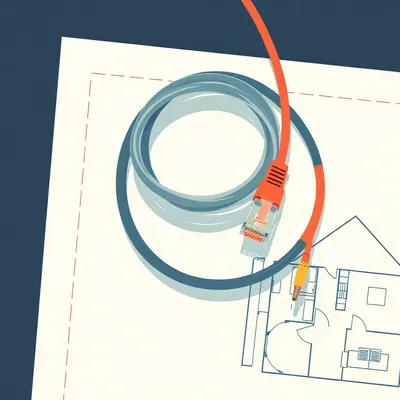
Daniel sent us this one — and it's the kind of question that hits you about two days after the fiber installer leaves. The ONT is sitting there by the front door, blinking happily, and you realize your actual office is on the second floor, and you need to bridge that gap. Do you run Cat 6 through the wall, or do you go fiber? And what does that choice actually mean for everything downstream?

This is the moment where most people just grab whatever cable is in the garage and hope for the best. But the numbers say this matters more now than ever. Point Topic tracked global fiber-to-the-home and fiber-to-the-building subscribers hitting one point two billion in twenty twenty-five. That's a lot of ONTs suddenly sitting in hallways, and a lot of people making this exact decision with very little guidance.
The guidance that does exist tends to be either "Ethernet is fine, don't overthink it" or "fiber or bust, copper is dead." Neither of which actually helps you when you're staring at a wall and a spool of something.
And Daniel's prompt gets at the thing most people don't even know to ask — which is, what are you actually working with at that demarcation point? The ONT isn't just a magic box. It has specific output options, and those options dictate your entire topology. If your ONT gives you an SFP cage, you have choices. If it only gives you an RJ45 Ethernet port, your path is set unless you want to get creative with media converters.
We're going to walk through exactly that decision. What the ONT actually is, why you can't split it, and what the two branching topologies — Ethernet or fiber — really demand from you. Then we'll get practical about which one belongs in your walls, and when the answer might genuinely be both.
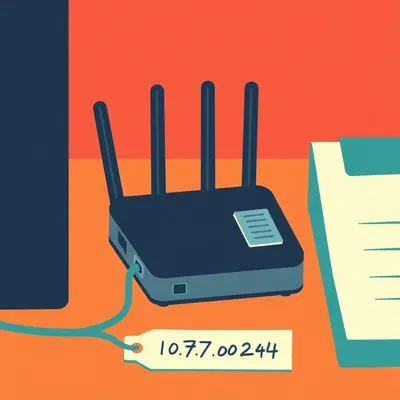
PON — Passive Optical Network — is how the ISP gets fiber to your wall. No powered equipment between the central office and your house, just glass and passive splitters. The ONT is where that optical signal hits your premises and gets converted to something electrical.
Optical Network Terminal. The box where light becomes electrons.
And it's a single box. This is the thing Daniel flagged as the first misconception — people hear "network" and think they can just split the fiber coming in, run it to three different rooms, put an ONT in each. You can't. The ISP authenticates one ONT per subscriber drop. That ONT is the demarc — the hard boundary between their network and yours.
The branching has to happen after the ONT. You're not splitting the PON, you're distributing from a single converted point.
And what you can do from there depends entirely on what outputs that ONT gives you. Some are dead simple — one RJ45 port, maybe two point five gig, maybe one gig. You plug in a router, you're done. But some ONTs — like the Nokia G dash zero one zero S dash P — give you an SFP cage instead. And an SFP cage changes the game because you're not locked into copper.
Which brings us to the two topologies Daniel's asking about. From the ONT, you either build out with Ethernet — Cat five E, Cat six, Cat six A — or you go fiber, using SFP modules and fiber patch cables to an SFP-equipped switch. Or, and this is where it gets interesting, you do both.
That's really the framework we're laying out. Not "which cable is better" in the abstract, but what does each path actually require from you in hardware, cost, and planning. Once you understand that, the decision for any given run becomes much more obvious.
We should be clear about what we're not doing here, too. We've talked before about the physical act of running fiber through walls — conduit, bend radius, pulling tension, all of that. This is the layer above it. You've got the ONT. What topology are you building out from it, and why?
With that foundation — single ONT, two branching paths, and sometimes a mix of both — let's look at what each topology actually demands.
Let's start with the Ethernet path, because it's what most people default to. Your ONT has an RJ45 port — maybe one gig, maybe two point five — and you run Cat 6 from that port to a switch. Cat 6 is rated for ten gig up to fifty-five meters, which covers basically any run inside a single-family home. You terminate with standard RJ45 connectors, you plug things in, and you're done.
RJ45 crimpers cost twenty bucks. Keystone jacks are a dollar each. Every device you own already speaks Ethernet. There's a reason this is the default.
PoE changes the calculus completely. If that access point on the second floor needs power, one Cat 6 cable delivers both data and up to thirty watts — or more with PoE plus plus. With fiber, you're running a separate power cable or putting a PoE injector at the far end. That alone tilts the decision for most people.
The downsides though — hundred-meter hard limit, and if your cable path runs past anything noisy, like an old electrical panel or a ham radio setup, you can get interference. Also, four-pair copper is thick. Bundle eight Cat 6 cables together and you're wrangling something that feels more like a garden hose than structured cabling.
Not usually a problem within a single room, but if you're connecting two buildings — which Daniel said he's setting aside, but it's worth noting — copper can create a path for ground differential that fiber completely avoids. No electrons, no ground loop.
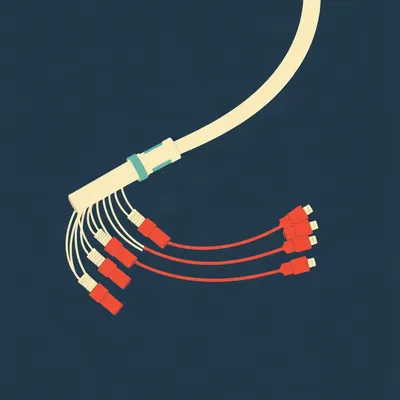
That's Ethernet. Now the fiber path. Your ONT has an SFP cage — like that Nokia G dash zero one zero S dash P — and instead of plugging in a copper cable, you insert an SFP module. Could be a thousand BASE dash LX for single-mode, ten kilometer reach, costs maybe twenty to fifty dollars. Then you run a duplex LC to LC patch cable to an SFP-equipped switch.
Now you've got a link that's immune to EMI, thinner than a pencil, and capable of speeds that make ten gig look quaint. Single-mode OS2 fiber can carry four hundred gig and beyond over kilometers. The cable itself is future-proof in a way copper simply isn't.
— and this is the but that matters — you now need SFP ports on both ends. Your average consumer router doesn't have an SFP cage. So you're looking at something like the MikroTik CRS three oh five, which gives you four SFP plus ports. Fantastic little switch, but it's a step up in complexity and cost from a fifty-dollar unmanaged Ethernet switch.
With Ethernet, you crimp. With fiber, you either buy pre-terminated patch cables in exact lengths — which is what I'd recommend for almost everyone — or you invest in a fusion splicer and cleaver that'll set you back hundreds. Field-terminated fiber is not the weekend project that crimping Cat 6 is.
Plus no PoE. If you're running fiber to that second-floor access point, you still need to get power there somehow.
Which brings us to the hybrid approach, and this is where Daniel's question about running both gets interesting. You absolutely can, and a lot of well-designed home networks do. Picture this: ONT with an SFP cage, thousand BASE dash LX module, single-mode fiber run to a central switch in a closet or basement. That switch — say the MikroTik CRS three oh five — has both SFP plus ports and at least one copper port. From there, you run Cat 6 to your PoE access points and cameras.
Fiber is your backbone, and copper is your edge. It's the spine-leaf architecture scaled down to a house. The fiber handles the long or noisy runs and gives you a future-proof trunk, while the copper handles everything that needs power or connects to consumer gear.
Here's the concrete example Daniel was asking about. Nokia ONT with SFP cage, insert a thousand BASE dash LX SFP, run a single-mode LC to LC patch cable to one of the SFP ports on a MikroTik CRS three oh five dash one G dash four S plus IN. Then from that switch's copper port, Cat 6 out to a PoE access point on the second floor. You've got a ten-gig-capable fiber backbone and standard PoE distribution, all from one demarc.
That's the topology that actually makes sense for someone who wants the benefits of fiber without giving up the convenience of Ethernet where it matters. You're not choosing one or the other — you're choosing where each one belongs.
Those are the topologies. But the real question is: which one should you actually run through your walls? Let's get practical.
Practical starts with what you're staring at when you open the wall. Patch panels and cable management look very different depending on which medium you chose.
With Ethernet, it's almost boring how standardized it is. Keystone jacks snap into a patch panel, you punch down the conductors, and you've got a clean row of RJ45 ports. A twenty-four port Cat 6 patch panel costs maybe thirty dollars. The whole ecosystem is built around making this easy.
Fiber patch panels are a different beast. Instead of keystone jacks, you're using LC duplex couplers — little rectangular inserts that snap into the panel. Each coupler costs a few dollars, and you need two per run if you're terminating at both ends. It's not ruinously expensive, but it adds up. A loaded fiber patch panel is cleaner than Ethernet for high density though — those LC connectors are tiny compared to RJ45 plugs.
The cable management is actually nicer with fiber in some ways. A bundle of twelve duplex LC patch cables is maybe half the diameter of twelve Cat 6 cables. No crosstalk concerns, no need to maintain bend radius on copper pairs — though fiber has its own minimum bend radius, usually about ten times the cable diameter for single-mode.
The patch panel question really comes down to: are you willing to pay a bit more per port for a cleaner, thinner bundle? For most people running two or three drops, the difference is negligible. For someone wiring a whole house with sixteen runs, the fiber panel starts looking tidier.
Now let's apply this to the scenario Daniel actually asked about. ONT near the front door, access point on the second floor. What dictates the choice?
Two things, and one of them is power. If that AP needs PoE — and almost all of them do — Ethernet is the answer unless something forces you off it. One cable, data and power, done. The moment you go fiber, you're now also running electrical to the AP location or putting a PoE injector up there, which needs its own outlet.
The second factor is distance and environment. If the run is under fifty-five meters — which covers nearly any vertical run in a house — Cat 6 gives you ten gig with no drama. But if that cable path snakes past the electrical panel, or you've got a subpanel on the second floor throwing off noise, fiber's immunity to EMI becomes relevant. I've seen Ethernet links get flaky when someone ran Cat 5e parallel to Romex for fifteen feet.
Or if the run somehow exceeds a hundred meters — unlikely in a single home, but possible in a sprawling ranch with a convoluted path — Ethernet simply won't work.
The decision tree is: under fifty-five meters, no EMI concerns, needs PoE? Over a hundred meters or EMI-heavy? Fiber, with a power plan. Between fifty-five and a hundred meters? Cat 6A, which gets you ten gig at the full hundred meters.
Which brings us to the future-proofing argument, because I know that's where your instinct goes, and Daniel said the same thing. His instinct is fiber all the way.
I get it. Single-mode OS2 can carry four hundred gig and beyond. The glass itself is basically infinite in capacity — the limits are the optics on either end. So the argument goes: run fiber once, never open the walls again.
Here's the counter. In a home, the bottleneck is almost never the cable. It's the ONT speed tier — most residential plans are one to five gig — and it's the switch hardware you're plugging into. Cat 6 already does ten gig up to fifty-five meters. Unless you're running a NAS with multi-gig local traffic, doing 8K video editing off a server, or streaming VR content across the house, ten gig is already overkill for the next decade.
That's the honest assessment. Future-proofing with fiber makes sense if you're building a LAN backbone that will carry serious internal traffic — think multiple editors hitting a NAS simultaneously, or a home lab with clustered storage. For someone whose heaviest internal traffic is a Netflix stream and a Zoom call, Cat 6 is already future-proof enough.
Why is Cat 6 still so entrenched? It's not just inertia.
It's the ecosystem. Every laptop, every game console, every smart TV, every AP — they all have RJ45 ports. Almost nothing consumer-grade has an SFP cage. So even if you run fiber through your walls, you're converting back to copper at the endpoint. You're adding SFP modules at twenty to fifty dollars per end, plus an SFP-equipped switch, to get a link that a five-dollar patch cable would have given you.
The cost of entry for DIY is wildly different. A thousand-foot spool of Cat 6 is about a hundred dollars. OS2 single-mode is about a hundred fifty for the same length — not dramatically more. But the tooling gap is enormous. An RJ45 crimper is twenty bucks. A fiber cleaver and fusion splicer starts at two hundred and goes up fast. Most homeowners are never going to field-terminate fiber.
Which is why I always tell people: if you're going fiber, buy pre-terminated LC duplex patch cables from somewhere like FS dot com. Measure your runs exactly, add a little slack, and order them to length. Skip termination entirely. It's the only way this makes sense for a DIY project.
Let's ground this in two concrete cases. First, the one Daniel's describing. Homeowner with a two gig ISP plan, a NAS with ten gig Ethernet, and a single AP on the second floor. The run is maybe forty feet. The pragmatic choice: Cat 6 from the ONT to a ten-gig switch, Cat 6 to the AP with PoE. Fiber adds SFP modules, an SFP switch, and a power solution at the AP — complexity with no benefit.
Counter-case: detached garage, a hundred and fifty feet from the ONT. Ethernet maxes out at a hundred meters — about three hundred twenty-eight feet — but a hundred fifty feet is well within spec. Except this run goes underground, past the main electrical feed, and you're connecting two structures with different ground potentials. Ethernet is asking for trouble. OS2 single-mode with LC connectors and thousand BASE dash LX SFPs on both ends solves it cleanly. No ground loop, no EMI, and you've got headroom for whatever speed you want later.
That's the framework. Not "which is better," but "what is this specific run asking of me." The cable is just the answer to that question.
We've covered the tradeoffs. Let's boil this down to three things you can actually act on. First — and this is the one thing to do before you buy anything — check your ONT's output. Walk over to it right now. If you see an SFP cage, you have the option to go fiber from the demarc. But only exercise that option if your run exceeds a hundred meters, crosses EMI-heavy zones, or you're building a multi-gig LAN backbone for internal traffic. Otherwise, Ethernet is simpler and cheaper, and simpler means fewer things to debug at eleven PM.
Second, for the access-point-on-the-second-floor scenario Daniel asked about, let PoE drive the decision. If that AP needs power over Ethernet — and almost all of them do — Cat 6 is your answer unless the run is physically too long. One cable, data and power, no extra outlet required. If you absolutely must run fiber to that location, put a PoE injector at the far end and make sure you've got power there.
Third, if you do go fiber, do not field-terminate. Buy pre-terminated LC duplex patch cables in exact lengths from somewhere like FS dot com. Measure your actual path — not as the crow flies, but the actual route through walls and around corners — add a couple feet of slack, and order them cut to length. Use a fiber patch panel with LC duplex couplers for clean wall termination. And skip multi-mode entirely for new installs. OM3 and OM4 made sense a decade ago when single-mode optics were expensive. Now OS2 single-mode costs about the same for short runs and doesn't box you in.
That last point trips people up because multi-mode still dominates a lot of enterprise legacy installs. But the price gap on optics has basically closed. A thousand BASE dash LX SFP is twenty to fifty dollars. The single-mode fiber itself is maybe a hundred fifty dollars for a thousand-foot spool. There's just no reason to install something that caps out at a hundred meters on OM4 when OS2 will carry whatever speed you throw at it for the next thirty years.
So: check the ONT, let PoE decide for access points, and buy pre-terminated single-mode if you're going fiber. Three things you could do this weekend without losing your mind.
Where does this leave us? The ITU-T has already ratified the G dot nine eight oh four dot x standards for twenty-five and fifty gig PON. That means ONTs capable of pushing twenty-five gig to the home are coming — not in some distant future, but in the next hardware refresh cycle. When your ISP hands you a fifty-gig drop, suddenly ten-gig Cat 6 doesn't look quite so roomy anymore.
That's exactly the tension. The cable might be ready — single-mode OS2 will swallow fifty gig without blinking — but what are you plugging it into? Your laptop still has an RJ45 port. Your Apple TV still expects copper. The ecosystem inertia Herman mentioned isn't just about what's in the walls, it's about what's in every device you own.
That's the open question I keep coming back to. Will we actually see consumer gear with native SFP plus ports? A router with a cage you can slot a module into? A NAS that takes fiber directly? The enterprise world has done this for decades, but the consumer market has shown zero appetite for it. The RJ45 port is cheap, it's understood, and it carries power.
The power part might be the real lock-in. Until someone figures out how to deliver PoE over fiber — which is physically impossible, photons don't carry current — Ethernet owns the edge. You can run fiber to every room, but the last three feet to the device will still be copper.
Unless we see a shift toward fiber to the outlet. Imagine a wall plate with an SFP cage behind it, and a short copper pigtail to the device. It's not elegant, but it's how a lot of enterprise deployments handle it. The fiber runs to the work area, conversion happens at the wall.
Which is the hybrid model again, just pushed further toward the edge. It's not fiber or Ethernet — it's fiber where it earns its keep, and Ethernet where it doesn't.
The fifty-gig PON standards are going to force that conversation sooner than people expect. When the pipe coming into your ONT is fifty gig, and your internal backbone is Cat 6 capped at ten, you've got a mismatch. That's when fiber-to-the-room stops being an enthusiast flex and starts being the only way to actually use what you're paying for.
Yet — I'd bet good money that in ten years, most homes will still have Cat-something running to most rooms. The ecosystem is just too heavy to pivot fast. Fiber will own the backbone and the long runs, and copper will own the last meter. Same as today, just faster.
That's the trajectory. The question isn't whether fiber wins — it's whether it wins all the way to the device, or stops one conversion short. And that's going to depend on whether anyone bothers to build a consumer SFP ecosystem.
Something to watch. In the meantime, check your ONT, let PoE call the shots, and buy pre-terminated single-mode if you're going glass. You'll sleep better.
This has been My Weird Prompts, with thanks as always to our producer Hilbert Flumingtop. If you enjoyed this, leave us a review wherever you listen — it helps other people find the show.
We're at my weird prompts dot com. New episodes every week. We'll be here.