Daniel sent us this one — he's asking about the right way to wire a modern home network when you've got fiber coming in from the ISP. The core tension here is whether you should keep the signal in fiber for your internal backbone runs, or transition to copper Ethernet early, and what that topology actually looks like when you're running cable between floors and through walls. He's also asking about EMF sensitivity, conduit spacing, and wants us to spec out a couple of real architectures — something with a few access points, a home office, a server, a smart TV, that kind of setup. So we're basically designing a network from the ONT onward.

This is the good stuff. Okay, let's start with the first decision point — literally the first cable. Your ISP brings fiber to the side of the house or the basement, terminates at what they call the ONT, the optical network terminal. That's the box that takes light and turns it into something your network can use. The question is, what comes out of that ONT and where does it go? In most consumer installs, the ONT has a gigabit Ethernet port, and the ISP just plugs in whatever router they're giving you. But the prompt's asking about running to a networking cabinet on another floor or the other end of the house. So now we're talking about a deliberate infrastructure run, not just setting the ISP router on the nearest shelf.
Right, because the ONT might be in the basement, or on an outside wall in the kitchen, and the actual network cabinet is in a closet upstairs or in the home office. That first run could be fifty feet, could be a hundred and fifty feet. So the question is, do you run that as fiber or as copper?
The answer is almost always fiber. Let me give you the concrete reasons. If you're running single-mode fiber, you can go kilometers. Even multimode with OM3 or OM4 will do a hundred meters at forty or a hundred gig, and three hundred meters at ten gig. Meanwhile, copper Ethernet — Category Six A — tops out at a hundred meters for ten gig under ideal conditions. If your ONT is in the basement and your cabinet is in the attic on the far side of the house, you could be pushing that limit before you've even connected your first switch.
The hundred-meter spec for copper isn't just the horizontal run, it's the whole channel — patch cables at both ends included.
So a ninety-meter in-wall run with five-meter patch cables on each end is already at the limit. With fiber, that's just not a constraint in a residential setting. Second reason: electrical isolation. Fiber is glass. It doesn't conduct electricity. If you're running between floors, you're potentially crossing different ground potentials, and copper Ethernet can create ground loops that introduce noise or, in worst cases, damage equipment. Fiber eliminates that entirely.
You're saying the first run — ONT to the main switch location — should be fiber.
And practically speaking, the cleanest way to do this is to place your main router right next to the ONT, have it do the routing and firewall functions, and then run fiber from one of its SFP plus ports to your core switch in the cabinet. Or, if the ONT has an SFP plus cage and your ISP allows it, you can bypass their router entirely and run fiber direct to your own router in the cabinet. That's a more advanced setup, but it's increasingly common in prosumer builds.
Let's talk about that, because "increasingly common" is doing some work there. ISPs are not universally friendly to the idea of you bypassing their equipment.
It depends on the ISP and the country. AT and T Fiber has historically been notorious for requiring their gateway, though there are workarounds with what people call the "dumb switch bypass" or using the WPA supplicant extraction method. Verizon Fios is easier — if you're on an Ethernet handoff from the ONT, you can plug directly into your own router. Some smaller fiber ISPs actively encourage it and will provide you the PPPoE credentials or VLAN tagging information you need. But the trend is toward more openness. The FCC has been pushing for more consumer choice in gateway equipment.
The architecture we're converging on is: ONT in the utility area, fiber run to the main cabinet, and then from that cabinet, you're distributing to the rest of the house. Now the prompt asks, for those distribution runs — between switches, out to a home office, to a server — do you also use fiber, or do you transition to copper Ethernet at that point?
This is where you have to think about what you're actually connecting. Let's break it down by endpoint. A home server — if it's a real server with SFP plus or SFP twenty-eight ports, or even a desktop with a PCIe network card — absolutely run fiber. You can get a Mellanox ConnectX-four twenty-five gig card for thirty or forty dollars on the used market, and a twenty-five gig transceiver for another twenty. That's a twenty-five gigabit link for under sixty dollars in optics and NIC.
The switch port to drive it?
That's the real cost. A switch with SFP twenty-eight ports is still several hundred dollars, but prices are dropping. MikroTik and UniFi both have options in the three to five hundred dollar range for a switch with a couple of twenty-five gig ports and a bunch of ten gig. But even if you're not doing twenty-five gig, ten gig over fiber is cheap. A used Brocade ICX switch with SFP plus ports can be had for under two hundred dollars, and optics are practically free at this point.
"Practically free" is one of those phrases that means "forty dollars instead of four hundred." But for a home server doing backups, media serving, maybe some homelab workloads, ten gig is the sweet spot.
It really is. Now, for the smart TV and the access points — those are almost certainly going to be copper. Smart TVs have gigabit Ethernet ports, if you're lucky. Some still ship with hundred-megabit ports, which is absurd in twenty twenty-six, but here we are. Access points, same thing — most consumer and prosumer APs top out at two and a half gig on copper. So for those endpoints, you're running Category Six A from the nearest switch and that's perfectly adequate.
The topology starts to look like: fiber backbone between the main cabinet and any satellite switch locations, and then copper for the last hundred feet to individual endpoints.
And I want to be specific about what "backbone" means here. In a typical two-story house, you might have the main network cabinet in the basement or a ground-floor utility room. Then you'd run fiber to a switch in the attic or a closet on the second floor, and that switch feeds the upstairs AP, the home office, maybe a bedroom TV. The fiber run between those two switches is your backbone. Inside each zone, copper handles the last few meters.
The fiber for that backbone run — are we talking single-mode or multimode?
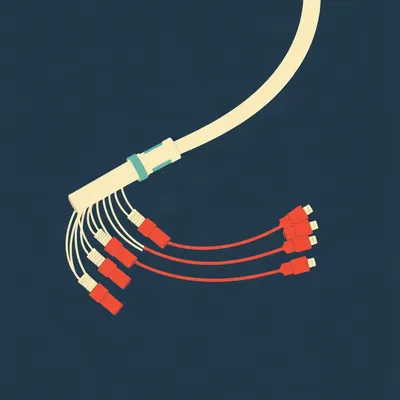
I've gone back and forth on this over the years, but my current recommendation for residential is single-mode. OS2 fiber with LC UPC connectors. Here's why. Multimode — OM3, OM4 — uses cheaper optics, which used to be the argument for it. But the gap has narrowed so much that it barely matters for a home user buying two or four transceivers. Single-mode can carry basically any speed you'll ever want — ten gig today, a hundred gig tomorrow, four hundred gig in a decade — over the same fiber. Multimode hits distance limits at higher speeds that single-mode doesn't. And single-mode fiber itself is actually cheaper than multimode per meter. So you buy a pre-terminated OS2 cable in the length you need, pull it through your conduit, and you're future-proofed essentially forever.
Forever is a strong word in networking.
"For the usable life of the house" is more accurate. The fiber installed in the nineteen nineties for FDDI rings at a hundred megabits is still capable of carrying a hundred gig today if it's single-mode. The optics changed, the fiber didn't.
That's actually a compelling point. Alright, let's get into the physical installation questions. The prompt asks about running cable in the space behind walls, conduit spacing, and EMF sensitivity. This is where people who've never done this before get nervous.
They should be a little nervous, because doing it wrong means redoing it. Let's start with the good news: fiber optic cable is completely immune to electromagnetic interference. You can run it alongside electrical wiring, next to fluorescent ballasts, through the same conduit as power cables if you wanted to — though you shouldn't, for code reasons, but optically it wouldn't matter. The signal is light in glass. There's nothing for EMF to couple to.
Fiber's EMF sensitivity is zero. What about copper Ethernet?
Copper Ethernet uses twisted pairs specifically to reject interference. The twists cause external noise to couple equally into both conductors, and the differential receiver cancels it out. In practice, unshielded Category Six A is quite robust, but there are rules. The National Electrical Code says you need at least two inches of separation between communications cables and power cables when running parallel. If you're crossing at a right angle, no separation is needed. In residential, this usually isn't hard to achieve — stud bays are fourteen and a half inches wide, you put power on one side and data on the other.
If you're running through the same hole in a joist?
Drill separate holes. It's not just about interference, it's about heat. Power cables can get warm under load, and bundling them with data cables in a tight space isn't good practice. But honestly, for a typical home with a few dozen feet of parallel runs, the interference risk is low. The bigger issue with copper is something people don't think about: lightning.
Right, because copper is a conductor, and a nearby lightning strike induces current on anything metallic.
That current will happily travel through your Ethernet cables and fry every piece of equipment connected at both ends. Ethernet ports have isolation transformers rated for about fifteen hundred volts, but a nearby strike can induce much more than that. Fiber doesn't have this problem. If you're running a cable to an outbuilding — a detached garage, a shed that's been converted to an office — you should absolutely run fiber, not copper. The ground potential difference alone can cause issues, and the lightning risk makes copper genuinely dangerous in that scenario.
The prompt also mentioned conduit. Let's talk about when you need conduit and when you don't.
In most residential interior walls, you don't need conduit for low-voltage communications cable. You can run plenum-rated or riser-rated cable through walls, floors, and ceilings as long as you follow the local building code. Plenum-rated cable has a jacket that doesn't emit toxic smoke when it burns, which is required if you're running through air-handling spaces. Riser-rated is for vertical runs between floors. Most of the time in a home, riser-rated is fine unless you're going through an air return.
Conduit makes it easier to pull new cable later.
That's the real argument for conduit — not code compliance, but future-proofing. If you install a one-inch or one-and-a-quarter-inch Smurf tube, the orange flexible conduit, from your basement to your attic, you can pull whatever you want through it ten years from now. The cost of the conduit itself is negligible. The labor is the same whether you're pulling cable through a wall cavity or through a conduit. So my strong recommendation is: if you're opening walls anyway, put in conduit. Label both ends. Your future self will thank you.
"Smurf tube" is the technical term?
It's the industry term, I swear. ENT, electrical nonmetallic tubing, but everyone calls it Smurf tube because it's blue or orange. The orange is for low-voltage. And speaking of conduit, if you're running fiber and copper in the same conduit, there's no issue. The fiber doesn't care. But don't run fiber in the same conduit as power — not for interference reasons, but because it's against code and it's a safety issue. The power cable's jacket could be damaged, and now your low-voltage conduit has line voltage in it.
Alright, let's move to the actual architecture. The prompt asked for a couple of different specs. Let's walk through a realistic floor plan and design it.
Let's assume a two-story house, about twenty-five hundred square feet. ONT is in the basement, on the outside wall. We want a network cabinet in a basement utility room, a home office on the first floor, a living room with a smart TV on the first floor, two access points — one per floor — and a home server in the basement. That's a pretty typical prosumer setup.
The ISP is delivering, say, two gig symmetric fiber. Common enough now.
So architecture one — let's call it the pragmatic build. ONT in the basement, right next to it we place the ISP's gateway or our own router. From that router, we run a single OS2 single-mode fiber cable to a core switch in the network cabinet, which is also in the basement but maybe twenty feet away on the other side of the room. That switch is a twenty-four port gigabit PoE switch with four SFP plus ten-gig uplinks. Something like the UniFi Pro Max twenty-four PoE.
The fiber from the router to the switch is carrying...?
Ten gig, using an SFP plus LR transceiver on each end. That's your trunk. Now, from that core switch, we run Category Six A copper to the home office — let's say that's a run of about fifty feet. The office gets a small eight-port switch if there are multiple devices, or just a wall jack if it's a single PC. We also run copper to the smart TV, probably thirty feet. And we run copper to the first-floor access point, which is ceiling-mounted in a central hallway.
For the upstairs?
We run a single OS2 fiber from the core switch's second SFP plus port up to the attic or a second-floor closet, where we place a smaller switch — an eight-port PoE switch with two SFP plus uplinks. That satellite switch feeds the second-floor AP via copper, and any bedrooms that need wired connections. Total fiber runs: two. Everything else is copper.
That's clean. What's the cost on something like that?
The core switch, around four hundred dollars. The satellite switch, maybe two hundred. Pre-terminated OS2 cables — two of them, custom length — maybe sixty dollars total. Four SFP plus LR transceivers at about twenty-five dollars each, so a hundred. Category Six A cable, a thousand-foot spool is around two hundred dollars, and you'll use maybe half of it. Keystone jacks, wall plates, patch panel, another hundred. So all in, we're looking at around eleven to twelve hundred dollars in materials. If you're paying a low-voltage contractor to do the pulls, double that for labor. But this is a network that will handle ten gig internally with a clear upgrade path to twenty-five or a hundred on the backbone.
The alternative architecture? You mentioned there were a couple.
Architecture two — the all-fiber enthusiast build. This is for someone who wants to eliminate copper from the backbone entirely and run fiber to every fixed location. Same ONT and router setup, but now the core switch is a full SFP plus switch — sixteen or twenty-four SFP plus ports. From that switch, you run individual fiber drops to every room that needs a wired connection. In each room, you terminate the fiber at a small media converter or a switch with an SFP plus uplink, which then provides copper ports for local devices.
That sounds expensive and complicated.
It is, and honestly, it's overkill for almost everyone. The fiber itself isn't the cost driver — OS2 is cheap. It's the optics and the switches. A sixteen-port SFP plus switch is significantly more expensive than a copper switch with a few SFP plus uplinks. And then you need transceivers for every single drop — two per link. For a house with six wired locations, that's twelve transceivers. And you still need copper switches at each endpoint to connect actual devices. You're adding a layer of conversion that doesn't buy you anything unless you need ten gig or higher to every room.
Which almost no one does. The server might benefit from ten gig, but the smart TV doesn't, the AP doesn't, the printer definitely doesn't.
The printer doesn't even need a hundred meg. And yet printer manufacturers still put gigabit ports on them. It's aspirational networking.
" I'm putting that on a plaque.
There's a middle ground that's worth mentioning — architecture three, which I'd call the hybrid with high-speed zones. You use the pragmatic build as your baseline, but you identify specific locations that justify fiber. The home office, if someone's doing video editing or CAD work off a NAS, gets a fiber drop. The server gets fiber. The living room entertainment center, which is just a TV and a game console, gets copper. The APs get copper. So you might have three or four fiber runs and eight to ten copper runs.
That feels like the sensible default for anyone who's asking this question seriously.
I think it is. And here's a number that might surprise people: a ten-gig fiber link between a workstation and a NAS, using used enterprise cards and transceivers, the client-side cost is under a hundred dollars. That's the NIC, the transceiver, and the fiber cable. For a hundred dollars, you can move large files at over a gigabyte per second. That transforms workflows that involve large media files.
The bottleneck at that point is the storage itself.
Yes, and that's the next rabbit hole. You need either a RAID array with enough spindles, or NVMe storage, to actually saturate a ten-gig link. A single hard drive tops out around two hundred megabytes per second, which is well under two gig. So you need either multiple drives in a striped array or solid-state storage. But that's a storage problem, not a network problem. The network is ready.
Let's talk about the wireless side of this. The prompt mentioned a couple of APs and devices feeding into them. Where do APs fit in this topology?
APs are copper-fed, Power over Ethernet, and they should be ceiling-mounted whenever possible. The signal propagates downward and outward from a ceiling-mounted AP much better than from a shelf or a desk. In a two-story house, one AP per floor, centrally located, is usually sufficient for twenty-five hundred square feet. If you've got a basement, add one there. If you've got a large yard, consider an outdoor-rated AP mounted under the eaves.
The backhaul for these APs — gigabit copper is fine for most people?
For most people, yes. Wi-Fi seven can theoretically push multiple gigabits, but real-world throughput even on Wi-Fi seven with a good client is maybe two to three gig under ideal conditions. A two-and-a-half gig PoE port is nice to have, and many Wi-Fi seven APs now include a two-and-a-half gig uplink. If your switch supports multi-gig PoE, great. If not, gigabit is still fine for the vast majority of use cases. The people who need more than a gig to their phone are exactly zero people.
I don't know, my phone needs to download operating system updates I didn't ask for at maximum possible speed.
It will do that at three in the morning when you're asleep, so the gig link is plenty. But more seriously, the AP placement matters more than the backhaul speed. A poorly placed AP on a ten-gig backhaul will perform worse than a well-placed AP on a gig backhaul. RF doesn't care about your switch port speed.
There's a metaphor for life in there somewhere. Alright, let's get back to the physical layer for a minute. The prompt asked about spacing from other things in a conduit. We touched on power separation, but what about other data cables? If you've got coax, phone lines, speaker wire?
No issue with any of them. Low-voltage cables can share conduit and pathways freely. The only thing you need to watch is bend radius. Fiber has a minimum bend radius — typically about ten times the cable diameter for installation, and fifteen to twenty times for long-term. For a typical three-millimeter OS2 patch cable, that's about thirty millimeters, just over an inch. You can bend it around a corner of a conduit without a problem. What you can't do is kink it. A sharp kink will crack the glass and the cable is dead. Copper is more forgiving, but you still don't want to kink Category Six A — it can untwist the pairs and degrade performance.
Fiber is surprisingly strong in tension — the strength members are aramid yarn, same stuff as Kevlar. But you shouldn't pull fiber by the connector, ever. Use a pulling eye or a pulling grip that attaches to the cable jacket. The general rule is don't exceed twenty-five pounds of pulling force for a standard indoor fiber cable. For copper, the limit is usually twenty-five pounds for Category Six A as well, but in practice people pull harder and usually get away with it.
"Usually get away with it" is the motto of home improvement.
It really is. And I want to mention one more thing about the installation: labeling. Every cable, at both ends, should be labeled. It doesn't have to be fancy — a Brother P-Touch label with a unique number, and a simple spreadsheet that maps number to location. "Cable oh-oh-one: basement ONT to core switch port one." "Cable oh-fourteen: core switch port fourteen to living room TV." Six months from now, when something doesn't work, you will not remember which cable is which.
Labeling is the part of networking that separates the professionals from the people who will be crawling through the attic with a toner at ten PM on a Tuesday.
I have been that person. It builds character, but not the kind you want.
Let's shift gears slightly. We've been talking about the physical infrastructure, but there's a logical topology question embedded in the prompt. How do you actually segment this network? VLANs, subnets, that kind of thing.
For a home network of this scale, I recommend at least three VLANs. One for your trusted devices — your PC, your server, your phone. One for IoT devices — the smart TV, the thermostat, the smart speakers. And one for guests. The IoT VLAN has no access to your trusted network, and ideally no internet access except to the specific services they need. The guest VLAN is internet-only, client isolation enabled so guests can't see each other.
The access points need to be VLAN-aware.
Yes, which is standard on any prosumer AP. You configure multiple SSIDs, each mapped to a different VLAN. Your main SSID goes to the trusted VLAN, a separate IoT SSID goes to the IoT VLAN, and a guest SSID goes to the guest VLAN. The AP tags the traffic, the switch honors the tags, and the router or firewall enforces the rules between subnets.
This is where the choice of router matters. The ISP-provided gateway probably doesn't support VLANs.
Almost certainly not. Which brings us back to the earlier point about using your own router. If you're going to the trouble of running fiber backbones and installing a managed switch, you should also be running a router that gives you actual control. pfSense, OPNsense, a UniFi Dream Machine, a MikroTik, even a small FortiGate if you want to go enterprise. Something that does VLANs, firewall rules, maybe intrusion detection. The network infrastructure is only as smart as its least capable component, and the ISP gateway is usually the dumbest box in the chain.
"The dumbest box in the chain" — also going on the plaque.
I'm full of quotable moments today. But seriously, if someone follows our fiber backbone recommendation and then plugs everything into an ISP router that can't do VLANs and has a firewall from twenty eighteen, they've built a race car and put bicycle tires on it.
To summarize the pragmatic build: fiber from ONT to router, fiber from router to core switch, fiber from core switch to any satellite switches, copper from switches to endpoints. Conduit where possible. VLANs for segmentation. Own your router.
That's the blueprint. And I want to emphasize something about the fiber choice that people often get wrong. There's a tendency to think "I'll just use Cat Eight for everything, it's rated for forty gig." Cat Eight is a standard that exists, but it's designed for data centers, specifically for short-reach twenty-five and forty gig connections up to thirty meters. It uses different connectors — GG forty-five or Tera — that are not compatible with standard RJ forty-five. It's not a drop-in replacement for Cat Six A in a home. And the cable is thick, stiff, and miserable to work with. It's the wrong tool for residential.
Cat Eight is the networking equivalent of buying a Formula One car to commute to the grocery store.
It's technically capable, but impractical, expensive, and you'll hate the experience. The TIA doesn't even recommend Cat Eight for residential. Cat Six A is the highest they recommend for home use, and honestly Cat Six is fine for most runs under fifty-five meters if you're only doing ten gig.
What about Cat Seven? I feel like Cat Seven is the ghost of networking — it exists in theory, people talk about it, but nobody's actually seen one.
Cat Seven is not recognized by the TIA or the IEEE. It's an ISO standard, and it uses different connectors than RJ forty-five — GG forty-five or Tera, same as Cat Eight. You can get cables labeled Cat Seven with RJ forty-five ends, but they're not actually Cat Seven compliant. They're basically Cat Six A with better marketing. It's the monster cable of Ethernet.
"The monster cable of Ethernet.
I'm on a roll. But it's a real thing — companies sell "Cat Seven" cables at a premium, and people buy them thinking they're getting something better, when they're actually getting a non-standard cable that performs identically to a good Cat Six A.
This is why people get intimidated by networking. The standards are confusing, the marketing is misleading, and the consequences of getting it wrong are invisible until something doesn't work.
Then you're the person in the attic with a toner at ten PM. Which is why we're having this conversation. The physical layer is the hardest part to change. Switches, routers, APs — those get swapped out every few years. The cable in your walls is there for decades. Getting that right is worth the effort.
Let's talk about one more thing the prompt hinted at — the server location. If you've got a home server, where does it live in this topology, and what does its connectivity look like?
The server should be physically near the core switch if possible. Short patch cables, ideally in the same rack or cabinet. If it's in a different room, that's where a fiber drop makes sense. Put a dual-port SFP plus NIC in the server — something like an Intel X five twenty or a Mellanox ConnectX-four — and run two fiber strands to the core switch. You can do link aggregation if you need more than ten gig, or use one for storage traffic and one for everything else.
If the server is also doing router duties — running pfSense or OPNsense as a VM?
That's a common homelab setup, but it adds complexity. If your router is a VM on your server, and the server goes down for maintenance, your entire network goes down. Including the Wi-Fi your family is using to stream Netflix. This is known as the "honey, why is the internet down" failure mode.
A failure mode that is self-correcting, in the sense that you will correct it very quickly under duress.
Under extreme duress. My recommendation is to keep the router as a separate physical device. A small fanless appliance running pfSense or OPNsense is a couple hundred dollars and saves you from being the person who broke the internet because you wanted to swap a hard drive.
Spoken like someone who has been that person.
I have no comment.
Alright, so we've got the pragmatic build, the all-fiber enthusiast build, and the hybrid. We've covered conduit, EMF, spacing, bend radius, labeling, and VLANs. Is there anything we're missing?
One thing about power. A network cabinet with a switch, a router, maybe a small UPS, and a server is going to draw a few hundred watts continuously. Make sure the circuit that feeds it can handle the load, and put it on a UPS. A small UPS — even a five-hundred-VA unit — will keep your network up through brief power blips and gives you time to shut down gracefully if the power goes out for real. It also conditions the power, which extends the life of your equipment.
The UPS should be in the cabinet, not somewhere else.
Most network cabinets have space at the bottom for a UPS. If you're rack-mounting, get a rack-mount UPS. If you're using a wall-mount cabinet or a structured media enclosure, a small desktop UPS works fine.
What about cooling? A closed cabinet with a switch and a server can get toasty.
Most network switches are rated for operating temperatures up to about fifty Celsius, and they'll throttle or shut down above that. A small cabinet with passive ventilation is usually fine for a switch and a router. If you're putting a server in there, especially one with spinning hard drives, you need active cooling. A couple of quiet USB fans mounted in the cabinet can make a huge difference. Some cabinets have fan mounts built in.
I feel like we've covered the practical engineering. Let's zoom out for a second. The prompt is essentially asking, "How do I build a network that won't feel slow in five years?" What's the short answer?
Run single-mode fiber for your backbone. It's the one cable that has consistently outlived every speed upgrade. The fiber I pull today for ten gig will carry a hundred gig or four hundred gig with just an optics swap at each end. Category Six A for the last hundred feet to endpoints. Place your APs carefully. Use a real router. That network will feel fast for a decade.
Don't buy Cat Seven.
Definitely don't buy Cat Seven.
The hierarchy is: fiber for distance and future-proofing, copper for convenience and endpoint compatibility, and don't overthink the parts that don't matter. The smart TV does not need a ten-gig link.
The smart TV barely needs a network connection, given how bad the software is on most of them. But that's a different episode.
That's a therapy session.
Now: Hilbert's daily fun fact.
Hilbert: In the eighteen sixties, naturalists in Patagonia advanced a widely accepted theory that a species of giant slime mould was responsible for the creation of the region's distinctive banded iron formations, proposing that the organisms secreted iron-rich waste in rhythmic cycles linked to tidal patterns. The theory held for nearly forty years before being abandoned.
Patagonia's geology was, for a brief moment, attributed to iron-pooping slime moulds with a sense of rhythm.
Tidal rhythm slime. I'm not sure if that's better or worse than the actual explanation.
It's definitely more interesting.
This has been My Weird Prompts. We're at myweirdprompts dot com, and if you enjoyed this episode, leave us a review wherever you get your podcasts — it helps other people find the show.
We'll be back next week. Until then, label your cables.