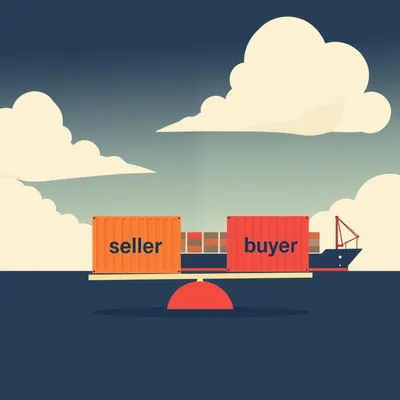
You get a quote for two thousand dollars to ship a container from Shanghai to Los Angeles. You accept it. You pay it. Then the container arrives and the invoice says three thousand eight hundred. And here's the thing — that gap isn't bad luck. It's not a mistake. It's how freight forwarders quote. Daniel sent us this one because he's been watching first-time importers walk into exactly this trap, and he wants to know how to read a quote, how to pressure-test it, and how to make sure the number on the screen is actually what you're going to pay.

The core problem is structural. Freight forwarders build their business around commercial importers — people who already have in-house customs brokers, warehousing, drayage teams. They quote ocean freight as the headline number because that's what their regular clients want to see. The regular client already knows the destination charges are coming and has a budget line for them. The first-time importer doesn't know any of that exists.
The forwarder's default quote is systematically incomplete for the person who needs completeness the most.
And that's not an accident, it's an incentive structure. Ocean freight is a commodity. Margins are razor thin. The profit lives in what the industry calls accessorials. Chassis rental, container demurrage, port congestion surcharges, customs exam fees, ISF filing fees, documentation amendment fees. A forwarder who quotes you an honest all-in price might look twenty percent more expensive than the competitor who quotes ocean freight plus "destination charges TBD." And TBD doesn't mean they haven't calculated it. It means they'll decide later, and you'll pay it.
"We'll decide later, and you'll pay it" is basically the freight forwarder motto.
I wish that were a joke. So the first concept Daniel's asking about is this thing called "all destination charges" — ADC. It's a single quote that bundles port handling, customs brokerage, documentation fees, terminal handling charges, and inland delivery. It's the closest thing the industry has to a total price. And most forwarders won't offer it unless you ask.
Why wouldn't they offer it? If I'm a forwarder and a first-time importer calls me, I know they don't have a customs broker. I know they don't have a warehouse at the port. Wouldn't I want to quote them the thing they actually need?
You'd think so, but no. Because if you quote the real number and your competitor quotes the thin number, you lose the business. The system selects for opacity. The forwarder who itemizes transparently looks expensive on paper, even though they're actually cheaper once all the hidden fees surface. It's a market for lemons problem — the bad quotes drive out the good ones.
The first rule for a new importer is: if the quote doesn't say "all destination charges" or "all-in," it's not a quote. It's a starting bid.
And I want to be precise about what has to be in that ADC quote, because "all destination charges" isn't a regulated term. Different forwarders include different things. Here's what you're looking for. Number one: port terminal handling charges — THC. That's the fee the terminal charges to move your container from the vessel to the pickup area. Number two: customs brokerage fee. That's typically seventy-five to two hundred dollars per entry, and it covers the broker preparing and filing your customs entry. Number three: customs bond fee. If your shipment is valued over two thousand five hundred dollars — which, if you're importing a container from China, it is — you need a bond. Single-entry bonds run fifty to a hundred dollars for shipments under a hundred thousand in value.
That bond isn't optional. CBP won't release the cargo without it.
Number four: ISF filing fee. Importer Security Filing. That's twenty-five to fifty dollars, and it has to be filed twenty-four hours before the cargo is loaded on the vessel at origin. If it's late, penalties start at five thousand dollars. That's not a typo. Five thousand dollars for a late filing.
Which the forwarder will absolutely pass through to you, by the way. That's not their problem.
It is not. Number five: documentation processing fee. Twenty-five to seventy-five dollars. Number six: chassis rental. When your container comes off the ship, it needs a chassis to be moved by truck. That runs fifty to a hundred dollars per day. Number seven: if you're shipping less than a full container load, you'll have CFS fees — container freight station fees — for consolidating and deconsolidating. Number eight: delivery order fee, which is the charge for the terminal to release the container to your trucker. And number nine: exam and inspection fees. If CBP decides to inspect your container — and they can, randomly or based on risk scoring — you're paying for it. An X-ray exam might be a few hundred dollars. A full intensive exam where they unload the entire container can run into the thousands.
Let me put a real scenario on this, because I think the numbers make it concrete. Daniel mentioned someone importing electronics from Shenzhen. They get a quote for twenty-two hundred dollars ocean freight. They accept it. Then they get an additional bill for eleven hundred dollars in destination charges they never saw itemized, including a three hundred fifty dollar "port congestion surcharge" that was added after they accepted the quote.
That port congestion surcharge is the perfect example of the problem. It's not made up — ports really do impose congestion surcharges when volumes spike. But the forwarder knew, or should have known, that the surcharge was in effect when they quoted. They just didn't include it because it would have made their quote less competitive. And the first-time importer has no way of knowing what a normal surcharge looks like.
How do you force a forwarder to give you a real number? Because I can ask for an ADC quote, and they can still leave things out.
This is where the distinction between an estimate and a quote matters. Most forwarders will give you an estimate. An estimate is a guess. It's not binding. If the actual charges come in higher, you pay the difference. What you want is a "not-to-exceed" figure. You say: give me a number that you commit will not be exceeded. If the actual charges come in under that number, great, I pay the actual. If they come in over, you eat the difference.
How many forwarders will actually agree to that?
But here's what's interesting — the ones who will are the ones you want to work with. It's a screening mechanism. A forwarder who won't commit to a not-to-exceed figure on destination charges is telling you something. They're telling you they don't have enough confidence in their own cost structure to stand behind it, or they're telling you they plan to recover margin on the back end. Either way, that's useful information.
It's almost a reverse filter. The forwarder who says yes to NTE pricing is the one who's actually competent enough to know their costs and honest enough to quote them.
The forwarder who says "we can't do that, it depends on too many variables" — I mean, some of that is true. There are variables. But a good forwarder can bound those variables. They can say "based on current terminal rates and our historical data, your destination charges will be between eight hundred and eleven hundred dollars, and we'll cap it at twelve hundred." That's a conversation. "TBD" is not a conversation.
That covers the fees the forwarder controls. But Daniel's second question gets at something trickier. Can the forwarder actually predict customs and import fees before you accept the order?
This is where we move from "the forwarder is being opaque" to "the forwarder genuinely can't guarantee the number." And the distinction matters, because if you don't understand it, you'll blame the forwarder for something that's not their fault — or worse, you'll trust a forwarder who overpromises.
Walk me through what happens when a container hits US customs.
When your goods arrive, the customs broker — who may or may not be the same company as your freight forwarder — files an entry with CBP. That entry includes the commercial invoice, the packing list, the bill of lading, and most importantly, the HTS code. The Harmonized Tariff Schedule code is a ten-digit number that classifies your product. That code determines your duty rate. And here's the thing: the importer of record is legally liable for the correct classification. Not the forwarder. Not the broker.
If the forwarder's broker classifies my LED light fixtures as "furniture" because it's easier or the duty rate is lower, and CBP catches it, I'm the one on the hook for the underpayment plus penalties.
And CBP does catch it. They have a whole system for flagging suspicious classifications. If your goods are consistently misclassified, you can be hit with a penalty of up to twenty percent of the underpaid duties for negligence, or even more if they determine it was fraudulent. The forwarder will say "we relied on the information you provided" and walk away. You're holding the bag.
That's the liability question. But what about the forwarder's ability to estimate? Can a good forwarder give you a reasonable duty estimate before you ship?
A good forwarder with a licensed customs broker in-house can do something called a protestable estimate. They take your commercial invoice, they look up the HTS code, they calculate the duty rate, and they give you a number. But even the best forwarder cannot guarantee that number, because CBP makes the final determination. The agency can disagree with the HTS code. They can decide your goods fall under a different classification. And if that classification carries a higher duty rate — or if it triggers Section 301 tariffs on Chinese goods, which as of now range from seven and a half to twenty-five percent — your costs just changed dramatically.
Let's put a case study on this, because I think it's the kind of thing that sounds theoretical until you hear the actual numbers.
There's a well-known example in the importing community. An importer of auto parts from China got a forwarder's estimate of two and a half percent duty. They built their pricing around that. CBP classifies the parts under a different HTS code — one that carries a twenty-five percent Section 301 tariff. The importer owes an additional four thousand seven hundred dollars. They call the forwarder. The forwarder says, and I'm paraphrasing here, "we can't control CBP's classification." And legally, they're right. The estimate wasn't a guarantee. The importer had no recourse.
The forwarder's estimate was off by a factor of ten, and the importer eats it.
This happens more often than people realize, especially with products that sit in gray areas of the tariff schedule. Electronics accessories versus computer parts. Furniture versus lighting fixtures. Auto parts versus machinery components. The line between categories can be ambiguous, and CBP's interpretation may differ from your broker's.
What about the other direction? What if the forwarder overestimates duties? Do you get the money back automatically?
Almost never automatically. If you overpay duties, you can file a protest with CBP within a hundred and eighty days of the date of entry to request a refund. But the forwarder rarely initiates this. It's your responsibility to notice the overpayment, file the paperwork, and pursue it. Most first-time importers don't even know the protest mechanism exists.
The asymmetry is complete. If the estimate is low, you pay the difference plus potential penalties. If the estimate is high, you have to fight to get your money back. The forwarder bears none of the risk in either direction.
Which is why the question Daniel's really asking — "can I trust this number?" — has a nuanced answer. You can trust a good forwarder's duty estimate as a planning figure. You cannot trust it as a guarantee. And the difference between a forwarder who says "approximately five percent duty, here's the HTS code we're using" and one who says "I can't tell you, duties are extra" is the difference between a partner and an order-taker.
That HTS code detail is crucial. If they give you the code, you can look it up yourself. You can verify the duty rate. You can even call CBP and ask for a binding ruling if you're unsure about classification. But if they won't even tell you what code they're using, you're flying blind.
That brings us to the real scope of what we're talking about. Most first-time importers think the equation is: cost of goods plus shipping equals total cost. The real equation is: cost of goods plus ocean freight plus all destination charges plus customs duties plus customs bond plus cargo insurance plus inland drayage beyond the port plus warehousing plus compliance fees. An ADC quote only covers the middle third of that chain.
Even a perfect ADC quote is incomplete. It doesn't include duties. It doesn't include the Merchandise Processing Fee, which is about a third of a percent of the declared value — point three four six four percent to be exact, with a minimum of twenty-nine dollars and sixty-six cents and a maximum of five hundred seventy-five dollars and thirty-five cents at current rates.
It doesn't include the Harbor Maintenance Fee — point one two five percent of cargo value for imports arriving by vessel. These are small percentages individually, but on a fifty-thousand-dollar shipment, MPF is about a hundred seventy-three dollars and HMF is sixty-two fifty. Add customs bond, add the broker fee, add terminal handling, add chassis, and suddenly you're looking at hundreds or thousands of dollars the ocean freight quote never mentioned.
Let's get practical. Daniel's core objective here is that someone dealing with a freight forwarder for the first time can look at a quote and know whether it's real or whether they need to push back. What's the checklist?
First question: does the quote say "all destination charges" or "all-in"? If it doesn't, you're looking at a partial quote. Ask for a revised version with every line item broken out. Not a lump sum — line items. You want to see exactly what they're including and what they're not.
Second: does it include customs brokerage and bond fees? If not, mentally add a hundred fifty to three hundred dollars to whatever number you're looking at.
Third: does it include terminal handling and chassis? If not, add another three hundred to six hundred. Fourth: does it include a duty estimate with the specific HTS code they're using? If the answer is no, or if they say "duties are extra, we can't estimate that," you're dealing with someone who's either not capable or not willing to do the work. Either way, that's a red flag.
Then there are the three questions Daniel wants every first-time importer to ask before they accept anything. Question one: can you provide a not-to-exceed figure for destination charges?
Question two: what HTS code are you using for the duty estimate, and what is the duty rate?
Question three: if the actual charges exceed your estimate by more than ten percent, will you cover the difference?
That third question is the one that separates the serious forwarders from the rest. Most will say no. Some will negotiate — maybe they'll cap it at fifteen percent, or they'll agree to eat anything beyond a certain threshold. But even the "no" is useful. It tells you that this forwarder is not willing to stand behind their numbers.
I think there's a broader point here about leverage. A first-time importer with one container feels like they have no power in this negotiation. But actually, they have one advantage that large importers don't: they can walk away. A big importer with a contract and a supply chain built around a specific forwarder is locked in. A first-timer can get three quotes and pick the best one.
You should get three quotes. Not just to compare the total — compare the line items. Forwarder A quotes twelve hundred for ADC but doesn't include chassis. Forwarder B quotes fifteen hundred but includes everything. Forwarder B is actually cheaper, but you'll only know that if you're looking at the line items, not just the bottom line.
Here's a pro tip I've seen work: ask for the forwarder's standard rate card for destination services. Most forwarders have one. It's an internal document that lists their standard charges for every service — THC, documentation, exam fees, chassis, everything. They don't typically share it unless you ask, but if you get it, you've turned a bespoke negotiation into a menu. You can see exactly what they charge and compare it across forwarders.
That's a great move. And it also protects you from the "we added a surcharge because of conditions" problem. If the rate card says chassis rental is seventy-five dollars a day, and your invoice shows a hundred and twenty-five, you have something to point to.
One more thing on the duty estimate front. There are a few line items that a really thorough forwarder will include in what's called a landed cost worksheet. Beyond the duty itself, you should see the Merchandise Processing Fee, the Harbor Maintenance Fee, and any applicable Section 301 tariffs broken out separately. A forwarder who gives you a single number for "duties and fees" is bundling things you should be seeing individually.
If you're importing from China, the Section 301 tariffs are not a rounding error. Depending on the HTS code, you could be looking at an additional seven and a half to twenty-five percent on top of the standard duty rate. A forwarder who doesn't mention Section 301 when quoting a shipment from China is either assuming you already know — which is a bad assumption for a first-time importer — or they're hoping you won't notice until the bill arrives.
That's the thing about all of this. None of these fees are secrets. They're all published. Terminal handling charges are published by the ports. MPF and HMF rates are published by CBP. Section 301 tariffs are published by USTR. The information exists. The problem is that the forwarder has no incentive to aggregate it for you unless you demand it.
That's really the thesis of this episode. The gap between the quote and the invoice isn't a bug in the system. It's a feature. The system is optimized for commercial importers who have in-house expertise and don't need hand-holding. If you're a first-time importer walking into that system, the default settings will cost you money. You have to actively change them.
Let's flip to the actionable synthesis. You're a first-time importer. You've requested quotes from three forwarders. You're looking at the numbers. What do you do?
Step one: verify that every quote includes all destination charges, itemized. If a quote doesn't say ADC or all-in, it's not a real quote. Set it aside or demand a revision. Step two: check for the specific line items. Terminal handling, customs brokerage, customs bond, ISF filing, documentation fee, chassis, delivery order, and any CFS fees if it's less than container load. If any of those are missing, ask where they are.
Step three: look at the duty estimate. Does it include an HTS code? Does it include the duty rate? Does it mention Section 301 if applicable? If the forwarder won't provide a code, that's a dealbreaker. You cannot make a business decision without knowing the duty rate.
Step four: ask the three questions. Not-to-exceed? HTS code and rate? Will you cover overages beyond ten percent? Step five: get the rate card if you can. Step six: compare the line items across quotes, not just the totals. The cheapest quote is often the most expensive once the hidden fees surface.
Step seven, which is maybe the most important: build your own landed cost worksheet. Take the forwarder's ADC quote, add the duty estimate, add MPF, add HMF, add cargo insurance, add inland trucking from the port to your actual destination, add any warehousing you'll need. That's your real number. If the forwarder won't help you build that, build it yourself. But don't make the mistake of thinking the ADC quote is your total cost.
The inland drayage point is worth underlining. ADC typically covers delivery to a point near the port — often a warehouse or cross-dock facility within a certain radius. If your actual destination is three hundred miles inland, that's extra. And those costs can be substantial. Make sure the quote specifies the delivery point.
We've covered how to read a quote, how to pressure-test it, what's in ADC, what's not, and what happens when duty estimates go wrong. Let's land on the forward-looking question. CBP is modernizing its ACE system — the Automated Commercial Environment. AI-powered customs classification tools are getting better at predicting the correct HTS code from a product description. As that technology improves, does the "estimate versus actual" gap shrink? Or do forwarders continue to use opacity as a profit center because it's built into the business model?
I think the technology will reduce genuine classification errors. An AI system that's trained on CBP rulings and the full tariff schedule will probably be more consistent than a human broker working off experience and intuition. But the incentive to quote low and recover on the back end — that's not a technology problem. That's a market structure problem. Until first-time importers consistently demand ADC quotes with not-to-exceed figures, the opacity will persist because it's profitable.
That's the thing to remember. The best time to ask about destination charges is before you book. The second-best time is right now. A quote is not a price until you've verified every line item. If you take nothing else from this episode, take that.
Now: Hilbert's daily fun fact.

In the nineteen fifties, a linguist working in Guyana attempted to document what he believed was a previously unknown polysynthetic language among the Wapishana people — only to discover, after six months of fieldwork, that he had been recording Inuktitut phrases taught to the community decades earlier by a retired Moravian missionary who had spent twenty years in the Canadian Arctic.
He discovered a language that had already been imported by a guy who couldn't stop speaking it.
The real shipping container of linguistics.
This has been My Weird Prompts. Our producer is Hilbert Flumingtop. If you found this useful, share it with someone who's about to pay a freight invoice they didn't see coming. You can find every episode at my weird prompts dot com.
Check the line items. I'm Corn.
I'm Herman Poppleberry. Good luck out there.