Daniel sent us this one — and I have to say, it's the kind of question that makes you realize how much of global trade runs on a document most people have never heard of. He's drawing a parallel between Incoterms and the DSM, which is the diagnostic manual for mental health. Both are these slowly updated, authoritative taxonomies that define where one thing ends and another begins. The 2020 Incoterms revision is now six years old, the next one is being debated, and Daniel's asking whether this system is becoming more useful or less as trade gets more complex — with consolidation hubs, split shipments, e-commerce. Is there a push toward alternatives? Should there be?

The DSM parallel is genuinely sharp. Both systems are categorical where reality is dimensional, both get criticized for moving too slowly, and both are still indispensable because nobody's come up with anything better. The DSM-5 came out in 2013, got a text revision in 2022, and the underlying framework debate — whether we should be diagnosing by symptom clusters or by underlying mechanisms — has been raging for over a decade. The National Institute of Mental Health launched its Research Domain Criteria framework back in 2009 specifically because it thought the DSM approach was too rigid. And yet here we are, still using it.
Because the alternative is every clinician using their own bespoke diagnostic system, which is worse.
And that's the same tension with Incoterms. The alternative to a standardized set of eleven templates isn't perfect flexibility — it's chaos, where every contract reinvents the wheel and nobody knows who bears what risk until they're in arbitration. But that doesn't mean the templates are keeping up.
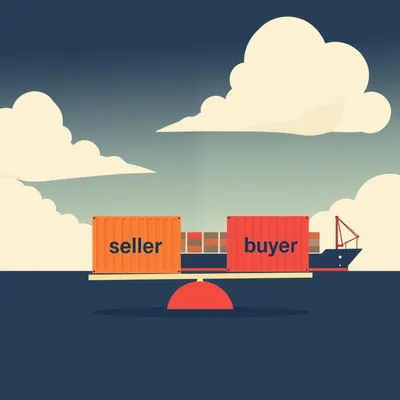
Let's step back and define what we're actually talking about — because the DSM parallel only works if you understand the structure of Incoterms. These are eleven predefined rules published by the International Chamber of Commerce, the ICC, that allocate cost, risk, and responsibility between buyer and seller in international sales contracts. They're not law. They have no force unless you incorporate them by reference into a contract. But practically speaking, they're the skeleton underneath most cross-border trade.
They've been around since 1936. That's the thing that gets me — we're talking about a standard that predates containerization, predates air freight as a commercial reality, predates the computer. The original 1936 version had six terms. FOB, CIF, and a handful of others that were built for a world where you loaded cargo onto a ship with a crane and a prayer. The entire system has had to evolve through eight revisions to stay relevant, and each revision tells you something about what was breaking in global trade at that moment.
With that framing in mind, let's look at how we got here — the evolution from 1936 to 2020, and what each revision reveals about the changing nature of trade.
The big inflection points are worth tracing. The 1980 revision was the first to introduce the term "carrier" — that might sound minor, but it was a direct response to containerization. Before containers, the ship owner and the carrier were the same entity. After containers, you had multimodal transport operators who might never touch a ship. The old language didn't fit. The 2000 revision clarified customs clearance obligations, which had become a mess as supply chains crossed more borders. Then 2010 was the real structural overhaul.
That's the one that killed the ship's rail.
The ship's rail. For decades, risk transferred from seller to buyer when goods passed over the ship's rail — literally the railing of the vessel. That made sense when cargo was loaded piece by piece with dock workers and nets. It made zero sense for roll-on roll-off ferries or containerized cargo that gets lifted aboard in a sealed box. So the 2010 revision replaced it with "on board" — risk transfers when goods are on the vessel. Clean, simple, reflects physical reality.
It's a beautiful example of a standard catching up to technology, thirty years after the technology changed.
That's the pace we're working with. The 2010 revision also did something structural that most people miss — it split the terms into two groups. Seven rules for any mode of transport: EXW, FCA, CPT, CIP, DAT, DAP, DDP. And four rules for sea and inland waterway only: FAS, FOB, CFR, CIF. That division was a recognition that multimodal shipping had become the norm. Most goods move by truck, train, ship, and truck again. Pretending everything was ocean freight was increasingly fictional.
2010 also reduced the total number of terms from thirteen to eleven, which is its own kind of editorial discipline. Most standards expand over time. The ICC actually removed terms.
They consolidated four D-group terms — DAF, DES, DEQ, and DDU — into two: DAT and DAP. That was controversial at the time. People had built contracts around those terms for years. But the ICC's argument was that the distinctions had become meaningless in a containerized world. Whether goods were delivered at the frontier or the quay mattered less when the container was sealed at origin and opened at destination.
Which brings us to 2020. And this is where things get interesting, because the 2020 changes weren't a structural overhaul — they were targeted fixes that reveal exactly where the system was straining.
Five main changes. Let me walk through them, because each one solves a real problem that anyone in B2B trade has probably encountered. First, DAT was renamed to DPU — Delivered at Place Unloaded. This is the first time in the history of Incoterms that a term was renamed rather than just revised. Under DAT, the place of delivery had to be a terminal. Under DPU, it can be any place — a warehouse, a factory, a distribution center — as long as the seller arranges unloading.
If I'm a seller delivering to a warehouse in Rotterdam that isn't technically a terminal, under DAT I couldn't use that term. Under DPU I can.
It sounds small, but terminals are specific legal entities with specific infrastructure. A lot of modern logistics involves delivery to places that aren't terminals. The old name was creating contractual gaps.
Second change — and this one has real money attached to it — the insurance divergence between CIF and CIP.
This is a big one. Under Incoterms 2010, both CIF and CIP required the seller to provide minimum insurance coverage under Institute Cargo Clauses C. That's basically named-perils coverage — it covers things like fire, explosion, vessel sinking, but not theft, damage from rough handling, or water damage. Under 2020, CIP now requires Institute Cargo Clauses A, which is all-risk coverage. CIF stays at the lower C level.
Why the split?
Because CIP is used for containerized goods, which tend to be higher value and more susceptible to damage during handling. CIF is used for bulk commodities — grain, oil, ore — where the risk profile is different and all-risk coverage would be prohibitively expensive. The ICC recognized that one-size-fits-all insurance was pushing sellers toward either over-insuring or under-insuring depending on what they were shipping.
If you're a seller using CIP for manufactured goods, your insurance costs went up in 2020. If you're using CIF for bulk, they stayed the same.
That's created an interesting dynamic. Some sellers have shifted preference back toward CIF to avoid the higher CIP insurance requirement, even when CIP would otherwise be more appropriate for the transport mode. The fix solved one problem and created a new incentive distortion.
That's going to be a theme.
The FCA and bills of lading fix. This one is elegant. Under FCA — Free Carrier — the seller delivers goods to a carrier at a named place, often a container yard. Under Incoterms 2010, the seller's responsibility ended at that point. The problem was that banks issuing letters of credit often require an onboard bill of lading as proof of shipment. But the seller couldn't get one because they weren't the party loading the goods onto the vessel — the carrier was. So you'd have goods shipped, but the seller couldn't get paid because the paperwork didn't match the letter of credit requirements.
That's the kind of problem that costs real money in demurrage and detention while someone sorts out the paperwork.
The 2020 fix is that the buyer and seller can agree that the buyer will instruct the carrier to issue an onboard bill of lading to the seller after loading. It's not automatic — it requires explicit agreement and carrier cooperation — but it creates a mechanism where none existed before.
Security-related clearances are now explicitly allocated. Post-9/11 security regimes like ISPS, the International Ship and Port Facility Security code, and CT-PAT, the Customs-Trade Partnership Against Terrorism, added costs and responsibilities that the old Incoterms didn't address. Who pays for container scanning? Who's responsible if a shipment is held for security inspection? The 2020 revision spells out that security obligations generally follow the same allocation as other costs — but at least they're mentioned now, which they weren't before.
The fifth change?
Under previous versions, the assumption was always that transport was arranged with a third-party carrier. The 2020 revision explicitly allows that the seller or buyer can use their own means of transport. This reflects vertical integration trends — companies like Amazon that own their own trucks, planes, and ships. It seems obvious in retrospect, but the old language didn't contemplate it.
Those are the five changes. DAT to DPU, CIP insurance upgrade, FCA bill of lading fix, security cost allocation, and own transport. Each one is a targeted response to a specific pain point. But none of them fundamentally rethinks the system.
That's the question Daniel's really asking. Those 2020 changes were targeted fixes, but they also reveal deeper tensions. Which brings us to the bigger question: are Incoterms becoming less useful as trade blossoms?
Let's take the e-commerce problem first. Incoterms are built for B2B transactions — a seller in one country, a buyer in another, a shipment that moves through established channels. But direct-to-consumer shipping doesn't fit that model. If I buy something from Alibaba and it ships to my door, which Incoterm applies? But DAP assumes the seller arranges carriage to the named place and bears all costs except import clearance. That's not how most e-commerce logistics actually work — there are multiple handoffs, last-mile carriers, local delivery partners.
The platforms themselves are increasingly imposing their own terms. Amazon Global Logistics doesn't reference Incoterms in its seller agreements — it has its own compliance manual that spells out exactly who does what. Alibaba's Trade Assurance program has its own dispute resolution framework. These proprietary systems are effectively replacing Incoterms for a growing segment of trade.
Then there's the consolidation problem. Daniel mentioned this specifically — when goods from multiple suppliers are consolidated at a hub, who bears what risk at which handoff? If I'm a European retailer importing from five Asian suppliers through a consolidation hub in Singapore, the goods from Supplier A and Supplier B are combined into a single container. That container is damaged in transit. Under which Incoterm does Supplier A's responsibility end? The answer is often "none cleanly," and you end up with bespoke consolidation agreements layered on top of whatever Incoterm was nominally in use.
The same problem arises with split shipments, where a single order is divided across multiple containers or vessels. Incoterms assume a unitary shipment — one set of goods, one carrier, one journey. The moment you fragment the shipment, you're in territory the templates don't cover.
We've got e-commerce, consolidation, split shipments, platform-specific terms, and vertical integration. Each of these strains the Incoterms framework in a different direction.
Then there's the digitalization gap. The 2020 revision mentions electronic documents, but it doesn't mandate them and it doesn't provide a framework for smart contracts or blockchain-based trade finance. The ICC has been working on digital standards through its Digital Standards Initiative, but it's slow going. Meanwhile, the container shipping industry is moving toward electronic bills of lading — Maersk and IBM's TradeLens platform was an early attempt, though it shut down in 2023. The point is, the technology is moving faster than the standard.
What about sustainability? Carbon costs, ESG compliance — none of that is allocated in current Incoterms. If the EU's Carbon Border Adjustment Mechanism imposes costs on imported goods, which party bears that cost under an FOB contract? The Incoterms are silent.
The pandemic exposed how fragile the assumptions are. When ports close and vessels are stranded, who bears the cost of delay? Incoterms don't address disruption risk allocation in any systematic way. The Red Sea crisis in late 2023 and early 2024 — when Houthi attacks forced container ships to reroute around the Cape of Good Hope, adding ten days and millions in fuel costs — created exactly these disputes. Sellers who had delivered goods FOB at an Asian port argued their responsibility ended at the ship's rail. Buyers whose goods were now taking three weeks longer to arrive argued the seller should share the cost. The Incoterms didn't resolve it.
What might the next revision address? Discussions are already underway at the ICC, and the expectation is something around 2030.
Based on the trade press and ICC working group papers, there are five likely areas. First, digitalization — not just mentioning electronic documents, but providing a framework for how smart contracts and blockchain fit into the Incoterms structure. Second, sustainability — explicit allocation of carbon costs, ESG reporting obligations, and compliance with regulations like CBAM. Third, e-commerce — possibly a new term for doorstep delivery with clear liability for last-mile issues. Fourth, data — who owns the trade data generated by a shipment, who's responsible for its accuracy, and who bears liability if it's compromised? Fifth, disruption — some form of force majeure or disruption risk allocation that goes beyond the current silence.
The data question is fascinating and completely invisible to most people. A single container shipment generates thousands of data points — location, temperature, humidity, customs declarations, inspection results. That data has commercial value and security implications, and right now nobody's clear on who owns it.
That's before you get into the geopolitics. If a shipment transits through a country with data localization laws, does the trade data have to stay in that jurisdiction? The Incoterms have nothing to say about this.
Is there a push toward alternative mechanisms? Daniel asked about that directly.
Yes, and it's coming from several directions. The big shippers — Walmart, Amazon, the major retailers — increasingly use proprietary vendor compliance manuals that effectively replace Incoterms. They specify exactly how goods must be packaged, labeled, shipped, and documented, and they impose penalties for non-compliance. From the seller's perspective, the Walmart manual is the real contract — the Incoterm is almost an afterthought.
Then there's what practitioners call "Incoterms-plus" — where parties use an Incoterm as the base but add riders for specific issues. Demurrage and detention costs, carbon offsets, data sharing obligations — these get bolted on because the base term doesn't cover them.
There are industry-specific terms that have coexisted with Incoterms for decades. GAFTA for grains, FOSFA for oils and fats — these are detailed contract forms that incorporate Incoterms but add layers of industry-specific provisions. In some commodity trades, the GAFTA contract is the standard, and Incoterms are referenced almost as background.
Then there are the legal frameworks — the UN's CMR convention for road transport, the Rotterdam Rules for multimodal transport. But those are liability regimes, not contractual terms. They govern what happens when something goes wrong, not how you structure the deal upfront.
The Rotterdam Rules are actually a cautionary tale here. They were adopted in 2008 and were supposed to be the modern multimodal framework that replaced the patchwork of older conventions. As of today, they've been ratified by five countries and haven't entered into force. The lesson is that getting international consensus on trade standards is incredibly hard, which is part of why the ICC's approach — a private body publishing voluntary rules — has been more successful than treaty-based alternatives.
That's an important point. The ICC isn't a government. It's a business organization based in Paris. Incoterms succeed because they're useful, not because they're mandatory. And that voluntary nature is both their strength and their vulnerability — strength because they can evolve without treaty negotiations, vulnerability because they can be ignored when they're not useful enough.
Which brings us back to the DSM parallel. The DSM isn't law either — it's published by the American Psychiatric Association, a private professional body. But it's incorporated by reference into insurance reimbursement systems, disability determinations, and court proceedings. It has authority without being authoritative in a legal sense.
Both systems face the same criticism: they're too categorical. The DSM says you either meet the criteria for major depressive disorder or you don't. Incoterms say risk transfers at a specific point — the ship's rail, the terminal, the named place. But reality is messier. Depression exists on a spectrum. Risk in a supply chain is distributed across multiple handoffs, not concentrated at a single point.
The NIMH's Research Domain Criteria framework was an attempt to address this — instead of categorical diagnoses, it looks at dimensions like attention, social processing, and arousal regulation that cut across traditional diagnostic boundaries. The question is whether there's an equivalent for trade. Is there a dimensional approach to allocating cost and risk that would be more flexible than eleven fixed templates?
I think the answer is that some large players are already building it, but it's proprietary rather than standardized. Amazon's vendor requirements are essentially a dimensional system — they specify requirements for packaging, labeling, shipping, and documentation that vary by product category, origin, and destination. It's more granular than any Incoterm. But it only works within Amazon's ecosystem.
That's the trade-off. Proprietary systems can be more precise because they're tailored to a specific supply chain. But they don't create the interoperability that makes global trade efficient. The reason Incoterms have survived since 1936 isn't that they're perfect — it's that they're common. Everyone knows what FOB means, or at least they know enough to negotiate from a shared starting point.
Where does that leave us? Let's get practical — here are four things you can do right now to navigate the gaps.
First, check your insurance. If you're using CIP, you're now paying for Institute Cargo Clauses A all-risk coverage. That's appropriate for high-value containerized goods, but if you're shipping lower-value items, you may be over-insuring. Conversely, if you're using CIF for anything valuable, remember that you're only getting Clauses C — named perils. The container falls off the ship in a storm? Someone steals the container at the port? You may need supplemental insurance.
Second, the FCA bill of lading fix is only as good as your contract language. Don't assume it happens automatically. You need an explicit clause stating that the buyer will instruct the carrier to issue an onboard bill of lading to the seller after loading at the named place. And you need to confirm the carrier will actually do it — some smaller carriers may not have processes for this.
Third, for multimodal or consolidated shipments, don't rely on a single Incoterm for the whole journey. Break the shipment into segments and assign appropriate terms for each handoff. Alternatively, use a through bill of lading with clear sub-terms that specify what happens at each transfer point. The consolidation hub in Singapore needs its own risk allocation — don't let it fall into a contractual gap.
Fourth, prepare for the next revision now. The ICC is almost certainly going to address digitalization, sustainability, and e-commerce in the 2030 update. If your contracts are straining against the current terms in any of these areas, document it. The ICC working groups rely on industry input. The companies that show up with concrete use cases and specific language proposals are the ones that shape the next version.
A bonus fifth: watch the platform terms. If you're selling through Alibaba, Amazon Global, or similar platforms, read their vendor compliance manuals carefully. The Incoterm you put on the contract may be overridden by platform requirements you agreed to in the terms of service. This is especially true for liability and returns — areas where platform policies often impose obligations that go beyond what any Incoterm would require.
To wrap up, let's return to the DSM parallel and ask what the future of trade classification looks like. The DSM has survived despite decades of criticism because the alternatives — dimensional frameworks, biomarker-based diagnosis — haven't proven clinically superior at scale. They're better in theory, but they don't yet produce better patient outcomes in practice.
Incoterms are in a similar position. The alternatives — proprietary vendor manuals, industry-specific terms, platform policies — are more precise in their specific domains, but they fragment the standardization that makes global trade work. A world where every major buyer has its own Incoterms equivalent is a world with higher transaction costs, more disputes, and more barriers to entry for smaller players.
The question isn't whether Incoterms are good or bad. They're clearly good enough to have survived for ninety years. The question is whether the ICC can evolve them fast enough to match the complexity of the trade they're meant to enable. The 2020 changes were sensible but incremental. The 2030 changes will need to be more ambitious — because the gap between the templates and the reality is widening, and the proprietary alternatives are getting better.
The open question Daniel's really asking: will the ICC move fast enough, or will we see a fragmentation where Incoterms become a legacy reference while the real action happens in proprietary and industry-specific terms? My bet is on coexistence rather than replacement — Incoterms as the skeleton, with riders and platform terms as the musculature. But the skeleton needs to keep growing, or eventually the body outgrows it.
Now: Hilbert's daily fun fact.

In some Australian Aboriginal languages, a single kinship term can encode over thirty distinct relationship categories, including the speaker's gender, the relative's age, and whether they are related through the mother's or father's line — making "cousin" in English look like it's barely trying.
That explains a lot about family reunions.
This has been My Weird Prompts. If you want to dig deeper into any of the topics we cover, you can find us at my weird prompts dot com. I'm Herman Poppleberry.
I'm Corn. We'll be back next time.