So Daniel writes in with a follow on from the box through the window episode, and this one starts with what I'd call a moment of physical honesty. He's moved into the new apartment, the outdoor overflow storage is gone, everything has to come inside, and the Eurobox system we talked about is now stacked on shelving running two and a half to three metres tall. A loaded box weighs fifteen to twenty five kilos. And his opening observation is that the standard answer, use a ladder, is dangerous when you're alone. You're two metres up, pulling a heavy box toward your chest, then climbing back down one handed with your centre of gravity somewhere out in front of you.

And he's right that putting them back up is arguably the worse half. Going up with a box is worse than coming down with one, because you're working against gravity the entire time and you can't see your feet.
So he's asking us to start with the professional world before improvising. What does warehousing actually do when humans need things from high storage? What do the formal manual handling guidelines say about lifting above shoulder height and carrying loads on ladders? Then work down to what could realistically live in a rented apartment where you can't bolt into structure. He wants us to test a manual stacker, a wall mounted hoist, a counterweighted dumbwaiter, a lift table that only does the bottom half of the journey, or the simplest option, designing the storage so heavy boxes never go above shoulder height at all. And he's explicitly told us to be straight about which of these is over engineering.
He's asking the right question. Before we improvise, let's see what the people who move boxes for a living have already figured out. Because they've spent a hundred years solving exactly this problem, and the principles transfer directly.
So where do we even start?
We start by understanding what this actually is. The storage system itself is settled. The Euroboxes work, the shelving works, the industrial storage part is done. What's failing is the interface between human and shelf at height. And that's a materials handling problem, which is a discipline that exists precisely because people kept hurting themselves doing exactly what Daniel's describing.
And there's a hidden third character in this whole thing, which is the rental constraint. He's got limited floor space, good vertical space, but he cannot bolt into walls or ceilings without permission, cannot install permanent equipment, and cannot cut into structure. So every solution has to be freestanding or reversible. That's not a minor footnote. That eliminates a huge chunk of the professional toolkit immediately.
Right, and this matters far beyond Daniel's apartment. Every home with tall shelving has this exact problem. The default solution is unsafe ladder behaviour, reaching, stretching, pulling heavy things toward your chest. What we're really doing here is asking what best practice looks like when you scale it down to a single person in a rental.
So the arc of this episode is straightforward. First, what professionals do and why. Second, what the safety research actually says about the limits. Third, testing the home solutions against the rental reality. Then Hilbert has a story from his warehouse days that I think is going to land harder than either of us expects. Then the verdict.
Let's get into the professional toolkit first, because the principles there are what everything else hangs on. And I want to be clear about something up front. The professional world has essentially decided that humans should not lift heavy things above their shoulders. Full stop. The entire industry is built around that conclusion.
Let's go through the toolkit then. What's actually in a modern warehouse?
The first thing is the vertical lift module, or VLM. This is the big automated cabinet, sometimes called a vertical carousel. It's essentially a giant enclosed shelving unit with a central extractor mechanism. The machine brings the stored tray or box down to an ergonomic access window at waist height. The operator never climbs anything, never reaches above shoulder height, never has to catch a falling box. The entire vertical journey is done by the machine, and the human only handles the box at a safe height.
And Daniel already flagged these as obviously beyond any home in budget, size and weight. He's right. These are industrial machines that cost tens of thousands of dollars and weigh several tonnes. But the principle is the important part. The machine does the vertical journey, the human does the handling at a safe height.
And that principle repeats across the whole toolkit. Next you've got stackers. Semi electric and manual stackers use a mast with hydraulic or mechanical lift to raise a platform or forks. The operator loads the box at floor level, then the machine raises it. The operator only handles horizontal movement at a safe height. Manual stackers are actually shockingly affordable for what they do. You can get a basic manual stacker with a five hundred pound capacity for somewhere in the three to eight hundred dollar range. Search for manual stacker five hundred pound capacity or winch lift table and you'll find them.
And the key distinction there is straddle versus counterbalance designs. A straddle stacker has legs that go around the pallet or load, which makes it stable but requires floor space on either side. A counterbalance stacker has the weight at the back to balance the load at the front, which means it can get closer to shelving but it's heavier and needs more room to manoeuvre. Neither of those is trivial in a small apartment.
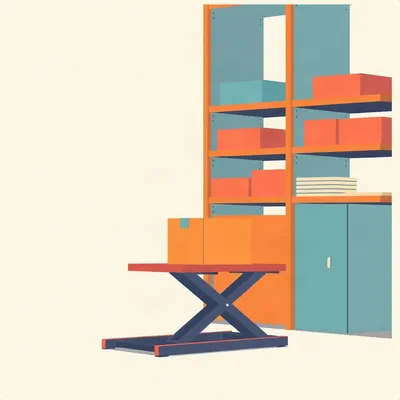
Then you've got scissor lift tables. These raise the load to the operator rather than the operator to the load. You put the box on the table at floor height, pump the hydraulic pedal, and the table rises to whatever height you need. The operator never climbs anything. Scissor lift tables come in all sizes, from tiny benchtop units to massive industrial platforms. A small one rated for a couple hundred kilos is a few hundred dollars.
And order pickers are the opposite. Those raise the person to the load. That's the ladder problem mechanised. You're standing on a platform that goes up, and then you're reaching for the box at height. It's safer than a ladder because you have a platform and guardrails, but it's still fundamentally asking a person to handle a load above shoulder height. The professional world uses order pickers, but they're generally the least preferred option for heavy items precisely because they don't solve the ergonomic problem.
And vacuum lift assists are the most interesting one from a principle standpoint. A vacuum tube with a suction head attaches to the box or item, and the vacuum does the actual lifting. The operator just guides the load. They're common in warehouses for bags, boxes, and sheet materials. The principle is that the machine carries the weight and the human only steers. That's the ideal division of labour.
So the unifying principle across all of these is what you said. Professional solutions almost never ask a person to lift above shoulder height. The machine does the vertical work, the human does the horizontal work at a safe height. And that's not just convention. That's written into the formal guidance.
This is where the NIOSH lifting equation comes in. NIOSH is the National Institute for Occupational Safety and Health. Their lifting equation is the standard tool for evaluating whether a lift is safe. It multiplies several factors together to get a recommended weight limit. The load constant, the horizontal distance from the body, the vertical position, the travel distance, the asymmetry, the frequency, and the coupling quality.
And the vertical position multiplier is the one that matters here. At floor to knuckle height, which is roughly seventy five centimetres, the multiplier is at its maximum, one point zero. As you go higher, it drops. By the time you're above shoulder height, around a hundred and seventy five centimetres, the multiplier has dropped dramatically. The recommended weight limit at that height is a small fraction of what it is at waist height.
The practical translation is that a twenty kilo box that's perfectly safe to lift from a shelf at waist height becomes formally unsafe to lift from a shelf at head height. The equation doesn't just say it's harder. It says the safe limit drops to a fraction of what it was. And above shoulder height, the multiplier approaches zero. The formal guidance is simply that lifting above shoulder height should be avoided or minimised entirely.
So that's the lifting side. Now the ladder side. And this is where Daniel's instinct was exactly right. He said climbing down with a box one handed with your centre of gravity out in front of you is slightly dangerous. The formal guidance says it's not slightly dangerous. It's prohibited.
OSHA, the Occupational Safety and Health Administration, issued a standard interpretation letter in nineteen ninety two on exactly this question. The letter confirms that carrying loads on ladders is prohibited when it prevents the worker from maintaining three points of contact. Three points of contact means two feet and one hand, or two hands and one foot, always in contact with the ladder. A heavy Eurobox being pulled toward your chest at two metres up inherently breaks that rule. You need both hands for the box, which means you have no hands for the ladder.
The recognised safe limit for carrying anything up a ladder is effectively zero if it requires both hands or shifts your centre of gravity. There's no clever technique that makes it safe. The rule isn't be careful. The rule is don't do it.
The professional answer to vertical transport is to separate the vertical journey, done by a machine, from the human handling, done at a safe height. The question for Daniel is what's the cheapest, most rental friendly way to achieve that separation for a fifteen to twenty five kilo box over two and a half to three metres.
That's the pivot. The professional principles are clear. Now we test the home solutions against the rental reality. And I want to start with the anchoring problem, because that kills the wall mounted hoist before we even get to the parts list.
Let's talk about that, because it's the one Daniel specifically asked about and it's the one that sounds most appealing on paper. A wall mounted or shelf integrated hoist using a hand winch or block and tackle. You mount a pulley or winch above the shelf, run a cable down, hook it to the box, and crank it up. Sounds simple.
The problem is the forces involved. A twenty five kilo box on a two to one block and tackle puts fifty kilos of force on the anchor point. On a four to one, it's a hundred kilos. That's the static load. When you're cranking and the box shifts or snags, you get dynamic loads that can spike well above that. And standard rental drywall or studs will not safely support that without significant reinforcement.
Here's the thing about rentals. You can't cut into the structure. You can't open the wall to add blocking between studs. You can't through bolt into a concrete column without permission. You can't install the kind of anchor that would actually be rated for that load. A toggle bolt in drywall is rated for maybe twenty or thirty kilos in tension if you're lucky. A hundred kilos of force on a toggle bolt in drywall is not a question of if it fails, it's when.
The failure mode is the scary part. The anchor doesn't fail slowly. It rips out of the wall suddenly, and now you've got a twenty five kilo box falling from two and a half metres with a cable whipping behind it. That's worse than the ladder problem by a wide margin. The ladder problem is a back injury waiting to happen. The failed anchor problem is a head injury waiting to happen.
The wall mounted hoist is out for a rental unless you can find a freestanding frame to mount it to. And at that point, you've essentially built a stacker anyway, so you might as well buy a stacker.
Which brings us to the manual stacker or winch operated lift truck. Daniel asked about this specifically, and it's commercially available. Search for manual stacker five hundred pound capacity or winch lift table and you'll find units in the three to eight hundred dollar range. A basic manual stacker has a mast, a platform or forks, and either a hydraulic foot pump or a hand winch to raise the load. You load the box at floor level, pump it up to shelf height, then slide it across.
The principle is exactly right. This is the professional answer scaled down. The machine does the vertical journey, the human does the horizontal transfer at a safe height. A manual stacker rated for two hundred and fifty kilos would handle a twenty five kilo Eurobox with a ten to one safety margin.
The problem is the footprint. A straddle stacker needs legs that go around the load, which means it's wider than the box and needs clear floor space on both sides. A counterbalance stacker needs weight at the back, which means it's longer and heavier. Both of them need a flat, clear path from wherever they're stored to wherever the shelving is. And in a small apartment, that path doesn't exist.
The failure pattern here isn't mechanical, it's behavioural. The stacker is bulky enough that it lives in a corner and never gets used. Every time Daniel needs a box from the top shelf, he looks at the stacker, thinks about dragging it out, positioning it, pumping it up, transferring the box, lowering it, and putting the stacker back. And then he grabs the ladder and does it the unsafe way because it's faster. The machine that never gets used is worse than no machine at all, because it cost money and floor space.
The stacker is technically viable but practically doomed in a small apartment. Now the counterweighted dumbwaiter style carriage on a rail. This is the most elegant engineering solution, and I'll say that up front. A carriage running on a rail up the side of the shelving with a counterweight means the motor or winch only handles the difference in weight, not the full load. If the box weighs twenty five kilos and the counterweight weighs twenty, the winch only has to move five kilos. That's beautiful engineering.
It is, and it's also the most over engineered solution for a rental. It requires rail systems, precise alignment, counterweight travel space, and a mounting structure that can handle the full load plus the counterweight plus the dynamic forces. You can't bolt the rail to the wall because of the rental constraint. You'd have to build a freestanding frame, which is essentially building a piece of industrial equipment in your living room.
The failure pattern is dangerous. A misaligned carriage jams, or worse, drops a twenty five kilo box. The counterweight is moving in the opposite direction, so if the box side fails, you've got a twenty kilo counterweight falling one way and a twenty five kilo box falling the other way. That's a lot of kinetic energy in a small space.
You can't test it properly without permanent installation. A dumbwaiter needs to be aligned, levelled, and secured before you trust it with a real load. In a rental, you'd be testing it on a temporary frame and hoping it holds. That's not a test, that's a gamble.
The dumbwaiter is out for a rental. Which brings us to the lift table that only handles the bottom half of the journey. And this is where I think the pragmatic middle ground actually lives.
Let's talk about this one properly, because it's the first solution that actually aligns with the professional guidance instead of fighting it. A small scissor lift table, or even a simple platform on a hand winch, raises the box from floor level to about one point two to one point five metres. That's shoulder height. At that point, you transfer the box to the shelf at a safe height, using the lifting technique that the NIOSH equation actually approves of.
The top shelf then only ever holds light, bulky things. Heavy boxes never go above shoulder height. This aligns with the NIOSH guidance without requiring permanent installation. A small scissor lift table is freestanding, movable, and doesn't need to be bolted to anything.
The parts here are actually straightforward. A small scissor lift table rated for two hundred kilos costs somewhere in the two to four hundred dollar range. Search for small scissor lift table or hydraulic lift cart. You want one with a platform that's at least sixty by forty centimetres to match the Eurobox footprint. The hydraulic ones have a foot pedal, which is fine because you're not lifting the box by hand, you're pumping the pedal. The box does the vertical journey on the table.
There's an even cheaper version, which is just a platform on a hand winch mounted to a freestanding frame. A simple hand winch rated for two hundred and fifty kilos is thirty to fifty dollars. A basic steel frame can be built from slotted angle iron or even heavy duty shelving uprights. The winch raises the platform from floor to shoulder height, and the whole thing lives next to the shelving when not in use.
The tools for that build are a drill, a socket set, and a level. Maybe a hacksaw if you need to cut the frame to size. Total cost for the winch and frame version is maybe a hundred to a hundred and fifty dollars if you build the frame yourself. The scissor lift table is more expensive but it's a finished product with no assembly and a proper safety rating.
But here's the thing. Even the lift table is treating the symptom. And this is where the redesign option comes in, which is the professional answer translated to home. Warehouses do not store heavy items on top shelves. They store them in what's called the golden zone, between knuckle and shoulder height. The top shelves in a warehouse hold light, bulky items. Bedding, seasonal decorations, empty boxes. Heavy items stay in the golden zone.
The golden zone principle requires no mechanism at all. It's just a rule about what goes where. The top one and a half metres of shelving only holds light, bulky things. Heavy boxes live between knee and shoulder height. Nothing over about five to eight kilos goes above shoulder height. That's it. That's the entire system.
The honest verdict, which Daniel explicitly asked us to give, is that a good ladder plus a strict rule about what goes on the top shelf beats every mechanism for most cases. But the rule has to be strict, and the ladder has to be the right type.
Let's talk about the ladder first, because there's a right answer and a lot of wrong answers. The wrong answer is an A frame ladder that you climb with a box in your arms. The right answer is a proper step ladder with a platform, sometimes called a platform ladder or a podium ladder. These have a wide, flat platform at the top that you stand on with both feet, and a guardrail or at least a high handrail. They're rated for the load, they're stable, and they give you a proper working position.
A good platform ladder rated for a hundred and fifty kilos costs somewhere in the hundred to two hundred dollar range. Search for platform step ladder or podium ladder. You want one that gets you to about one point five metres standing height, which puts your shoulders at about two metres, which is exactly where the top shelf transfer happens. And you never carry a box up or down the ladder. You climb up empty handed, pull the box from the shelf, hand it down to a helper or set it on the platform, then climb down and lift it from the platform. Or for putting boxes up, you lift the box to the platform, climb up, then lift it from the platform to the shelf.
That's the key insight. The ladder is not for carrying boxes. The ladder is for getting yourself to the right height so you can do a safe lift at shoulder height. The box never travels with you on the ladder. It travels separately, either handed off or staged on the platform.
The rule about what goes on the top shelf is the design part. Heavy boxes never go above shoulder height. Light, bulky things live at three metres. That's not a compromise, that's the professional answer. Warehouses have been doing exactly this for decades. The golden zone is between knuckle and shoulder height. Everything else is either light or handled by a machine.
The verdict is actually three tiered. First, redesign the storage so heavy boxes stay in the golden zone. That's free and it's the single biggest safety improvement. Second, if you need to move heavy boxes vertically on a regular basis, a small scissor lift table or a winch platform that handles the bottom half of the journey is the pragmatic mechanical solution. Third, a platform ladder for the light items on the top shelf, with the strict rule that nothing heavy ever goes up there.
The moment you need to move a twenty kilo box from a three metre shelf alone, you have already failed the design. The mechanism is treating the symptom, not the cause. The cause is that a heavy box is on a top shelf, and the fix is to not put it there.
There's a story about a warehouse in Slough that I think is relevant here. And it's not about the equipment at all.
Go on.
Hilbert worked for a summer back in nineteen ninety four as a warehouse assistant at a mail order catalogue company in Slough. The picking system was entirely manual. Trolleys, ladders, and a supervisor who enforced a no climbing with boxes rule by threatening to dock pay. And he remembers the one time he saw a colleague try to carry a heavy box down a ladder. The supervisor's reaction wasn't a safety lecture. It was a story about a guy who had done the same thing and spent six weeks off with a back injury.
The rule wasn't about the ladder at all. It was about the box weight.
The warehouse had a simple colour coding system. The heaviest items were always stored on the bottom two shelves. The top shelves only ever held light stock like pillowcases and catalogue returns. And Hilbert has been waiting this whole episode to point out that Daniel's Eurobox system already has the answer built in. The boxes are standard sizes, so you can weigh them once and colour code the lids. The rule becomes visual rather than remembered.
That's actually brilliant. A red lid marker means heavy, lives below shoulder height. A green marker means light, can go up top. You don't have to remember which box is heavy. You can see it from across the room.
That's exactly how professional warehouses actually enforce storage decisions. They don't rely on people remembering which items are heavy. They make it visual. Colour coded bins, labelled shelf positions, painted floor zones. The system does the remembering so the person doesn't have to.
The colour coding idea turns the rule from a memory task into a visual one. Weigh each box once, mark the lid, and the storage decision is made before you even start lifting. That's the difference between a rule you follow and a rule that follows you.
It costs almost nothing. A pack of coloured tape or a set of permanent markers is five dollars. The weighing is a one time task that takes an afternoon. After that, the system runs itself.
Let's put the whole thing together, because Daniel asked for parts, tools, assembly, and budget, and we should be concrete about what we're actually recommending.
The primary recommendation is the redesign. Heavy boxes stay in the golden zone, between knee and shoulder height. Light, bulky items go up top. Colour code the lids so the rule is visual. That costs five dollars for tape or markers and an afternoon of weighing and marking. No tools required beyond a bathroom scale and a permanent marker.
The secondary recommendation, if he needs to move heavy boxes vertically on a regular basis, is a small scissor lift table rated for two hundred kilos. Search for small scissor lift table or hydraulic lift cart on AliExpress or Amazon. Platform at least sixty by forty centimetres. Budget two to four hundred dollars. That handles the bottom half of the journey, from floor to shoulder height, which is where the safe transfer happens.
The tertiary recommendation is a proper platform ladder for the light items on the top shelf. Search for platform step ladder or podium ladder on Amazon or at a local hardware store. Rated for a hundred and fifty kilos. Budget a hundred to two hundred dollars. The rule is you never carry a box on the ladder. You climb up empty handed, transfer the box at shoulder height, and climb down.
The tools for the whole thing are minimal. A bathroom scale for weighing boxes, a permanent marker or coloured tape for the lids, and that's it. If he goes the winch platform route instead of the scissor lift table, he'll need a drill, a socket set, and a level for the frame assembly. But the winch platform is the budget version and it's more work to build.
The failure pattern are worth being explicit about, because Daniel asked. The wall mounted hoist fails by ripping the anchor out of the wall and dropping the box. The manual stacker fails by taking up so much floor space that it never gets used. The dumbwaiter fails by jamming or dropping the load if the alignment is off. The lift table fails by being slightly annoying to position, which is a much better failure pattern. And the redesign fails by being ignored if the colour coding isn't visual enough.
The redesign is the only solution where the failure pattern is a back injury from ignoring the rule, which is the same failure pattern as the ladder, but with the rule making it much less likely. The mechanism solutions all have mechanical failure pattern that can hurt you in new and interesting ways. The redesign just asks you to follow a colour code.
Let's talk about the open question, because there is one. At what point does the complexity of the mechanism become worth it? If the apartment were owned rather than rented, would a wall mounted hoist or dumbwaiter ever be the right call? Or is the design first answer always superior?
I think the design first answer is always superior for a home, even an owned home. Because the mechanism only pays off if you're moving heavy boxes vertically on a regular basis. And in a home, that's just not a thing that happens. You move boxes in, you unpack, you settle, and then you're moving one box a month at most. The mechanism sits idle for weeks at a time and becomes a piece of furniture you have to maintain.
The real lesson is that storage systems should be designed around the human handling limit, not the available space. Vertical space is only usable if the items going up there are light enough to handle safely. A three metre shelf that holds a twenty kilo box is not storage, it's a trap.
The next time you look at tall shelving, the question is not how do I get heavy things up there. It's why are heavy things up there at all. And the answer, in a properly designed system, is that they're not.
The total budget is somewhere between five dollars and six hundred dollars depending on how far Daniel wants to go. Five dollars for the colour coding and the redesign, which is the essential part. Two to four hundred for the scissor lift table if he wants the mechanical assist. A hundred to two hundred for the platform ladder for the light stuff up top. And the honest answer is that the five dollar part is the one that actually solves the problem.
Send us a picture of the colour coded lids when it's done. I want to see the red and green system in action. And thanks to our producer Hilbert Flumingtop for the Slough warehouse story, which turned out to be the most practical thing in the whole episode.
This has been My Weird Prompts, the human AI collaboration podcast. If you enjoyed this, leave us a review wherever you listen, and we'll see you next time.
Until then, keep the heavy stuff low and the light stuff high.
Never carry a box up a ladder.