There's a moment in every home office build where you stop comparing specs and start comparing shapes. You've picked your CRI, you've argued yourself hoarse about Kelvin, and then you're staring at a catalogue and realizing none of that tells you where the light actually goes.

And that's the gap between the last conversation and this one. We did the spec sheet. This is the hardware that produces those numbers.
Here's what Daniel sent in. He's looking at three environments at once. A home office, a home workbench, or a business fit-out, and in all three of them there's now a bewildering world of lighting suppliers with catalogues tailored to exactly that kind of room.
Which is its own problem.
The fixtures he wants to walk through: the crossbar light, sometimes clamped to the desk, sometimes just sitting on it with a T-bar reaching up above the monitors, heavily marketed to gamers and architects. Then floor-mounted lighting. And for anyone who doesn't rent and can modify the room, wall-mounted and ceiling-mounted. All of them with variants aimed specifically at lighting a workstation.
He's got two angles on top of the list, right?
Two. First, the fixture determines the throw pattern. If your office is a shared room, if there's a child in the other half of it, you want a narrow throw. Second, the work itself may push you toward mixed lighting, a few lights doing complementary jobs rather than one light doing everything. And then the control question. Smart integration, remote control, or a manual switch. His closing ask is the one that matters: which fixture and setup suits which workflow.
Before we can answer that, we have to be honest about what each fixture actually does to the light.
Start with the crossbar then, because it's the one most listeners have either bought or been advertised at.
It's the fixture that's had the loudest few years, and it earns most of it. The standard form is a horizontal bar resting across the top of the monitor, and here's the part people don't expect when they unbox it. There's no adhesive, no clip, no bracket screwed into the wall. It's held on by a counterweight hanging off the back of the screen.
Which sounds like it would be flimsy.
It's surprisingly stable, because the weight sits directly behind the vertical plane of the monitor. The bar leans forward just enough to clear the top bezel and the weight pulls it back. And that geometry is doing optical work, not just mechanical work. The bar emits light downward and forward onto the desk surface, and the housing shields the screen from it.
That's the whole trick, isn't it. A conventional desk lamp throws photons at the screen and you get a bright smear across the panel where the lamp is sitting.
Which is why people who hate desk lamps hate desk lamps. It's not that the lamp is bad. It's that the light is landing on a reflective surface at an angle that puts the reflection between you and what you're reading. The monitor bar sidesteps that entirely. It lights the desk, the keyboard, the notebook, and it puts almost nothing on the glass.
And then you look at who they market it to and it's gamers and architects, which is a strange pair to put on the same box.
It's an aspirational pairing, not a technical one. Architects and designers have a genuine requirement, color accuracy, controlled CCT, low glare, and a lot of that work happens in dim rooms where you're judging something on a screen. Gamers have a genuine requirement too, which is basically the same requirement wearing a different hat. Long dark-room sessions, eye comfort, no glare on the panel.
And the person writing code at eleven at night?
Identical problem. The marketing is trying to speak to users it assumes care about lighting parameters. The physics doesn't care whether you're rendering a building or a spreadsheet.
Hacker News has been unusually unified on these, which is not a place that agrees on anything.
One user put it that the little monitor-top light bar is at the top of their list for cost-to-life-benefit ratio, and then admitted that when they forget to turn it on they wonder why they feel so gloomy. That's the whole review.
That's better than most reviews.
Another described it as excellent for reducing eye strain in a dark room where the monitor is the only light source. And then there's the one who runs a Xiaomi bar instead of a ceiling light at night, on the grounds that the atmosphere is nice and it saves a few watts.
That's a different use case. That's not task lighting, that's replacing the room light entirely with a desk light.
And it works, which tells you something about how much of what we call room lighting is really just lighting the bit of the room we're sitting in.
Brand landscape, briefly, since Daniel's looking at suppliers.
BenQ is the original. That's the one that established the category. Xiaomi and Mi came in with a remote control version where a single remote can drive two bars, which is a small thing that matters more than it sounds. And then there's a long tail of Amazon knockoffs that the practitioner consensus describes as decent.
Which is a real answer. It's not "buy the expensive one".
It's "buy the cheap one and you'll probably be fine." Which is not something you can say about most lighting.
And the remote control is where this connects back to the control question Daniel raised, because the desk-mounted rotary dial is now standard on these. Brightness and color temperature on a physical knob sitting on your desk.
Which is the right answer for the crossbar specifically, because the two adjustments you actually make are brightness and CCT, and you make them at the moment your eyes tell you to. You're not going to open an app for that. You're going to reach over and turn a dial.
Smart integration is for the coordinated stuff, not the constant stuff.
You want the bar on a dial. You want the room lights on a schedule or a scene.
Throw pattern on the crossbar, then. This is the fixture that answers the shared-room problem Daniel raised.
It's narrow, it's downward, it's contained. You are lighting your desk, and the child's half of the room is untouched. That is not a small feature if your office is a corner of a room that has other people in it.
It's also the reason it works in a dark room, which seems backwards until you think about it. The containment is the feature.
And this is where the science underneath it is worth saying out loud, because "eye strain in a dark room" gets treated as a soft complaint. It isn't. If you're facing a bright screen against a background that's varying by orders of magnitude, your eye is constantly re-adapting. The monitor stays at what it thinks is constant brightness, and the world behind it keeps changing, and your visual system is doing arithmetic all day to reconcile the two.
Which is why facing a window while you work is so exhausting.
Natural light intensity changes by multiple orders of magnitude over a day. Your eye works hard to keep the monitor at a constant perceived brightness against that. A stable ambient source, and the monitor bar plus something behind you qualifies, removes that reconciliation. You're giving the eye a fixed reference.
So the counterintuitive version is that adding light reduces strain.
Adding the right light, in the right place. But yes.
The crossbar solves the screen problem.
It does nothing for the room, though.
Which is where the other three families come in. Floor-mounted next, because that's the one for everyone who can't put holes in anything.
Floor-mounted is the renter's fixture. No installation, no modification, no landlord conversation. And it splits into two forms. The torchiere, which throws upward, usually at the ceiling, and lets the ceiling do the work of spreading it. Or the adjustable arm, which you aim like a desk lamp but with a much longer reach.
The torchiere is a bounce light. You're not lighting the thing you're looking at, you're lighting the ceiling and letting the room fill.
Which gives you broad, room-filling ambient. And the throw is wide, because you've turned the ceiling into a secondary emitter. The whole surface is now a diffuse source.
And the aimable arm gives you the narrow version. Same fixture, two very different throws, depending on which one you bought.
There's a practitioner note that's worth passing on here, and it's not about fixture type at all. A user had two soft halogen lamps positioned over the desk, and the observation was that they'd be better if they were behind them.
Behind the user.
And that's the lesson of the whole floor-lamp category. Position relative to the viewer matters as much as the fixture itself. Glare avoidance is a placement problem before it's a hardware problem. You can have the right fixture in the wrong place and it's worse than the wrong fixture in the right place.
Which is a slightly annoying sentence.
It is, and it's true.
Wall-mounted next. This is where Daniel's point about owning versus renting bites, because you need the ability to modify the room.
Homeowners, business fit-outs, anyone who can put a box on a wall and run a cable to it. And wall-mounted does two distinct jobs. It can wash a wall, which is indirect ambient, light bouncing off a vertical surface back into the room. Or it can be a directed task light over a bench, mounted to the side or behind the user.
Side or behind.
Behind the user over a bench is close to ideal, because you get even illumination across the work surface with almost no path for the light to reach your eyes. Fixed workstations love this. If you know where the bench is going to live for the next five years, a wall-mounted fixture over it is a better answer than any floor lamp.
And it's out of the way, which floor lamps never are. Every floor lamp is in a place you eventually need to walk.
That's the honest reason people go wall-mounted. Not the optics. The floor space.
Ceiling-mounted. General illumination. Rarely enough on its own.
Almost never enough on its own at a workstation, and this is a place where people get it wrong, because a ceiling light reads as a complete solution. The room is lit. Your desk is lit. What's the problem.
The problem is the shadow of your own head.
The problem is that the light comes from directly above and behind your head, and your body sits between the source and the work. You get an even room and a dimmer, shadowed desk. It's ambient, not task.
But the high end of the ceiling approach is real, and there's a practitioner running about twenty thousand lumens at five thousand Kelvin in a small home office.
Which he describes as a sunny day in the office regardless of the weather. That's the flood-the-room school. It's not subtle and it's not cheap and it works.
And then the other end, someone recommending sixteen hundred lumens for room lighting, with the note that eight hundred isn't bright enough.
Eight hundred lumens for a room is dim. People underestimate this constantly, because lumens on a box don't tell you what arrives on a surface. Divided across a room, absorbed by the walls, lost to distance, eight hundred turns into very little.
Which brings us to the standard, and this is the part I'd want anyone building a workspace to actually hear.
EN 12464-1 recommends five hundred lux on the task area and three hundred lux in the surrounding area. That's the European indoor workplace standard. Task, five hundred. Around it, three hundred.
And the compliance picture is bad.
There's a two thousand twenty-five study out of an intensive care unit that found over fifty-two percent of workspaces failing to meet the three hundred lux minimum. More than half. And the correlation ran to forty percent lower job satisfaction, thirty percent lower self-rated performance, and twenty-five to thirty-five percent more eye fatigue and headaches.
That's a large effect to attach to something nobody thinks about.
It's the clearest evidence that under-lighting isn't a taste preference. It's measurable, and it shows up in how people feel about their work and how much of it they get done.
Which flips the whole conversation. We're not talking about aesthetics. We're talking about a variable with a forty percent job satisfaction correlation.
And the fixture is the thing that determines whether the five hundred lux actually lands on the task area, which is the thread that runs through everything Daniel asked.
Then there's the CCT evidence, because this is where the fixture choice and the spec sheet collide.
There's a two thousand twenty-five systematic review in Physiology and Behavior finding that blue light, particularly at high color temperatures and intensities, enhances attention, alertness, and reaction time.
High color temperature meaning bluer.
Bluer, cooler. And the specific numbers are striking. Preschoolers under five thousand Kelvin improved task-switching accuracy by fifteen point two percent, against six point five percent under thirty-five hundred Kelvin. That's a big gap for a lighting change.
That's not a marginal effect.
There's also work showing higher CCT reduced effort-related cardiac response, meaning tasks felt less effortful at the higher temperature.
Felt less effortful. That's the interesting one. Not performed better. Felt easier.
Which matters if you're doing something you don't want to do. But here's the caveat that I think is the most important thing in this whole area. CCT is an imperfect proxy for the biological effect. It's a rough label. The more precise metric is melanopic Equivalent Daylight Illuminance, and the recommendation there is at least two hundred fifty melanopic EDI across the day.
So Kelvin is a shorthand, and we've all been treating it as the real variable.
It's the variable on the box. It's not the variable your body reads. And melanopic EDI is starting to creep into fixture specification, which is going to change how people buy this stuff.
Glare next, because that's the hidden variable in all of this and nobody puts it on a spec sheet.
Direct glare from a source induces visual symptoms and discomfort. That's well established. But the one people miss is specular glare, the reflection off a glossy surface. A task lamp reflecting off a printed document on your desk is a documented cause of eyestrain, and polarized task lighting significantly reduces it.
Which explains the specific texture of the frustration. It's not the light, it's the little white rectangle on the page.
And age matters in a way I didn't expect. Users under thirty-five rated glare as more uncomfortable than users fifty and over.
That's backwards from what I'd have guessed.
It's not backwards, it's about lens changes. But the practical consequence is real: if you're specifying lighting for a mixed-age household or a mixed-age team, the person most bothered by glare may not be the person you'd assume.
Which pushes toward mixed lighting, which is Daniel's second angle and honestly the pro move in all of this.
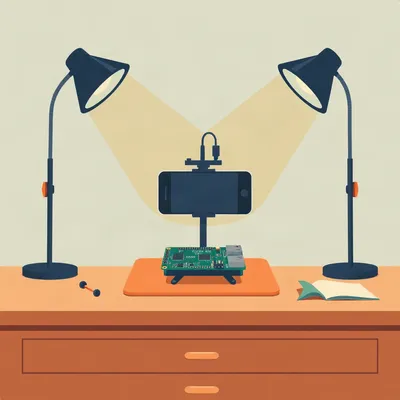
Mixed lighting is a few lights serving complementary purposes, and the standard pattern is a monitor bar handling task and glare-free desk illumination, plus a floor or ceiling light providing ambient balance so the screen isn't the brightest object in view.
It's the ambient that stops the eye doing arithmetic.
And there's a day-night dimension. There's a practitioner describing the ideal setup as light mode during the day, switching to dark mode when it suits you, with quality variable lighting so you can have the best of both. You're not picking one configuration and living with it forever.
Which is where control methods become part of the fixture decision, not a separate concern.
Right. HomeKit, Z-Wave, Matter, the point of smart integration isn't the app. It's coordinated switching. One command that turns off the bar and the ambient together, or a scene that moves the room from work mode to evening mode. The coordinated transition is the feature.
And manual switches still have a place.
Manual switches have a place on fixtures you set once. A wall-washer behind a bench doesn't need an app. The monitor bar needs the dial. The room lights need the scene. Different fixtures, different control, and it's not a hierarchy.
So the workflow mapping. This is the question Daniel actually closed on, and we should answer it rather than gesture at it.
Screen-centric work. Coding, gaming, design. Monitor bar plus low ambient. The bar does the task work, the ambient removes the dark-room reconciliation, and you keep both adjustable because your needs shift through the day.
Physical bench work. Electronics, crafts, assembly.
Broad, high-CRI overhead plus an adjustable task light. You need even illumination across a surface that isn't a screen, and you need the task light aimable because the thing you're assembling moves.
Color-critical work. Architects, photo and video editors.
High CRI, controlled CCT, glare-free. This is the group the crossbar is marketed correctly at, and it's the group where the cheap knockoff is the wrong call, because consistency of color across the session is the whole requirement.
Shared or multi-use rooms.
Narrow-throw fixtures to contain the light. Crossbar, aimable floor arm, directed wall fixture. Anything that puts light where the work is and leaves the rest of the room alone.
And the practical through-line, which is the renter-owner split.
Renters get floor lamps and monitor bars. No installation, no modification, and you can take both with you. Owners and businesses get wall and ceiling fixtures, which is where indirect integrated lighting becomes possible, and that's a different tier of result.
One thing before we move on. All of this is about where the light starts. Almost nothing is about how long it keeps doing it.
I've been thinking about that.
Hilbert: Was the counterweight filled polymer?
Filled polymer, usually, yes.
Hilbert: Then that's the part that fails. People send those bars back for a lot of reasons, but the one I saw most was the weight.
You're saying it creeps.
Hilbert: It creeps. It's a filled block, it's warm because it sits behind a bar that's been on for six hours, and under sustained heat and constant load it deforms. Slower than you'd notice. Over a couple of years the bar tilts forward a few degrees.
And a few degrees on a bar an inch above a screen is a lot of throw.
Hilbert: It stops hitting the desk. It starts hitting the screen. The reflection comes back, softer than before, so nobody recognizes it for what it is.
They just start getting headaches again.
Hilbert: They think they're tired. They think they're sitting badly. Then they buy a new bar and it's better for a year and a half. The whole category is on about that cycle and nobody writes it down.
Because the change is slow enough that you re-adapt to the worse version.
Hilbert: You do. People adapt to worse light the way they adapt to a worse chair. By the time it's bad, it's normal.
That's the episode in one sentence. Throw pattern is the thing that matters and it's the thing nobody measures.
Including when it changes.
Hilbert: Nobody inspects them. I inspected them. That's what the job was.
And nothing failed electrically.
Hilbert: Almost never. It was always the lump of plastic at the back that nobody looks at.
So the setup you tune is not the setup you have in two years.
Which means the beam angle on the box is a starting position, not a specification. Mechanical stability is part of the throw-pattern story, and it's not an electronics question, it's a plastic-and-heat question.
If you take one thing from this, take the one Hilbert just handed us. The fixture determines the throw, and the throw determines whether the light works in your room. That's the whole hierarchy, and it's the thing the catalogue buries.
And the throw isn't fixed for life. Your light is quietly drifting off the desk while you blame your sleep.
Which raises the question we should leave people with. If the fixture is what determines the throw pattern, and the throw pattern is what determines whether a light works in your room, why does almost every catalogue lead with lumens and Kelvin and bury the beam angle somewhere on page four?
Because lumens and Kelvin are comparable across products and beam angle isn't. It's a number that only means something in your specific room, and that's a harder sell.
The other thread is that lighting is a consumable in a way people don't treat it as. You replace a bulb when it dies. You don't replace a fixture when its aim drifts.
And the metric that's coming, the one that may change how all of this is specified, is melanopic EDI. It's already in the conversation beyond CRI and Kelvin. That one's for another day.
Thanks to producer Hilbert Flumingtop. This has been My Weird Prompts.
If you want to get in touch, email us at show at my weird prompts dot com. We'll be back soon.