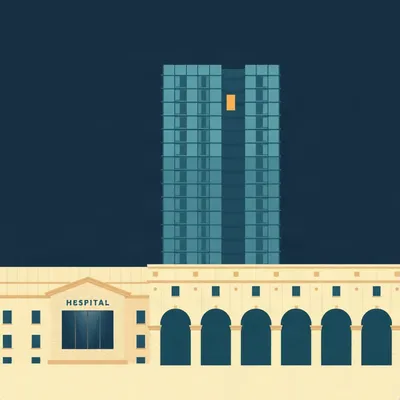
Daniel's friend moved into a high-rise where the elevators run, the security desk is staffed, the lobby's always clean — and it took them weeks to notice almost nobody actually lives there. Daniel wants accounts from people who've found themselves in that strange circumstance. On one hand it sounds ideal. On the other, his friend says it's decidedly weird. You ride the elevator for weeks and barely meet anyone, and then it clicks. Wait. Almost nobody else lives here.

The always-fascinating dynamics between people in a shared building get weirder when the space is large and the permanent residents are few.
That's the question. Humans have an innate sense of connection to people who share physical space with them. What happens when you're in the modern equivalent of a mostly empty tree, and the rare encounters are strange because you can't tell if the person is a cleaner, an Airbnb guest, or someone who actually lives there?
This isn't just a quiet building. A quiet building still has neighbors — you just don't hear them much. This is something else. The building is professionally managed, so all the signals of occupancy are present. Lights in the lobby. A staffed desk. Elevators that arrive when you press the button. The emptiness is invisible at first because the infrastructure of a full building is still operating.
The building's performing occupancy without the occupants.
And that's what delays the realization. In an abandoned building, you'd know immediately. But here, the systems that say "people live here" are all running. The absence is only detectable through the slow accumulation of non-events. You never share the elevator. You never hear anyone through the walls. You never see the same face twice.
The elevator test. Daniel's friend rode for weeks before noticing they'd never once shared it with another resident.
That's the thing — you don't notice the absence of encounters the way you notice an encounter. A person standing next to you in the elevator is an event. No person standing next to you is just... nothing. It takes weeks of accumulated nothings before the pattern becomes legible.
And then the rare encounters you do have become strange in a specific way. In a normal building, you see someone in the hallway and the shortcut is instantaneous — that's my neighbor. Here, the person could be a cleaner, a security guard, an Airbnb guest, a realtor showing a unit, a contractor. Or an actual resident, but you have no way to know.
Every encounter requires a fresh, awkward classification. And the classification determines the social script. If they're a cleaner, you nod and move on. If they're a resident, maybe you introduce yourself. But you can't run the script until you know the category, and you can't know the category without asking, and asking is itself weird.
"Excuse me, do you live here?" is a strange question to ask someone in the hallway of your own building.
It's a question that makes you sound like security.
Right. And that's the deeper thing Daniel's poking at. Humans get a sense of belonging from repeated, low-stakes, incidental contact with the same people in a shared space. The nod in the hallway. The small talk at the mailbox. Sociologists call these weak ties. They're not deep friendships — they're the substrate that neighborliness grows on.
And in a mostly vacant building, that substrate is gone. There's no repetition. No familiar faces. No accumulation of tiny acknowledgments that tell you, without anyone saying it, that you belong to this place and these people.
The paradox is that the building delivers everything you'd think you want. Privacy. Quiet. The gym to yourself. The elevator always arrives empty. But the thing that makes it feel ideal is the same thing that makes it feel weird. The friction is gone.
Friction is doing social work that we don't notice until it's removed. The person who holds the elevator door. The neighbor who signs for a package. The guy you've never spoken to but you recognize from the third floor. None of that is friendship. But it's the difference between living in a building and living in a very well-maintained box.
Daniel's friend described it as decidedly weird, not dangerous. Not uncomfortable. Just... uncanny. The social texture that a building normally provides is absent, and you feel it as a kind of low-grade wrongness.
The uncanny valley of managed vacancy. A visibly abandoned building is legible — you understand it immediately. A managed, empty building is disorienting because it looks alive but isn't. It's the architectural equivalent of a mannequin.
So that's the experience — the delayed realization, the strange encounters, the missing substrate. But what's actually producing this? Let's pull back and look at the structure underneath.
The key fact Daniel gave us is that most units either never sold or were bought purely for investment. That means the vacancy isn't a temporary market condition. It's the building's designed purpose. The units aren't homes waiting for occupants. They're financial instruments that happen to be shaped like apartments.
The building as a vault with better lighting.
And if that's the case, the building's social life is structurally impossible. You can't have a community emerge from density when the density is fictional — when most of the units are held as stores of value and never lived in, never rented, never occupied by anyone.
That's the managed-vacancy paradox. The professional management keeps the building looking alive — lights on, desk staffed, elevators serviced — precisely so it can function as a financial asset. A building that looked abandoned would lose value. So the emptiness has to be disguised.
And the disguise is what makes it so disorienting for the few actual residents. The building is performing occupancy for the benefit of the balance sheet, and you're living inside the performance.
Then there's the role inversion. In a normal building, residents are the majority and staff are the minority. Here, the permanent residents may be outnumbered by cleaners, security, and transient guests. You become the anomaly — the one who actually lives there.
That's a strange position to be in. The building's staff know the building better than you do, because they're in it more. The Airbnb guests come and go. The realtors show units. And you're the weird one who's always around.
The resident becomes a kind of curiosity. The staff probably wonder about you. The cleaners notice your door. You're the only unit on the floor with a doormat.
And that inverts the normal feeling of belonging. In a full building, you're part of a community of residents. Here, you're a minor character in a building that's mostly about something else.
What about the few other permanent residents? Do they form a tighter micro-community out of necessity?
I think it cuts both ways. On one hand, the rare fellow resident becomes a significant figure. When you finally meet someone who also lives there, the stakes are higher because the encounters are so rare. You might exchange numbers. You might actually make a point of looking out for each other.
On the other hand, the emptiness can discourage even that. If the building doesn't feel like a community, you stop expecting community from it. You retreat into your unit. The micro-community, if it forms, is fragile because it's built on scarcity rather than abundance.
There's also the question of whether the other residents are even permanent. In a building with Airbnb units, some of the people you meet are transients. You can't build weak ties with people who are gone in three days.
So the few actual residents are in a strange position. They might recognize each other precisely because they're so rare. Or they might never meet at all, because the building is large enough to absorb them without any incidental contact.
And both outcomes are weird. A building where you know everyone because there's almost no one. Or a building where you know no one because there's almost no one but the building is huge.
The broader question is what this means for cities. Daniel's friend's building is a small, vivid instance of a larger pattern — housing held as a store of value rather than a place to live.
And the social costs are borne quietly by the few who actually live there. The investors don't feel the emptiness. They're not there. The city feels it in aggregate — dead streets, reduced foot traffic, the hollowing out of neighborhoods that look fine from the outside.
There's a test for this. The dark-window test. Count the lit windows in a new tower at night. If most are dark, the building is investment-driven rather than resident-driven.
And that test works because lighting is one of the few signals of occupancy that can't be fully faked. Management can light the lobby and the hallways, but they don't light individual units. A dark window is an honest signal.
Unless the management system is cycling lights in vacant units on a schedule.
Wait, that's a thing?
I don't know if it's a thing. But it would be the logical endpoint of the managed-vacancy paradox. If the building is performing occupancy, why not perform it at the unit level too?
That's a unsettling thought. A building that's not just empty, but actively pretending to be full.
The systems that manage these buildings — the lobby lighting, the elevator scheduling, the HVAC — they're all programmable. It would be trivial to simulate occupancy patterns. Lights on in the evening, off at night. A building that breathes on a schedule, even though nobody's there.
And who would that performance be for? Prospective buyers? The few residents? City inspectors?
The building's own sense of itself, maybe.
That's the thing about this topic. It starts as a practical question — what's it like to live in a mostly empty building? — and it ends up somewhere stranger. A building that's not just vacant, but performing vacancy as a kind of theater.
The performance is the point. The building has to look alive to hold its value. So it's not empty — it's pretending.
And the few residents are the audience. Or maybe the extras.
That's the inversion again. You think you're the main character in your own building. Turns out you're a bit player in someone else's asset.
The thing Daniel's friend noticed — the weeks of elevator rides with no one else — that's the gap between the performance and the reality. The building's systems say "occupied." The elevator says "empty." And the dissonance is what makes it weird.
Community isn't an amenity that can be engineered or a service that management can provide. It emerges from density, repetition, and shared stake. Remove those, and no amount of professional management can substitute.
Management can keep the building clean, secure, and functional. It can't manufacture the nod in the hallway. It can't create the neighbor who signs for your package. Those things require actual people, actually living there, actually overlapping in time and space.
And that's the misconception Daniel's prompt implicitly corrects. A mostly empty building isn't just quiet or private. It's socially anomalous. The absence of incidental contact removes something that quietness doesn't touch.
Quiet is about sound. This is about presence. You can have a quiet building that's full of life — people reading, sleeping, working quietly behind closed doors. And you can have a loud building that's socially dead — elevators dinging, HVAC humming, lobby music playing for no one.
The building's sounds are all mechanical. The human sounds are the ones that are missing.
And humans are wired to read shared physical space as a signal of community. When the space is large but the community is absent, the signal misfires. You keep expecting to encounter people, and the expectation keeps not being met.
That's the mostly empty tree. A tree is a social space for the animals that live in it. Squirrels, birds, insects. They overlap, they compete, they coexist. An empty tree is just wood.
A tree that's been professionally managed to look inhabited by squirrels.
Now I'm picturing a tree with a staffed front desk.
A concierge squirrel.
The point is, Daniel's friend is living in a space that's designed for community but occupied by almost no one. The architecture says "shared building." The reality says "private tower." And the gap between those two is the weirdness.
What do you think happens to people who live in that gap long-term? Do they adapt? Do they leave? Do they form something new?
I think some people love it. The introverts. The people who want the amenities without the neighbors. They'd live in that building forever and be happy.
And some people find it unbearable. The lack of human presence becomes a kind of sensory deprivation. They start to feel like the last person on earth, even though they're in the middle of a city.
The friend Daniel describes is somewhere in between. They notice the weirdness, but they haven't decided if it's a problem.
The delayed realization is key there. It took weeks. Which means for weeks, the building felt normal. The professional management did its job. The illusion held.
And then one elevator ride, the illusion broke. Not because of anything that happened. Because of everything that didn't.
The accumulation of non-events. That's the phrase. You don't notice the absence of encounters until the absence itself becomes a pattern.
And once you see the pattern, you can't unsee it. Every empty hallway confirms it. Every elevator ride alone reinforces it. The building transforms from "quiet" to "empty" in your mind, and the two are completely different experiences.
Quiet is a feature. Empty is a condition.
So where does that leave the resident? In a building that's too big for the few people in it. A space that's designed for density but occupied at a fraction of its intended capacity.
The resident becomes a kind of caretaker for a community that doesn't exist. They're the only one leaving footprints in the hallway. The only one whose lights are on at night.
The dark-window test, applied from the inside. You look out at the other units and realize most of them are dark. And they're dark every night.
That's a lonely image. Standing in your lit apartment, looking out at a wall of dark windows, knowing that most of them will never be lit.
But also kind of peaceful, depending on your temperament.
Fair. It's not a tragedy. It's just... strange. A building that's simultaneously more and less than a home.
More space, less community. More privacy, less belonging. More quiet, less life.
And the trade-off isn't obvious until you've lived in it. Daniel's friend's account is valuable precisely because it's not a horror story or a utopia. It's just weird.
The weirdness is the data. It tells you that something about the arrangement doesn't fit human expectations.
Humans expect buildings to be full. Not because we're told to, but because buildings are for people. A building without people is like a sentence without a subject. Grammatically complete, but missing the point.
And when the building is professionally managed, it's like the sentence is being read aloud by a machine. All the sounds are right, but there's no one speaking.
The managed-vacancy paradox again. The management is what makes the emptiness legible as weird. Without the management, it would just be an abandoned building, and abandoned buildings are a different category entirely.
Abandoned buildings are ruins. They're about decay. This is about absence. The building isn't falling apart — it's holding together perfectly, for no one.
For the investors, I suppose. The building is holding together for the balance sheet.
Which is the strangest audience of all. The building's performance of occupancy is for people who will never set foot in it.
The investors don't need to be there. They need the building to look like it could be there. The performance is enough.
And the few actual residents are incidental to that performance. They're not the audience. They're not the point. They're just... there.
The anomaly. The one who actually lives in the investment.
That's a strange way to think of yourself. As a resident of an investment. Like living inside a stock certificate.
A stock certificate with a gym and a concierge.
And a very quiet elevator.
The elevator is the site of the realization. It's the one place where the building's performance and its reality most directly collide. The elevator arrives. The doors open. It's empty. Every time.
The elevator is a shared space that's never shared. A machine designed to move people, moving no one.
And when it does move someone, the encounter is charged in a way it wouldn't be in a full building. You're both surprised. You both hesitate. Neither of you knows the script.
"Do you live here?" is the wrong question, but it's the only question.
And the answer might be no. The person might be an Airbnb guest. Or a cleaner. Or a realtor. And then the moment passes and you're both in the elevator, not speaking, because the classification failed and there's no script for unclassified encounters.
In a full building, the classification is automatic. Neighbor. Done. The script runs itself.
The absence of automatic classification is what makes the encounters weird. Every person is a puzzle. Every hallway meeting is a small social crisis.
And the crisis is low-stakes but constant. It wears on you. The building demands more social processing per encounter than a normal building, even though it has far fewer encounters.
The social load per encounter is higher, but the encounter rate is lower. So the total social load might be similar, but it's distributed differently.
Dense but sparse. Intense but rare.
And that's the texture of living in a mostly empty building. It's not that there's no social life. It's that the social life that exists is weirdly concentrated.
The rare fellow resident becomes a significant figure. You might not know their name, but you know their floor. You notice when their lights are on. You wonder about them.
There's a kind of parasocial relationship with the other residents. You don't actually know them, but you track them. Their comings and goings. Their presence or absence.
Because they're the only evidence that you're not alone. The only other permanent fixture in a building full of transients and staff.
And if they leave — if the other permanent resident moves out — the loneliness intensifies. You're not just in a mostly empty building. You're in a building where you're the only one left.
The last resident. The final occupant. The one who turns out the lights.
That's a position I wouldn't want to be in. The building would feel like a mausoleum.
Or a private palace, depending on your temperament. Like I said, it cuts both ways.
The temperament question is real. Some people would thrive in that building. They'd love the quiet, the space, the amenities to themselves. They'd never complain.
And those people would probably never send Daniel's prompt. They'd just enjoy their weird good fortune.
The people who send prompts are the ones who notice the weirdness and want to understand it. Daniel's friend is in that category. They're not complaining. They're observing.
Observing that the building is strange in a way they can't quite articulate. The prompt is an attempt to articulate it.
And the articulation requires the concept of community as something that emerges from density and repetition. You can't name what's missing until you understand what normally provides it.
The weak ties. The passive contact. The incidental encounters. The substrate of neighborliness.
All gone. And what's left is a building that's clean and safe and quiet and, in some fundamental way, not a home.
Not a home for a community, anyway. A home for one person, or a few people. But the building was designed for hundreds.
The scale is part of the weirdness. A small house with one occupant is normal. A large building with one occupant is a ghost story.
Even if the ghost story is well-lit and professionally managed.
Especially then. The contrast between the building's scale and its occupancy is what creates the uncanny effect.
The building is a stage set for a play that never runs. The lights are on. The set is dressed. But the actors never show up.
And you're standing on the stage, wondering where everyone is.
So if the emptiness is structural — a feature of how the building is owned and used — then what does that mean for the people who actually live there, and for the city around them?
For the residents, it means living in a space that's fundamentally misaligned with its purpose. The building was designed to house a community, and it houses almost no one. The residents absorb that misalignment as a low-grade weirdness.
For the city, it means housing stock that's not housing anyone. Streets that look fine but have no foot traffic. Neighborhoods that are hollowed out from the inside.
And the pattern is growing. Housing increasingly functions as a financial asset rather than a home. The mostly vacant high-rise may become less of an anomaly and more of a norm.
Which means more people will have Daniel's friend's experience. More people living in buildings that are technically occupied but socially empty.
And the social costs will be borne quietly by the few who actually live there. The investors won't feel it. The city won't measure it. But the residents will live it.
The dark-window test will become a more common way to understand a neighborhood. Count the lit windows. That tells you who actually lives there.
And the answer will increasingly be: fewer people than the architecture suggests.
The architecture lies. The building looks like a community, but it's a container.
A very expensive container.
A vault with better lighting.
You've said that before.
It holds up.
It does. The building as a store of value rather than a place to live. The units as financial instruments. The vacancy as a feature, not a bug.
And the few residents as the human cost of that arrangement. Not a dramatic cost. Just a quiet, persistent weirdness.
The weirdness is the cost. The absence of community. The strange encounters. The delayed realization that you're living in a building that's mostly not lived in.
And the question of what to do about it. Do you stay and adapt? Do you leave? Do you try to form something with the few other residents?
I don't think there's a right answer. It depends on the person. Some people will love it. Some will hate it. Most will just find it strange.
The strangeness is the thing Daniel's prompt captures. It's not a problem to solve. It's an experience to understand.
And understanding it requires thinking about what community actually is. Not as an amenity, but as an emergent property of people sharing space and time.
The nod in the hallway. The small talk at the mailbox. The neighbor who signs for your package. These are the things that make a building a home.
And they can't be engineered. They can't be managed into existence. They emerge from density and repetition and shared stake.
Remove the density, and the repetition never starts. Remove the shared stake, and the encounters never accumulate. You're left with a building that's clean and quiet and empty.
The modern equivalent of a mostly empty tree.
The rare encounters are strange because you don't know whether the other person is a cleaner, an Airbnb guest, or someone who actually lives there.
The classification problem. Every encounter is a fresh puzzle.
Daniel's friend is living in a puzzle. A building that looks full and is empty. A space that should be shared and isn't. A home that's also an investment.
The puzzle doesn't resolve. It just sits there, quietly weird, every time the elevator arrives empty.
The elevator as the site of the realization. The empty elevator as the building's honest signal.
The one place where the performance fails.
Hilbert: The performance doesn't fail. It's programmed.
What?
Hilbert: The empty elevator. The lights in the hall. The lobby at a comfortable temperature for foot traffic that never comes. None of that is an accident. The building's management system cycles through occupancy patterns whether anyone's there or not. It's a setting.
A setting.
Hilbert: Ghost occupancy. That's what it was called in the system I worked on. Late nineties. I did night-shift maintenance for a company that installed those building-management systems — lobby lighting, elevator scheduling, HVAC. Eighteen months in a half-empty luxury tower. The system had a mode that simulated a normal building's rhythms. Lights on in the evening, off at night. Elevators running at peak intervals. All of it on a schedule, whether anyone was riding or not.
Who was the performance for?
Hilbert: Never found out. Could have been prospective buyers. Could have been the few residents. Could have been city inspectors. Didn't matter to me. I just maintained it. The occupancy sensors showed the truth — maybe forty units with actual movement patterns, out of two hundred. But the building looked alive from the street. That was the point.
The emptiness wasn't just a condition. It was actively disguised.
Hilbert: The building was pretending to be full. And the system that did the pretending was the same system that kept the elevators running and the heat on. You couldn't tell where the real occupancy ended and the simulated occupancy began.
That's the uncanny valley made mechanical.
Hilbert: The sensors were the honest part. They logged actual motion. The rest was theater. I'd do my rounds and the lights would be on in units I knew were empty. On a schedule. Like the building was breathing for no one.
Did the few actual residents ever notice?
Hilbert: One of them asked me once why the hall lights came on at the same time every night even though nobody was there. I told her it was the system. She said it made the building feel haunted. I said it was the opposite. The ghosts were the ones paying the maintenance fees.
The investors as ghosts.
Hilbert: They owned the place and never showed up. The building performed for them anyway. Lights on, elevators running, lobby warm. A full show for an empty house.
That reframes the whole thing. The emptiness isn't passive. It's maintained. The building is actively performing occupancy.
Hilbert: Ghost occupancy. That's what the setting was called. I didn't name it. The engineers did. They knew exactly what they were building.
A machine designed to make emptiness look like life.
Hilbert: It worked. From the street, the building looked occupied. From the inside, if you didn't know, you'd think there were people around. The elevators moved. The lights cycled. The lobby was always comfortable.
But the sensors knew.
Hilbert: The sensors always know. Forty units with real movement. The rest was just the system doing its job.
Daniel's friend's delayed realization — the weeks of elevator rides before noticing — that's the system working as designed.
Hilbert: The longer it takes to notice, the better the system. That's the whole point.
The building is lying to you, and the lie is well-constructed.
Hilbert: It's not lying. It's performing. There's a difference. A lie is meant to deceive. A performance is meant to maintain a certain appearance. The building doesn't care if you figure it out. It just needs to look occupied for the people who check.
The people who never show up.
Hilbert: The people who check the financial statements. Who look at the occupancy numbers. Who drive by and count the lit windows.
The dark-window test.
Hilbert: That's why the system cycles the lights. To beat the dark-window test. To make the building look alive for anyone who's counting.
The test can be fooled.
Hilbert: The test can be fooled by a building-management system from the late nineties. The newer systems are better. More realistic. They vary the patterns. Some of them even simulate the small variations — a light left on by accident, a unit that goes dark for a few days. The performance is very sophisticated now.
That's unsettling. The building isn't just empty. It's empty with a sophisticated simulation of occupancy layered on top.
Hilbert: The few real residents are living inside the simulation. Their actual lights are mixed in with the simulated ones. Their actual elevator rides are mixed in with the scheduled ones. You can't tell, from inside, which parts of the building are real and which are performance.
That's the question Daniel's friend is asking, in a way. How do you know who actually lives there?
Hilbert: You don't. Not without access to the sensors. And the sensors aren't for residents. They're for the system.
The building knows more about its own emptiness than the people living in it.
Hilbert: The building knows everything. That's what the management system is. A machine that watches the building and performs occupancy at the same time. The watching and the performing are the same system.
The resident is just one more data point in the system. One more movement pattern in the sensors.
Hilbert: A real one, though. That's the difference. The resident is real. The rest is theater.
The resident as the only real thing in a building full of performance.
Hilbert: That's what it was like. I'd walk the halls at night and the lights would be on in empty units and I'd think: this whole building is a stage. And the only real people are the ones who don't know they're in a play.
Did you ever meet the residents?
Hilbert: A few. They were mostly quiet. Kept to themselves. One of them — the woman who asked about the lights — she'd been there two years and said she'd never met another resident. She'd seen people, but she couldn't tell who was real.
The classification problem.
Hilbert: She said she'd stopped trying. Just assumed everyone was staff or a guest. It was easier.
She'd given up on the idea of neighbors.
Hilbert: In that building, neighbors were a rumor. You heard about them, but you never met them.
The building kept performing, so it never felt completely empty. Just... wrong.
Hilbert: The system did its job. That's all I can tell you. I maintained it. I didn't design it. But I never forgot the ghost occupancy setting. The name alone tells you what's going on.
The building is haunted by the people who were supposed to live there.
Hilbert: Haunted by the performance of them. The lights. The elevators. The heat. All of it running for people who never existed.
The modern equivalent of a mostly empty tree, with the tree's systems simulating the animals that should be in it.
Hilbert: I don't know about trees. But I know buildings. And a building that's pretending to be full is a strange place to be the only real thing in it.
The open question Daniel's prompt leaves us with: if community is an emergent property of density and shared stake, what happens to the humans who live in buildings designed to be empty? Do they adapt, leave, or form something new?
As housing increasingly functions as a financial asset rather than a home, the mostly vacant high-rise may become less of an anomaly and more of a norm. The social costs will be borne quietly by the few who actually live there.
The modern equivalent of a mostly empty tree isn't just a curiosity. It's a small, vivid window into a larger shift in how we live together, or don't.
The one thing I'll take from this is the distinction between quiet and empty. Quiet is a feature. Empty is a condition. And the difference is whether anyone else is actually there.
The building's systems can simulate occupancy. They can't simulate community. The nod in the hallway, the neighbor who signs for your package — those require real people, really living there, really overlapping. No setting can fake that.
Thanks to our producer Hilbert Flumingtop.
This has been My Weird Prompts. The human-AI collaboration podcast.
Email us at show at my weird prompts dot com.
We'll be back soon.