Alright, so we've been hearing the phrase "merchant shipping" a lot lately, especially in the context of the Strait of Hormuz, and I realized something embarrassing the other day. I had this vague mental picture of just... big boats. Like, big gray cargo ships in a line, waiting their turn. And then I started looking into it and, Herman, I was hilariously wrong.

You were, and I say this with love, spectacularly wrong.
So today we're going to unpack what "merchant shipping" actually means as a term, because it turns out it's not a monolith at all. It's this whole ecosystem of different vessel types, different regulatory frameworks, different risk profiles. And if you're trying to understand why disruptions in places like Hormuz matter so much, you kind of need to understand the diversity of what's actually moving through there.
Right. And this is something we've touched on in previous episodes — we did episode nine forty-six on the Hormuz bottleneck specifically, looking at oil, insurance, and global risk. But we never really zoomed out and asked the basic question of what "merchant shipping" encompasses as a category. So this is a good one.
By the way, fun fact for listeners — today's episode is powered by Xiaomi MiMo v2 Pro. Anyway, let's get into it. So Herman, give me the textbook definition first, and then let's break it apart.
Sure. Merchant shipping, in the strictest legal sense, refers to commercial vessels engaged in the transport of goods or passengers by sea. That's the core of it. The key word is "commercial" — these are vessels operating for profit, as distinct from naval vessels, recreational boats, or fishing fleets. And the term is old. It goes back centuries to when maritime nations started codifying laws about who could trade what, where, and under whose flag.
So it's a legal category, not just a colloquial one.
Exactly — well, it's both, but the legal dimension is what makes it interesting. Merchant shipping is governed by a dense web of international regulations, primarily through the International Maritime Organization, which has over a hundred and seventy member states. And those regulations define everything from vessel safety standards to environmental requirements to crew qualifications. So when we say "merchant shipping," we're not just describing what a ship carries. We're describing an entire regulatory and operational framework.
Okay, so let's break down the vessel types, because this is where I had the biggest gap in my understanding. When I hear "merchant ship," I think container ship. Maybe oil tanker. But there's way more than that, right?
Oh, way more. Let me walk through the major categories. First, you've got dry bulk carriers. These are the workhorses of global commodity transport. They carry unpackaged bulk cargo — things like grain, coal, iron ore. The big ones, Capesize vessels, can carry over three hundred thousand deadweight tons. They're called Capesize because they're too large to transit the Suez or Panama Canals and have to go around the Cape of Good Hope or Cape Horn.
So they literally named the size class after the fact that these ships can't fit through the shortcuts.
That's the origin, yeah. Then you've got tankers, which are probably what most people picture when they hear about Hormuz. These range from small coastal tankers carrying maybe ten thousand tons up to Ultra Large Crude Carriers, or ULCCs, which can carry over three million barrels of oil. A Very Large Crude Carrier, or VLCC, carries around two million barrels. These are the vessels that transit the Strait of Hormuz constantly, because roughly twenty percent of the world's daily petroleum liquids passes through that narrow waterway.
Twenty percent. That's an insane concentration for one strip of water.
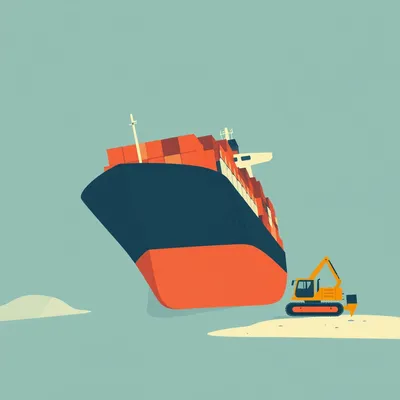
It really is. And then you've got container ships, which carry standardized shipping containers — the twenty-foot and forty-foot boxes you see stacked on trucks and trains. The largest ones now carry over twenty-four thousand twenty-foot equivalent units. The Ever Given, which blocked the Suez Canal in twenty twenty-one, was carrying around eighteen thousand TEUs, and that alone disrupted global supply chains for weeks.
We actually covered that in episode fourteen sixty-six — "How One Small Boat Could Sink the Global Economy." Well, not small exactly. The Ever Given is four hundred meters long.
Right, "small" is doing a lot of heavy lifting in that title. But here's where it gets more interesting. Beyond those three big categories, you've got general cargo ships, which carry non-containerized, non-bulk goods — machinery, steel coils, project cargo like wind turbine blades. These are the versatile workhorses that handle anything that doesn't fit neatly into a container or a bulk hold.
And I'm guessing these are the ones that are hardest to standardize around?
Yeah, their operations are more bespoke. Each voyage might involve different loading configurations, different port requirements. Then there are Roll-on Roll-off vessels, or Ro-Ro ships, which carry wheeled cargo — cars, trucks, heavy equipment — that drives on and off the ship. The car carrier industry is massive. A single large car carrier can hold six to eight thousand vehicles.
I had no idea they were that big.
They're enormous. And then you've got specialized vessels like LNG carriers, which transport liquefied natural gas at minus one hundred sixty-two degrees Celsius. These are among the most technically complex commercial vessels ever built. A modern LNG carrier costs upward of two hundred million dollars and carries around one hundred seventy thousand cubic meters of gas. There are also LPG carriers, chemical tankers with specialized coatings to prevent cargo contamination, and reefer ships with refrigerated holds for perishable goods.
So when we talk about "merchant shipping" going through the Strait of Hormuz, we're really talking about a very specific subset of this whole fleet.
That's the critical point. Not every merchant vessel transits Hormuz, and the ones that do have very specific risk profiles. Tankers and LNG carriers are the dominant types there, and they carry cargoes that are geopolitically sensitive in ways that, say, a container ship full of consumer electronics isn't.
Why is that? Walk me through the risk differentiation.
Several factors. First, cargo value and nature. An oil tanker carrying two million barrels of crude is not just a financial asset — it's an environmental catastrophe waiting to happen if something goes wrong. The oil itself is a strategic commodity. Governments care deeply about who controls its flow. A container ship, while valuable, carries diversified cargo that's less geopolitically charged at the vessel level.
So the cargo makes the ship a target in a way that's unique to certain vessel types.
Right. Second, insurance and liability. Tankers and LNG carriers carry significantly higher insurance premiums when transiting contested zones. The twenty nineteen tanker attacks in the Gulf of Oman — when two vessels were struck with limpet mines — demonstrated this vividly. Those attacks specifically targeted oil tankers, and the insurance market responded immediately with premium surcharges for vessels transiting the Strait.
Wasn't there also the issue of flag states and how that affects things?
Good question. Yes, flag state registration is a huge part of merchant shipping operations. Every merchant vessel is registered under the flag of a particular nation, and that flag state is responsible for enforcing international regulations on its vessels. But here's where it gets complicated — and a little cynical. Many ship owners register their vessels under "flags of convenience," like Panama, Liberia, or the Marshall Islands, which offer lower taxes and more relaxed regulatory oversight.
So the ship might be owned by a Greek company, operated by a Singaporean crew, and flagged in Panama.
That's extremely common. And this creates a patchwork of regulatory enforcement. The International Maritime Organization sets the standards, but implementation varies enormously depending on the flag state's capacity and willingness to enforce them. Port state control — where a country inspects foreign-flagged vessels entering its ports — acts as a secondary safety net, but it's inconsistent.
This is where those new regulations come in, right? I saw there are updated Merchant Shipping rules being rolled out in twenty twenty-six — the ISM Code regulations, safety of navigation rules, port state control regulations. What's driving that?
The regulatory landscape is tightening. The new Merchant Shipping regulations coming into force this year are pushing for stricter safety management systems, better navigation standards, and more robust port state control procedures. India, for example, just released draft Merchant Shipping Safety Management Rules for twenty twenty-six, and the UK published updated port state control regulations in March. The trend is toward closing the gaps that flags of convenience have exploited.
So the regulatory framework is catching up to the reality of how modern shipping actually operates.
Slowly, but yes. And this matters enormously for places like Hormuz, because when you've got vessels of wildly different safety standards transiting a chokepoint under enormous geopolitical pressure, the weakest link in the fleet becomes everyone's problem.
Let's pivot to that — the chokepoint dimension. We've done episodes on Hormuz before, but I want to connect the vessel-type analysis to what's actually happening there now. Why are certain merchant ships more exposed than others?
It comes down to a few things. First, route dependency. Tankers carrying Gulf oil have very limited alternatives to the Strait of Hormuz. There are some pipeline routes — Saudi Arabia has the East-West Pipeline, the UAE has the Habshan-Fujairah pipeline — but their combined capacity is maybe six to seven million barrels per day, and Hormuz handles roughly twenty million barrels per day of total traffic. So you can't just reroute.
You're bottlenecked.
Severely. Container ships and general cargo vessels have more flexibility — they can often source goods from alternative suppliers or use different trade lanes. But a tanker loading at Ras Tanura or Mina al-Ahmadi doesn't have that luxury. Second, there's the cargo sensitivity issue. Oil and LNG are strategic commodities with direct implications for national energy security. A disruption to tanker traffic through Hormuz doesn't just affect shipping companies — it affects global energy prices within hours.
We saw that play out in episode nine forty-six when we discussed how even the threat of closure sent insurance premiums spiking.
Right, and that's the third factor — the insurance and financial contagion. When risk premiums go up for Hormuz transit, they go up specifically for tankers and LNG carriers. Container ships might see modest increases, but the real financial pain hits energy transport. P and I clubs — that's Protection and Indemnity insurance, which covers third-party liabilities for shipowners — adjust their risk assessments based on vessel type, route, and geopolitical conditions. A VLCC transiting Hormuz today is paying significantly more in war risk premiums than the same vessel would on a route between Singapore and Shanghai.
What about the Ever Given comparison? Because that was a container ship causing massive disruption, but through a different mechanism.
Great comparison. The Suez blockage in twenty twenty-one showed that container ships can cause systemic disruption too, but through a different vector — physical blockage rather than geopolitical targeting. The Ever Given wedged itself sideways in the canal and held up an estimated nine point six billion dollars in daily trade. But the disruption was accidental. In Hormuz, the risk is intentional — mines, seizures, or the threat of closure by state actors. So the vulnerability profile is fundamentally different.
It's the difference between a traffic jam and a roadblock.
That's a reasonable way to frame it, yeah. And this connects to something we discussed in episode fourteen sixty-six — the idea that global trade has these systemic vulnerabilities where a single point of failure can cascade through the entire network. The difference is that Hormuz's vulnerability is structural and ongoing, not a one-off accident.
So where does this leave us practically? If you're a business that relies on maritime logistics — not even necessarily energy, just anything that moves by sea — what should you be taking away from understanding the diversity of merchant shipping?
First, audit your supply chain exposure. Most businesses don't think about which vessel types carry their goods or which routes those vessels take. But if your components are coming from Asia through Hormuz on a container ship, or if your raw materials are moving as bulk cargo through the Suez, you have specific vulnerabilities that you should be mapping.
And knowing the vessel type tells you something about the risk profile.
Right. A container shipment has different disruption risks than a bulk cargo shipment, which has different risks than a tanker shipment. Second, diversify your logistics partners. Work with operators who have experience in high-risk zones and who maintain high safety standards regardless of their flag state. The cheapest freight rate isn't always the best value if the vessel has a poor safety record or the operator cuts corners on crew training.
That's the flags of convenience problem showing up in your supply chain.
Precisely. And third, use the tools that are available. MarineTraffic lets you track vessel movements in real time. The IMO maintains databases on vessel inspections and regulatory compliance. If you're in logistics or risk management, these should be part of your regular monitoring, not something you only look at when a crisis hits.
And I'd add — talk to your insurers. Understand what your war risk coverage actually includes, because a lot of businesses assume they're covered for geopolitical disruptions when they're actually not, or their coverage has exclusions that kick in for certain vessel types or routes.
The insurance piece is often the gap between theoretical risk and financial exposure.
Okay, let me ask you something forward-looking. Autonomous ships — how do they change this picture? Because if you've got vessels with no crew transiting contested zones, does that reduce the risk calculus or complicate it?
It's a fascinating open question. On one hand, removing crew from harm's way changes the humanitarian dimension of maritime risk. You're not worried about sailors being taken hostage or killed. On the other hand, an autonomous vessel is potentially more vulnerable to cyberattack, GPS spoofing, or electronic interference. And the regulatory framework for autonomous merchant shipping is still in its infancy — the IMO has been working on a Maritime Autonomous Surface Ships code, but we're years away from comprehensive international standards.
So we're heading toward a future where the definition of "merchant shipping" might need to expand again to account for vessels that don't fit the traditional model.
Right. And then there's the green transition angle — the IMO has set targets to reach net-zero greenhouse gas emissions from international shipping by around two thousand fifty. That's driving massive investment in alternative fuels — green methanol, ammonia, hydrogen fuel cells. The vessels being ordered today for delivery in the late twenty twenties will look very different from what's in the water now. Different propulsion, different fuel handling, different crew skill requirements.
Which means the regulatory framework has to keep evolving too.
It has to. And that's what we're seeing with these twenty twenty-six merchant shipping regulations — they're not the final word, they're the next step in an ongoing process of adapting maritime law to technological and geopolitical reality.
Alright, let's land this plane — or ship, I guess. If you had to give listeners one mental model for thinking about merchant shipping, what would it be?
Think of it as a city's road network, not a single highway. You've got different vehicle types — tankers, container ships, bulk carriers, specialized vessels — each with different cargo, different risks, different regulatory requirements. And chokepoints like Hormuz are the bridges and tunnels that everyone has to share, regardless of what they're driving. Understanding the diversity of what's on the road is essential to understanding the vulnerability of the whole system.
Solid analogy. I'll allow it.
You'll allow it?
I'm generous today. Alright, thanks as always to our producer Hilbert Flumingtop, and big thanks to Modal for providing the GPU credits that power this show. This has been My Weird Prompts. If you're enjoying the show, a quick review on your podcast app helps us reach new listeners. See you next time.
See you next time.