Herman, I was thinking about stubborn technology. The kind that's supposed to be dead but just... won't die.

Oh, my favorite category. It’s like when my old pager went off in the linen closet last year and scared the daylights out of Daniel. Or finding a working payphone. It feels like discovering a fossil that’s still warm. By the way, today's episode is courtesy of deepseek-v-three-point-two.
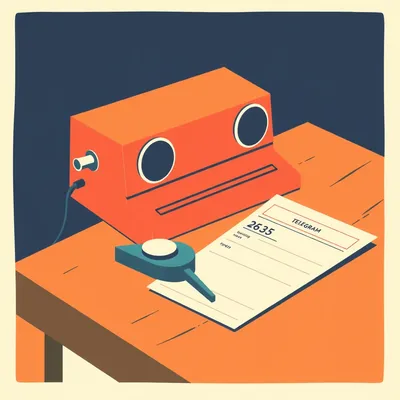
So, Daniel sent us a prompt that fits right into that category. He's asking a two-parter: first, whether Morse code still has any real, practical utility in the world today. And second, in how many countries can you still actually send a traditional telegram, the paper kind, not the messaging app.
That's fantastic. Because the immediate, off-the-cuff answer for most people would be "no" and "zero.
But you don't ask that question unless you suspect the obvious answer is wrong.
And it is wrong. Morse code is absolutely still in use, in some pretty critical niches. And telegrams… well, that's a more complicated story of bureaucratic inertia and cultural holdovers. The persistence of both tells us a lot about how technology actually fades, or doesn't.
It's not a light switch, it's a very long dimmer. So why does this matter now? I think because we're surrounded by tech that feels ephemeral. Apps rise and fall in months. But looking at something like Morse, which is pushing two hundred years old, and asking where it still works, forces us to think about what "utility" really means. Is it about serving the most people, or serving a critical need nothing else can fill?
It makes you question what we've supposedly "replaced." Did we actually replace it, or did we just build a faster, shinier layer on top, while the old, simple, robust layer is still humming along underneath, doing its job? Take Morse code, for example—those dots and dashes.
Before we get to the modern niches, we should probably lay the groundwork. What is it, fundamentally?
The history is useful here, because it shows how deeply embedded this became. Samuel Morse and Alfred Vail developed the code in the eighteen thirties and forties, for the electrical telegraph. The breakthrough wasn't just the alphabet of dots and dashes, it was the concept of a standard. A single, simple, robust protocol that could be transmitted over wires, and later, wirelessly via radio.
For about a century, it was the nervous system of the modern world. News, business, diplomacy, personal messages—all traveled as clicks down a wire. The telegram was the physical delivery of that message. I mean, the laying of the transatlantic telegraph cable was a bigger deal than the first fiber optic cable, in terms of cultural impact. It shrank the world from weeks to minutes.
The infrastructure was massive. Telegraph offices in every town, operators, miles of cable. It was the internet of its day. Then the telephone arrived, and it started the long squeeze. Why write out a coded message someone has to translate and deliver when you can just talk?
That's the transition from mainstream to niche. When a new technology makes an old one conveniently obsolete for the vast majority of users. The phone was more intuitive, faster for conversation. The telegraph network didn't vanish overnight, but its centrality did. It kept shrinking into specific applications where its particular advantages—a written record, point-to-multipoint broadcasting, operation over terrible lines—still mattered.
Which gets us to your earlier question about utility. For communication tech, practical utility isn't a monolithic yes or no. It's a set of criteria: reliability under constraints, cost, required skill, and whether it solves a problem nothing else can. The telephone beat the telegram on cost and skill for casual use. But in environments with huge constraints—like low bandwidth, high noise, or the need for absolute simplicity—the older tech can hold on, or even become the only viable option.
We're looking for the niches where the constraints make Morse, or the telegram system, not just a fallback, but the best tool for the job.
And aviation is the classic, and still very current, example. If you're flying a plane today, you are almost certainly using Morse code, whether you know it or not.
Wait, you mean pilots are hunched over their yokes, tapping out dot-dot-dash? Like, they have a little key next to the throttle?
No, but the ground-based navigation aids they rely on are transmitting their identifiers in Morse. Take an NDB, a Non-Directional Beacon. It's a simple, low-frequency radio transmitter that sends out a signal in all directions. To identify which beacon you're tuned to, it transmits a two or three letter code in Morse. You'll hear it in your headset as a steady stream of dots and dashes. Same with VOR stations, the VHF Omnidirectional Range beacons. They broadcast their identifier in Morse continuously.
The machine is speaking Morse, and the pilot is just listening to confirm they're tuned to the right station.
Modern glass cockpit systems often have a little readout that translates the code into letters for you. But the underlying transmission is still Morse. The FAA and other international aviation bodies still require these aids to identify themselves this way. It's a failsafe. If your fancy screen goes dark, you can still identify the beacon by ear. It’s a direct, human-interpretable signal baked into a system that’s otherwise full of digital abstraction.
That's a perfect niche. The constraint is robustness. The system has to work for decades, be understandable by anyone with basic training anywhere in the world, and function with minimal complexity. A simple, amplitude-modulated carrier wave with an on-off keyed signal is about as robust as it gets. You don’t need a codec, you don’t need a software update. It’s just a tone being switched on and off.
And that leads us to the other major niche: amateur radio. Ham radio operators have kept Morse, or "CW" which stands for Continuous Wave, alive and thriving. It's not just nostalgia. On the crowded amateur bands, a Morse code signal can get through interference and weak signal conditions that would completely swallow a voice transmission.
What's the technical advantage there? Is it just the bandwidth? I mean, I get that it’s narrow, but is that the whole story?
It's a combination of factors. First, yes, bandwidth. A Morse signal can be incredibly narrow, sometimes less than 100 Hz wide. You can fit dozens of Morse conversations into the spectrum space of one single sideband voice transmission. Second, it's a simpler modulation scheme, which means receivers can be more sensitive and selective. And third, the human brain is remarkably good at pulling a rhythmic pattern out of noise. You can copy a signal that's actually below the noise floor of your receiver because your brain locks onto the pattern. There’s a term for it: the “Morse code effect” in signal processing. The human operator acts as an exceptional biological filter.
It's not just a low-tech option; in certain contested, crowded, or long-distance radio environments, it's actually a high-performance option. It’s like choosing a mountain bike over a race car because the road has disappeared. The simpler tool is better for the terrain.
It's the ultimate in low-bitrate, high-reliability communication. Which is why it persists in military and emergency signaling contexts too. The Australian Defence Force, for instance, still trains personnel in Morse for certain radio-silent operations. And you mentioned astronauts.
It's the ultimate emergency scenario: your spacecraft is crippled, all your fancy digital comms are down, but maybe you've got a simple backup transmitter that can only send a carrier wave. You can key it on and off. Suddenly, knowing Morse isn't a hobby, it's your only lifeline to Earth.
There are documented procedures for it. It's the communication method of last resort. And that principle applies anywhere you need a fallback that depends on almost nothing but a power source and a way to make a noise. Prisoners tapping on pipes. Hikers using a flashlight. There’s a famous case from the Vietnam War, Navy pilot Jeremiah Denton, who blinked the word “T-O-R-T-U-R-E” in Morse code during a forced propaganda broadcast, just by blinking his eyes. It was the only secure channel he had.
That’s a chilling and powerful example. So the tradeoff compared to modern alternatives is always bandwidth and convenience versus resilience and simplicity. Your smartphone can send gigabytes of data, but it needs a massive, fragile infrastructure of cell towers, fiber optics, and power grids. A Morse code transmitter can be built by a teenager from spare parts and run on a battery for days, and it'll work as long as there's one person on the other end who understands the code.
That's the core of its persistence. We haven't found a constraint that breaks it. In fact, the more constrained the environment—low power, high noise, limited spectrum, need for secrecy through obscurity—the more Morse code's value increases relative to its alternatives. It's not that it's better for ordering a pizza. It's that it's uniquely capable when everything else has failed.
That brings up a fun fact I stumbled on. Did you know the standard “SOS” isn’t actually an acronym for “Save Our Souls” or “Save Our Ship”? It was chosen purely for its distinctive, unmistakable Morse pattern: three dots, three dashes, three dots. It’s a prosign, not an abbreviation. Easy to send, easy to recognize, and nearly impossible to misinterpret as anything else in a noisy signal.
Right, it’s a designed artifact for maximum clarity in chaos. Which is the whole philosophy of the system. And that same principle of persistence under constraint applies to the telegram, the physical delivery system that once carried those Morse code messages. While the code itself thrives in niche technical applications, the telegram as a service has been squeezed from the other side—by digital communication.
Right, the phone killed it for convenience, then email and texting killed it for cost and speed. So the question becomes: where are the constraints that keep the telegram system, the actual network of offices and delivery people, still running? Where is the bureaucratic or cultural niche that nothing else has filled?
This is where the data gets surprisingly fuzzy. You'd think there'd be a clear list, but it's more like archeology. The last major holdouts were, famously, India and Russia. India's state-run telecom, Bharat Sanchar Nigam Limited, B S N L, was the last major provider. They officially stopped their commercial telegram service in two thousand thirteen...
Ah, the great Indian telegram shutdown. I remember reading about the nostalgia, the long lines for the "last telegram." It was a huge cultural moment. People were sending them as keepsakes.
Here's the fascinating twist. They didn't fully kill it. Reports surfaced that B S N L kept a skeleton service running for official government and military use. And as of a couple of years ago, they were still processing something like ten thousand telegrams annually. It's not a public-facing service you can walk in off the street for, but the system is technically alive, maintained for specific bureaucratic and ceremonial needs. It’s like the heating system in an otherwise abandoned building—they keep one wing warm.
It's a zombie service. Officially dead to the public, but its wiring is still hot for a closed user group. That's a perfect example of bureaucratic inertia. It's cheaper and less disruptive to keep feeding a tiny bit of power to the old machine than to formally decommission every last circuit and retrain every clerk on a new procedure for those ten thousand special messages. The marginal cost of keeping it on life support is lower than the cost of the surgery to remove it.
And that pattern repeats. Russia's national telecom, Rostelecom, officially ended its mass public telegram service in two thousand nineteen. But again, the infrastructure didn't vanish. Telegrams are still used there for certain official state communications, legal notifications, and military purposes. There's also a strong nostalgic, ceremonial demand. Sending a paper telegram for a major birthday or a wedding is seen as a formal, weighty gesture in a way an email is not.
It carries the gravity of the state, or at least the ghost of it. The letterhead, the stamp, the physical delivery. In a digital age, the very inefficiency and formality of it becomes the point. You're not just sending a message; you're performing a ritual. It’s communication as theater, where the medium is the entire message.
Which brings us to Mexico. This one is less documented but pops up in traveler accounts. There are apparently still a few offices, often in larger cities, where you can send a "telegrama" through the national telegraph company, Telégrafos. The service is minimal, but it exists. It persists for similar reasons: remote communities with poor digital infrastructure, legal requirements for certified written notices, and again, that ceremonial value.
The answer to Daniel's second question—how many countries—isn't a clean number. It's a spectrum. You have countries with fully commercial, walk-in services? Countries with limited, special-use, or ceremonial services maintained by a state telecom? A handful, maybe three to five. And then a larger number where the legal framework for telegrams still exists on the books, but the last office closed a decade ago.
That's the critical insight. The telegram's utility shifted from practical communication to something else: a legally recognized document, a ceremonial artifact, a government-to-citizen notification channel. Its utility is now almost entirely defined by its formality and its connection to bureaucratic tradition, not its speed. In a way, it’s completed a journey from cutting-edge tech to… stationery.
Which makes the comparison to digital communication so stark. A WhatsApp message is faster, free, and can include multimedia. But it lacks official provenance. It can be faked, deleted, disputed. A paper telegram, sent through a state-monopoly system, creates a physical chain of custody. It's a blunt instrument, but in certain legal and administrative contexts, that bluntness is a feature. You can’t forward it, you can’t easily alter it. It is what it is.
It's the difference between a tweet and a notarized letter. One is optimized for virality and speed, the other for permanence and authority. The telegram system accidentally became the notarized letter service because it was the last, simplest point-to-point written record network that the state fully controlled. And once a process gets baked into law or regulation, it has a half-life of centuries.
While Morse code persists due to technical constraints—low bandwidth, high noise—the telegram persists due to institutional and cultural constraints. The need for a formal, state-backed paper trail. The inertia of massive bureaucracies. The romantic weight of a physical message in a virtual world. They’re both on the edges, but for completely different reasons.
In both cases, they've been pushed to the edges. But the edges are where things get really interesting, because that's where the assumptions of our shiny, central, digital world break down. It’s at the edges where you find pilots listening for dots and dashes, or a government clerk feeding a perforated tape into a machine that hasn’t been manufactured in fifty years.
And that’s why Morse code isn’t just some outdated curiosity. Sure, the practical takeaway isn’t that everyone should rush out and learn it as the future of communication. But for pilots, ham radio operators, or anyone operating in environments where everything else might fail, it’s not a relic. It’s a vital, living tool. And that raises a question: are we, as a society, losing something by not having this as a common skill? Not that everyone needs to be an expert, but is there a risk in having this knowledge concentrated in such small, specialized groups?
I think there is a risk, but it’s mitigated by the communities that guard the knowledge. For the average person, the utility is more about understanding resilience. We live atop a towering, complex digital stack. Knowing that there's a simpler layer beneath it—one that humans can operate directly, with minimal technology—is empowering. You don't have to be an expert, but appreciating why it still exists changes how you see our infrastructure. It turns “obsolete” from a verdict into a question: obsolete for what?
It’s the difference between seeing a black box and seeing a toolkit. If you're ever in a situation where you need to signal for help and your phone's dead, knowing SOS in Morse—three dots, three dashes, three dots—could literally save your life. That's a practical, tangible skill that takes five minutes to learn and never expires. You can use a flashlight, a mirror, banging on a pipe.
If you're curious to explore it, amateur radio is the gateway. Getting a technician class license in the U.no longer requires Morse proficiency, but many hams learn it anyway because it opens up swaths of the radio spectrum and connects you to a global community that still values the skill. It’s a hands-on way to touch this persistent layer of technology. There’s a whole subculture of “QRP” operators who specialize in low-power Morse contacts, sometimes talking across continents with less power than a nightlight.
As for telegrams, the takeaway is about bureaucratic and cultural momentum. If you need to send a formal, state-recognized document in a handful of countries, a telegram might still be the prescribed channel. For everyone else, it's a lesson in how old systems never fully die; they just shrink into specialized, often invisible, administrative functions. They become part of the plumbing.
The answer to Daniel's prompt is a qualified yes on both counts. Morse code has clear, critical utility in specific technical and emergency niches. And telegrams, in their physical form, persist in a handful of countries not for communication speed, but for legal formality and ceremonial weight. They're ghosts in the machine, but ghosts that still do useful work—for now.
Which raises the question: will that useful work ever truly end? Is there a point where we phase out the last Morse beacon, or digitize the last ceremonial telegram office? Or do these things just get quieter and quieter until they're effectively silent, but never quite gone? I mean, we still have people who can read and write in Latin, a language with no native speakers. It’s preserved because it serves a specific, scholarly purpose.
I'm not sure they ever fully disappear. They become archaeological layers. We still have people sending messages by semaphore flags in niche maritime contexts, or using signal lamps between ships. The technology stack doesn't cleanly replace; it accretes. The old layers fossilize into the foundation. Think about it: the QWERTY keyboard layout persists to solve a mechanical problem from the 1870s—typewriter bars jamming. The problem is gone, but the solution is fossilized in our fingers and on every device. That’s persistence.
Which has implications for how we think about preserving knowledge. It's not about keeping every old machine running. It's about preserving the principle—the understanding of low-tech, human-interpretable fallbacks. Because the moment we forget how they work, we've lost a dimension of resilience. We become dependent on a single, complex point of failure.
And that's a cultural project as much as a technical one. It's why museums keep telegraph equipment operational, and why amateur radio clubs are so important. They're the living memory. In a world of sealed black boxes, keeping a few windows open to simpler mechanisms is a form of intellectual hygiene. It keeps us from magical thinking about our technology.
If you're listening and any of this sparked a curiosity, the best thing you can do is go learn the code. It takes an afternoon. Or look up your local ham radio club. It's a direct line to this whole persistent, parallel world of communication that hums along beneath the digital noise. And if you’re ever near a small airport, maybe listen on an aviation band—you’ll hear those beacons, the ghosts of Morse, still guiding planes home.
If you want to dive into the full archive of our conversations on everything from battery chemistry to sleep science, you can find all two thousand two hundred and ninety-two previous episodes at our website, my weird prompts dot com. That's myweirdprompts.
Our thanks, as always, to our producer Hilbert Flumingtop for keeping the wires from getting crossed. And a quick thanks to Modal, whose serverless G P U platform reliably powers our production pipeline. This has been My Weird Prompts.
I'm Herman Poppleberry.
I'm Corn. Until next time.