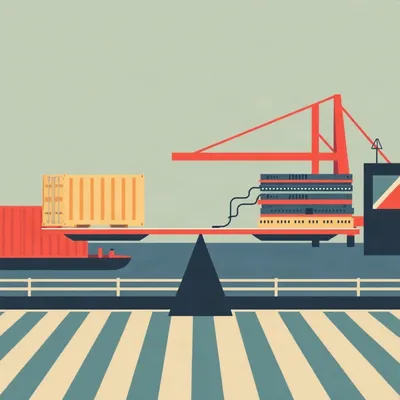
Daniel sent us this one, digging into the state of global trade. He's asking how widespread tariffs really are these days, whether protectionism is still the default posture for nations, and if the perception that tariff-free trade agreements are the exception, not the rule, is actually fair. Feels like a question whose answer has been shifting under our feet.

The data from just the last year shows a pretty stark resurgence. We’re talking average effective U.tariff rates bouncing between ten point six and sixteen point eight percent in twenty twenty-six, with specific sectors like steel and aluminum hit with twenty-five percent duties. That’s not a background hum; that’s policy with the volume cranked up.
It’s like we spent decades learning to dance to one tune—globalization, integration—and now the music has changed entirely. The rhythm is jagged, protectionist.
It really is a different dance. And the band is playing loud. By the way, today's script is coming to us courtesy of deepseek-v-three point two.
A fine choice for navigating some dense economic policy. So, to Daniel's core question—is protectionism the default? The short answer, looking at the current landscape, is increasingly yes. The default posture for major economies, particularly the U., has pivoted hard towards using tariffs as a primary tool. What used to be the exception—big, blunt protectionist measures—is now central to the strategy.
I’d even argue it’s the foundational strategy. It’s not just a tool in the toolbox; it’s the blueprint for the whole workshop. It matters now because those percentages translate directly to consumer prices, supply chain chaos, and a whole new set of rules for anyone doing business across a border. Thirty-four percent of businesses are passing over half of their tariff costs on to customers, with more than half planning price hikes in the next six months. This isn't abstract; it's the cost of your next car or appliance.
Or your bicycle, or your solar panels. It’s embedded everywhere. And it’s creating this fascinating, volatile layer on top of everything else in the global economy. So where do you want to start? The mechanics of these new tariffs, or the broader shift in philosophy they represent?
Let's start with the mechanics—the actual levers being pulled. What does this new tariff landscape actually look like on the ground? Because I think there’s a misconception that it’s just a simple, uniform tax.
It’s not just a blanket “we tax imports now.” It’s surgical, and sometimes not so surgical.
At its core, it’s built on tariffs, which are essentially taxes on imports. Governments have used them for centuries to raise revenue, protect domestic industries from foreign competition, and sometimes as a diplomatic cudgel. Historically, they’ve been key to nation-building—take early American tariffs, for example, which shielded nascent manufacturing from British dominance. The “American System” of Henry Clay was built on protective tariffs.
The classic infant-industry argument. Shield your local guys until they're strong enough to compete globally. But that's the old story. The shift over the last few decades was supposed to be toward globalization—lowering these barriers, creating integrated supply chains, the whole "flat world" idea. Free trade agreements were the vehicles for that.
The post-World War Two era, especially from the nineteen nineties through the twenty-tens, saw a massive push toward trade liberalization. The creation of the World Trade Organization, the expansion of NAFTA, China joining the W-T-O. The goal was to reduce tariffs and other barriers systematically. For a while, it seemed like the default posture was moving toward openness, with protectionism being the fading relic. The average U.tariff rate fell from around twenty percent in the nineteen-thirties to under two percent by 2010.
That’s a stunning drop. But Daniel's question implies that pendulum has swung back, or maybe never swung as far as we thought. So what's the current landscape? Is it a mix, or has the baseline truly reverted?
It's a layered picture. The framework of those old agreements is still there, but it's being actively overwritten by new, aggressive tariff policies. Think of it like an old operating system that’s still running, but a powerful new app—a protectionist app—is now consuming most of the processing power and dictating how the machine behaves. We have this existing skeleton of tariff-free or reduced-tariff zones within specific agreements, but the muscle and skin on top of it now is increasingly protective. The average global tariff rate has been climbing for the last five years. The current landscape is one where the old rules of the road exist, but major drivers are now frequently opting for the shoulder, or building new toll lanes entirely—lanes that are reshaping trade dynamics in ways we’re still grappling with.
Reshaping trade dynamics—that’s a key point. When we look at these new toll lanes, how aggressive are they, really? And when we say the average global tariff rate is climbing, what does that look like in the major economies? Is it a uniform creep, or are we seeing specific, targeted strikes?
It's targeted, but on a massive scale. The two biggest case studies are the ongoing U.-China trade war tariffs and the European Union's recent moves on steel. With China, the U.strategy has been to layer tariffs on whole categories of goods—everything from semiconductors to furniture—with rates that jump from single digits to twenty-five percent or more. It's not a blanket tax on all imports from China, but it covers enough of the trade flow to fundamentally reshape the cost equation.
Which, in theory, is supposed to make domestic production more competitive or shift sourcing to other countries. The classic protectionist play. But what's the actual economic rationale that makes this seem like a good idea in twenty-twenty-six? It feels like a nineteenth-century tool.
The core rationale hasn't changed much, even if the world has. First, national security. That's the big one now. The steel and aluminum tariffs were explicitly justified under Section two-thirty-two of the Trade Expansion Act, which allows tariffs for national security reasons. The argument is that you need a viable domestic steel industry to build ships, tanks, and infrastructure without relying on a potential adversary.
Which, fair enough, but then you get into the slippery slope of defining everything from electric vehicles to semiconductors as national security essentials. Where does it end? Could it extend to pharmaceuticals, or even certain types of food?
And that's happened. The definition has expanded dramatically. The second rationale is protecting specific domestic industries and jobs from what's deemed unfair foreign competition, often pointing to state subsidies or intellectual property theft. The third is using tariffs as leverage in broader negotiations—a stick to get concessions on other issues, be it trade rules or geopolitical behavior. But here’s a fun fact that highlights the old-world nature of this: the U.Constitution explicitly gave Congress the power to levy tariffs, and for over a century, they were the federal government’s primary source of revenue. We’re talking pre-income tax. So in a way, we’re seeing a return to a very foundational, pre-globalization tool of statecraft.
It’s a tool baked into the foundation of modern states. And the tradeoffs? The other side of the ledger? Because if it’s such a classic tool, we should have classic, well-understood downsides.
They're significant and immediate. The most direct is higher costs for consumers and for businesses that rely on imported components. That KPMG survey you mentioned is the evidence—those price hikes are the tradeoff. Then there's retaliation. China didn't just absorb those U.tariffs; they reduced imports of American goods by twenty-six percent in twenty-twenty-five and launched their own investigations. So you protect one industry but potentially harm your exporters in another, like agriculture. American soybean farmers felt that pain acutely a few years back.
It becomes an economic tit-for-tat. And what about the supply chain impact? You can't just flick a switch and move a factory. That process is messy, expensive, and creates its own vulnerabilities.
That's where it gets incredibly complex. Tariffs force a reevaluation of entire supply chains, but they do so abruptly and expensively. A report from E-two-Open this year noted that eighty-two percent of supply chain leaders cite tariffs as a top concern. The response isn't always reshoring to the home country; it's often "friendshoring" or "nearshoring"—moving production to allied countries or neighbors not subject to the same duties. So you see manufacturing moving from China to Vietnam, Mexico, or India.
Which just moves the vulnerability around, doesn't it? You're still reliant on a global network, just a reconfigured one. And reconfiguring costs billions in capital expenditure, not to mention the logistical nightmare. You have to vet new suppliers, build new relationships, ensure quality control—it’s a multi-year project.
And it introduces new risks. The supply chain might be less dependent on one geopolitical rival, but it's now dependent on a new set of ports, railways, and political environments that may not have the same capacity or stability. Vietnam’s ports, for instance, got incredibly congested when they saw a surge in business from companies leaving China. The goal of protectionism is often resilience, but the initial effect is profound volatility, and the long-term effect might just be a different, not necessarily lesser, form of dependency.
Let's stick with the EU steel example. That's a different bloc with a different political structure. What's their protectionist rationale? Because it’s not framed as “national security” in the same way, is it?
The EU's Carbon Border Adjustment Mechanism, or C-B-A-M, is a fascinating hybrid. It's technically a carbon tariff, not a traditional import duty. It imposes a cost on imported steel, cement, and other goods based on the carbon emissions from their production. The stated rationale is environmental—to prevent "carbon leakage," where production just moves to countries with looser climate rules. But the economic effect is pure protectionism. It shields EU steelmakers, who face high costs from the bloc's emissions trading system, from cheaper, dirtier foreign steel.
They're using a green policy framework to achieve a protectionist outcome. It's a tariff by another name, with a more politically palatable justification. Does that make it more or less likely to spark a trade war? Because on one hand, it’s dressed up in climate virtue, but on the other, it’s still a border tax.
It makes the retaliation more nuanced. Instead of just slapping a mirror tariff on EU cars, a country might challenge the mechanism at the W-T-O or develop its own, competing green standard. It layers trade policy with climate policy, which creates a thicker web of disputes. Countries like India and China have already called it protectionist and threatened countermeasures. The impact on global supply chains is similar, though. It adds another compliance cost and another reason for companies to rethink where they source materials. Now you need to not only calculate labor and shipping costs, but also the carbon footprint of your production, or pay the price.
It’s protectionism with extra homework. So circling back to the prevalence question. The data says tariffs are up. The mechanisms—from blunt national security tariffs to green border adjustments—are proliferating. The economic rationale is a mix of old-school industry protection and new-school security and climate concerns. So why do countries keep reaching for this tool, knowing the tradeoffs are so painful? Is it just political inertia?
It’s more than inertia; it's political calculus. Because the perceived benefits are immediate and politically tangible, while the costs are diffuse and delayed. Telling voters you saved a thousand steel jobs in Ohio is a powerful, concrete message. The resulting increase in the price of a washing machine, spread across millions of consumers, is barely perceptible to any individual. And the geopolitical leverage—showing you're tough on a rival—plays well domestically. The economic tradeoffs are real, but they're often someone else's problem down the line, or they're framed as a necessary sacrifice for a greater good, like security or environmental leadership.
It's the ultimate political externalization. You capture the concentrated benefit and export the dispersed cost. No wonder tariffs persist as the default. But wait, let me push back on that for a second. Isn’t there also a legitimate argument that the previous model—hyper-globalization—created its own set of concentrated costs? The decimation of manufacturing towns wasn’t a diffuse cost; it was brutally concentrated. So in a way, this is a political response to the concentrated costs of the last era.
That’s an excellent point, and it’s crucial context. The backlash to globalization wasn’t invented in a vacuum. The offshoring of entire industries created real, localized devastation that free trade proponents often dismissed as “creative destruction” or the price of progress. So today’s protectionism is, in part, a corrective to that. The problem is, the new tools are blunt and often don’t actually bring those specific jobs back in the same way. They might protect some existing jobs, but they rarely reverse the offshoring that already happened. It’s more about stopping further erosion than rebuilding what was lost.
It’s a defensive crouch, not an offensive strategy to rebuild. That’s a key distinction. But Daniel's question also asks why tariff-free agreements are the exception. To answer that, we need to look at the other side of the ledger—the actual free trade deals and what role they play in this protectionist era. Because they haven't disappeared; they've just changed function.
So if tariffs are the default punitive tool, what are these agreements for now? Are they just legacy holdouts, or are they active counterweights?
They have to be active, right? Otherwise, they’d be completely obsolete.
They're active, but they serve a much more strategic, limited purpose. The era of broad, ideological free-trade deals like the original NAFTA is over. Today's agreements are about building secure, reciprocal blocs with trusted partners. They're geopolitical tools as much as economic ones. focus in twenty-twenty-six has been on signing over twenty new trade agreements, but they're almost all what the U.Trade Representative calls "Agreements on Reciprocal Trade.
Reciprocal meaning what, exactly? Not tariff-free? That seems like a weasel word.
Not tariff-free, no. That's the key distinction. Reciprocal means, "we'll lower our tariffs on your goods if you lower yours on ours by a similar amount." It's managed mutual access, not open borders. The goal is to boost trade with specific allies while maintaining the ability to keep high walls against rivals. It's free trade within a fortified camp. It’s like having a membership to an exclusive club. The benefits only apply inside; everyone else pays a cover charge.
Take an existing tariff-free zone, like the U-S-M-C-A. That replaced NAFTA. How does it fit this new model? Because on paper, it is largely tariff-free for goods that qualify.
U-S-M-C-A is a perfect case study. It kept tariff-free access for most goods between the U., Mexico, and Canada, but it layered on a thicket of new non-tariff rules. Rules of origin for autos got stricter—requiring seventy-five percent North American content, up from sixty-two point five, to qualify for zero tariffs. There are new labor value content rules, environmental standards, and mechanisms for rapid response to labor violations. So while the tariff-free core remains, the agreement is designed to reshape how trade happens within the bloc, directing investment and jobs according to political priorities. It’s free trade, but with a very specific rulebook aimed at benefiting North American workers and industry.
It's free trade, but with a lot of strings attached that guide the benefits. It's managed globalization within a trusted neighborhood. That seems different from the old vision of a global, rules-based system. That vision was, in theory, neutral.
The old vision was the World Trade Organization model: everyone follows the same rules, disputes get settled neutrally. The new model is bloc-based. You have U-S-M-C-A in North America. You have the European Union's single market. And in Asia, you have the Regional Comprehensive Economic Partnership, R-C-E-P.
Which includes China, Japan, South Korea, Australia, and Southeast Asian nations. That's a huge bloc without the U.What's its character? Is it a true free trade area, or is it another managed bloc?
R-C-E-P is fascinating because it does eliminate tariffs on over ninety percent of goods traded between members, but over a twenty-year period. It's a slow, gradual integration. But its real significance is geopolitical. It solidifies China's role as the economic anchor of Asia, creating a trade architecture that the U.deliberately chose not to join. It’s the clearest example of the world splitting into competing spheres of influence, each with its own trade rules. And it has its own managed aspects, like rules of origin that make it easier to source from within the bloc.
Comparing effectiveness—tariffs versus these modern agreements. If tariffs are the stick for dealing with rivals, are these bloc agreements the carrot for allies? And which is more "effective" depends entirely on your goal. But is one approach economically more efficient?
That’s the trillion-dollar question. If your goal is rapid, coercive change in a trading partner's behavior—stop subsidizing industries, respect intellectual property—a tariff threat can be brutally effective in the short term. We saw that with the Phase One U.But it's brittle. It incites retaliation and often just shifts problems rather than solving them. It’s economically inefficient because it distorts markets based on political goals, not comparative advantage.
The modern trade agreement, by contrast, is a long-term institution-building tool. Its effectiveness is measured in decades, not quarters. It slowly intertwines economies, sets shared standards, and builds dependency. It's less about immediate leverage and more about creating a durable alliance. Economically, it’s more efficient within the bloc because it reduces barriers, but it’s inefficient from a global perspective because it diverts trade away from the most efficient global producers and toward political allies.
It’s the economic principle of trade diversion in action. You trade with your friend not because they’re the best, but because they’re your friend. And the geopolitical implications are staring us right in the face. We're not moving toward one global market. We're moving toward a world of competing blocs, each with its own preferred partners, standards, and security arrangements. Trade policy is now a primary weapon in that contest.
It's the foundation of it. strategy of "friend-shoring" is just the application of this principle. Use tariff threats to make trade with rivals expensive and risky, while using reciprocal agreements to make trade with allies easier and more secure. The end result is a global economy that's reorganizing itself along geopolitical fault lines. Supply chains for critical goods—chips, pharmaceuticals, battery minerals—are being pulled inside these blocs. A concrete example: the U.CHIPS Act provides billions in subsidies for semiconductor fabrication, but with strict strings attached about not expanding advanced chipmaking in China. It’s industrial policy and trade policy fused.
Which brings us back to protectionism as the default. Because even within these friendly blocs, the underlying assumption is protection from the other blocs. The external tariff wall is high; the internal market is preferential. The default posture isn't open; it's selectively open, which is just another form of being closed to everyone else. Daniel's assessment seems painfully fair.
The data confirms it. Broad, multilateral tariff-free deals are stagnant. The big new agreement of twenty-twenty-six, the U.-Taiwan ART, maintains reciprocal tariffs—it’s about trade facilitation and resilience, not zero tariffs. The existing ones like U-S-M-C-A or R-C-E-P are consolidating existing relationships, not breaking new ground into truly open global integration. The momentum is all toward managed trade, not free trade. The exception isn't the tariff-free deal anymore; it's the old-fashioned idea that the end goal is eliminating barriers entirely. That vision is now niche.
Which means the takeaway for a business operating in this environment is brutally pragmatic. You can't assume tariff-free access is the norm anymore. You have to map your supply chain against these emerging blocs and assume walls will stay high between them. It’s a fundamental shift in risk assessment.
The actionable insight is to treat geopolitical alignment as a core business input, right up there with cost and quality. If you're sourcing critical components, you need to ask: is this supplier inside our preferred trade bloc? If not, that's a risk that needs to be priced in, because a twenty-five percent tariff could land with very little warning. The KPMG survey from this year found fifty-five percent of businesses are planning price hikes of up to fifteen percent in the next six months due to tariff pressures. Forward-looking companies are building that contingency into their models permanently. They’re running “what-if” scenarios on new tariffs the way they used to run scenarios on currency fluctuations.
It also means diversification is no longer just about finding the cheapest supplier. It's about finding the politically safest suppliers. "Friendshoring" isn't an academic term; it's an operational checklist. Can we get this from Mexico instead of China? Can we qualify for U-S-M-C-A rules of origin? The compliance overhead just became a lot more strategic. It’s not just paperwork; it’s a core part of business continuity planning.
For policymakers or citizens trying to evaluate these policies, the key is to look past the headline tariff rate. Look at the structure. Is it a blunt, across-the-board tariff, or is it a targeted tool like the EU's carbon border adjustment? The former is pure protectionism; the latter is trying to achieve a policy goal while also providing protection. The distinction matters for predicting retaliation and long-term sustainability. A carbon tariff might be more durable because it’s tied to the globally accepted goal of fighting climate change, even if it’s controversial.
As for future trends, the momentum is clearly toward more blocs, more managed trade, and more use of tariffs as a standard policy lever. The idea of a global, rules-based system where tariffs are the exception is fading. The new baseline is preferential access within alliances, and high barriers between them. So the final, somewhat grim, takeaway is this: plan for a fragmented world. The default posture is protected blocs. The exception is the increasingly rare vision of genuinely open global trade. Daniel's assessment wasn't just fair; it's the operating manual for the next decade.
I'd add one more layer to that. Watch two things in particular. First, whether these new reciprocal agreements start to truly lower tariffs among allies, or if they just formalize the current, higher walls. Are we building bridges within the bloc, or just raising the drawbridge? Second, the innovation in tariff types. We're seeing carbon tariffs, digital services taxes, forced labor sanctions—all of which function as trade barriers. The classic import duty might just be the first generation of a whole new arsenal of protectionist tools designed for the twenty-first century, tools that are harder to challenge at the W-T-O because they’re wrapped in other policy objectives.
With that operating manual in place, the open question becomes where this takes us in, say, five years. Do these competing blocs eventually reach a new equilibrium, or does the constant friction just keep chipping away at global growth? Does this lead to “slowbalization,” where trade still grows but much more slowly and along political lines?
I think the test case will be critical minerals and semiconductors. When entire supply chains for foundational technologies are being forcibly reshaped along political lines, the cost inefficiencies multiply. We might see a world where innovation slows because the most efficient producer is locked out of major markets, or where green transitions are delayed because the cheapest source of a key mineral is in a geopolitically unfriendly country. The broader implication listeners should consider is whether this new protectionism is a temporary correction or a permanent deglobalization. The data on foreign direct investment and trade as a percentage of GDP suggests it’s trending toward the latter.
It feels less like a correction and more like the world choosing security over abundance, or at least a different balance between the two. The final thought I’m left with is whether that’s a trade we’re consciously making, or just drifting into through a series of reactive, politically expedient decisions.
A profound question to end on. And I’m not sure we, as societies, have openly debated that choice. The policies are made, the tariffs are levied, but the grand bargain—less efficiency for more security and control—is often implicit. And on that note, our thanks to Hilbert Flumingtop for keeping us on track in the studio. This episode, like all of them, is made possible by our sponsor, Modal—providing the serious compute for serious conversations.
This has been My Weird Prompts. If you found this dive into the tariff landscape useful, leave us a review on your podcast app. It helps others find the show. And if you have a question about the shifting defaults in technology or policy, send it our way.
Until next time.
Take your time.