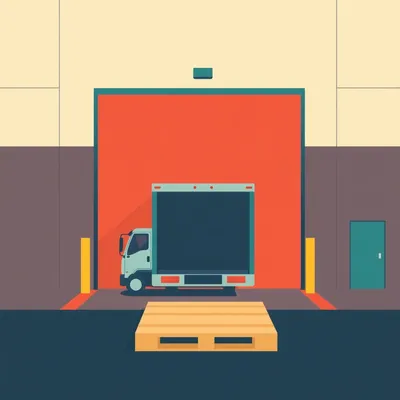
Daniel sent us this one — he just got a delivery of Euro boxes for his move and his home inventory system, and the order shipped with a pallet he paid a small surcharge to keep. Then he noticed a shop next door had a pallet lying out, and right as he was wondering whether he could just take it, a woman in her early twenties pulled up and asked the shopkeeper for it. So now he's got two questions. What is the actual protocol for acquiring pallets that look abandoned? And what on earth do people want them for in the first place?

The pallet economy. This is one of those invisible infrastructures that runs the entire world and nobody thinks about until they're standing next to a dumpster wondering if they're about to commit a misdemeanor.
The thrill of possibly stealing trash.
And the answer to whether you can take it is — it depends entirely on the pallet. There are grades. There are color codes. There are entire supply chains built around used pallet recovery, and you, standing there in your driveway, are competing with multinational pallet pooling companies.
Of course there are.
Let's start with the protocol question, because it's actually more interesting than a simple yes or no. In the United States, about ninety-five percent of wooden pallets are eventually recycled or recovered rather than landfilled. That's according to the National Wooden Pallet and Container Association. There is a massive secondary market. Pallets that look like trash to you are inventory to someone else.
The "free pallet by the dumpster" is not necessarily free.
It's not, and here's where it gets specific. Construction dumpsters are the trickiest case. If a pallet is leaning against a construction dumpster or sitting beside it, the general rule is that unless it's physically inside the dumpster, it hasn't been thrown away. Construction sites often stack pallets to the side for return or pickup. They're not discarding them — they're staging them.
Leaning against is not the same as in.
Exactly the distinction. Inside the dumpster, fair game. Outside, you're taking someone's returnable asset. And construction pallets are often the heavy-duty ones — the forty-eight by forty GMA pallets that are part of a rental pool. Those have deposit values.
Grocery Manufacturers Association. It's the standard North American pallet. Forty-eight inches by forty inches. Four-way entry. Those are the ones you see everywhere. And most of them aren't owned by the company that has them — they're rented from pooling companies like CHEP or PECO.
Wait, so the pallet behind the grocery store isn't the grocery store's pallet?
It's almost certainly not. CHEP alone manages something like three hundred and fifty million pallets globally. They're painted blue. You've seen them. Bright blue pallets with white CHEP lettering on the side. Those are never discarded casually. They have RFID tags. CHEP knows where every single one is supposed to be.
The pallet has an RFID tag.
Many of them do. The blue CHEP pallets, the red PECO pallets — these are tracked assets. If you take a blue pallet from behind a store, you haven't found free wood. You've taken rented equipment. And CHEP does prosecute.
For pallets worth hundreds of millions of dollars collectively. A single CHEP pallet costs about twenty-five to thirty dollars to replace. Multiply that by the millions that go missing annually, and it's real money. They have asset recovery teams. They audit retailers. If a store has too many pallets unaccounted for, they get charged.
The shopkeeper who gave the pallet to the woman in her early twenties — if it was a blue one, he might have just given away something he doesn't own.
And most shopkeepers know this. If they say yes to someone asking for a pallet, it's usually because it's a whitewood pallet — a generic, non-branded, single-use pallet that isn't part of any pool. Those have almost no value in the return system. They're made of cheap softwood, they're not built to last, and they're often just burned or mulched.
The color is the protocol.
The color is the first filter. Blue — CHEP, do not touch. Red — PECO, do not touch. Plain wood with no markings — probably fair to ask about. But here's the second filter: marked pallets with an IPPC stamp. That's the International Plant Protection Convention. Every pallet that crosses international borders has to be heat treated or fumigated and stamped. That stamp tells you the treatment method and country of origin.
You can read a pallet like a passport.
The stamp has the IPPC logo, the country code, a unique registration number for the producer, and the treatment code. HT for heat treated, MB for methyl bromide — which you don't want to burn indoors, by the way. MB-treated pallets are toxic when burned.
If you're taking pallets to make rustic furniture or whatever, check the stamp.
Check the stamp. HT is safe. MB is not. And that brings us to the second question — what do people want pallets for? Because the answer is genuinely enormous.
The woman asking for the pallet. What was she doing?
The DIY pallet economy is vast. We're talking about a global phenomenon. People make furniture — beds, coffee tables, bookshelves, outdoor seating. They make wall art, accent walls, planter boxes, compost bins, chicken coops. Pinterest alone has millions of pallet project pins.
The pallet has become the raw material of the aspirational craft class.
And it makes sense when you think about it. A pallet is essentially a kit of pre-assembled, rough-cut lumber. It's already joined. The dimensions are standardized. For someone who doesn't have a table saw or a planer, a pallet is the closest thing to ready-made construction material you can get for free.
It's the IKEA flat-pack of the street.
Except the instructions are whatever you found on a YouTube video at two in the morning. And there are tiers to this. The casual DIY person takes one or two pallets. The serious upcycler has a pallet dismantling station in their garage with a dedicated pallet buster tool.
A dedicated pallet buster tool.
It's a thing. It's a long-handled lever tool specifically designed to pry pallet boards apart without splitting them. Costs about forty dollars. People who have one are not messing around.
I feel like once you own a specialized tool for disassembling trash, you've crossed a line.
You've crossed into the palletcraft community, which is surprisingly organized. There are forums, there are guides on which pallets are worth taking, how to identify hardwood versus softwood pallets, how to read the stamps, how to safely dismantle them without nails flying everywhere.
This is where it gets really interesting. Most pallets in North America are softwood — southern yellow pine, spruce, fir. But some pallets, especially ones used for heavy industrial equipment or imported goods, are made of hardwood. Sometimes even tropical hardwoods.
You could find a pallet made of mahogany.
It's rare, but yes. There are documented cases of people finding pallets made from valuable wood. There's a whole subculture of pallet hunters who check the wood species before they even think about what to build.
That's a sentence I didn't expect to hear today.
It connects back to the protocol question. Because if you're a pallet hunter, you're not just grabbing any pallet. You're looking for specific stamps, specific wood, specific conditions. You know which businesses get shipments on good pallets. You build relationships with shopkeepers. You become a regular.
The woman Daniel saw might not have been random at all. She might have been working a route.
She might have been. And shopkeepers, in my experience, are generally happy to give away non-pool pallets. It saves them disposal costs. Most businesses have to pay to have pallets hauled away if they're not part of a return program. Giving them to someone who wants them is a win-win.
The protocol is: if it's plain wood, ask, and the answer is probably yes. If it's blue or red, walk away. If it's in a dumpster, take it. If it's leaning against a dumpster, ask.
That's the short version. The longer version involves understanding the pallet supply chain, which is fascinating. The used pallet market in the United States alone is valued at something like fifteen billion dollars annually. There are companies that do nothing but buy, repair, and resell used pallets.
Fifteen billion dollars in used pallets.
Billion with a B. And those companies are the ones competing with the DIY crowd. A used pallet in good condition sells for about eight to twelve dollars to a pallet recycler. The recycler fixes any broken boards, re-grades it, and sells it for maybe fifteen to twenty dollars. A new pallet costs twenty-five to thirty dollars. So the economics work.
When you see a stack of pallets behind a warehouse, that's not trash. That's inventory waiting for a truck.
And this is where Daniel's move into the Euro box system connects to the pallet question in a satisfying way. Because the whole point of standardization is that everything fits together. Euro boxes are designed to fit on Euro pallets. The Euro pallet is eight hundred by twelve hundred millimeters. It's part of the European Pallet Association system, and those pallets are even more tightly controlled than CHEP pallets in the US.
The Euro pallet has its own mafia.
It basically does. The EPAL system is a closed pool. Every Euro pallet is built to an exact specification and licensed. If you want to manufacture Euro pallets, you need EPAL certification. If you want to use the EPAL logo, you pay a license fee. And the pallets are repaired and recirculated through an authorized network. It's like a currency.
A currency made of wood and nails.
A currency where each unit costs about twenty-five to thirty euros and circulates for years. The average Euro pallet makes something like ten to fifteen trips before it's retired. And when it's retired, it often gets turned into exactly the kind of DIY project we've been talking about.
Daniel's Euro boxes are designed to fit on Euro pallets. But he's in Jerusalem, so he's probably dealing with a mix of standards.
Israel uses a mix of Euro pallets and ISO pallets, plus whatever comes in through the supply chain. The Israeli shipping and logistics sector is interesting because it sits at the intersection of European and American standards. You'll see CHEP pallets, Euro pallets, and generic pallets all in the same warehouse.
Which means his pallet might not actually match his boxes.
That's a real possibility. The Euro box system is designed around the twelve-hundred by eight-hundred millimeter footprint of the Euro pallet. If he got an American standard forty-eight by forty inch pallet, which is about twelve-nineteen by one thousand sixteen millimeters, it's close but not exact. The boxes might overhang slightly.
Close but not exact is the motto of international logistics.
It really is. And that's why the pallet world has so many standards. There's the GMA pallet in North America, the Euro pallet in Europe, the Australian standard pallet which is square — eleven hundred and sixty-five millimeters on each side — and the Asian pallet which is eleven hundred by eleven hundred. Four different standards, all designed to move goods efficiently in their region, and none of them quite interchangeable.
Which means zero standards.
It's the classic XKCD situation. There are fourteen competing standards, let's create one universal standard to replace them. Now there are fifteen competing standards.
Daniel has entered this world voluntarily.
Voluntarily and with enthusiasm. He paid a surcharge for a pallet. That's a commitment to the bit.
It's a level of dedication I respect. But I do wonder about the practical value. He said himself he can't think of an immediate need for it.
Let's think about what a pallet actually does in a home inventory context. It's not just a platform. It's a standardization layer. If all your boxes are designed to fit on a pallet, and you have a pallet, you can stack your entire inventory into a single movable unit. With a pallet jack or a hand truck, one person can move several hundred kilos of stuff in one go.
Assuming they have a pallet jack.
Which is the next purchase. The pallet is a gateway drug to the pallet jack.
The slippery slope of industrial logistics. You start with a free pallet, and six months later you're leasing warehouse space and negotiating with freight carriers.
I've seen it happen. Not literally, but the psychology is real. Once you start thinking in standardized units, you start optimizing for them. The Euro box fits on the Euro pallet. The Euro pallet fits in the truck. The truck docks at the loading bay.
The IKEA bag, by contrast, is chaos. No standard dimension. Just a floppy blue sack of disorder.
The IKEA bag is the antithesis of modular logistics. It's designed for a single trip from the store to your home, and then it lives in a closet until the end of time.
I have a closet full of them. They're breeding.
Most people's are. And that's the contrast Daniel's making, consciously or not. He's moving from a consumer logistics model — buy it, bag it, figure it out later — to an industrial logistics model where everything has a place and a dimension and a stackability factor.
The stackability factor. That should be a podcast.
It might already be. But here's what I find interesting about the pallet acquisition question. It reveals something about how we think about value. A pallet looks like trash. It's rough wood. It's got nails sticking out. It's often dirty. But it's part of a system that moves something like ninety percent of global trade.
Pallets carry roughly ninety percent of all goods globally at some point in their journey. The world runs on pallets. And yet the average person sees one and thinks "free firewood" or "potential coffee table.
Or "is that trash or is someone going to be angry if I take it?
And the answer to that question depends entirely on context that's invisible unless you know the system. It's like seeing a shopping cart in a parking lot. Is it abandoned, or is someone still using it? You need local knowledge.
The shopping cart of industrial logistics.
And just like shopping carts, there are people whose job it is to recover them. Pallet recovery is an entire industry sector. There are pallet brokers, pallet recyclers, pallet repair operations. In the US, there are about two thousand pallet companies employing something like forty-five thousand people.
Forty-five thousand people whose job involves pallets.
Making, repairing, recycling, brokering, transporting. It's a whole ecosystem. And these companies are the ones who would be most annoyed by someone taking pallets from behind a business, because those are their supply. The used pallet sitting behind a grocery store is going to be picked up by a recycler who pays the store a small amount per pallet, repairs them, and resells them.
By taking a pallet, you're not stealing from the store. You're stealing from the pallet recycler.
In a sense, yes. The store has already contracted with the recycler. That pallet is spoken for. The store might not care if you take it, but the recycler's truck shows up and their expected count is off.
Which brings us back to the dumpster question. If it's in the dumpster, the store has already decided it's waste. The recycler isn't coming for it.
Inside the dumpster is the one clear case where the pallet has been abandoned. But even then, you might want to check local ordinances. Some municipalities have rules about scavenging from construction waste. And if the dumpster is on private property, you're technically trespassing.
The truly safe free pallet is the one that's on the curb on bulk trash day.
Or the one the shopkeeper explicitly tells you you can take. Which is the other clean case. If you ask and they say yes, you're in the clear. And most shopkeepers, as we said, will say yes for non-pool pallets.
The woman who asked — she did it right.
And the fact that she was in her early twenties and asking for a pallet says something about the moment we're in. Pallet DIY has become mainstream in a way it wasn't a decade ago.
The Etsy-fication of industrial waste.
That's the phrase. Pinterest and Instagram have created an aesthetic around reclaimed wood. The pallet wall, the pallet headboard, the pallet herb garden. These projects are aspirational. They signal a kind of craft authenticity. "I made this from something that was going to be thrown away.
Which is admirable, I think. The reuse impulse is good. Even if the execution sometimes results in a coffee table that looks like it was made from a pallet.
The pallet coffee table is the most divisive piece of furniture in the modern home. It's either charmingly rustic or it's a tetanus hazard with delusions of grandeur.
Tetanus hazard with delusions of grandeur. That's going to stick with me.
There's a more practical angle to the pallet acquisition question that we haven't addressed. Daniel mentioned that industrial suppliers often have minimum order quantities that make buying pallets impractical for consumers.
If you want to buy one pallet, where do you go?
This is actually a real problem. Most pallet manufacturers and distributors sell by the truckload. Minimum orders of a hundred, two hundred, five hundred pallets. They're not set up for retail.
The used market is actually more accessible.
It is, and there are ways in. Pallet recyclers will often sell singles or small quantities to walk-in customers. Some of them have retail yards. You can find them by searching for "pallet recycler near me" or "used pallets for sale." Expect to pay five to fifteen dollars per pallet depending on condition and grade.
That's surprisingly reasonable.
And there are also online marketplaces — Craigslist, Facebook Marketplace, local classifieds — where people sell pallets in small quantities. Sometimes they're businesses that got a shipment and don't have a return arrangement. Sometimes they're individuals who collected too many for a project.
There's a secondary market in pallet overstock from overambitious DIY projects.
There really is. The "I was going to build a shed from pallets but I only got through dismantling three of them" market.
The dismantling is the bottleneck.
It's difficult. Pallet wood is rough. The nails are ring-shank, which means they're designed not to come out. The boards split easily. Dismantling a pallet cleanly takes skill, patience, and the right tools. Most people give up after one or two.
Which is why the pallet buster tool exists.
And even with the right tool, you're looking at ten to fifteen minutes per pallet to get usable boards. If you value your time at anything above minimum wage, you're better off buying lumber.
That's not the point, is it? The point is the story. The point is saying "this table used to be pallets.
The provenance is the value. It's the same reason people pay extra for reclaimed barn wood. The material carries a narrative.
Daniel's pallet has a narrative too. It's the pallet that delivered the Euro boxes. It's part of his transition to a modular system. Even if he never uses it for anything, it's a symbol.
A totem of the new order.
The pallet as transitional object. In the psychological sense.
That's actually quite nice. And it's not just symbolic. Having a pallet on hand is useful for certain things. Keeping things off the floor in a basement or storage area. Creating a level surface on uneven ground. Stacking boxes so they're easier to move with a hand truck.
Even without a grand project, the pallet earns its keep.
And if he gets a second one from the shopkeeper, he's got a matched pair. Two pallets plus some plywood is a quick and dirty workbench. Two pallets plus some casters is a rolling storage platform. The possibilities are limited only by your tolerance for splinters.
Your willingness to explain to visitors why there are pallets in your apartment.
That's the real test. The pallet in the living room is a statement. The pallet in the garage is just storage.
There's a line between "industrial chic" and "why is there a pallet in here?" and it's thinner than people think.
It's about context. In a warehouse conversion loft, a pallet coffee table reads as intentional. In a suburban split-level, it reads as "we couldn't afford furniture.
Location, location, location.
The three rules of real estate and pallet decor.
To summarize the protocol for Daniel, because he asked a very practical question: if you see a pallet by a dumpster, check if it's actually in the dumpster. If it's leaning against, ask someone. If it's blue or red with a company logo, leave it alone. If it's plain wood and you ask the shopkeeper, they'll probably say yes because it saves them disposal costs. And if you want to buy pallets legally in small quantities, look for pallet recyclers who sell to the public.
That's the protocol. And I'd add one more thing: if you're taking pallets for indoor projects, check the IPPC stamp. HT is safe. MB is not. You don't want methyl bromide residue in your living room.
The pallet has a safety label, a country of origin, a treatment code, and possibly an RFID tag. It is, in its own way, a highly documented object.
It's more documented than most consumer products. A pallet tells you where it was made, how it was treated, what standard it conforms to, and who owns it. That's more transparency than you get from a smartphone.
The pallet as the most honest object in the supply chain.
The most overlooked. Nobody thinks about pallets until they need one or they're trying to figure out if taking one is stealing.
Which brings us to the deeper question Daniel's prompt is really asking. When you start thinking in terms of modular systems and standardization, you start seeing infrastructure everywhere. The pallet, the shipping container, the Euro box — these are all pieces of a hidden order that most people never notice.
Once you see it, you can't unsee it. You start noticing pallet stacks behind every grocery store. You start recognizing CHEP blue. You start evaluating dumpsters differently.
The pallet gaze.
The pallet gaze. It's a thing. And it's part of a broader phenomenon that Daniel's been exploring with his home inventory system. The world is full of standards that are invisible until you need them. Thread pitches on bolts. These are all decisions someone made, and they shape what's possible.
The A-four versus letter paper divide. A tragedy that will never be resolved.
A-four is the Euro pallet of paper. It's based on the square root of two ratio, which means when you fold it in half, the proportions stay the same. Letter paper is just... eight and a half by eleven. No mathematical elegance. Just a number someone picked.
The Americans looked at the golden ratio and said, "we'll take the beige one.
The beige ratio.
That's a whole other episode. The point is, Daniel's pallet acquisition is part of a larger project of imposing order on chaos. He's not just moving apartments. He's building a system.
The pallet is the foundation. It's the bottom layer of the stack. Everything else sits on it.
The small surcharge for the pallet was not a quirk. It was the first brick in the wall.
Or the first plank in the pallet, if we want to extend the metaphor.
We probably shouldn't.
There's one more thing I want to dig into. The woman who asked for the pallet. What do we think she wanted it for?
Given the demographics — early twenties, pulling up to a shopkeeper specifically to ask for a pallet — I'd say there's about an eighty percent chance it's a DIY project. Furniture, wall decor, or a planter. About fifteen percent chance she's an artist who needs it for an installation or a photo backdrop. And about five percent chance she's another Daniel — someone building a modular storage system and thinking in pallet-scale units.
The small warehouse of tech parts demographic.
It's a niche, but it exists. And it's growing. The maker movement, the home lab community, people running small businesses out of their garages — they all need storage, and they all eventually discover that consumer storage products are terrible for anything systematic.
Because consumer storage is designed to look good in a catalog, not to stack efficiently in a truck.
The IKEA bin is designed to sit on an IKEA shelf. It's not designed to be palletized, shipped, or integrated into a warehouse management system. The Euro box is designed for exactly that.
Once you've made that switch mentally, there's no going back. You're a logistics person now.
You start using words like "cube utilization" and "stacking pattern" in casual conversation.
You measure your possessions in cubic meters.
You know the load capacity of your shelving units.
You have opinions about corrugated versus plastic.
The cardboard-versus-plastic debate is surprisingly heated in certain circles.
I can imagine. And I assume Daniel is firmly in the plastic camp.
Euro boxes are almost always plastic. Stackable, nestable, washable, durable. They're the industrial standard for a reason. Cardboard is for one-way shipping. Plastic is for systems.
The pallet is the base, the Euro boxes are the units, and the whole thing becomes a modular, movable, standardized inventory system that can survive multiple apartment moves without descending into chaos.
That's the vision. And it's a good one. The average person moves something like eleven times in their lifetime. Most of those moves are chaotic. Boxes get lost. The labeling system falls apart by box three.
That's a lot of chaos.
And each move is an opportunity to either impose order or surrender to entropy. Daniel's chosen order.
With a pallet.
With a pallet. And a surcharge.
The surcharge is the detail that gets me. He paid extra for the pallet. That's not opportunism. That's intentionality.
It's the difference between "I found a pallet" and "I acquired a pallet as part of a planned logistics transition.
One is a story about luck. The other is a story about design.
Design is the point. The whole Euro box system, the pallet standardization, the modular approach — it's all about designing the chaos out of the process.
Which is, when you think about it, what architecture is. Hannah's been teaching Daniel about architecture as a functional discipline, not just an aesthetic one. And this is architecture at the scale of a single household's possessions.
Domestic logistics as architecture. I like that. The floor plan of your storage is a design problem. The flow of goods from storage to use to disposal is a design problem. The interface between your inventory system and the moving truck is a design problem.
The pallet is the interface layer. It's the USB port of physical goods.
The pallet standardizes the connection between storage and transport. Just like USB standardizes the connection between devices. Before USB, every device had its own cable. Before pallets, every shipment had its own loading method.
The pallet is the USB-A of logistics. Ubiquitous, not particularly elegant, but it works everywhere.
Just like USB, there are competing standards that are technically better but can't achieve the same ubiquity. The Euro pallet is arguably a better design than the GMA pallet. It's stronger, it's more precisely specified, and it's designed for four-way entry with both forklifts and pallet jacks. But the GMA pallet dominates North America because it was there first and the installed base is enormous.
The QWERTY keyboard of the warehouse.
And that installed base is why Daniel's pallet question matters. Because there are billions of pallets in circulation. They're everywhere. They're the most common standardized object in the world that most people never think about.
Until they need one. And then they're standing by a dumpster wondering about protocol.
Now they know.
Now they know. Check the color. Check the stamp. If it's in the dumpster, take it. If it's not, ask. And if you want to buy one legally, find a pallet recycler and pay your ten dollars.
If you see a CHEP pallet, walk away. The RFID tag is watching.
Big Pallet is watching.
That's a good place to wrap.
Before we do — Hilbert's daily fun fact.
Now: Hilbert's daily fun fact.
Hilbert: In nineteen-oh-five, a French expedition to Djibouti recovered a single ceramic tile from a medieval settlement near Lake Assal. The tile's geometry is a perfect regular pentagon, but its edges are notched in a way that allows it to tile a plane only when paired with a matching star-shaped piece — making it the sole surviving physical example of a two-shape aperiodic tiling system from the Islamic world.
A single tile.
Here's the forward-looking thought. Daniel's pallet is part of a system that's been evolving for about a century. The modern pallet was invented in the nineteen-twenties and really took off during World War Two when the military needed to move supplies fast. It's a technology that has shaped the physical world more than most software ever will. And it's still evolving. There are smart pallets now with GPS trackers and temperature sensors. There are pallets made of recycled plastic and pallets made of cardboard that weigh a fraction of wood. The humble pallet is not done innovating.
The question of what to do with used pallets — the DIY movement, the upcycling, the pallet hunters — that's part of the innovation too. It's a distributed, unplanned, creative reuse of an industrial artifact. Nobody designed the pallet coffee table.
The most interesting things always do. Thanks to Hilbert Flumingtop for producing. This has been My Weird Prompts. Find us at myweirdprompts dot com, and if you enjoyed this, leave us a review wherever you get your podcasts.
See you next time.