Daniel sent us this one — he's been watching his car turn into a rolling computer and wants to zero in on two sensor systems most drivers are actually encountering right now. First, the ultrasonic parking sensor — the thing that beeps faster as you back toward a bumper. How does that actually work, can you install it yourself, and if you've only got rear sensors, can you add front ones? Second, lane drift and lateral proximity sensors — technology developed extensively here in Israel. How do they read road markings in real time, and what's actually happening inside that little camera module on your windshield?

These two sensor families live at opposite ends of the driving stress spectrum, right? Parking sensors operate at three miles an hour in a cramped Tel Aviv side street where someone's bumper is six centimeters from your license plate. Lane departure systems are working at highway speeds on Route Six with faded white lines and a truck drifting into your blind spot. Completely different physics, completely different engineering challenges — but they're both answering the same basic question: where is the thing you're about to hit?
The gap Daniel's pointing at is real. Rear parking sensors have become basically standard on anything above a base model. Still a luxury trim feature on a lot of cars. And lane keeping — most drivers couldn't tell you whether their car beeps at them when they drift or actually grabs the wheel. There's a knowledge gap between what the car can sense and what the owner understands, and that gap has consequences. You either pay for features you don't have, or you don't use features you do have, or you assume the car will save you from something it was never designed to catch.
The timing on this is good too. We're at this inflection point where cars genuinely are rolling sensor platforms — more processing power than the Apollo guidance computer, more sensing modalities than a smartphone — but the consumer experience hasn't caught up. You buy a car, the window sticker says "parking assist" or "lane departure warning," and that's the last time anyone explains what's actually in the bumper or behind the rearview mirror. So let's fix that.
Let's start with the sensor that's probably screaming at you right now as you attempt a parallel park on Dizengoff — the humble ultrasonic parking sensor.
Before we dive into the physics, I think we should frame why these two sensor families belong in the same conversation. Because on the surface, they seem unrelated — one's for parking lots, one's for highways. But Daniel paired them for a reason.
They're the two sensors that intervene in the moments your spatial judgment fails. Parking is pure geometry — you're estimating the distance between your bumper and someone else's, and humans are terrible at judging the last thirty centimeters. Lane keeping is about drift — your attention wanders for half a second, the car migrates six inches left, and suddenly you're sharing a lane with a bus. Both failures are about losing track of where your vehicle ends and the world begins.
The engineering responses to those two failures are radically different, which is what makes this interesting. Ultrasonic parking sensors are glorified bats — they ping the world with sound and listen for echoes. Simple physics, been around for decades. Lane departure and lateral proximity systems are computer vision and radar — they're reading the road, tracking objects, making predictions about where things will be in the next three hundred milliseconds. One is acoustic, dumb, and reliable. The other is optical, smart, and computationally intense. But they both exist because human spatial awareness has hard limits.
The market reflects that asymmetry. You can buy a four-pack of aftermarket ultrasonic sensors for the price of a nice dinner. The install is drilling holes and splicing wires. That's a thousand-dollar system requiring professional calibration. The cost gap tells you something about the complexity gap.
Which brings us to the Israeli thread running through this. Daniel mentioned it in the prompt — lane drift and lateral proximity technology developed extensively here. He's talking about Mobileye, one of those rare cases where a local company didn't just participate in a global industry, it basically invented the category. Mobileye was founded in Jerusalem in nineteen ninety-nine by Amnon Shashua, a computer science professor at Hebrew University. The core insight was that you could do real-time lane detection and vehicle tracking with a single camera and a dedicated chip — no lidar, no radar, no sensor fusion. Just a monocular camera and extremely clever algorithms.
The reason that matters for this conversation is that Mobileye's systems were battle-tested on Israeli roads, which are not exactly the gentle, well-marked highways of a German test track. You've got faded markings, inconsistent signage, aggressive merging, and the general creative interpretation of traffic norms that characterizes driving here. If your lane detection system works on Road Four during rush hour, it'll work anywhere.
Intel certainly thought so — they acquired Mobileye in twenty seventeen for fifteen point three billion dollars, at the time the largest acquisition of an Israeli tech company ever. Today, Mobileye's chips and software are in something like a hundred and fifty million vehicles worldwide. The EyeQ chip — their custom processor — is purpose-built for this one job: take raw camera frames, extract lane markings, identify vehicles, calculate trajectories, and issue warnings, all in about sixteen milliseconds per frame. That's faster than a single frame of video at sixty frames per second.
We've got two sensor stories. One is about a technology so simple you can install it in your driveway with a drill and some patience. The other is about a technology so sophisticated it required a Jerusalem professor, fifteen billion dollars, and a custom silicon pipeline to get right. But they're both answering the same question Daniel's asking: what's around my car that I can't see, and how do I avoid hitting it?
The practical question underneath all of this is what can you actually do about it if your car doesn't have these sensors. Because the answer is very different depending on which sensor family we're talking about. With parking sensors, the aftermarket is mature and surprisingly capable. With lane departure, the aftermarket exists but it's limited, expensive, and the cheap workarounds have real caveats.
Let's start with the one you can fix yourself this weekend.
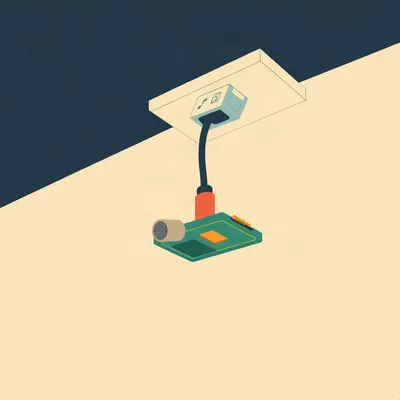
To understand how these things actually measure distance, we need to talk about bats for a second. Ultrasonic parking sensors are doing exactly what a bat does in a cave — they're echolocating. The sensor emits a pulse of sound at forty to forty-eight kilohertz, well above what human ears can pick up. That pulse travels outward, hits the car behind you — or the wall, or the shopping cart you forgot was there — and bounces back. The sensor measures how long the round trip took.
From that time, you get distance.
Speed of sound in air at twenty degrees Celsius is three hundred forty-three meters per second. So if the echo comes back after, say, ten milliseconds, the sound traveled about three point four meters total — out and back — which means the obstacle is roughly one point seven meters away. The control module runs that calculation continuously, dozens of times per second, and translates distance into the beep pattern you hear in the cabin.
The beep pattern is one of those pieces of interface design that nobody thinks about because it just works. Continuous tone when you're inside thirty centimeters — that's the "stop now" zone. Rapid beeps from thirty to sixty centimeters. Slow beeps from sixty to about a hundred fifty centimeters. The frequency of the beep is the distance — faster means closer. No screen, no numbers, no reading required. Your brain maps it instantly.
That's the elegance of it. It's a one-dimensional data stream — just distance — mapped to a single audio channel. No visual clutter, no cognitive load. You hear it and your foot moves to the brake before you consciously process what's happening. The engineering constraint that makes this work is that ultrasonic sensors are only useful at very short range — typically up to about two and a half meters. Beyond that, the echo is too weak and the time-of-flight measurement gets unreliable. Which is why these are useless at highway speeds. At seventy miles an hour, two and a half meters disappears in about eighty milliseconds.
The physics dictates the use case. Low speed, short range, hard surfaces. And that last part — hard surfaces — is where the limitations start stacking up.
Soft objects are a real problem. A person wearing a coat, a dog, a cardboard box — these absorb sound rather than reflecting it cleanly. The sensor might not see them at all, or might register them as much farther away than they actually are. Ice, snow, and mud are even worse because they can coat the sensor head itself, physically blocking the pulse. And if the sensor is mounted at the wrong angle — tilted up or down instead of parallel to the ground — you get false readings or dead zones where the beam is pointing at the sky or straight into the pavement.
This is the moment where someone who installed their own sensors discovers they drilled four holes in their bumper at a slight downward angle and now the car screams at them every time they reverse over a speed bump.
Which brings us to the installation question, because Daniel asked whether you can do this yourself, and the answer is yes — with some real caveats. Universal aftermarket kits run twenty to eighty dollars for a four-sensor system. They come with the sensors themselves, a control module, a buzzer or display for the cabin, and a wiring harness. The sensors are typically eighteen millimeters in diameter and they press-fit into holes you drill in the bumper.
The drilling is the part that separates the "I can do this" from the "I should have paid someone.
It's not mechanically difficult — you mark the positions, usually with a provided hole saw, and you drill. But the aesthetic stakes are high. You're putting four permanent holes in your bumper. If they're not evenly spaced, or if one is a few millimeters higher than the others, you will notice it every time you walk up to the car for the next five years. The other gotcha is paint matching. Most kits come with black or silver sensor heads. If your bumper is red or blue, you've got contrasting dots. Some sensors can be painted, but the paint layer has to be thin enough not to interfere with the ultrasonic pulse.
Then there's the wiring.
The wiring is straightforward in principle. You mount the control module somewhere in the trunk, usually behind a trim panel. You run the sensor wires through the bumper and into the vehicle — often through an existing grommet or vent. Then you need to tap into the reverse light circuit. That's how the system knows you're in reverse — it powers on when the reverse lights come on. You find the positive wire for the reverse light, splice into it, and that's your trigger.
But most cars have accessible reverse light wiring in the trunk, and the wire color is usually documented in forums or repair manuals. The real friction point is getting wires through the firewall if you're routing the buzzer or display to the front of the cabin. That can mean removing interior panels, fishing wire through rubber grommets, and contorting yourself under the dashboard. It's a Saturday project, not a lunch break.
Then Daniel's third question — if you've already got rear sensors from the factory, can you add front ones?
This is actually easier than starting from scratch, because you're not replacing the factory system — you're adding a separate aftermarket system just for the front. Most universal controllers support four to eight sensors, so you can install a four-sensor kit on the front bumper and run it independently. The key difference is the trigger. Rear sensors activate off the reverse light. Front sensors need a different trigger — typically a manual momentary switch you press when you're pulling into a tight spot, or a speed-based relay that activates them automatically below something like ten kilometers an hour.
The manual override is important, because front sensors in stop-and-go traffic would be a nightmare. You're sitting behind someone at a light, eighty centimeters from their bumper, and the sensor just screams at you for two minutes.
That's exactly the failure mode. Without a cutoff, front sensors make the car unusable in traffic. Most aftermarket controllers have a mute input or a switch circuit for exactly this reason. Some people wire them to a button on the dash. Others use a speed sensor module that cuts power above walking speed. Either way, you need a way to shut them up.
The bottom line on parking sensors — the physics is simple, the install is doable, and the main thing standing between you and front sensors is the willingness to drill holes in a perfectly good bumper and the discipline to wire a mute switch.
Now, parking sensors are great at five kilometers an hour. But what about a hundred and ten on a highway with faded lane markings and a truck drifting into your blind spot? That's where we leave acoustics behind and enter computer vision territory — and where Israeli engineering basically wrote the global standard.
This is where Daniel's prompt gets into the second sensor family — lane drift and lateral proximity. He's asking how these systems actually read road markings in real time, and what the difference is between the thing that warns you about drifting out of your lane and the thing that warns you about a car in your blind spot. Because those sound like the same job but they're completely different technologies.
They really are, and confusing them is one of those misconceptions that has real consequences. Lane departure warning — LDW — uses a forward-facing camera mounted behind the rearview mirror. It's looking at the road ahead and hunting for lane markings. Lateral proximity sensing — what most people know as blind spot monitoring — uses short-range radar, typically twenty-four or seventy-seven gigahertz, mounted in the rear bumper corners or the side mirrors. One reads paint on asphalt. The other bounces radio waves off metal. They don't overlap.
The camera system is literally reading the road like a text. And the radar system is just asking "is there an object in the zone next to me, and how fast is it moving relative to my car?" One is literate, one is just sensing presence.
That's a clean way to put it. And the radar side is simpler to explain first. Those twenty-four gigahertz sensors emit a continuous wave and listen for the frequency shift when it bounces off a moving car — basic Doppler. If something's in your blind spot and closing, the reflected frequency shifts up, the system calculates relative speed and distance, and it lights up a little amber icon in your side mirror. No road markings required. It works in parking lots, on unmarked dirt roads, in fog, at night. The limitation is range — typically about ten to fifteen meters — and the fact that it only sees metal objects of a certain size. A bicycle might not register.
A motorcycle definitely should, but whether it does depends on the system's tuning and the bike's radar cross-section. Which is its own anxiety.
Now the lane departure camera is doing something far more computationally ambitious. And this is where Mobileye comes in. Amnon Shashua's key insight back in the late nineties was that you could do real-time lane detection with a single camera and a dedicated processor — no stereo vision, no radar fusion, no lidar. Just one monocular camera and extremely efficient computer vision algorithms burned into custom silicon.
The fact that it's a single camera matters, because stereo would give you depth perception natively. With one lens, you have to reconstruct the three-dimensional world from a flat image. That's a harder math problem, but it's cheaper and simpler to manufacture.
Here's what happens inside that little camera module sixty times every second. The camera captures a raw frame. The first thing the EyeQ chip does is apply a perspective transform. It takes the trapezoidal view of the road — where parallel lane lines appear to converge toward a vanishing point — and mathematically flattens it into a bird's-eye view, as if you're looking straight down from above. That step alone makes the lane lines parallel in the image, which simplifies everything downstream.
It's doing in software what your brain does automatically — correcting for perspective so you can judge parallel lines as parallel.
Then it runs a Canny edge detector. This algorithm scans the flattened image looking for sharp contrast boundaries — places where pixel intensity changes abruptly. White line on dark asphalt, yellow line on concrete. The Canny filter outputs a binary map of edges, basically a line drawing of the road. Then a Hough transform takes those edges and finds which ones form straight lines at the angles you'd expect for lane markings. The output is a mathematical model of where the lane lines are in the current frame.
They fade out, they get covered in rain sheen, snow, construction scars. If the system just processed each frame independently, it would lose the lane every time the paint vanished for a few meters.
That's where the Kalman filter comes in, and this is the part I find elegant. A Kalman filter is a prediction algorithm. It takes the lane position from previous frames, models how the car is moving, and predicts where the lane should be in the next frame even if the camera can't see it. When the markings reappear, it snaps the prediction back to reality. This is why modern lane departure systems don't scream at you every time you drive over a patched section of highway. The system is maintaining a running hypothesis about where the lane is, not just reacting to what it sees in each individual frame.
It's not reading the road in real time the way a human reads text — it's more like it's humming the melody and filling in the missing notes from memory until the music comes back.
The whole pipeline — perspective transform, edge detection, Hough transform, lane model fitting, Kalman prediction, departure calculation, alert decision — runs in about sixteen milliseconds per frame. Faster than the camera can deliver the next image. The EyeQ chip is designed so that computation is never the bottleneck.
This is where the Israeli driving context becomes more than just a colorful detail. Mobileye's systems were trained and tested on roads where lane markings are often an aspirational concept. You've got faded paint, inconsistent widths, sudden disappearances at intersections, construction zones where old markings are painted over in slightly different positions. Israeli drivers also merge with a level of optimism that would be considered hostile in other countries.
Which means the edge cases that would flummox a system trained on pristine German autobahns are just Tuesday afternoon on Road Four. The algorithms had to be robust from day one — they couldn't rely on perfect inputs. That forced Mobileye to invest heavily in predictive tracking and edge detection tolerant of low contrast, partial occlusion, and contradictory signals. The result is a system that works surprisingly well in conditions where you'd expect it to fail.
The global robustness is a direct byproduct of the local chaos.
It really is. Now, Daniel also asked — can you retrofit this? And the answer is yes, but it's not a weekend project. The Mobileye six thirty is the main aftermarket lane departure system. It's a small camera unit that mounts on your windshield, professionally calibrated to your vehicle's centerline and the windshield's rake angle. If that calibration is off by even a degree or two, the perspective transform is wrong and the lane position calculations are systematically skewed. The install runs about a thousand dollars or more.
For that money, you get beeps and visual alerts — not steering correction. Lane keeping assist, which actually nudges the wheel, is a factory-integrated system. The aftermarket can warn you, but it can't grab the wheel. That distinction is one of those things Daniel was getting at — knowing what your car actually has versus what you think it has.
There is a cheaper middle ground worth mentioning. Some higher-end dashcams now include basic lane departure warning as a software feature — they're processing the same forward-facing video feed and running simplified versions of these algorithms. It's not Mobileye-grade. The edge detection is less robust, the Kalman filtering is cruder, and you'll get more false positives. But for maybe two hundred dollars instead of a thousand, you get about eighty percent of the functionality. For a lot of drivers, that's the practical sweet spot.
That percentage — eighty percent of the functionality for twenty percent of the cost — is a recurring theme in aftermarket sensor retrofits. With parking sensors, the gap between factory and aftermarket is narrow. With lane departure, the gap is a chasm. If you want front parking sensors, the path is clear. Buy a universal four-sensor kit — thirty to sixty dollars — and decide how you want to trigger it. A momentary switch on the dash is the simplest. A speed-based relay that cuts power above ten kilometers an hour is the elegant solution. Either way, you're spending under a hundred bucks and a Saturday. Do not pay a dealership nine hundred dollars for what is fundamentally the same technology in a branded box.
The dealership retrofit is the same eighteen-millimeter holes and the same wire splice. They just charge you for the labor and the logo. Now for lane departure, the math is different. The aftermarket systems that actually work — Mobileye-grade — are a thousand dollars plus professional installation. The calibration is not optional and it is not DIY. But here's the thing Daniel's question implicitly raises: do you actually need lane departure warning, or do you just want some insurance against the moment your attention wanders?
Because those are different products at different price points. A dashcam with lane departure software runs maybe two hundred dollars. It mounts on your windshield, plugs into your twelve-volt socket, and processes the same forward view the Mobileye would. The algorithms are less sophisticated, you'll get some false beeps when the sun hits the camera at a weird angle. But for the driver who just wants a nudge when they're drifting, it delivers about eighty percent of the value at twenty percent of the cost. If you're doing long highway drives and you know fatigue is a factor, the Mobileye is worth it. If you're mostly urban and just want a backup pair of eyes, the dashcam route is the smarter money.
Then there's the thing nobody does but everybody should — actually figure out what your car already has. Daniel's prompt hinted at this. A lot of people drive around thinking they have lane keeping assist because the window sticker said "lane departure warning" and they assumed those were the same thing. They are not. Lane departure warning beeps at you. Lane keeping assist grabs the wheel. One is a nudge, the other is an intervention. And many cars ship with one and not the other.
The owner's manual is the least-read book in automotive history, but it's where this distinction lives. Flip to the driver assistance section and look for the specific language. If it says "lane departure warning" or "LDW," you've got beeps. If it says "lane keeping assist" or "LKA," you've got steering input. The difference matters because if you assume the car will correct your drift and it only beeps, you're taking risks the car was never designed to cover.
The same logic applies to parking sensors. Some cars have rear sensors but display them only as a graphic on the infotainment screen with no audio alert until you're inside thirty centimeters. Some have front sensors that only activate when you shift into reverse first. The behavior is configurable on a lot of modern cars but the default settings are not always what you'd choose.
Which brings us to the bigger picture behind all of this. These sensors are not just convenience features. They're the three modalities that autonomous driving is being built on. Ultrasonic for low-speed close-quarters maneuvering. Cameras for lane discipline and object classification. Radar for blind spot monitoring and closing-speed detection in conditions where cameras go blind. Each sensor type covers the failure pattern of the others. Ultrasonic can't see far, cameras can't see in fog, radar can't read signs. But together they form a redundant perceptual mesh.
When you're drilling holes in your bumper for a forty-dollar sensor kit, you're participating in the same engineering logic that a hundred-thousand-dollar autonomous test vehicle uses. The scale and sophistication are different, but the principle is identical — fill the gaps in human perception with sensors that don't get distracted, don't get tired, and don't misjudge thirty centimeters as ten.
There's a question underneath all of this that I think doesn't get asked enough. All these sensors are generating data constantly. Your parking sensor knows exactly how close you park to curbs, how many times you nearly tapped the car behind you, whether you favor the right side of the space or the left. That's a behavioral profile. Who owns it?
That's the uncomfortable part. Right now, the answer is mostly the manufacturer. The data flows into the car's internal bus, and on connected vehicles, some of it phones home. Your braking patterns, your following distances, your lane discipline — it's all instrumented. The privacy policies around this are still catching up to the sensing capability.
A parking sensor feels innocent. It's just beeping. But multiply that by every sensor on the car, over years of driving, and you've built a model of a person that an insurance company would pay real money for.
The flip side is that some of this data makes driving safer. Aggregated sensor data is how Mobileye builds its high-definition maps and improves its algorithms. The tension between privacy and safety is real, and I don't think we've landed on the right balance yet.
Meanwhile, the hardware keeps shrinking. The next generation of ultrasonic sensors is MEMS-based — micro-electromechanical systems, solid-state devices smaller than a fingernail. They'll be embeddable directly into body panels. No more drilling eighteen-millimeter holes, no more contrasting dots on your bumper. The sensor just lives inside the plastic.
Which means the aftermarket install problem eventually disappears. If the sensor is a flexible sticker you apply inside the bumper cover, the whole drilling-and-wiring anxiety goes away. That's still a few years out from being cheap enough for universal kits, but it's coming.
The gap we started with — between what your car can sense and what it tells you — that gap is shrinking too. Cars are getting better at surfacing sensor data in ways drivers can actually use. But the responsibility still sits with the person behind the wheel to know what they've got and what it can't do. Understanding these sensors is the first step to not being surprised by your own vehicle.
Which leaves us with a question worth sitting with. As these sensors get cheaper, more capable, and more embedded, does the driver become a supervisor of the machine rather than its operator? And at what point does understanding your car's sensors become as basic a part of driving as checking your mirrors?
If you've got a weird prompt about that — or anything else — send it to prompts at my weird prompts dot com.
Now: Hilbert's daily fun fact.
Hilbert: In the eighteen-tens, the Scottish naval surgeon and botanist John Richardson collected lichen specimens in what is now Nunavut during John Franklin's Arctic expeditions, documenting a species whose translucent upper cortex acts as a natural optical filter — scattering blue wavelengths while transmitting red, which protects the underlying algae from the intense low-angle Arctic sun.
Lichen invented sunglasses.
This has been My Weird Prompts. I'm Herman Poppleberry.
I'm Corn. Find every episode at my weird prompts dot com. See you next time.