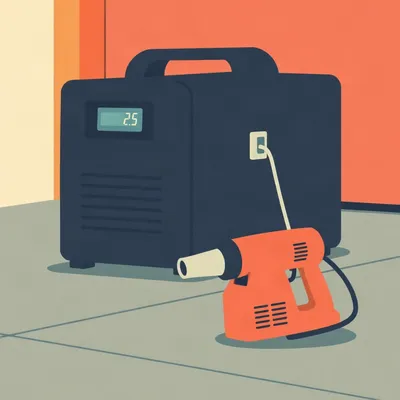
Daniel's prompt this week starts with a moment I think a lot of people have had and not known what to call it. He needed his hot air gun for some work on the car, walked over to the parking spot, and realized there is no outlet anywhere near where the car actually sits. And that's the thing about wired tools. They're not useless because they're broken. They're useless because of where you're standing. So he started looking at portable power stations, got confused about how they're different from the phone power banks we all carry, briefly considered repurposing an old UPS, and landed on three questions. What actually is a power station? Why is it better engineered for this job than a UPS? And what specs and calculations do you need to size one for a three hundred watt hot air gun run intermittently for about thirty minutes with a little headroom?

And the third question is where the real meat is, because the answer reveals something subtle about what these boxes are. Most people walk into this thinking they need a bigger battery. What they actually need is the right output wattage. The battery is almost never the binding constraint.
So the engineering story here is worth pulling apart before we get to the math. What is a power station, really, when you open one up?
Three components. A battery, an inverter, and a charge controller. The battery stores DC power. The inverter converts that DC to the AC that your wall outlets deliver. The charge controller manages how power flows in from whatever you're charging it with, solar panel, car port, wall adapter. That's the whole machine. Everything else, the USB ports, the car socket, the display, is just distribution. One vendor calls it a miniature mobile power grid, and that's not wrong.
Miniature mobile power grid. So it's a tiny nation state with a lithium iron phosphate heart.
And the decisive distinction from a power bank is the inverter. A power bank is a pocket battery with USB ports. No inverter. It can charge your phone, your tablet, small USB gadgets. It cannot run anything that plugs into a wall. The moment you need AC, you need an inverter, and the moment you have an inverter, you have a power station. There's a line from Solar eBoost that I think nails it. A power bank tops up the things in your pocket. A power station runs the things plugged into your wall.
And the capacity units trip people up constantly. Power banks are rated in milliamp hours. Power stations are rated in watt hours. Those are not the same thing, and the conversion depends on voltage.
Right, and this is where people get fooled. A ten thousand milliamp hour power bank sounds enormous. But at the typical cell voltage of three point six volts, that's thirty six watt hours. Thirty six. A small power station like the EcoFlow River 2 has two hundred fifty six watt hours. So the power bank you think is huge is delivering less than a seventh of what a small power station holds. And the River 2 is about the size of a boombox stereo and weighs just under eight pounds.
A boombox stereo. There's a reference point for people who remember what those are.
It's a useful size anchor. The point is, a power station is a different category of object. It's not a big phone charger. It's a small generator without the gas and the noise.
So now that we know what a power station is, let's talk about why Daniel's instinct to grab an old UPS was actually the wrong tool for the job. Because on the surface, a UPS and a power station look like the same thing. They're both big batteries with plugs on them.
They are both big batteries. But they are engineered for completely different problems. A UPS is built for instantaneous transfer. When the grid drops, it switches to battery in milliseconds so a desktop, a modem, a NAS never blinks off. That's its entire job. A power station is built for sustained output and flexible use. Capacity and versatility over instantaneous response. KnowDepot put it well. One is built for speed, the other for stamina.
Speed versus stamina. So the UPS is a sprinter and the power station is a marathon runner, but they're both carrying batteries.
And the transfer time detail is where this gets interesting. A standby UPS transfers in up to about ten milliseconds. A line interactive UPS does it in the low single digit milliseconds, often under four. An online double conversion UPS is near zero, because the battery is always in the circuit. Now, a typical PC power supply has what's called a hold up time of about twenty milliseconds. That's how long the computer can coast through a power gap before it reboots. So a good UPS switches fast enough that the computer never notices.
And a power station in its UPS style mode?
Many of them switch over in under thirty milliseconds, but with a brief interruption. Thirty milliseconds is outside that twenty millisecond hold up window. So a desktop plugged into a power station in EPS mode may still blink off and reboot. The marketing label says home UPS. The spec sheet says twenty to thirty millisecond switchover. Those two things are in tension.
So the label tells you nothing. The number that matters is switchover time in milliseconds.
And then there's the other side of the UPS coin. UPS batteries are deliberately small. They're sized to bridge a load for roughly five to thirty minutes, enough time to save your work and shut down safely. It was never meant to power your evening. A power station holds hundreds to several thousand watt hours and runs loads for hours to a day plus.
So Daniel's use case is the mirror image of the usual mistake. The usual mistake is buying a power station to protect a desktop, which fails because the switchover is too slow. Daniel's instinct was to repurpose a UPS for the car job, which fails because the battery is too small and the output wattage is too low.
And for his actual task, driving a wired tool briefly where there's no outlet, the UPS's millisecond switchover is completely irrelevant. There's no grid to switch away from. He's not protecting anything from an outage. He's just trying to run a hot air gun in a parking spot. The UPS's tiny battery and low wattage are disqualifying. The power station's high output and large capacity are exactly what's needed. They're not rivals so much as two stages of the same plan.
The UPS covers the blink. The power station covers the hours after the blink. Daniel doesn't have a blink problem. He has an hours problem.
And that's the engineering philosophy difference in one sentence. A UPS exists to cover a gap, the brief blink when grid power drops, fast enough that a sensitive device never notices. A power station exists to provide endurance, a big battery that keeps loads running for hours once the grid is already gone.
So the UPS is out. Now the real question. How do you actually size one of these things without either undersizing or blowing fifteen hundred dollars on a sixty pound brick?
The sizing method starts with understanding that there are two separate numbers that matter, and they are not interchangeable. Watt hours is capacity. It's the size of the gas tank. It tells you how long the unit can run. Watts is output. It's the horsepower. It tells you what the unit can start and run at all. Most buyers focus on watt hours and ignore watts. That's the most common mistake in this entire category.
So someone buys a two thousand watt hour unit and then discovers it can't actually run their air conditioner because the output wattage is too low.
Or the reverse, they buy a unit with a three thousand watt output and a tiny battery, and it runs the air conditioner for eleven minutes before it dies. Both numbers matter, but for different questions.
So walk me through the capacity math. Daniel's hot air gun is three hundred watts. He wants thirty minutes of intermittent operation with headroom.
The formula is straightforward. Multiply each device's running watts by the hours of use. Sum the watt hours. Add ten to fifteen percent for inverter losses. Then divide by roughly zero point eight five for usable capacity. That gives you the minimum nameplate watt hours to buy.
Why the eighty five percent derating?
Because a lithium iron phosphate station delivers roughly eighty five to ninety percent of its nameplate watt hours after inverter losses and the battery management system's low voltage cutoff. A thousand watt hour station gives you about eight hundred fifty to nine hundred usable watt hours. The nameplate number is the cell capacity. The usable number is what actually reaches your device.
So the marketing number and the real number are different, and the difference is about fifteen percent.
Right. Now let's apply this to Daniel's case. Three hundred watts times half an hour is one hundred fifty watt hours of raw energy demand. Add about fifteen percent for inverter losses, you get roughly one hundred seventy three watt hours. Divide by zero point eight five for usable capacity, you get about two hundred three watt hours of nameplate capacity needed. So even a modest three hundred watt hour unit comfortably covers the energy demand.
Two hundred three watt hours. That's the entire answer to the capacity question. A three hundred watt hour unit has plenty of margin.
Here's the thing. The binding constraint is not capacity. It's output wattage. The station's continuous AC output must exceed three hundred watts. That's the number that actually determines whether the hot air gun runs at all.
A small unit like the EcoFlow River 2, two hundred fifty six watt hours, six hundred watts output, would run this load with ample margin.
Roughly two hundred fifty six watt hours times zero point eight five usable divided by three hundred watts gives you about forty plus minutes of continuous operation. That's more than enough for thirty minutes of intermittent use, because intermittent means the gun is cycling on and off, not running flat out for half an hour straight.
The hot air gun is a resistive heating load. That matters for the surge question.
It matters a lot. A hot air gun is like a space heater or a hair dryer. It's a resistive load. It has no meaningful startup surge. The continuous watt rating is what matters. Three hundred watts is three hundred watts, whether it's the first second or the hundredth second. Motors are completely different. A fridge compressor, a pump, a power tool draws four to seven times its running watts at startup. A one hundred fifty watt fridge can inrush past a thousand watts for a fraction of a second.
If Daniel were trying to run a fridge, the math would be different. He'd need to look at surge rating, not just continuous output.
Rule of thumb. Pick a unit whose surge rating is at least double its continuous rating if any motor load is in the plan. A fridge that runs at one hundred fifty watts but inrushes past a thousand needs a unit with a surge rating above that thousand watt spike. Otherwise the inverter trips and the fridge never starts.
The oversizing trap is real and counterintuitive. The right unit is usually smaller than instinct suggests. Oversizing wastes money and weight. A two thousand forty eight watt hour unit costs about fifteen hundred dollars and weighs about sixty pounds. For Daniel's three hundred watt, thirty minute use case, a small three hundred watt hour unit with over three hundred watts output is sufficient.
The instinct is to buy the big one because it feels safer. But the big one is sixty pounds and fifteen hundred dollars, and Daniel would be using about seven percent of its capacity. That's not headroom. That's a boat anchor.
There's also the battery chemistry nuance. Lithium iron phosphate stations can be discharged to eighty or ninety percent depth of discharge safely. Doing the same to nickel manganese cobalt cells is not recommended. That's a chemistry difference that affects usable capacity and cycle life.
LiFePO4 is the standard now for good reason. It handles deep discharge without degrading the way older NMC cells do. It's also safer thermally. If you're buying a power station in the current market, you're almost certainly getting LiFePO4, and that's a good thing. The usable capacity is higher, the cycle life is longer, and the fire risk is lower.
The practical insight is this. For Daniel's use case, the binding constraint is almost never capacity. It's output wattage. The math is simple once you separate the two numbers.
The math itself is not hard. It's multiplication and division. The hard part is knowing which numbers to multiply and divide. Once you understand that watt hours is the gas tank and watts is the horsepower, the rest falls into place.
There's one more thing worth mentioning before we move on. The EPS mode marketing trap. Power stations sold as a home UPS via passthrough or UPS mode can still take twenty to thirty milliseconds to switch over. That's outside a PC's twenty millisecond hold up window. So the marketing label tells you nothing. The spec that matters is switchover time in milliseconds.
That's a spec almost nobody puts on the box. You have to dig into the manual or the detailed specs page. The box says home UPS. The reality is a desktop may still blink off. If you need true UPS protection, buy a UPS. If you need hours of portable power, buy a power station. Don't buy one expecting it to do the other's job.
The mirror image mistake. Buying a power station to protect a desktop fails because the switchover is too slow. Repurposing a UPS for the car job fails because the battery is too small and the output is too low. Both mistakes come from thinking these are the same category of object.
They're adjacent categories. They share a lot of DNA. But the engineering priorities are opposite. One optimizes for the first twenty milliseconds of an outage. The other optimizes for the next twenty hours.
That's where the math ends. But I know Hilbert's been sitting back there with a look on his face, and I think he has a story about inverters that involves a fried mixer and a very heavy battery bank.

Twenty two milliseconds. That's the actual hold up time on most ATX power supplies. The spec says twenty, but the ones I tested in the late nineties held for twenty two. It's the capacitors. They were bigger then.
The margin was even tighter than the spec suggests.
I spent a summer working for a mobile DJ company. We ran the whole rig, speakers, amps, lights, off a lead acid battery bank with a modified sine wave inverter we built ourselves. The hum was constant. The heat was worse. And one day the cheap inverter fried a mixer because the waveform was too dirty.
Fried a mixer. What actually happened?
The power supply in the mixer was a switching supply. Modified sine wave makes those run hot. They're designed for a clean sine, and when you feed them a stepped square wave, the switching transistors work harder. This one worked harder for about four hours and then it gave up. Smoke, smell, the whole thing. We replaced it with a pure sine inverter the next week.
That's the detail people miss when they look at inverter specs. It's not just about whether the device runs. It's about whether it runs without cooking itself over time.
The resistive loads didn't care. The lights, the heating elements in the fog machine, they ran fine on modified sine. It's the electronics that mind. Anything with a switching power supply, mixers, computers, some chargers, they want a clean wave.
Nearly every modern portable power station outputs pure sine wave now. So this is largely moot for new purchases.
It's one of those problems that used to be a real concern and has quietly disappeared. The market standardized on pure sine because the cost came down and the complaints about fried electronics were endless. If you're buying a power station made in the last five years, you're almost certainly getting pure sine.
That old rig weighed more than I did. The battery bank alone was four deep cycle marine batteries. Hundred twenty pounds. The inverter was another thirty. We had a hand truck just for the power setup.
A modern LiFePO4 station would replace all of that with something you can carry under one arm.
The one we abused would have killed for a River 2. Six hundred watts, eight pounds. We were hauling a hundred fifty pounds to run a mixer and two amps that pulled maybe four hundred watts total.
The inverter quality is the thing that separates a three hundred dollar station from a fifteen hundred dollar one, not just the battery. The cheap ones used to ship with modified sine and call it good enough. The expensive ones shipped with pure sine and better thermal management.
The mixer that fried was a Behringer. Not a cheap board. The inverter was the cheap part. We saved two hundred dollars on the inverter and spent four hundred replacing the mixer. That's the whole story of that summer.
The lesson is that the inverter is not a commodity. It's the part that actually touches your devices, and a bad one destroys them slowly or quickly.
That's why the pure sine standardization matters. It removed a whole class of failure mode from the category. You don't have to think about it anymore, which is good, because there are already enough numbers to think about.
I still have the fried mixer in a box somewhere. Kept it as a reminder. The power supply board has a hole burned through it. You can see exactly where the transistor let go.
A scorched Behringer as a memento mori for cheap inverters.
It worked. I never bought a modified sine inverter again.
That's a better cautionary tale than any spec sheet.
The other thing I remember is the sound. Modified sine makes transformers buzz. Not loud, but present. A room full of gear running on modified sine has this low mechanical hum that never goes away. Pure sine is silent. The first time we ran the new inverter, we thought it wasn't working because the room was quiet.
The waveform you can hear. That's a detail that never makes it into the marketing.
The marketing says pure sine wave like it's a feature. It's not a feature. It's the absence of a defect.
That's the right way to think about it. Pure sine is what the grid gives you. The inverter's job is to reproduce that. Modified sine is a cheaper approximation that works for some things and destroys others.
The modern power station inherits that lesson. The whole category standardized on pure sine because the alternative caused too many fried mixers.
The battery chemistry changed too. Lead acid you had to keep topped up, and if you ran it flat, it died young. LiFePO4 doesn't care. You can cycle it to ninety percent depth of discharge and it just keeps going.
That's the chemistry nuance that separates modern stations from older ones. LiFePO4 handles deep discharge without the cycle life penalty. NMC cells don't. If you discharge NMC to ninety percent regularly, you're shortening its life. LiFePO4 is designed for exactly that.
The modern power station is the beneficiary of two quiet revolutions. Pure sine inverters became cheap, and LiFePO4 chemistry became standard. The combination is what makes a three hundred dollar unit useful.
We would have paid three thousand for that in the nineties and still had to build it ourselves.
It would have weighed a hundred fifty pounds and hummed.
And fried the mixer.
The misconception that's worth naming here is that power banks and power stations are the same thing. They're not. The inverter is the decisive distinction. A power bank charges the things in your pocket. A power station runs the things plugged into your wall. Get that one distinction right and the rest of the decision falls into place.
The second misconception is that a UPS can substitute for a power station. It can't. A UPS is engineered for instantaneous transfer with a tiny battery. A power station is engineered for sustained output with a large battery. Speed versus stamina. Daniel's hot air gun needs stamina, not speed.
The open question I keep thinking about is whether power stations start replacing UPSes even for desktop protection. The transfer time gap is closing. Some newer units are claiming single digit millisecond switchover. If that trend continues, the engineering philosophy difference might start to blur.
The gap is closing, but the core difference remains. A UPS is always in the circuit, always regulating, always ready. A power station is a battery with an inverter bolted on. The best EPS mode still has a brief interruption. For a desktop, brief is enough to lose work. For a NAS, brief is enough to corrupt data. I don't think power stations replace UPSes for that job until the switchover is truly seamless.
The real takeaway for Daniel is this. The next time you're stuck without an outlet, the question isn't how big a battery do I need. It's what's the smallest box that can output the watts I need. For three hundred watts and thirty minutes, that's a small box. A very small box.
The math is worth doing before you buy, because instinct will tell you to buy the big one. The math will tell you the big one is sixty pounds and fifteen hundred dollars of overkill.
Thanks to Hilbert Flumingtop for producing, and for the cautionary tale about the fried mixer.
This has been My Weird Prompts. If you've got a prompt that made you stop and think, email us at show at my weird prompts dot com.
We'll be back soon.