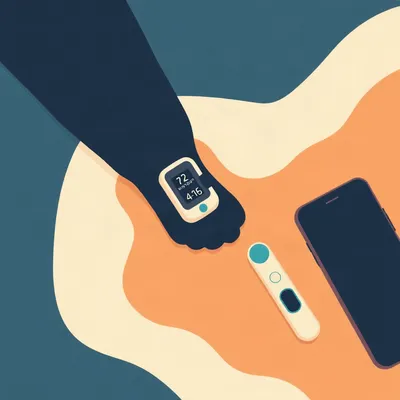
A pulse oximeter can read ninety-seven percent while a child is working so hard to breathe that the muscles between his ribs are caving in. That's the number Daniel saw this morning, and it's the number that almost told him to stay home.

And the thing is, the device wasn't wrong. The blood really was ninety-seven percent saturated. The device just wasn't answering the question Daniel actually needed answered.
Here's what Daniel wrote in. His fourteen-month-old woke up at six in the morning with labored breathing. The whole household has been down for days with what feels like a heavy cold, the daycare welcome package. Both parents are symptomatic, they're watching their son breathe rapidly, and they're trying to decide whether to go to urgent care. They're in Israel, so they have Terem, which fills the gap between primary care and the emergency department, especially after hours and around the Jewish calendar. Daniel reached for the pulse oximeter. He also mentions the rectal thermometer. And then he names the tension directly. There's a danger in having too many devices if it means you delay going to professional care. But in the era of telemedicine and judicious AI, there's also some benefit to being able to take the basics. What should households actually keep, for the kids and for the adults?
So let's start with what happened in that room, because the sequence of decisions is the whole episode.
The sequence was: wake up, hear breathing that sounds wrong, reach for a device, get a number, and then decide what to do with it.
And the number was reassuring. That's the part that scares me.
What was the number?
He didn't say in the prompt. But here's what I know from years of this. A fourteen-month-old with a daycare cold and labored breathing, if you put a consumer pulse oximeter on his toe or finger, you're going to get something in the mid to high nineties almost every time. Kids compensate. They maintain their oxygen saturation by working harder, not by letting the number drop.
So the device is measuring the thing the body is defending, not the thing that's wrong.
The body's priority is keeping oxygen in the blood. It will spend enormous energy doing that. The energy cost shows up as retractions, nasal flaring, grunting, head bobbing. The number stays normal until the body can't keep up anymore, and by then you're in real trouble.
So what does a pulse oximeter actually measure?
It shines two wavelengths of light through the skin, usually red and infrared. Oxygenated hemoglobin absorbs these wavelengths differently from deoxygenated hemoglobin. The device looks at the ratio of absorption and calculates the percentage of hemoglobin that's carrying oxygen. It's clever. It's also completely at the mercy of anything that interferes with the light path or the blood flow.
And a squirming fourteen-month-old is the worst-case scenario.
A squirming toddler with cold hands is about as hostile an environment for a pulse oximeter as you can design. Motion artifact is the big one. Every time he moves, the light path changes, and the device has to guess. Poor perfusion, cold extremities, that reduces the signal quality. Nail polish, dirt, even bright ambient light can throw it off. And most consumer units are not calibrated to the same standard as hospital-grade equipment. They're good enough for a healthy adult who sits still, which is not who we're measuring here.
So the number Daniel got might have been accurate, or it might have been noise, and he had no way to tell the difference.
Right. And even if it was accurate, it wasn't answering the question. The question at six in the morning is not what is the oxygen saturation. The question is, is this child in distress, and does he need to be seen by someone who knows what distress looks like.
Which brings us to work of breathing.
The thing a pulse oximeter cannot measure, and the thing that actually matters in respiratory distress. A parent can assess this without any equipment at all. You watch the child's chest. You look for retractions, which is the skin pulling in between the ribs, under the ribs, above the collarbone. You look for nasal flaring, the nostrils widening with each breath. You listen for grunting on exhalation. You watch for head bobbing, where the head moves with each breath because the accessory muscles are working so hard. And you count the respiratory rate.
What's normal for a fourteen-month-old?
Somewhere between twenty and thirty breaths per minute, depending on whether he's awake or asleep, calm or agitated. Above forty is worth paying attention to. Above fifty, in a child who's not running around, is a real signal. But here's the thing. A parent at six in the morning, sick themselves, anxious, counting breaths on a toddler who won't sit still, that's hard. Daniel mentioned a phone tap app in a previous conversation, and that's actually a reasonable approach. But the visual signs, the retractions, the flaring, the grunting, those are harder to fake and harder to miss.
So the phone camera plus a telemedicine clinician can do what the pulse oximeter can't.
A decent video call with a pediatrician can show retractions. It can show the child's level of alertness, his color, his work of breathing. The clinician can count the respiratory rate on screen. They can ask the parent to lift the shirt and show the chest. That's a real assessment. The pulse oximeter gives you one number. The video call gives the clinician eyes on the child.
And the rectal thermometer?
Still the reference standard for core temperature in infants and young children. For a child under three months, any fever is an emergency, and you need the most accurate reading you can get. The rectal route is the closest you can get to true core temperature without going invasive in a hospital sense. Axillary, under the arm, runs about half a degree to a full degree cooler, and the error is inconsistent. Tympanic, in the ear, is unreliable in young children because the ear canal is small and angled, and you're often measuring the temperature of the ear canal wall, not the eardrum.
And the friction is the point.
The friction is exactly why people skip it. It's awkward. The child hates it. The parent feels like they're doing something unpleasant. At six in the morning, with a sick toddler, the last thing you want to do is something that makes him cry. But the accuracy is worth the friction, because the fever number changes the decision. A rectal reading of thirty-eight point five tells you something different from an axillary reading of thirty-eight point five, which might be a true thirty-nine or might be a true thirty-eight.
So the pulse oximeter is the device Daniel reached for, and the rectal thermometer is the device he knew he should reach for.
And the difference between those two devices is the whole episode. The pulse oximeter feels easy and gives you a number that looks precise. The rectal thermometer feels hard and gives you a number that's actually accurate. The easy device is the one that can mislead you.
Let's sit with that. The false reassurance mechanism. How does a reassuring number actually delay care?
Anchoring. You get a reading of ninety-seven percent, and that becomes the anchor. Everything else you observe gets interpreted through that anchor. The retractions look less severe than they did a minute ago. The breathing sounds less labored. The grunting, well, he's probably just congested. The number said ninety-seven, so the visual evidence must be less alarming than I thought.
The number becomes the authority, and the parent becomes the interpreter of the number, rather than the observer of the child.
That's the strongest version of Daniel's concern, and it's a real phenomenon. It's not that parents are stupid or gullible. It's that a number feels objective, and a parent's gut feel feels subjective, and when the two conflict, the number wins. But the number was never designed to answer the question of whether this child needs to be seen.
And here's where telemedicine changes the calculus.
Completely. Because the same number, transmitted to a clinician, becomes a different kind of information. A respiratory rate and an oxygen saturation sent to a pediatrician at six in the morning is an input to someone else's judgment, not a substitute for your own. The clinician asks about the retractions. The clinician asks to see the child on video. The clinician integrates the number with everything else. The number stops being the decision and becomes one data point in a decision that someone with training is making.
So the device is a bridge to a clinician, not a replacement for one.
In a system where that bridge exists, yes. And that's the structural point about Israel. Terem changes the cost of just going. If your options are wait until morning or spend six hours in an emergency department, you're going to try to avoid the emergency department. That's rational. And in that system, a home pulse oximeter carries more weight, because it's the only signal you have. But if you have a Terem-style after-hours clinic, where you can walk in and be seen by a doctor in twenty minutes, the device is a bridge, not a substitute. The cost of going is lower, so the threshold for going should be lower.
And the device becomes less necessary, not more.
In a way, yes. The device is most useful when the alternative is a terrible emergency department experience and you need some way to triage at home. It's least useful when there's a good after-hours option and the right answer is almost always just go.
That's the child side. But Daniel asked about the adults too, and the device list there looks different, and so does the AI question.
The adult list is shorter than people think. A validated upper-arm blood pressure cuff, a thermometer, and for anyone with a chronic condition, a pulse oximeter. That's about it. The blood pressure cuff is the highest-value item, because hypertension is common, it's silent, and home readings are actually more useful than clinic readings for a lot of people. White coat hypertension is real, and masked hypertension is real, and a validated cuff at home cuts through both.
And wrist cuffs are the mistake.
Wrist cuffs are the most common and most consequential mistake in home monitoring. They're position sensitive. The wrist has to be at heart level, exactly, or the reading is wrong. Most people hold their wrist too low or too high, and the error is systematic and large. Upper-arm cuffs are harder to misposition, and the validated ones have been tested against the clinical standard. If you're going to spend money on one adult device, spend it on a validated upper-arm cuff.
What about the AI angle? Daniel mentioned judicious use of AI.
The defensible role for AI here is not diagnosis. It's structuring. A parent at six in the morning has a mess of observations. Breathing fast, seems to be pulling in under the ribs, won't eat, woke up crying, the nose is stuffy, he felt warm an hour ago. That's unstructured. An AI tool that converts that into a structured set of observations, respiratory rate, work of breathing signs, feeding, alertness, temperature, that's useful. It's a scribe. It organizes the mess into a form that a telemedicine clinician or an urgent-care intake nurse can act on.
The AI as the intake form, not the doctor.
And the failure mode matters enormously. An AI that says this sounds like it can wait until morning, when the child has early respiratory distress, that's a catastrophic failure. The asymmetry of harm is brutal. A false go now costs a wasted urgent-care visit. A false wait can cost much more. And current consumer AI tools are not calibrated for pediatric respiratory assessment. They don't know what a fourteen-month-old's normal respiratory rate is. They don't know how to weigh retractions against oxygen saturation. They don't know that a child can maintain saturation while working hard to breathe.
So the AI should never be in the position of saying wait.
Not in this context. The AI should be saying, here are the observations, here's what's missing, here's what to tell the clinician. The decision to go or stay belongs to the parent, ideally in consultation with a clinician, not to the tool.
And here's the knock-on effect I keep thinking about. The more households stock these devices, the more the telemedicine intake process gets designed around home readings.
That's a real feedback loop. Once the intake nurse knows that most callers have a pulse oximeter, they start asking for the reading. Once they start asking, the parents who don't have one feel the gap. The floor of what's expected rises. That's good for the families who can afford the devices and use them well. It's a real equity problem for the families who can't.
The device becomes a prerequisite for the conversation, not an optional input.
That's the thing nobody talks about when they talk about the democratization of health monitoring. The devices get cheaper, but the expectation rises faster. A family without a pulse oximeter calling a telemedicine service that expects a reading is now at a disadvantage. The device didn't make them worse off, but the system did.
The minimum viable kit. What actually belongs in the house?
Smaller than most people think. A rectal thermometer for the kids. A validated upper-arm blood pressure cuff for the adults. A pulse oximeter whose value is entirely contingent on what you do with the number. That's the kit. Everything else is either redundant or actively misleading.
The smart socks, the home stethoscopes.
The smart socks are a category of device that tells you the baby's heart rate and oxygen saturation continuously, and they generate more false alarms than useful information for a healthy infant. The home stethoscope is a device that requires training to interpret, and without training it's just a tube that makes you feel like you're doing something. The tympanic thermometer in an infant is less accurate than the rectal one and gives you a number that feels precise but isn't. These are devices that change how you feel, not what you decide.
The devices that change what you decide are the ones worth having.
The rectal thermometer changes the decision about whether the fever is high enough to warrant a call. The blood pressure cuff changes the decision about whether the medication is working. The pulse oximeter changes the decision only if you use it as an input to a clinician's judgment, not as a substitute for your own.
The device is not the intervention. The decision threshold is.
That's the whole episode in one sentence. The device doesn't do anything by itself. It feeds a threshold. If your threshold for seeking care is too high, a reassuring number will keep you home when you should go. If your threshold is too low, an alarming number will send you to the emergency department for nothing. The device amplifies whatever threshold you already have.
The real variable is the parent's judgment, not the equipment.
Judgment can be trained. That's the part that gets lost in the shopping list conversation. The most valuable thing a parent can have at six in the morning is not a device. It's the ability to look at a child and recognize work of breathing. That's a skill. It can be taught. It can be practiced. And it's free.
I keep thinking about the fact that Daniel and Hannah were both sick themselves.
That's the part that makes the whole thing harder. When you're febrile and exhausted, your judgment is degraded. You're more likely to anchor on a number, because a number is easier than thinking. You're more likely to delay, because going anywhere feels impossible. The device becomes a crutch, and the crutch is being used by someone who's also sick.
The kit matters most exactly when the people using it are least capable of using it well.
Which is an argument for keeping the kit simple. Two devices, maybe three. Simple enough that a sick, exhausted parent can use them correctly at six in the morning. The more complex the kit, the more likely it is to be used wrong.
There's a version of this where the device was never the point.

In ninety-seven I worked six months as a night-shift intake clerk at a walk-in clinic in Haifa. The single most useful thing I learned was how to read a parent's face. A parent who's worried about a child with labored breathing looks a certain way. They look at the child, then at you, then at the child again. They're not looking at a number. They're looking at the child. The parents who came in holding a printout of a home reading, those were the ones who'd waited too long.
The printout was the thing they trusted instead of their own eyes.
The clinic had a rule. Any child under two with labored breathing went straight to the back. No triage form, no vitals first. Straight to the back. I've never seen a home device that could beat that rule. The rule says, if you're worried enough to come in, you're worried enough to be seen. No device required.
It's saying the parent's concern is the triage instrument.
It worked. I still have the pulse oximeter I bought in two thousand three for my mother. Bulky finger unit with a fold-out screen. Still works. I've never once used it on myself. I don't trust a number I can't argue with. A number doesn't tell you it's wrong. A person does.
The false reassurance point, you'd push it further.
The real problem isn't too many devices. It's that a device gives a parent something to do at six in the morning. Doing something feels better than doing the right thing, which is often just leaving. The device is a way to postpone the decision. You take a reading, then you take another reading, then you check the batteries, and meanwhile the child is breathing the same way he was breathing when you first looked at him.
The device as procrastination.
The device as something to do instead of the thing you already know you should do. I carried that pulse oximeter between apartments for twenty-three years. Never used it. But I knew it was there. That's what a device is for most people. It's the feeling that you could check, if you needed to. The checking itself doesn't help.
The fold-out screen though. That's a detail.
It folds out like a little book. The hinge is still stiff. My mother never used it either. She said the same thing. She wanted to know it was there. She didn't want to know the number.
That's the difference between measurement and reassurance. The device in the drawer is reassurance. The device in your hand at six in the morning is measurement. And the measurement is only as good as the decision it feeds.
The question becomes, if the value of the device is entirely contingent on the decision threshold it feeds into, is the real intervention parent education rather than equipment?
I think it is. The parent who knows what retractions look like, who knows what a normal respiratory rate is, who knows that a child can maintain saturation while working hard to breathe, that parent doesn't need the pulse oximeter to make the right call. The parent who doesn't know those things might be misled by the pulse oximeter into making the wrong call.
The education is the part that doesn't scale.
Devices scale. You can sell a million pulse oximeters. You can't sell a million hours of pediatric respiratory assessment training. So the market produces devices, and the gap in judgment remains.
The telemedicine feedback loop makes the devices more useful over time, which makes the education gap more costly.
The families who can afford the devices and know how to use them get better triage. The families who can't afford the devices, or who have the devices but not the training, get left behind. The floor rises, and the people who were already behind fall further behind.
The image I keep coming back to is the six in the morning moment. The device is in your hand. The child is in front of you. The only question that matters is whether you're going to the clinic or not.
The device doesn't answer that question. It just gives you a number to hold while you decide.
Daniel and Hannah went. That's the part that matters. They looked at their son, they were worried, and they went. The pulse oximeter didn't stop them. That's the best possible outcome.
The device was there, it gave them a number, and they overrode it with their own judgment. That's exactly what the device is for. It's not the decision. It's one input among many. The fact that they went anyway is the system working.
The system in this case included Terem, which made going a reasonable option at six in the morning.
Which is the structural point. In a system where going is easy, the device matters less. In a system where going is hard, the device matters more, and the risk of false reassurance is higher. The optimal home kit depends on the health system you're standing in.
The answer to Daniel's question is: a rectal thermometer, a validated upper-arm blood pressure cuff, and a pulse oximeter whose value is entirely contingent on what you do with the number.
The most important thing in the house is not any of those. It's the ability to look at a child and know when the breathing is wrong.
The one thing I'd want a listener to take from this is that the device is not the intervention. The decision threshold is. A parent with good judgment and no devices will make better decisions than a parent with every device and no judgment.
The judgment can be taught. Work of breathing is visible. Retractions, nasal flaring, grunting, head bobbing. Learn to see those, and you've got the most important triage tool there is.
The forward-looking question is whether the telemedicine feedback loop makes the education gap worse before it makes it better. The devices will get cheaper and more common, the intake process will expect them, and the families who can't afford them or can't use them well will be penalized. That's the thing to watch.
The thing to build for, if you're thinking about this space. The tool that teaches a parent to recognize work of breathing is worth more than the tool that measures oxygen saturation. The education is the intervention.
Thanks to our producer Hilbert Flumingtop for keeping the show running.
This has been My Weird Prompts, the human-AI collaboration podcast.
If you've got a weird prompt of your own, email us at show at my weird prompts dot com.
We'll be back soon.