Daniel sent us this one — he wants to dive into the so-called shower effect. You know, that thing where you've been grinding on a problem for hours, nothing's clicking, and then you step into the shower or go for a walk and suddenly the answer just... He's asking how that actually works, what's happening in the brain, and maybe the harder question — how do you know when perseverance has hit its limit and it's actually time to step back instead of pushing through?

Oh, this is one of my favorite topics. And by the way — today's episode script is being written by DeepSeek V four Pro. Hello to our silicon friend.
That's generous. I'd say silicon subcontractor, but go on.
The shower effect — psychologists actually have a name for this. They call it the incubation effect. And what's wild is this isn't just folk wisdom. There's solid experimental evidence going back decades.
Sounds like what happens when you leave yogurt out too long.
Different thing entirely, though I appreciate the culinary pivot. No, incubation in this context means stepping away from a problem you've been consciously working on, and then finding that the solution emerges during that break. There was a major meta-analysis by Sio and Ormerod in two thousand nine that looked at dozens of studies. They found that incubation breaks do produce a real, measurable improvement in creative problem-solving — but here's the kicker — it's not uniform. The effect is strongest for certain types of problems and certain types of breaks.
Alright, so let's unpack that. What kinds of problems benefit most, and what kinds of breaks actually work?
The Sio and Ormerod -analysis found something really specific. The incubation effect is strongest for what they call divergent thinking tasks — problems that have multiple possible solutions, where you need to generate a lot of ideas rather than converge on one right answer. Creative insight problems, the kind where you need that aha moment. For more straightforward, analytical problems where you're just grinding through steps, incubation doesn't help nearly as much.
That makes intuitive sense. If I'm doing my taxes, stepping away isn't going to magically reveal deductions I forgot about. But if I'm trying to figure out how to phrase something tricky or solve a creative block, the shower suddenly becomes the most productive room in the house.
On the break side, the research distinguishes between different types. Some studies had people do nothing during the break — just rest. Others had them do a low-demand task, something that occupies your hands or senses but doesn't require deep thinking. And still others had them do a cognitively demanding task. The low-demand tasks consistently outperformed both total rest and high-demand tasks for generating creative insights.
The classic examples — showering, walking, gardening, washing dishes — those are low-demand tasks. Your brain is lightly occupied but not taxed.
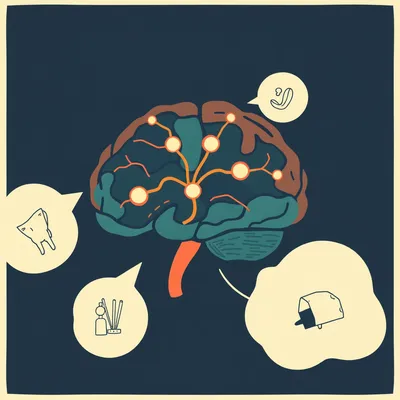
And the mechanism is where the neuroscience gets really interesting. There was a paper in Nature Scientific Reports in twenty nineteen that used fMRI to look at brain activity during creative problem-solving. They found something counterintuitive. When you're intensely focused on a problem, your prefrontal cortex is highly active — that's your executive control center. But creative insights often require a temporary downregulation of that prefrontal control.
Trying harder literally gets in the way.
The prefrontal cortex is great for focused, analytical work, but it can also keep you locked into a particular mental set. You get fixated on one approach, one framing, and the harder you push, the more entrenched that fixation becomes. When you step away and do something undemanding, the prefrontal cortex relaxes its grip, and that allows the default mode network to become more active.
Default mode network. That's the daydreaming circuit, right?
That's the one. The default mode network is a set of brain regions that become active when you're not focused on any external task — when your mind is wandering, when you're making loose associations. And it turns out this network is crucial for creative insight because it allows distant, seemingly unrelated ideas to connect in ways that focused attention would filter out.
The shower works not despite being a place where your mind wanders, but precisely because your mind wanders.
There's another layer to this. The neuroscience of creativity involves an interplay between three networks. You've got the executive attention network — your focused mode. You've got the default mode network — your wandering mode. And then you've got the salience network, which acts as a switch between them, detecting when something interesting bubbles up from the default mode and bringing it back into conscious attention.
The salience network is the guy who taps you on the shoulder and says, hey, that random thought you just had about pizza dough? That's actually the solution to your structural engineering problem.
That's a perfect way to put it. What's happening during incubation is that the salience network is monitoring the background processing. Your brain isn't just idling — it's still working on the problem, but in a different mode. The undemanding task keeps your executive network lightly occupied so it doesn't interfere, while the default mode network gets to freely associate.
Alright, so we've got the mechanism. Incubation works, it works best for creative problems, and it works best with low-demand breaks. But Daniel's second question is the one I find trickier. How do you know when to step back? Because if you step away too early, you're just avoiding hard work. If you push too long, you're spinning your wheels.
This is where the research gets more applied and less neat. But there are some really useful frameworks. The basic idea is that focused attention is a limited resource. When you've been doing intense cognitive work for an extended period, your performance degrades — you start making more errors, you get more rigid in your thinking, you're less able to see alternative approaches.
The practical question is, what's the signal? What tells you you've hit that point?
There are a few reliable indicators. One is what researchers call perseveration — when you find yourself trying the same approach over and over with minor variations, even though it's not working. That's a classic sign of cognitive fixation. If you notice you're just rearranging deck chairs on the Titanic, that's your cue.
Another one I've noticed personally is when I start getting frustrated with the problem itself rather than engaged with solving it. The emotional tone shifts. It stops being a puzzle and starts being an adversary.
That's well-documented. There's a concept called the Zeigarnik effect — named after Bluma Zeigarnik, a Soviet psychologist in the nineteen twenties. She found that people remember interrupted tasks better than completed ones. The unfinished problem creates a kind of cognitive tension, a low-level stress that keeps it active in your mind. That tension is useful — it's what keeps the problem simmering during incubation. But if it tips over into frustration or anxiety, it becomes counterproductive.
The sweet spot is enough tension to keep the problem alive in the back of your mind, but not so much that you're just stressing yourself out.
This connects to something I've seen in the research on expert performance. Anders Ericsson, the psychologist who did the famous work on deliberate practice — he found that elite performers in any domain tend to practice in sessions of about ninety minutes max, with real breaks in between. Not because they're lazy, but because sustained focused attention beyond that point yields diminishing returns.
That's interesting. So there might be a natural rhythm here that we ignore at our peril.
And for creative problem-solving specifically, the research suggests something even more counterintuitive. Taking a break isn't just about restoring depleted attention — it's actively productive. The incubation period is when a lot of the actual creative work happens. It's not downtime. It's a different kind of work time.
This is where I think a lot of productivity culture gets it wrong. The assumption is that output correlates with hours of focused effort. But if the breakthrough happens during the walk, not during the grinding, then the grinding might actually be the waste of time.
I'd push back slightly on that. The grinding is necessary too. The incubation effect only works if you've done the preparatory work. You can't incubate on a problem you haven't deeply engaged with. The initial period of intense, focused work is essential — that's what loads the problem into your working memory, what activates all the relevant neural circuits. The incubation period is when your brain reorganizes and recombines that material. Without the prep, there's nothing to reorganize.
It's not either-or. It's both, in sequence.
And the sequence matters. There's a model from Graham Wallas, who wrote about this back in nineteen twenty-six — he laid out four stages of creative problem-solving. Preparation, incubation, illumination, and verification. Preparation is the hard focused work. Incubation is stepping away. Illumination is the aha moment. Verification is checking whether your insight actually works.
Nineteen twenty-six. So this isn't new wisdom. We've known about this for a century and we still design workplaces and schools as if grinding continuously is the only path to results.
Isn't that remarkable? Wallas was writing almost a hundred years ago, and we're still rediscovering the same principles. But the neuroscience is now giving us the mechanistic explanation for what he described phenomenologically.
Alright, so let's get practical. Someone's working on a hard problem. They've been at it for a while. What are the specific signals that say step away now, not later?
I'd point to four specific signals. First, diminishing returns on time invested. If you've been working for an hour and the last fifteen minutes produced nothing new — no new ideas, no new approaches, no progress — that's a sign. Second, semantic satiation. That's when you've been staring at the same words or concepts so long they start to lose meaning. You read the same sentence five times and it's just shapes on a page.
I know that feeling intimately. The words become sounds, then just...
Third signal is what I'd call the narrowing of approach. Early in a problem-solving session, you're generating possibilities. You're divergent. As fatigue sets in, you become convergent too early — you lock onto one approach and can't see alternatives. If you notice you've stopped asking what if and started asking why isn't this working, that's the shift.
This one's underappreciated. Cognitive fatigue has physical correlates. Shallow breathing, tension in the shoulders or jaw, a kind of mental restlessness where you can't sit still but also can't focus. Your body is telling you something. Listen to it.
That's very leaf medicine of you.
I'm being serious. Stress hormones like cortisol impair cognitive flexibility. When you're physically tense from frustration, you're literally less capable of creative thought.
No, I'm with you. I'm just noting that my ancestral wisdom was ahead of the curve on this.
Your ancestral wisdom also claims sloths invented pizza.
A separate and equally valid tradition.
The practical takeaway is that these signals tend to cluster. When you notice two or three of them together — you're repeating yourself, you're frustrated, your shoulders are up around your ears — that's the moment to step away.
How long should the break be? Because I imagine there's a difference between a five-minute stretch and a two-hour walk.
The Sio and Ormerod -analysis found that breaks of around twenty to thirty minutes tended to produce the strongest incubation effects. Shorter breaks — five or ten minutes — showed weaker effects, possibly because the brain doesn't have enough time to fully disengage from the fixated approach. Longer breaks can work too, but there's a point of diminishing returns. Beyond an hour or two, you risk losing the activation — the problem stops simmering and just goes cold. There's also the practical issue that very long breaks are basically just procrastination with a scientific rationale.
Which I'm sure nobody would ever exploit.
Of course not. But here's something interesting — the quality of the break matters more than the duration. A twenty-minute walk in a natural setting tends to produce stronger effects than twenty minutes of scrolling on your phone. The phone scrolling is actually cognitively demanding in a fragmented way — it keeps your executive network engaged but not productively.
What you're saying is that doomscrolling is not a valid incubation strategy.
The research on attention restoration theory, which comes out of environmental psychology, suggests that exposure to natural environments is particularly effective for restoring cognitive function. Soft fascination is the term they use — the idea that nature captures your attention in a gentle, undemanding way that allows your directed attention to recover.
That's a lovely phrase. I'm going to use that to describe myself.
You are many things, Corn, but soft fascination is not among them.
I'm wounded. But go on — so nature walks beat phone scrolling. What about sleep? That's the ultimate step-away.
Sleep is a whole other category, and it's fascinating. There's solid research showing that sleep — particularly REM sleep — facilitates creative problem-solving. During REM, the brain is reactivating memories and experiences from the day, but it's also loosening the associative connections between them. The prefrontal cortex, which normally keeps associations tightly constrained, is less active during REM. So your brain is free to make connections that would seem nonsensical during waking hours.
Which is why dreams are so weird.
Dreams are what happens when your brain combines memories and concepts without the usual editorial oversight. And sometimes those bizarre combinations turn out to be useful. There are famous examples in the history of science — Kekulé supposedly discovering the ring structure of benzene after dreaming of a snake biting its own tail. Whether that specific story is apocryphal or not, the principle is well-established.
The advice might be — if it's a genuinely hard creative problem, sleep on it.
And there's even research on what you can do before sleep to prime the process. One study had participants work on a difficult problem, then some of them were told they'd continue working on it after a break, while others were told they were done. The ones who expected to return to the problem showed more dream incorporations of the problem material and better performance the next day.
Telling yourself this isn't over actually helps.
It keeps the problem tagged as active. Your brain prioritizes it during the consolidation processes that happen during sleep. It's like leaving a note for your nighttime brain — this one still needs work.
Alright, so we've covered the mechanism, the signals for when to step back, the types of breaks that work. But I want to push on something. You mentioned earlier that incubation only works if you've done the preparatory deep work. But there's a paradox here. The harder and more intensely you work on a problem, the more you need a break — but also the harder it is to actually take one. The fixation becomes emotional, not just cognitive.
That's a really important point. There's an emotional attachment to the problem that develops during intense work. You've invested time and effort, you feel like you're close, and stepping away feels like giving up. Even when you know intellectually that a break would help, it feels wrong.
That's where the sunk cost fallacy becomes relevant. We treat cognitive effort as an investment, and we don't want to walk away from an investment that hasn't paid off yet.
The more you've invested in a particular line of thinking, the harder it is to abandon it — even when a completely different approach would solve the problem in half the time.
How do you break that cycle? Because telling someone rationally that they should take a break doesn't help if they're emotionally committed to pushing through.
One technique that I've found useful, and that has some research support, is what's called implementation intentions. Instead of deciding in the moment whether to take a break — which is when your judgment is compromised by fatigue and fixation — you decide in advance. You set a rule for yourself. After ninety minutes of focused work, I will take a twenty-minute walk, regardless of how close I feel to a solution.
You're pre-committing. Taking the decision out of the moment.
This works because it bypasses the emotional calculus that happens when you're in the thick of it. You're not deciding whether to give up — you're just following a protocol you already established when you were thinking clearly.
That's very Stoic. Epictetus would approve.
There's also a related technique — I'm calling it Zeigarnik leverage. When you step away from a problem, don't resolve it completely in your mind. Leave a specific unresolved question hanging. Not I need to solve this whole thing, but I need to figure out why this particular piece doesn't fit. That specific unfinished question keeps the incubation process targeted.
You're giving your default mode network a specific assignment rather than just hoping it figures something out.
The research suggests that incubation is more effective when the problem is well-defined and you've identified a specific impasse. Vague incubation — I'll just stop thinking about it and hope for the best — is less reliable.
That makes sense. It's the difference between telling someone find me something interesting and find me the missing piece that connects A to B.
This connects to a broader point about how expertise interacts with the incubation effect. The more you know about a domain, the more effective incubation tends to be for you. Because your default mode network has richer material to work with — more concepts, more patterns, more analogies stored away. The wandering mind of an expert produces better insights than the wandering mind of a novice, even if both are equally relaxed.
Which is both obvious and a little discouraging if you're just starting out in a field.
It's not that novices don't benefit from breaks — they do. It's just that the quality and specificity of the insights tend to improve with expertise. But everyone benefits from the basic mechanism. The key is doing the preparatory work first. You can't incubate on a problem you haven't loaded into your brain.
Let me ask you something. You were a practicing pediatrician for years. Did you experience this in your clinical work? Were there diagnoses or treatment puzzles where stepping away made the difference?
Medicine is full of this. Differential diagnosis is essentially a creative problem-solving task — you've got a set of symptoms, some of which fit multiple conditions, some of which are contradictory, and you're trying to find the pattern that makes sense of all of it. I can remember cases where I'd been going back and forth on a difficult diagnosis, looking at labs, looking at imaging, and then I'd go home, put on some music — this was my version of the shower — and suddenly the pieces would click into place.
What was the music?
Depended on the case. Sometimes classical, sometimes something with a beat. The DJ side hustle wasn't just for fun — it was restorative. There's something about music that occupies just enough of your attention to free up the rest.
DJ Herman Poppleberry was actually practicing evidence-based cognitive restoration.
Without knowing the terminology at the time, yes. And I think a lot of people have their own version of this without realizing what's happening mechanistically. The gardener who solves work problems while weeding. The knitter who figures out a plot twist while working on a scarf. These aren't coincidences. They're the incubation effect in action.
I'm now imagining a corporate wellness program that replaces the mindfulness app with mandatory knitting circles.
Honestly, that might be more effective than a lot of what passes for corporate wellness. But let me push back on something I said earlier, because I want to be precise. I said the incubation effect is strongest for creative, divergent problems. That's true. But it's not zero for analytical problems. Even for something like debugging code or solving a math problem, there's often a creative element — finding the right representation, the right approach. And that creative element is where incubation can help.
Even if the problem seems purely analytical, there might be a framing or approach issue that benefits from stepping back.
The classic example is functional fixedness — when you're so used to using an object or a concept in one way that you can't see alternative uses. Incubation helps break functional fixedness because it weakens the associative strength of the dominant use and allows alternative associations to surface.
Give me an example of functional fixedness in a non-physical context. Not a hammer and a nail — something cognitive.
Think about someone trying to improve a business process. They've been doing it the same way for years, and when they try to optimize it, they think in terms of making the existing steps faster or cheaper. They're functionally fixed on the current process structure. What they can't see is that you could eliminate three of the steps entirely by reorganizing who does what. The structure itself is the thing they're fixed on.
Stepping away helps them see the structure rather than just the steps within it.
The break allows them to move from what cognitive scientists call a local search — tweaking parameters within the existing framework — to a more global search — questioning the framework itself.
That distinction between local and global search is really useful. Most of the time, when we're grinding, we're doing local search. We're optimizing within the box. The breakthrough usually requires stepping outside the box entirely.
Here's the thing — local search is important. You need to do it. You need to understand the problem space thoroughly. But at some point, the local search stops yielding improvements, and that's when you need the global search. The incubation break is what enables that transition.
The practical skill is recognizing when you've exhausted the local search and it's time to go global.
And I think one of the reasons people resist taking breaks is that local search feels productive even when it isn't. You're doing something. You're trying variations. You're putting in the hours. Stepping away feels like doing nothing, even though it's when the global search happens.
Our culture has a real bias toward visible effort. If I'm at my desk, staring at a screen, I'm working. If I'm on a walk, I'm slacking off. Even if the walk is when I actually solve the problem.
That bias is probably costing organizations enormous amounts of money. If the insight that saves a project arrives during a twenty-minute walk rather than during hour six of desk-grinding, then the walk was the most productive twenty minutes of the day.
Which brings us back to Daniel's question about knowing when perseverance has reached its limit. I think the answer has two parts. The first is recognizing the signals — repetition, frustration, narrowing, physical tension. The second is having the discipline to actually step away when those signals appear, even when every instinct says to push harder.
I'd add a third part. It's not just about when to step away — it's about what you do when you step away. The break needs to be restorative. Low-demand, not no-demand. Walking, showering, gardening, music, knitting — something that occupies your senses or your hands lightly but leaves your mind free to wander.
Not your phone.
Especially not your phone. The phone is the enemy of incubation. It provides exactly the wrong kind of cognitive engagement — fragmented, attention-demanding, constantly switching. It keeps your executive network occupied without giving your default mode network room to breathe.
The shower effect isn't really about the shower. It's about what the shower represents. A space where you're physically occupied but mentally free. Where the outside world can't reach you for a few minutes.
The shower is just a particularly reliable way to create those conditions. You're standing up, which is mildly physiologically activating. You're engaged in a familiar, automatic routine. There's white noise blocking out distractions. And you can't look at your phone because it would get wet.
The waterproof phone case industry is literally destroying human creativity.
I wouldn't go that far, but there's a kernel of truth there. The constant availability of distraction means we have to be more intentional about creating incubation spaces. Previous generations got them naturally — waiting in line, walking places, doing manual chores. We've engineered a lot of those natural gaps out of our lives.
We need to engineer them back in.
And I think that's actually a more useful framing than just take more breaks. It's about designing your day so that incubation spaces exist. Scheduled walks without headphones. A commute without podcasts. A lunch break where you actually step away from your desk.
I'm going to push back on the no-headphones thing, because you just said music helped you with diagnoses.
It depends on the music and the problem. Instrumental music, familiar music, music without lyrics — that can serve the same low-demand function as ambient noise. But if you're listening to a podcast or an audiobook, that's not incubation. That's just more cognitive input.
It's about whether the auditory input demands processing or just provides atmosphere.
The principle is the same — you want something that occupies just enough of your attention to prevent you from consciously returning to the problem, but not so much that it prevents the default mode network from doing its thing.
Alright, let me try to synthesize what we've covered. The shower effect is real, it's called the incubation effect in the literature, and it works because stepping away from focused effort allows your default mode network to make loose associations that your focused prefrontal cortex would filter out. It works best for creative, divergent problems where you need fresh approaches rather than more grinding. Low-demand breaks — walking, showering, gardening — are more effective than either total rest or cognitively demanding breaks. The signals that you need a break include repetition without progress, emotional frustration, narrowing of approach, and physical tension. And the discipline to actually take the break requires pre-commitment, because in the moment your brain will tell you to keep pushing.
That's a solid summary. The only thing I'd add is the preparation requirement. Incubation only works if you've done the hard preparatory work first. The break isn't a substitute for deep engagement — it's a complement to it.
The full picture is: work hard, step away at the right moment, do something low-demand, and trust that your brain is still working even when it doesn't feel like it.
And that last part — trust — is surprisingly important. If you spend your entire break anxiously thinking about the fact that you're not working on the problem, you're not actually incubating. You're just stressing in a different location.
Which defeats the purpose.
The incubation effect requires actual disengagement from the problem at the conscious level. Not suppression — you're not trying to not think about it. You're just letting your attention rest elsewhere and trusting that the background processing will deliver when it's ready.
There's something almost spiritual about that. The idea that your brain knows more than your conscious mind has access to, and you have to get out of your own way to let it speak.
I wouldn't go full mystical on it, but there's a reason this experience has been described in almost spiritual terms throughout history. The muses, divine inspiration, the eureka moment — these are pre-scientific descriptions of the same phenomenon. The difference is we now understand it as a feature of how the brain works rather than an external visitation.
Though I have to say, if a muse did show up in my shower, I'd probably just be annoyed about the lack of privacy.
That's very on-brand for you.
I value my shower time. It's when I do my best thinking and also my best napping.
You nap in the shower?
I'm a sloth. We're efficient about these things.
That's not efficiency, that's a safety hazard. But moving on — I think there's one more angle worth touching on. The research on incubation has implications for how we structure education and work. If creative breakthroughs depend on this rhythm of focus and disengagement, then environments that demand constant focus are actively suppressing creativity.
The open-plan office, the packed school schedule, the culture of busyness as a status symbol — all of it works against the very thing it claims to value.
This isn't just speculation. There's research on what's called psychological detachment — the ability to mentally disconnect from work during non-work time. People who achieve better psychological detachment show higher levels of creativity, better problem-solving, and lower burnout. The inability to detach is a predictor of creative stagnation.
The person who can't stop thinking about work isn't a harder worker. They're just a less effective one.
In the long run, yes. And that's a message that I think a lot of people need to hear, because the culture tells them the opposite.
Alright, so what's the one thing you'd want someone to take away from this? If they remember nothing else from this episode?
That stepping away isn't giving up. It's a different phase of the work. The break is part of the process, not an interruption of it. And your brain is smarter than you are — sometimes you need to get out of its way.
I'd add: learn to recognize your own signals. The frustration, the repetition, the physical tension. Those aren't signs that you need to try harder. They're signs that you need to try differently, and the first step of trying differently is often not trying at all for a little while.
Now: Hilbert's daily fun fact.
Hilbert: In the nineteen twenties, beekeepers on the Faroe Islands discovered that honey produced from angelica flowers had an unusual acoustic property — when a jar was tapped with a spoon, it produced a distinctly higher-pitched ring than honey from any other floral source, a phenomenon local farmers attributed to the angelica nectar's unusually low water content and high fructose crystallization pattern.
...right.
I have so many questions, none of which I'm going to ask.
Truly, the acoustics of Faroese honey is something I never knew I didn't need to know.
This has been My Weird Prompts. Thanks to our producer Hilbert Flumingtop, and thanks to Daniel for the question.
If you enjoyed this, leave us a review wherever you get your podcasts. It helps more than you'd think.
Until next time.