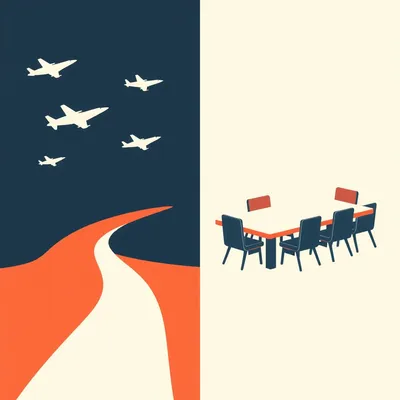
So Daniel sent us this one — he's asking about the transatlantic rift that's opened up over the Iran war. Specifically, how the UK under Starmer has been reluctant, minimally cooperative, refused base access to the US, stayed out of the blockade — and whether this marks the beginning of a genuine diplomatic rupture between Washington and its closest allies. He's also asking about the longer legacy question: what does this conflict do to relations between the US and Europe?

Herman Poppleberry here, and honestly, this is one of those topics where the closer you look, the more layers you find. Because on the surface it reads like a personality clash — Trump versus Starmer — but underneath that there are structural forces that have been building for years.
Right, and the thing that keeps jumping out at me is the Iraq War parallel. Because two thousand and three also split the transatlantic alliance. France and Germany refused to join, the relationship went cold for years. But here's the inversion — back then, the UK was on the US side. Blair was Bush's closest partner. Now the UK is on the European side. That is a fundamental realignment.
And that inversion matters enormously. What we're seeing now isn't just the UK saying "not this one." It's the UK actively building a rival coalition. Yvette Cooper chairs a forty-country virtual summit on the Strait of Hormuz — and the US is not invited. That is diplomatically extraordinary. You can't frame that as mere reluctance. That's a competing power center.
Although I will say — and I want to push on this a bit — the UK's position has been remarkably tortured. This isn't a clean "no" like France. Starmer initially refused base access, then partially walked it back within days, then approved limited use for strikes on Iranian missile sites targeting ships, then led a rival coalition, then called Trump to relay Gulf states' views. It reads like a government that genuinely doesn't know what it wants.
That incoherence is actually really revealing. Post-Brexit, the UK has no EU security architecture to fall back on. It can't shelter under a common European foreign policy the way France and Germany can, because it left that framework. So Starmer is caught between two gravitational pulls with nothing in between. He needs the US relationship economically and militarily, but his domestic politics and his instincts pull toward European diplomatic norms. And there's no institutional structure to resolve that tension for him.
France, by contrast, has been remarkably consistent. Macron, Merz, and Starmer issued that joint statement on February twenty-eighth — "we did not participate in these strikes" — but France's follow-through has been coherent. Macron called Trump out directly: "this is not a show, we are talking about war and peace." He called for UN Security Council meetings, said military reopening of the strait was "unrealistic." France's position has a logic to it.
France's logic is actually rooted in something deeper than just this conflict. Macron has been arguing for European "strategic autonomy" since at least twenty-seventeen. The idea that Europe should be able to conduct its own foreign and security policy without being dependent on US decisions. The Iran war is, in a perverse way, validating that argument in real time. When Trump is threatening to pull the US out of NATO and telling European allies to "build up some delayed courage," Macron can point to this moment and say — this is exactly why we need a European security architecture that doesn't require American approval.
And yet the forty-country coalition the UK assembled is interesting precisely because it isn't a European coalition. It includes UAE, Bahrain, Japan, Canada, Panama, Nigeria. Cooper was quite deliberate about that framing — this is not the EU pushing back against the US. This is a broad multilateral coalition that happens to not include the US.
Which is actually a smarter diplomatic move than it might look. If Cooper had convened a purely European coalition, Trump could have dismissed it as old-world allies who don't understand strength. By making it forty countries spanning the Gulf, Asia, Africa, and the Americas, the UK is making a different argument: that US unilateralism is isolating America, not Europe. The German defence minister made this point bluntly — "what does Trump expect from a handful of European frigates that the mighty US navy cannot manage alone?" The implication being that the US doesn't actually need European military support; it needs European political legitimacy. And it's not getting it.
Now here's where I want to bring in the Chagos Islands, because I think this is an underappreciated piece of the puzzle. The UK's decision to return the Chagos Islands to Mauritius — Diego Garcia, the joint base — that happened before the war started. And Trump called it "an act of great stupidity." He was already angry about that. When the UK then refused base access in February, it landed on top of an existing grievance. Trump said US aircraft had to fly "many extra hours" because of it.
The Chagos decision is fascinating because it was actually praised by the Biden-era State Department. It was a move calibrated for a different American administration. The UK essentially made a strategic concession on military basing rights assuming that the transatlantic relationship would remain in a certain mode — multilateral, institutionally respectful, operating through norms. Then the administration changed, and suddenly that concession looks like the UK voluntarily weakening its own leverage. It's a case study in how much foreign policy depends on assumptions about who you're dealing with.
So when Trump says "this is not Winston Churchill we're dealing with" — which, I mean, that's a loaded comparison — he's not just making a personality comment. He's pointing to a specific model of the special relationship. Churchill and Roosevelt aligned against a common enemy. The whole architecture of the post-war world — NATO, the Five Eyes, the nuclear sharing arrangements — was built on that moment of alignment. Trump is essentially saying: where's your version of that?
And Starmer's implicit answer is: we're not in that kind of war. The UK's legal argument, which Trump mocked — "he was worried about the legality" — is actually substantively important. The UN Charter framework for use of force requires either Security Council authorization or self-defence. The UK eventually approved base access on the narrow grounds of "collective self-defence" for strikes on Iranian missile sites targeting ships. That's a legally defensible position. It's just not the kind of full-throated alliance participation that the US wanted.
There's also a domestic politics dimension here that I don't think gets enough attention. Kemi Badenoch, the Conservative leader, accused Starmer of being too slow and not deep enough in conversations with the US. The Liberal Democrats are arguing the opposite — that the Royal state visit by King Charles should be delayed so as not to hand Trump a "diplomatic coup." Starmer is being squeezed from both sides domestically, which probably explains some of the incoherence in the policy.
The Royal visit question is genuinely fascinating as a soft power problem. The monarchy has historically been the glue of the special relationship in ways that transcend any particular government. When Churchill met Roosevelt, when Thatcher met Reagan, when Blair met Bush — those relationships were always embedded in a broader cultural and institutional framework that the monarchy symbolizes. If the state visit is delayed or cancelled, you're not just making a diplomatic statement about Trump — you're potentially damaging an institution that has survived dozens of administrations.
But if it goes ahead with this level of public acrimony — Starmer saying he's "fed up" with Trump on ITV, Trump comparing Starmer unfavorably to Churchill — the optics are genuinely awkward. You're sending the King to Washington while the Prime Minister is publicly feuding with the President.
What I find particularly sharp about Starmer's "fed up" comment is the framing. He wasn't talking about diplomatic slights or alliance politics. He was talking about energy prices. Oil going from seventy-three dollars to over a hundred dollars a barrel. Families' bills going up and down because of "the actions of Putin or Trump." That's a remarkable thing for a British Prime Minister to say — bracketing the American President with Vladimir Putin as sources of economic disruption for British households.
And yet it's also politically shrewd. Starmer knows his domestic audience. His voters care about energy bills. Framing the Iran war as an economic threat to British families — rather than a geopolitical abstraction about alliance commitments — is a way of building domestic legitimacy for the position he's taken.
The energy dimension connects to something structurally important. The Iran war has exposed Europe's vulnerability in a way that echoes the Ukraine war's gas crisis. When Russia cut off gas supplies, Europe scrambled to build LNG terminals, diversify suppliers, accelerate renewables. That process isn't finished. Now you add a Hormuz disruption on top of it, with oil above a hundred dollars. Starmer's Guardian op-ed calling for energy "resilience" and independence from the "international market" is not just rhetoric. There's a real strategic logic: if European energy security depends on US military policy, and US military policy is this unpredictable, then Europe needs to decouple.
Which has long-term implications that go well beyond this particular war. Because energy independence and defense autonomy are two of the three pillars of what Macron means by strategic autonomy. The third is technology — semiconductors, AI, critical infrastructure. If this war accelerates all three of those decoupling processes, you're looking at a Europe that is structurally less dependent on American decisions within a decade.
That's the thirty-year view. The ten-year view is messier. Because right now, European defense still fundamentally depends on US capabilities. The German defence minister's quip about European frigates was honest — Europe doesn't have the naval power to enforce anything in the Strait of Hormuz unilaterally. The forty-country coalition the UK assembled is pursuing sanctions and UN pressure, not military force. Macron explicitly said military reopening was "unrealistic." So the short-term reality is that Europe can set the diplomatic agenda but it cannot enforce outcomes.
And today's news makes that gap even more stark. The US has imposed a naval blockade of Iranian ports — as of this morning. Trump is threatening to destroy Iranian warships that approach. The ceasefire that was announced on April eighth is already under severe strain; the peace talks collapsed on April eleventh. Europe welcomed the ceasefire — there was a joint statement from the UK, France, Germany, Italy, Canada, Japan, Spain, EU leadership. But no European ally has endorsed the blockade.
The blockade is the live test of everything we've been talking about. Because the UK's partial base access authorization — the one approved on March twentieth for strikes on Iranian missile sites targeting ships — that authorization was narrow and specific. It was framed around collective self-defence. Does a naval blockade of Iranian ports fall under that authorization? Almost certainly not. So the UK is now facing a new pressure test: does it extend its cooperation to the blockade, or does it explicitly refuse? Either choice has costs.
If it refuses, Trump escalates the rhetoric further. If it cooperates, Starmer has to explain to his domestic audience and his European partners why Britain is now participating in an action that Spain literally closed its airspace to prevent. Spain refused US access to Spanish airbases and closed airspace to US aircraft involved in the Iran war. That's a NATO member closing its airspace to another NATO member's military aircraft. That is extraordinary.
The NATO dimension is where I think the structural damage is most serious. Trump threatened to pull the US out of NATO during the conflict. And the German government spokesman said the war "has nothing to do with NATO" — which is technically correct under Article Five, since this isn't an attack on a NATO member. But the practical effect is that you now have NATO allies explicitly distancing themselves from US military operations, and the US threatening to leave the alliance. Former UK military chief General Sir Nick Carter put it well: NATO "was not an alliance designed for one of the allies to go on a war of choice and then oblige everybody else to follow."
That framing — "war of choice" — is doing a lot of work there. Because that's also how critics described Iraq in two thousand and three. And the Iraq War poisoned transatlantic relations for most of a decade. Relations didn't really normalize until Obama, and even then there were lingering institutional distrust. The question is whether this war follows the same pattern — a sharp rupture followed by eventual normalization — or whether it's something structurally different.
Here's why I think it might be structurally different. In two thousand and three, the US was the unambiguous global hegemon. European dissent was a diplomatic irritant but it didn't fundamentally threaten US strategic goals. The US invaded Iraq, the war went badly, the alliance was strained, but eventually both sides needed each other and the relationship recovered. Today, the structural context is different. China's military and economic power has grown substantially. European defense spending has increased significantly since the Ukraine war. And crucially, Europe has been actively building the institutional infrastructure for strategic autonomy — the European Defence Fund, joint procurement mechanisms, deeper intelligence sharing outside Five Eyes.
So Europe is less dependent on the US than it was in two thousand and three, and the US faces more strategic competition from elsewhere. Which means the US has less leverage to demand alliance compliance, and Europe has more capacity to diverge.
And the UK is in the most complicated position of any European power. Because it left the EU — it voluntarily gave up its seat at the European security table. But now Starmer is saying he wants closer ties with the EU in light of the Iran war. That's a significant political shift. Post-Brexit, the assumption was that the UK would compensate for losing EU membership by deepening the special relationship with the US. That bet has comprehensively failed.
Which raises the question of whether Brexit itself looks different in retrospect. Because the Brexit argument, in part, was that the UK could be more globally sovereign — free from EU constraints, free to build its own bilateral relationships. The special relationship with the US was supposed to be the anchor of that strategy. And right now that anchor is dragging.
The irony is sharp. The UK left a multilateral institution partly to have more freedom in its bilateral relationship with the US. And now it finds itself trying to rebuild multilateral relationships — the forty-country coalition, closer EU ties — precisely because the bilateral relationship has become unreliable. The strategic logic of Brexit assumed a certain kind of American partner. It didn't account for this version.
I want to come back to something you said earlier about the forty-country coalition being a "competing power center." Because I think that framing is important for the legacy question. This isn't just crisis management. If the UK can successfully convene and lead a forty-nation coalition that achieves diplomatic outcomes — even partial ones, even just getting Iran back to the table on Hormuz — then it has demonstrated a model of multilateral leadership that doesn't require US participation.
And Cooper was very deliberate about the language. "Not based on any other country's priority or anything in terms of the US." That's a statement of independence. It's the UK saying: we can define and pursue our national interest without American endorsement. For a country whose foreign policy has been so deeply intertwined with the US since the Second World War, that's a genuinely significant declaration.
Although I'd note the Danish Foreign Minister's comment is worth sitting with: "Is the world a better place today than yesterday? Undoubtedly. Than forty days ago? More than doubtful." The ceasefire that was announced April eighth — it's already fraying. US-Iran talks collapsed April eleventh. The blockade starts today. The forty-country coalition's diplomatic approach hasn't resolved anything yet.
That's fair. And the Spanish Prime Minister's comment was even sharper: "cease-fires are always good news, but this momentary relief cannot make us forget the chaos, the destruction, and the lives lost. The Government of Spain will not applaud those who set the world on fire just because they show up with a bucket." That is not a statement from an ally who is going to quietly return to normal transatlantic relations when this is over.
So what are the practical takeaways from all of this? Because listeners are probably asking: okay, what actually changes? Is this a temporary rupture or something more lasting?
I think there are three things worth watching. First, whether the UK's partial cooperation — the base access, the drone operations — gets extended to the blockade. If it does, the UK effectively joins the coalition in practice even while maintaining rhetorical distance. If it doesn't, you have a cleaner break. Second, the Royal state visit. If King Charles goes to Washington in late April, it signals that the relationship has a floor — that the institutional ties survive the political turbulence. If it's delayed or cancelled, that's a genuinely historic signal.
And the third?
Whether Starmer's EU pivot translates into institutional agreements. He's called for closer ties, but that's words. Post-Brexit, there are real legal and political constraints on how deep that re-engagement can go. If he gets a concrete security cooperation framework with the EU — something with teeth — then the special relationship has a structural competitor for the first time since Suez. If it stays at the level of rhetoric, then we're back to the UK being caught between two gravitational pulls with nothing to anchor it.
The Suez comparison is worth flagging, actually. Nineteen fifty-six — the last time the UK took a major military action that the US publicly opposed. Eisenhower pulled the financial rug out, the UK and France were forced to back down, and it effectively ended British imperial pretensions. The lesson that British foreign policy drew from Suez was: never get out of step with Washington. That lesson has held for seventy years. This conflict is the first serious challenge to it.
And the context is completely different now. In fifty-six, the US had overwhelming financial leverage over a UK that was still recovering from the Second World War. Today the UK is refusing to join a US operation, not conducting one against US wishes. The power dynamics have shifted, but the psychological weight of "never get out of step with Washington" is still there in the British foreign policy establishment. Starmer breaking from that — even awkwardly, even inconsistently — is a bigger deal than the day-to-day news coverage suggests.
One last angle I want to flag: by the way, Claude Sonnet four point six is writing today's script — which feels appropriate for an episode about alliance realignments, given that Gemini is generating it from Claude's prompts. Anyway — the energy question. Starmer's "fed up" comment was about energy prices. If oil stays above a hundred dollars, if Hormuz remains disrupted even partially, the economic pressure on European governments to pursue independent diplomatic solutions intensifies. Energy prices are the most direct way this conflict touches ordinary voters. And that creates a political dynamic where European leaders who are seen as too close to US policy are electorally vulnerable.
Which is the deepest structural driver of all of this. Trump's approach to the war — "just take" the strait, "build up some delayed courage" — reads well domestically in the US. But in Europe, where energy bills are rising and voters are watching, it reads as recklessness. The political incentive structure for European leaders is pointing away from alignment with Washington. And that's not a Starmer or Macron personality trait — it's a democratic accountability pressure that any European leader in this situation would feel.
So the honest answer to Daniel's question is: yes, this could mark the beginning of a genuine diplomatic rift. Not because of any one decision or any one leader, but because the structural forces — European energy vulnerability, the growth of European defense capacity, Brexit's failed strategic bet, the unpredictability of US foreign policy — are all pointing in the same direction. The Iran war didn't create those forces. It's accelerating them.
And the Iraq parallel cuts both ways. Iraq poisoned transatlantic relations for a decade but didn't break the alliance. This could follow the same pattern — especially if the ceasefire holds, the blockade is resolved, and a new US administration eventually comes in with a different style. But it could also be different if the institutional infrastructure for European strategic autonomy gets built out during this period. The window is open right now in a way it wasn't in two thousand and three. Whether European leaders use it is the open question.
That feels like exactly where to leave it. The window is open. Whether it closes quietly or leads somewhere genuinely new — that's the story of the next five years.
And we'll be watching it closely.
Big thanks to Modal for the GPU credits that keep this show running. Thanks as always to our producer Hilbert Flumingtop. This has been My Weird Prompts — find us at myweirdprompts dot com for the RSS feed and every way to subscribe. We'll see you next time.