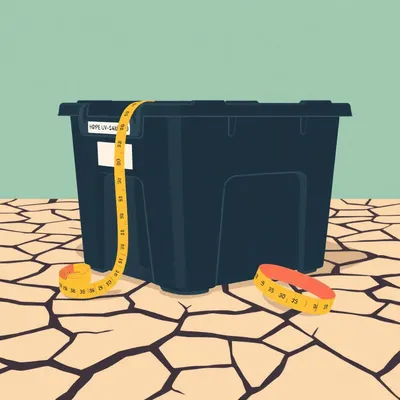
Daniel sent us this one — and it's personal. He bought a Keter storage bench, an Israeli company by the way, and six months later it's basically a pile of plastic confetti. The thing disintegrated. He's been thinking about industrial storage systems, the Eurobox philosophy, and he's asking whether professional users like warehouses have outdoor storage needs that are met by products consumers can actually buy. Specifically, are there plastic bins rated to withstand harsh UV conditions, the kind we get here in Israel, that won't fall apart after one summer? And if so, what are they called?

This is one of those questions where the answer is yes, absolutely, but the path to finding them is deliberately obscured by the consumer retail industry. And the Keter example is actually perfect. Keter is an Israeli company — they know exactly what the Israeli sun does to plastic. They've been manufacturing resin-based products for decades. And yet, their consumer outdoor line still falls apart in six months. That's not incompetence. That's a business model.
The musical equivalent of beige wallpaper with a six-month expiration date.
And here's the thing — warehouses DO have outdoor storage needs. Think about any industrial yard. They're storing raw materials, waste products, equipment, palletized goods waiting for transport. All of it sitting in direct sun, sometimes for years. The difference is, when a factory's outdoor storage fails, the purchasing manager doesn't write a bad review on Amazon. They call their industrial supplier and say "send me the ones that don't do that.
There's a whole parallel universe of plastic storage that actually works.
And it's not sold at Home Depot or IKEA. It's sold through industrial supply catalogs, and it has specific material designations that tell you exactly what you're getting. The core question here isn't "does UV-resistant outdoor storage exist." It's "how do I learn to read the label like a professional buyer instead of a consumer.
Which is basically the thesis of this entire podcast applied to one specific problem.
The industrial supply chain is the hidden source of durable goods. And the trick is knowing the names, the standards, and the suppliers. Once you know those three things, you stop being a consumer and start being a buyer.
Let's start with the disaster. What actually happened to Daniel's Keter bench at the molecular level? Because I think most people look at a disintegrated storage bench and think "cheap plastic." But there's actual physics happening.
And understanding it is the key to never getting burned again. So here's what's going on. Most consumer outdoor plastic products are made from polypropylene, or PP, or polyethylene, which is PE. These are long chains of carbon atoms with hydrogen attached. Think of them like microscopic spaghetti strands, all tangled together. That tangling is what gives the plastic its strength and flexibility.
The plastic is structurally pasta.
Structurally pasta, yes. And UV-B photons from sunlight are like tiny, very energetic scissors. When a UV-B photon hits one of those carbon-carbon bonds, it has enough energy to break it. The polymer chain gets snipped. Do that enough times, across millions of chains, and your tangled spaghetti becomes short little bits of nothing. The plastic can't hold itself together anymore.
That's the embrittlement, the chalking, the cracking.
The technical term is photo-oxidative degradation. The UV light initiates a chain reaction where oxygen in the air attacks the broken polymer ends, and the whole thing cascades. The surface starts to chalk — that white powder you see on old plastic — and then micro-cracks form, and then one day you sit on your storage bench and it just gives way.
In Israel specifically, this happens on fast-forward.
Dramatically fast-forward. Israel's UV index in summer is ten to eleven. That's extreme. Most of Europe and the United States sits at six to eight. The UV index is logarithmic, by the way — a UV index of ten is not twenty-five percent more than eight. It's substantially more damaging. So a product tested for "outdoor use" in, say, Germany, where the UV index might peak at seven, is getting a fundamentally different experience in Tel Aviv.
When Keter, an Israeli company, designs a product that fails in Israel, they're not confused about what happened. They made a choice about what to put in the plastic.
They made a cost decision. And this is where the chemistry gets interesting. The solution to UV degradation has been known for decades. You add stabilizers to the plastic during manufacturing. There are three main types. The first is carbon black — literally just fine carbon particles dispersed through the plastic. At two to three percent loading, carbon black is the gold standard for UV protection. It absorbs UV photons and dissipates the energy as heat before they can break the polymer chains. HDPE with carbon black can last decades outdoors.
Which is why every industrial outdoor plastic product is black.
That's the black bin rule. If it's black and made from HDPE, it's probably UV-stabilized. Not definitely — some manufacturers use cheap dyes that look black but offer zero protection — but probably. The second type is hindered amine light stabilizers, or HALS. These don't absorb UV — they scavenge the free radicals that form when polymer chains break, stopping the cascade reaction before it can spread. HALS are more expensive than carbon black, but they allow you to make colored plastics. The third type is UV absorbers, which work similarly to carbon black but are transparent or can be formulated for specific wavelengths.
Consumer products use the cheapest possible version of all of this.
Or none at all. A consumer deck box from a big-box store might have just enough stabilizer to survive the warranty period — maybe a year or two in moderate climates. In Israel, that same product gets six months. The stabilizer package is the single biggest cost variable in outdoor plastics, and it's completely invisible to the consumer. You can't see it, you can't feel it, you can't test it at the store. You only find out six months later when your bench is a pile of dust.
It's the perfect scam. Sell a product whose failure mode is invisible at purchase and only manifests after the return window closes.
It's not even illegal, because terms like "outdoor" and "weatherproof" on consumer packaging are essentially unregulated marketing claims. There's no legal standard for what "outdoor" means. It could mean "survives on a covered porch in Seattle" or "direct sun in the Negev desert for a decade." The consumer has no way to know which.
How do industrial buyers solve this? They can't afford to have their yard storage disintegrate.
They use standards. Specifically, ASTM D2565 and ISO 4892. These are accelerated weathering tests. You put the plastic in a xenon-arc weatherometer — a machine that blasts it with intense UV light, controls temperature and humidity, and simulates years of outdoor exposure in weeks. For outdoor-rated industrial plastics, the standard is a thousand to two thousand hours of xenon-arc exposure. That translates to roughly five to ten years of real-world outdoor use in a moderate climate.
Consumer products are tested to what?
Often three hundred to five hundred hours. Or not tested at all. The manufacturer might do some internal testing, but they're not required to publish the results or meet any specific threshold. If a consumer deck box has been through ASTM D2565 testing at all, they'll usually advertise it prominently. If they don't mention it, assume it hasn't been tested.
The consumer is essentially buying blind, while the industrial buyer is buying to a specification.
That specification is embedded in the material grade. This is where it gets practical. When an industrial buyer orders UV-stabilized storage, they're not ordering "a black tote." They're ordering a product made from a specific resin grade. For polypropylene, you might see something like LyondellBasell's Pro-fax UV-stabilized grades. For HDPE, Borealis makes a grade called Borstar HE3490-LS — the LS stands for light-stabilized. These are not retail brand names. You'll never see "Pro-fax" on a shelf at Home Depot. But they're the actual material specifications that determine whether the product survives outdoors.
The brand on the label is almost irrelevant. The material underneath is everything.
The brand tells you who molded the plastic. The material grade tells you whether it will survive. And here's the frustrating thing — the material grade is rarely printed on consumer products. On industrial products, it often is. Look at the bottom of a proper industrial bin and you'll often find a recycling code plus a material designation. PP, HDPE, sometimes with additional markings. UV-stabilized variants will sometimes have a "UV" or "L" suffix in the product code.
Which connects back to Euroboxes. Standard Euroboxes, the DIN 3269 ones we've talked about, are indoor products.
Standard Euroboxes are made from polypropylene with no UV stabilization. They're designed for warehouse use — controlled environment, no direct sunlight. If you put a standard Eurobox outside in Israel, it'll start degrading within months. But — and this is the key — there ARE UV-stabilized Eurobox variants. They're typically gray or black, and they'll have a "UV" or "L" designation in the product number. They cost about thirty percent more than the standard versions. And they're used in outdoor logistics — automotive parts storage in yards, agricultural supply chains, that kind of thing.
The Eurobox system does extend outdoors, you just need to know which suffix to look for.
And this is the industrial trickle-down concept. The consumer market takes the industrial standard, strips out the expensive stabilizers to hit a price point, slaps a lifestyle brand on it, and sells it as "outdoor furniture." The industrial original is still out there, often cheaper per year of service, but you have to know it exists.
Covering the covers. The real product is hidden behind the fake version of itself.
That's a perfect way to put it. And the fake version is what most people buy because it's what's available and what's marketed.
Let's get concrete. If someone in Israel — or Arizona, or southern Spain, or anywhere with a UV index above eight — wants outdoor plastic storage that won't die, what specifically should they be looking for?
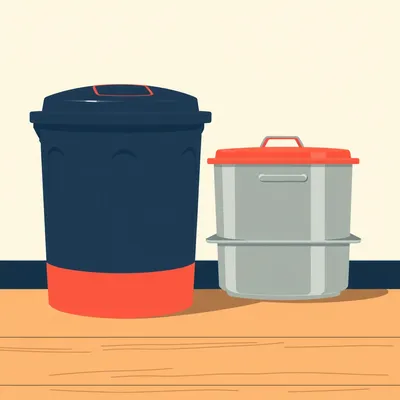
Let me break this into categories. First, the industrial tote market. These are heavy-duty bins in the twenty to fifty gallon range, designed for job sites, truck beds, and industrial yards. The gold standard example is Rubbermaid's ActionPacker line. These are made from UV-stabilized HDPE, they've been around for decades, and they're genuinely durable. They're getting harder to find as Rubbermaid shifts toward cheaper consumer lines, but they're still available through industrial suppliers.
What does " durable" mean in practice?
I've seen ActionPackers that have lived in the back of pickup trucks in the Southwest for five-plus years and they're still functional. But structurally intact. Compare that to a Keter bench that's dust in six months. The difference is entirely in the stabilizer package.
Rubbermaid ActionPacker is one name.
Akro-Mils is a major industrial bin manufacturer. They have a line called WeatherGuard that's specifically UV-stabilized for outdoor use. These are stackable totes, often used in manufacturing and logistics. Quantum Storage Systems makes UV-resistant bins as well — you'll find them through industrial distributors, not retail stores. And then there's Allit, a German company. Their Profi-Plus line includes UV-stabilized variants in the six hundred by four hundred millimeter Eurobox footprint. Those are used in automotive logistics for outdoor parts storage. You can get them through European industrial distributors and they'll ship internationally.
The pricing on these?
Here's where the total cost of ownership math gets interesting. A consumer deck box from Keter or Suncast might cost a hundred and fifty dollars and last six months in extreme UV. An industrial UV-stabilized tote from Akro-Mils or Quantum might cost eighty dollars and last five-plus years. Per year of service, the industrial option is dramatically cheaper. It's just that the upfront cost feels higher because you're comparing it to a similar-sized consumer bin that costs thirty dollars and dies in a year.
The consumer is actually paying more over time for the privilege of worse performance.
This is the false economy at its purest. And it's exactly the same dynamic we talked about with Euroboxes versus IKEA storage. The industrial product costs more upfront, but you buy it once. The consumer product is designed to be replaced.
Like adopting a feral cat. You think you're saving money, but you're signing up for recurring disappointment.
Recurring trips to the store, and recurring assembly, and recurring frustration. The industrial buyer's mindset is "what's the cost over the service life?" The consumer mindset is "what's the cheapest option right now?" And retailers are perfectly happy to let you stay in that mindset.
What about the buying process itself? If I'm a regular person, not a purchasing manager with a corporate account, how do I actually acquire these things?
This is the practical hurdle. You're not going to find these products on Amazon — or if you do, they'll be mislabeled, overpriced, or the wrong variant. The real sources are industrial suppliers. In the US, that's Grainger, McMaster-Carr, and Uline. McMaster-Carr in particular is excellent because their product descriptions are detailed and honest. If something is UV-stabilized, they'll say so. If it's not, they won't pretend.
For someone in Israel?
The Israeli industrial supply market is smaller but it exists. There are local distributors for European brands like Allit and Auer. You can also order from European industrial suppliers — many will ship to Israel. The key is knowing what to search for. Don't search for "outdoor storage bench" or "deck box." Search for "UV-resistant bulk container" or "outdoor storage tote industrial" or "weatherproof HDPE bin." The search terms themselves filter out the consumer junk.
It's not just about knowing the products. It's about knowing the vocabulary.
The vocabulary is everything. When you search like a consumer, you get consumer results. When you search like a buyer, you get industrial results. The words "UV-stabilized HDPE" in your search query will do more to find you a durable product than any brand name.
Let's talk about the black bin rule more carefully. You mentioned it's not foolproof.
The rule of thumb is: if it's black and made from HDPE, it's probably UV-stabilized because carbon black is the cheapest and most effective UV stabilizer for polyethylene. But "probably" is doing a lot of work there. Some manufacturers use black dyes or pigments that look identical but offer no UV protection whatsoever. The plastic is black, but it's cosmetically black, not functionally black.
How do you tell the difference?
You look for a UV rating or ASTM test data in the product specifications. If the manufacturer has actually put carbon black in the resin for UV protection, they'll usually say so — because it costs more and they want credit for it. If the product description just says "black" and nothing about UV resistance, assume it's cosmetic. Also, look for the recycling code. HDPE is number two. PP is number five. If it's HDPE and black and the manufacturer mentions UV resistance or outdoor use, you're probably in good shape. If it's PP and black, you need to dig deeper because carbon black is less commonly used in PP — they tend to use HALS instead, and HALS loading varies wildly.
What about the gray bins? You mentioned UV-stabilized Euroboxes are often gray.
Gray is an interesting case. For industrial bins, gray often indicates a UV-stabilized variant. The gray color comes from a combination of carbon black at low loading plus titanium dioxide or other pigments. You get some UV protection from the carbon black, but not as much as a fully black bin. The advantage is you can see inside the bin more easily, which matters for inventory management. A fully black bin is a black hole — you can't tell what's at the bottom without emptying it.
There's a functional tradeoff between UV protection and usability.
And it's the kind of tradeoff that industrial buyers think about explicitly and consumers don't think about at all. A warehouse manager choosing outdoor storage bins will weigh "do I need maximum UV life, or do I need to be able to see what's in these things?" A consumer just buys the beige one because it matches the patio furniture.
The beige one that's going to be chalk dust by September.
The beige one is almost certainly the least UV-resistant option available. Light colors reflect visible light, which keeps the bin cooler — and that's actually good for some aspects of durability — but they provide essentially no UV absorption in the plastic itself. So the polymer chains are getting hammered by photons while the bin sits there looking pleasant.
Let's talk about the specific numbers on UV testing. You mentioned ASTM D2565 and a thousand to two thousand hours.
ASTM D2565 is the standard for xenon-arc exposure of plastics intended for outdoor applications. A thousand to two thousand hours in the weatherometer is the typical benchmark for "this product is rated for continuous outdoor exposure." In a moderate climate — say, UV index six to eight — that translates to roughly five to ten years of real-world service life. In an extreme climate like Israel with UV index ten to eleven, you'd want to be at the high end of that range, or even beyond it.
If a product doesn't mention ASTM testing at all?
Assume it hasn't been tested. Or assume it's been tested to a lower standard like three hundred hours, which might get you through a year or two in a mild climate. The absence of test data is itself information. Industrial suppliers publish this data because their customers demand it. Consumer brands hide it because their customers don't know to ask.
The information asymmetry is total. The industrial buyer knows exactly what they're getting. The consumer knows nothing and is actively misled by marketing.
This is why the episode matters right now. We're heading into peak UV season in the Northern Hemisphere. June and July are when people are shopping for outdoor storage, setting up their patios, organizing their yards. Every purchase made in the next six weeks is a purchase that will either survive or disintegrate based on decisions made at the molecular level that the buyer can't see.
The timing on this is actually urgent. People are about to waste money.
They're about to waste money in predictable, preventable ways. And the fix isn't complicated. It's just hidden. The industrial supply chain has solved this problem. The products exist. They're not even that expensive when you do the math. But you have to know they exist.
Let's talk about some specific case studies. You mentioned the Allit Profi-Plus line.
The Allit Profi-Plus in UV-stabilized PP is a great example. It comes in the six hundred by four hundred millimeter Eurobox footprint, which means it stacks and interlocks with standard Eurobox systems. It's used in automotive logistics — think BMW or Mercedes parts distribution — where bins sit outdoors in storage yards for extended periods. The UV-stabilized version is explicitly rated for outdoor exposure. You can find it through European industrial distributors. It's not cheap — you might pay fifteen to twenty euros per bin — but it'll last.
Compare that to a Keter deck box at a hundred and fifty dollars that lasts six months.
The Keter box costs twenty-five dollars per month of service. The Allit bin costs maybe three dollars per month of service over five years. The math is not close.
Yet Keter sells millions of these things.
Because the failure is delayed. If the Keter box disintegrated on day one, nobody would buy it. But it disintegrates on day one hundred and eighty, by which time the consumer has already internalized the purchase as "done" and doesn't connect the failure back to the buying decision. They just think "outdoor furniture doesn't last" and buy another one.
It's a subscription model for storage benches.
That's exactly what it is. And the subscription is enforced by the laws of polymer chemistry.
What about the Rubbermaid ActionPacker? You said it's getting harder to find.
The ActionPacker has been around for decades. It's a heavy-duty HDPE tote with a locking lid, originally designed for camping and job site use. The older ones were made with a robust UV stabilizer package — you'll still see them in the back of contractors' trucks, faded but intact after years of sun. Rubbermaid has shifted a lot of their production toward cheaper consumer lines, and the current ActionPackers may not be exactly what they used to be. But they're still available through industrial channels, and they're still a better bet than anything sold as "outdoor furniture.
The brand is a starting point, not a guarantee.
The brand tells you who made it. The specification tells you whether it'll last. And even within a brand, specifications change over time as cost-cutting happens. The ActionPacker from two thousand fifteen might be substantially different from the ActionPacker of today, even though they look identical.
Which is another argument for buying from industrial suppliers who publish specifications rather than retailers who publish lifestyle photos.
McMaster-Carr's product pages are a thing of beauty. They tell you the material, the dimensions, the temperature range, the UV rating if applicable, the load capacity, the chemical resistance. No lifestyle photos. No aspirational copy about "elevating your outdoor living space." Just "here's what this thing is made of and what it can do.
The glockenspiel of corporate approachability, but for storage bins.
It's refreshing. You know exactly what you're buying. The flip side is that industrial suppliers don't hold your hand. They assume you know what you're looking for. So you need to do your homework before you visit the site.
Which is what we're doing right now. So let's synthesize the practical advice. If someone listening wants to buy outdoor plastic storage that will survive harsh UV conditions, what's their checklist?
Step one: ignore the brand name. Look for the material specification. You want UV-stabilized HDPE or UV-resistant PP, explicitly stated in the product description. If it doesn't say UV-resistant, assume it's not.
Look for ASTM D2565 or ISO 4892 test data. A thousand hours minimum, two thousand preferred for extreme climates. If there's no test data, you're guessing.
Apply the black bin rule as a heuristic, but verify. Black HDPE is probably UV-stabilized. Check the specs to confirm.
Buy from industrial suppliers, not home improvement stores or Amazon. Grainger, McMaster-Carr, Uline in the US. European industrial distributors for Allit and similar brands. Local industrial packaging suppliers wherever you are.
Search like a buyer, not a consumer. "UV-resistant bulk container," "outdoor storage tote industrial," "weatherproof HDPE bin." The search terms determine the results.
Do the total cost of ownership math. An eighty dollar industrial bin that lasts five years costs sixteen dollars per year. A forty dollar consumer bin that lasts one year costs forty dollars per year. The "expensive" option is actually cheaper.
Step seven, for Eurobox users specifically.
Look for the UV or L suffix in the product code. Standard Euroboxes are indoor-only. The UV-stabilized versions exist, they're typically gray or black, and they cost about thirty percent more. Worth it if they're going outside.
That's a solid playbook. And it applies far beyond Israel — anywhere with high UV exposure benefits from this approach. Arizona, New Mexico, Australia, southern Spain, anywhere at high altitude.
Altitude is an underappreciated factor. UV increases about ten to twelve percent per thousand meters of elevation. Denver gets significantly more UV than sea-level cities at the same latitude. If you're in the mountains, the degradation happens even faster.
The Keter bench in Denver would also die young, just slightly less young than in Tel Aviv.
It would die young, and the consumer would still be confused about why their "outdoor" furniture didn't survive outdoors.
Let's zoom out for a second. The deeper pattern here is that consumer goods are increasingly designed to fail, while industrial goods are designed to work. And the gap between them is widening.
It's widening for a few reasons. One is the relentless pressure on consumer price points — retailers know that most shoppers buy on price, not longevity, so manufacturers compete to strip costs out. The stabilizer package is one of the easiest things to cut because the failure is delayed and invisible to the buyer at the point of purchase. Another reason is that the consumer market has shifted toward fast furniture and disposable outdoor decor. The expectation of longevity has been eroded.
Meanwhile, the industrial market hasn't changed its standards at all. A factory still needs bins that don't disintegrate.
The factory's purchasing manager has a different incentive structure. If they buy cheap bins that fail, they get blamed for the failure. If they buy expensive bins that last, they get credit for solving the problem. The consumer's incentive is reversed — they get credit for saving money upfront, and when the product fails later, they blame themselves or the category, not the purchasing decision.
The industrial buyer is rewarded for durability. The consumer is punished for it.
And the system is designed that way. It's not an accident.
What about the environmental angle? All these disintegrating consumer products are creating plastic waste that didn't need to exist.
It's enormous. A UV-stabilized industrial bin that lasts ten years generates a fraction of the waste of consumer bins that get replaced every year. The plastic itself is often the same base resin — PP or HDPE — but the consumer version becomes trash ten times faster. And the waste from degraded plastic is worse because it's in tiny fragments that are harder to collect and more likely to end up in the environment.
Buying industrial is actually the more environmentally responsible choice.
By a wide margin. But it's not marketed that way because the consumer brands want you to buy replacements. The sustainability messaging in the consumer space is often about using recycled content, which is fine, but the most sustainable thing you can do is buy a product that doesn't need to be replaced.
Build me a chair nobody notices they're sitting in, but make it UV-stabilized.
The best outdoor storage is the one you forget exists because it just keeps working.
Let's address some misconceptions head-on. The first one: "outdoor" and "weatherproof" on the label means it'll last for years in direct sun.
These terms are marketing, not engineering. There's no legal definition of "outdoor" for plastic products. A manufacturer can call something "outdoor" if it survives on a covered porch in a mild climate. That same product might disintegrate in three months of direct sun in Israel. The word on the box tells you nothing. The material specification tells you everything.
Second misconception: black plastic is always UV-resistant.
Carbon black is a UV stabilizer, but not all black plastics contain carbon black. Some use dyes that provide the color but no UV protection. If the product doesn't explicitly say "UV-stabilized" or provide ASTM test data, the black color might be purely cosmetic.
Third misconception: industrial storage is too expensive for home use.
This one drives me crazy. The total cost of ownership is almost always lower for industrial products when you factor in replacement costs. An eighty dollar industrial tote that lasts five-plus years is cheaper than a forty dollar consumer tote replaced annually. The upfront cost is higher, but the per-year cost is lower. If you can afford the upfront cost, you save money.
If you can't afford the upfront cost, you're trapped in the poverty of cheap things.
Which is a real economic problem. The cheap option is only cheap if you have the cash flow to absorb the replacement cycle. If you're stretched thin, you buy the forty dollar bin because that's what you can afford today, and you end up spending two hundred dollars over five years instead of eighty dollars once.
The Sam Vimes theory of economic injustice, applied to storage bins.
And it's not just storage bins. It's shelving, it's tools, it's clothing, it's everything. The industrial-grade version exists for most product categories, and it's almost always cheaper over the long run, but it requires upfront capital and knowledge to access.
Which brings us to the broader question. What other consumer goods could be replaced by industrial equivalents?
Shelving is the obvious one — industrial wire shelving from companies like Metro or InterMetro will outlast any IKEA bookshelf by decades. Lighting — commercial-grade LED fixtures have better thermal management and longer lifespans than consumer bulbs. Fasteners — stainless steel bolts from industrial suppliers are cheaper per unit and actually meet their stated specifications, unlike the mystery metal in consumer hardware packs.
The entire home could be furnished from industrial catalogs.
It would be more durable, often cheaper over time, and refreshingly free of marketing nonsense. The tradeoff is aesthetics — industrial products aren't designed to look good in a living room. But for storage, for utility spaces, for anything that's going to live outside, the industrial option is almost always superior.
The philosophy is: identify the professional user, find out what they buy, and buy that.
That's the whole thing. It's the same approach we took with Euroboxes — what do warehouses actually use? — applied to outdoor storage. The professional user has already solved the problem. You just need to follow their lead.
The professional user's solution for outdoor plastic storage is UV-stabilized HDPE or PP, tested to ASTM standards, bought from industrial suppliers, with explicit UV ratings in the product specifications.
That's it. That's the answer. The products exist. They have names like Akro-Mils WeatherGuard, Quantum Storage UV-resistant bins, Allit Profi-Plus UV, Rubbermaid ActionPacker. They're available through Grainger, McMaster-Carr, Uline, and European industrial distributors. They cost more upfront but dramatically less over time. And they won't turn into dust after one Israeli summer.
The sun is relentless, but the industrial supply chain has your back.
You just have to know the door is there to be opened.
Now: Hilbert's daily fun fact.

In the eighteen sixties, it was widely reported that the coronation of King Radama the second of Madagascar took place on the island of Mauritius — a claim that persisted in European accounts for decades until historians confirmed that while Radama did visit Mauritius, his actual coronation occurred in Antananarivo, Madagascar, and the Mauritius story was a conflation with a diplomatic reception held in his honor at Port Louis.
A coronation got credit for a cocktail party.
The ultimate diplomatic upgrade.
This has been My Weird Prompts. Thanks to our producer Hilbert Flumingtop. If you found this useful, share it with someone who's tired of replacing their deck box every summer. Find us at myweirdprompts.Until next time.