Daniel sent us this one — he wants a practical guide to modular storage standards, the kind warehouses use, but applied to home contexts. Whether you're running a home business out of your spare room or just tired of the mismatched-bin chaos in your garage, the question is: what standardized systems actually exist, what shelving do they need, what do lids and specialty boxes look like, and what's this going to cost someone starting from scratch? It's a good one, because most people don't realize there's a whole parallel universe of storage that actually works together.

It's one of those things where once you see it, you can't unsee it. You walk into someone's garage and it's this graveyard of Sterilite bins that don't stack, lids that went missing three moves ago, and shelving that's bowing in the middle like a hammock. The alternative exists and it's not even that expensive. It's just invisible to most consumers because it was never marketed to them.
The great hidden infrastructure of logistics, available to anyone with a tape measure and mild frustration.
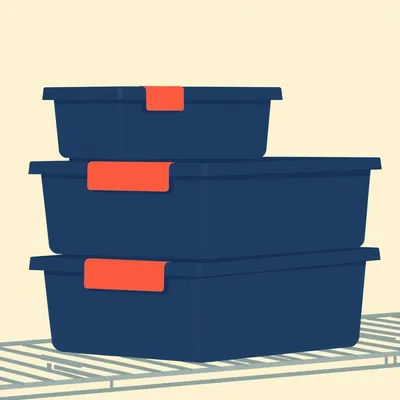
So let's define what we're talking about. Modular storage, in the sense that matters here, means standardized container sizes built around a consistent footprint — a base dimension that everything else derives from. These containers interlock, they stack on compatible shelving without wasted space, and the standard doesn't change when the marketing department rebrands. The backbone of this is the Euro box system, formally defined under EN 13199 and ISO 3394. The base footprint is six hundred by four hundred millimeters.
Which is roughly twenty-three point six by fifteen point seven inches, for the metrically challenged among us.
And that number, six hundred by four hundred, isn't arbitrary. It comes from the twelve hundred by eight hundred millimeter Euro pallet. You can fit exactly four of these boxes on one pallet with no overhang. The system then scales down by halving — you get three hundred by four hundred millimeter boxes, which is half the width, and two hundred by four hundred, which is a third. Heights stack in standardized increments: one twenty, one seventy, two twenty, three twenty, and four twenty millimeters. A six hundred by four hundred by two twenty box holds about forty liters. That's enough for twenty to thirty paperback books, or a full winter coat, or a frankly irresponsible quantity of pasta.
I like that you've done the pasta math.
I have a spreadsheet. The point is, every box in this system is designed to play nicely with every other box. A three hundred by four hundred box sits perfectly next to another three hundred by four hundred box on the same shelf, occupying exactly the same footprint as one six hundred by four hundred box. You can mix heights on the same shelf and they still align. It's the storage equivalent of a well-designed lego set, except the bricks have been the same since the nineteen seventies and nobody's releasing a new incompatible version to sell more bricks.
Unlike every consumer storage brand in existence. And this is where the frustration lives. You buy a ten-pack of bins from a big box store, two years later you need more, and the model's been discontinued or subtly resized. Your garage becomes a museum of near-compatible plastic.
Consumer bins vary by up to three inches in footprint even within the same nominal category. A "twenty-seven gallon tote" from one brand might be twenty-four by eighteen by sixteen inches, and from another it's twenty-six by twenty by fifteen. They look the same in the aisle. They are not the same on your shelf. And lids are model-specific. Even within Sterilite's own lineup, a lid from a 2019 bin probably won't fit the 2024 version of what looks like the same bin. It's planned obsolescence for plastic rectangles.
The glockenspiel of corporate approachability.
I don't know what that means but I'm choosing to take it as a compliment. So the Euro box system solves all of this by being boring and standardized and refusing to change. But it's not the only game in town. In the US, we have a few de facto standards that emerged from supply chains rather than formal specification bodies. The most familiar is the bankers box — designed for letter or legal size files, roughly ten by twelve by fifteen inches, stackable, widely available. It's not a formal standard but the dimensions have been stable for decades because office filing can't tolerate random resizing.
The classic twenty-seven gallon tote, which you mentioned, has become a kind of accidental standard through sheer market dominance, even though the dimensions drift by brand.
Then there's the RPC standard — Reusable Plastic Containers — used in US grocery and retail supply chains. These are built around the forty-eight by forty inch GMA pallet, which is the North American equivalent of the Euro pallet. Common RPC footprints are things like twenty-two by fifteen by ten inches, or twenty-three by fifteen by twelve. They're not as elegantly modular as the Euro system, but they're abundant and cheap on the secondary market because grocery distribution cycles through millions of them.
If you're in North America, you've essentially got three lanes. One, import or source Euro boxes and commit to the metric system. Two, embrace the RPC ecosystem and build around the GMA pallet footprint. Three, go with bankers boxes for lighter, file-oriented storage. And the choice really determines everything downstream — what shelving you buy, how efficiently you use your floor space, whether you'll be able to expand in five years without starting over.
Let's talk shelving, because this is where I see people make the most expensive mistakes. The shelving has to match the boxes, and the weight ratings have to match what you're actually storing. There are two main types that matter for home use. First, rivet shelving — this is the classic US garage shelf, steel frame with particle board or wire decking, typically forty-eight inches wide by eighteen or twenty-four inches deep. Weight ratings range from five hundred to two thousand pounds per shelf when evenly distributed. Second, boltless shelving — sometimes called Euro shelving or longspan shelving — which uses rivet-and-slot assembly, no bolts required, and typically comes in deeper configurations with higher weight ratings, a thousand to fifteen hundred kilos per shelf.
Here's the critical dimension mismatch that the plan calls out. A Euro box is six hundred millimeters deep, which is twenty-three point six inches. If you put it on an eighteen-inch deep rivet shelf, which is the most common size sold at home improvement stores, the box hangs off the front by almost six inches. It'll sit there, but it's unstable, it looks terrible, and you're losing the whole point of the system. You need a twenty-four inch deep shelf for Euro boxes to sit flush.
The other direction matters too. A forty-eight inch wide shelf can hold two six hundred millimeter boxes side by side — that's forty-seven point two inches of box on forty-eight inches of shelf, nearly perfect. Three of the three hundred millimeter wide boxes fit across the same shelf. The math just works, which is the whole magic of standards.
You mentioned this in the plan and I think it's where home users consistently underestimate. What does a box of books actually weigh?
A six hundred by four hundred by two twenty Euro box filled with average hardcover books weighs about fifty to sixty pounds. Fill it with canned goods and you're looking at sixty-five to seventy-five pounds. Fill it with tools or ammunition or free weights and you're easily over eighty. Now put six of those on one shelf. You're at three hundred and sixty to four hundred and eighty pounds. Your typical "heavy duty" garage shelf from a big box store is rated for two hundred and fifty pounds per shelf. It will sag. It may fail. I've seen it happen, and the aftermath is a cascade of broken plastic and crushed hope.
The rule of thumb is: calculate your expected load and buy shelving rated for at least fifty percent more. If you think each shelf will hold three hundred pounds, get shelves rated for five hundred. The cost difference between medium-duty and heavy-duty shelving is maybe fifty to a hundred dollars per unit. That's cheap insurance against your storage system turning into a landslide.
There's an important distinction between evenly distributed load and point load. A rivet shelf rated for two thousand pounds evenly distributed might only handle five hundred pounds concentrated in the center. Euro boxes distribute weight across their entire footprint, which helps, but if you're storing a single extremely dense item — say, a box of lead ingots or a very committed rock collection — you need to factor that in.
"A very committed rock collection." That's my next hobby.
Okay, so we've established the box dimensions, the shelving compatibility, and the weight math. Let's talk about lids, because this is another place where consumer storage fails spectacularly and industrial storage doesn't.
The lid situation in consumer-land is genuinely bleak. You lose one lid and the entire bin becomes an open-top dust collector. And as you mentioned, even within the same brand, lids are model-specific and frequently discontinued. It's like they want you to buy a whole new set every three years.
Euro boxes have proper clip-on lids. They come in three main varieties: solid, vented, and transparent. Solid lids seal completely, good for long-term storage where you want to keep dust and pests out. Vented lids have slots or holes, useful for items that need airflow — clothing, certain food items, anything that might mildew. Transparent lids let you see contents without opening the box. All three types fit the same box footprint, and a lid from a box you bought in 2010 will fit a box you buy tomorrow. That's the standard.
There are specialty lids for specific applications. Anti-static lids for electronics, made from conductive plastic — you see these in ESD-safe boxes used for circuit boards and components. Gasketed lids with rubber seals for dust and water resistance, useful if you're storing things in a basement or garage that might get damp. Even lockable lids with padlock holes for inventory security.
The lid clips onto the box at all four sides, which means when you stack boxes, the weight transfers through the box walls, not through the lid. Consumer bins often have lids that just sit on top, and if you stack three or four high, the bottom lid cracks and suddenly everything's bowing inward. The Euro box clip-on system means you can stack five or six filled boxes high safely. Empty, you can stack ten or more, which is great if you're storing boxes you only use seasonally.
Let's talk specialty sizes for home users, because this is where the system gets useful beyond just "big plastic rectangles." For clothing, there's the four-twenty millimeter height box — that's about sixteen and a half inches tall, which fits folded jeans, sweaters, and bulkier items without crushing them. There's also a wardrobe box in the Euro system, six hundred by four hundred by six hundred millimeters, with a hanging rod built in. You can store suits, dresses, coats, and they hang properly without getting creased. It's like a miniature portable closet.
For electronics, the key thing is ESD protection. Standard plastic boxes generate static electricity, which can destroy circuit boards and components. ESD-safe boxes are made from conductive polypropylene — usually black with a surface resistance of less than ten to the eleventh ohms. They're available in the Euro footprint, most commonly the smaller sizes like three hundred by two hundred by one twenty millimeters for cables, adapters, and small PCBs. Brands like Conductive Containers and Eurostat sell these, starting around fifteen dollars for the small sizes and going up to thirty or forty for the larger ones with lids.
For food storage, you want FDA-approved polypropylene — food-grade plastic that won't leach chemicals. These usually come with gasketed lids for an airtight seal. The six hundred by four hundred by one seventy size is great for dry goods like flour, rice, pasta — holds about thirty liters, which is roughly twenty-five pounds of flour. Stackable, pest-resistant, and you can label the front with contents and date.
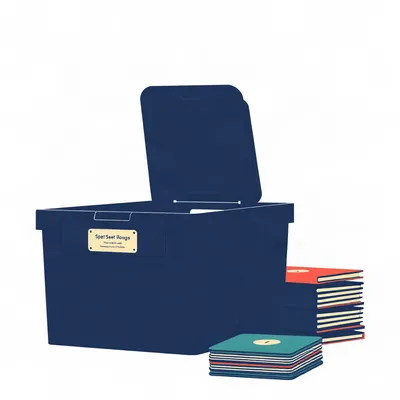
Which brings us to labeling. The Euro system has standardized label holders that clip onto the front of the box. You can use paper labels, barcode stickers, or RFID tags if you're running inventory software. This is something Corn has actually done.
I run a miniature fulfillment center in my apartment. Shelf numbers, box numbers, open-source inventory software. Every box has a barcode. When I need something, I look it up, find the shelf and box number, and it takes thirty seconds instead of thirty minutes of opening lids and rummaging. It sounds obsessive, and it is, but the system makes it possible because everything is standardized. You can't barcode chaos.
The barcode is the enemy of entropy. I love it. Let's talk about mobility, because one of the underappreciated aspects of the Euro system is that there are dollies and carts designed specifically for the six hundred by four hundred millimeter footprint. You can stack four or five boxes on a dolly and wheel them around. If you're running a home business where you're constantly picking and packing, or if you just want to be able to reconfigure your storage area without unloading every box individually, these dollies are transformative.
They're cheap. A basic Euro box dolly is twenty to thirty dollars. It's a plastic or metal frame with four casters, two of which lock. It's the kind of thing that sounds like an extravagance until you use it once and realize you've been carrying heavy boxes by hand for no reason.
Alright, let's get to the question everyone's been waiting for: what does this actually cost? And I want to break this into new versus used, because the secondary market for industrial storage is one of the best-kept secrets in home organization.
New Euro boxes: a six hundred by four hundred by two twenty millimeter box runs about twelve dollars, and the lid is another five. So seventeen dollars per complete unit. The one-seventy height is maybe ten dollars plus four for the lid. The four-twenty height, which is the big deep one, is closer to twenty dollars plus six for the lid. Shelving: a new rivet shelving unit, forty-eight by twenty-four by seventy-two inches with five shelves, runs about two hundred to three hundred dollars depending on weight rating. Boltless Euro shelving in the same dimensions is two hundred and fifty to four hundred dollars new.
If you're setting up a six-by-six-foot area — which is a typical garage corner or spare room section — you might have two shelving units and, say, thirty boxes of various sizes. New, you're looking at about six hundred to nine hundred dollars total. That's real money. But here's where it gets interesting.
Pallet recyclers and industrial surplus dealers sell used Euro boxes for three to eight dollars each. These are boxes that have been through a few cycles in a warehouse or distribution center, they might have scuffs or label residue, but they're structurally sound. Lids are two to four dollars used. Used shelving — rivet or boltless — shows up on Craigslist, Facebook Marketplace, and at office furniture liquidators for fifty to a hundred dollars per unit. I've seen entire warehouse teardowns where they're practically giving away shelving if you show up with a truck.
A full setup that costs eight hundred dollars new can be done for two hundred and fifty to three hundred and fifty used. The trade-off is condition and availability. You have to hunt a bit. But if you're patient and willing to inspect before buying — check for cracks in the boxes, make sure the lid clips aren't broken, verify the shelving isn't rusted or bent — you can build a professional-grade storage system for less than the cost of a new set of consumer bins that won't stack properly.
The used boxes are often the exact same models still sold new. A Euro box manufactured in 2015 is identical to one manufactured yesterday. That's the whole point of the standard. There's no used-car anxiety about whether the 2015 model had transmission problems.
"Transmission problems" on a plastic box. I'd love to see that recall notice.
"Warning: your bin may spontaneously downshift into a smaller size." So to put numbers on a specific scenario: a home business storing two hundred SKUs of craft supplies. You could use twenty Euro boxes in the six hundred by four hundred by one seventy size on two forty-eight by twenty-four by seventy-two inch rivet shelving units. New, that's about two hundred and forty dollars for the boxes with lids, plus four hundred to five hundred for the shelving, total around six fifty. Used, you're looking at maybe two hundred dollars all in. For a system that will still be functional and expandable in twenty years.
That expandability is the thing that's hard to put a price on. With consumer bins, every time you need more storage, you roll the dice on whether the bins you bought last time still exist. With a standard, you just order more of the same part number. The marginal cost of expansion is low and predictable.
Let me address a misconception that comes up a lot: the idea that heavy-duty shelving is overkill for home use. I hear people say "I'm just storing Christmas decorations, I don't need industrial shelving." But a single Euro box filled with decorations — ornaments, lights, the ceramic village that your spouse insists on — can easily weigh forty pounds. Six of those on a shelf is two hundred and forty pounds. Light-duty shelving rated for two hundred and fifty pounds is right at the limit, and those ratings assume perfect weight distribution, which never happens in real life. The shelf sags. The particle board warps. Eventually the rivets shear.
The failure mode is not graceful. It's not a slow bow that gives you warning. It's a sudden collapse at two in the morning that sounds like someone threw a dishwasher down the stairs.
I've heard that exact sound. It's not pleasant. So the guidance is: buy shelving rated for at least fifty percent more than your estimated load, and if you're storing anything dense — books, tools, canned goods, ammunition — go for double. The cost increment from a five-hundred-pound-rated shelf to a thousand-pound-rated shelf is maybe thirty percent. It's one of the highest-return safety margins you can buy.
Another misconception: the idea that all plastic bins are basically the same size. They're not. And the variations are not random — they're strategic. Consumer brands change dimensions slightly so that their bins don't stack well with competitors' bins. They want you locked into their ecosystem. The problem is they don't even maintain compatibility within their own ecosystem across time. So you end up locked into a system that doesn't exist anymore.
It's the printer ink model applied to plastic boxes. The bin is cheap, but the lock-in is permanent and expensive.
And the Euro system is the opposite. It's an open standard. Anyone can manufacture to it. There are dozens of companies producing Euro boxes — Auer, SSI Schaefer, Bito, Allibert, and many others — and they all interoperate. That competition drives prices down and keeps quality up. It's the Linux of storage.
That's actually a perfect analogy. It's not the prettiest. It doesn't have the slickest marketing. But it works, it's reliable, and the community around it ensures it never goes away.
Let's talk about some practical considerations for getting started. The first thing you should do is measure your space. Not approximately — actually measure. Width, depth, height. Account for baseboards, pipes, electrical outlets, anything that protrudes. Then calculate how many boxes you can fit based on the six hundred by four hundred millimeter footprint. Remember that you need clearance to slide boxes in and out — add at least two inches of clearance on each side.
Most home storage areas have eight or nine foot ceilings, which means you can fit a seventy-two inch shelving unit with five or six shelves and still have room on top for rarely-used items. The top shelf is great for seasonal stuff in labeled boxes that you only access twice a year. The bottom shelf is for heavy items — it's more stable and easier to lift from.
For sourcing: industrial suppliers like Uline and Global Industrial carry new Euro boxes and compatible shelving. They're not the cheapest but they're reliable and the specs are clearly documented. For used, search for "pallet recycler" or "industrial surplus" in your area. eBay has a surprising amount of used Euro boxes, often in lots of ten or twenty. Craigslist and Facebook Marketplace are good for shelving — office furniture liquidators frequently have boltless shelving from warehouse closures.
One thing to watch for when buying used boxes: inspect the lid clips. Those are the small plastic tabs on the lid that snap onto the box rim. If they're broken, the lid won't stay on securely and the stackability is compromised. A missing clip or two is usually fine — most lids have eight to ten clips and you can lose a couple without issue. But if half the clips are broken, walk away.
Also check for cracks, especially near the top rim and the bottom corners. Those are the stress points. A small crack can propagate under load. And smell the boxes if you're buying from a food distributor — some residues are hard to remove and you don't want your winter coats smelling like pickles.
The pickle-coat problem is real and underdiscussed.
There's a podcast episode in that alone.
Let's summarize the decision framework. If you're in Europe, the Euro box system is the obvious choice — it's widely available, competitively priced, and everything in the logistics ecosystem is built around it. If you're in North America, you have a choice. You can import Euro boxes, which are increasingly available through US industrial suppliers, or you can build around the RPC and GMA pallet system. My recommendation, and I think this is where we converge, is to go with the Euro system even in the US if you're starting from scratch.
The math is cleaner. The modularity is better. The long-term availability is more certain. And the price premium for importing or sourcing Euro boxes in the US has dropped significantly in the last few years as more distributors carry them. It's maybe ten to fifteen percent more expensive than the RPC alternative, and you get a system that's more flexible and better documented.
If you're already invested in RPCs or bankers boxes, don't throw them out. But be aware that expanding that system will get harder over time as specific models change. The Euro system is the one that will still be the same in twenty years.
There's a broader point here about standardization and consumer culture. We've been trained to accept planned obsolescence in everything — phones, appliances, furniture, even storage bins. The idea that you could buy a box today and buy another one in 2046 and they'd be identical and compatible is almost radical. It shouldn't be.
It's the IKEA effect in reverse. IKEA designs products to be replaced. The Billy bookcase you buy today is not the same Billy bookcase from 1995. The dimensions shifted. The materials changed. The Euro box is the anti-Billy. It's designed to be boring forever.
"Boring forever" is a surprisingly compelling value proposition.
And it connects to something larger. As home businesses grow — e-commerce sellers, crafters, small-scale manufacturers — the line between home storage and warehouse storage blurs. People are running fulfillment operations out of spare bedrooms. They need real inventory systems. The Euro box standard lets you start small and scale without rebuilding your infrastructure.
As people move more often — the rental market being what it is — having a modular storage system that disassembles and reassembles consistently is a real advantage. You're not rebuilding your storage logic every time you change apartments. The boxes, the shelves, the labels, the system — it all moves with you and snaps back together in the new space.
The rental nomad's best friend: a standardized plastic box. It's not glamorous, but it's true.
You're sold on the idea. What do you actually do tomorrow? Step one: measure your space. Step two: decide on the Euro box system. Step three: calculate how many boxes you need and what heights make sense for what you're storing. Step four: source shelving that's twenty-four inches deep with weight ratings at least fifty percent above your estimated load. Step five: check new prices from industrial suppliers, then check used prices from pallet recyclers and online marketplaces. Step six: buy, assemble, label, and enjoy the kind of organizational serenity that most people assume is only available to professional warehouses.
Start small if you're unsure. Buy ten boxes and one shelving unit. Live with it for a month. See how the system feels. You'll almost certainly want more, but the incremental buy-in is low enough that you can test without committing to a full garage overhaul.
One final practical note: the six hundred by four hundred by one seventy box is probably the sweet spot for most home storage. It's big enough to hold meaningful quantities but not so big that it becomes impossibly heavy when full. At forty liters, it holds about the same as a large consumer tote but in a footprint that actually fits on shelving efficiently.
The one-twenty height is great for shallow items — cables, office supplies, craft materials, spice packets, the kind of stuff that gets lost in deeper boxes. Having a mix of heights on the same shelf, all sharing the same footprint, is where the modularity really shines.
Before we wrap, let's zoom out and think about where this is heading. Will consumer brands ever adopt a universal standard, or will the Euro system remain a niche for enthusiasts and professionals?
I'm skeptical that consumer brands will standardize voluntarily. The lock-in model is too profitable. Why sell someone a bin they'll use for thirty years when you can sell them a new set every five? But I do think the Euro system will continue to leak into the consumer space through home businesses, 3D printing communities, and maker culture. People who need real organization find the standard, and once they find it, they tell other people.
The other vector is technology. As home automation and smart inventory systems get cheaper, the value of standardized storage increases. You can put a QR code on a Euro box and scan it with your phone. You can build a database of what's in each box. You can integrate with home assistant platforms. None of that works if your box dimensions are a moving target. The standard is the platform.
3D printing adds another layer. You can print custom inserts for Euro boxes — dividers, trays, holders for specific tools or components. There's a growing ecosystem of open-source insert designs on sites like Printables and Thingiverse, all built around the six hundred by four hundred millimeter footprint. You can't do that effectively with consumer bins because the dimensions aren't stable enough for a design to work across brands or model years.
The standard becomes a foundation for customization. Which is the opposite of what most people expect — they think "standardized" means "limited." It actually means "compatible with everything else that uses the standard." The limitations come from proprietary systems that change every few years.
Alright, I think we've covered the dimensions, the shelving, the lids, the costs, the specialty sizes, and the philosophy of why standards matter. Let's land this with the key takeaways.
First: start with the Euro box system, six hundred by four hundred millimeter footprint. It's the closest thing to a universal standard, it's available worldwide, and it'll still be compatible with itself decades from now.
Second: match your shelving depth to your box depth. Twenty-four inch shelves for six hundred millimeter boxes. Verify weight ratings exceed your expected load by at least fifty percent. Heavy-duty shelving is not overkill when boxes of books or tools are involved.
Third: buy used when you can. Pallet recyclers, industrial surplus dealers, and online marketplaces can cut your costs by fifty to seventy percent. Inspect for cracks and broken lid clips, but don't be afraid of scuffs or label residue — those are cosmetic.
The immediate action: measure your space, calculate your box count based on the six hundred by four hundred millimeter footprint, and start sourcing. Whether you go new or used, you can build a warehouse-grade storage system in your home for somewhere between two-fifty and nine hundred dollars depending on scale and condition.
The open question we'll leave you with: as home automation, 3D printing, and smart inventory tracking become more accessible, does standardized modular storage become the default for home organization, or does it stay in the enthusiast niche? My bet is on the former. The advantages are too obvious once you experience them.
I think so too. The friction is awareness, not value. Most people simply don't know this exists. Now our listeners do.
And now: Hilbert's daily fun fact.

In the 1880s, geologists studying the volcanic islands of Vanuatu widely believed that the specific mix of sulfur dioxide and hydrogen sulfide emitted by Mount Yasur was evidence of a subterranean coal seam burning beneath the Pacific — a theory known as "abyssal conflagration" that persisted until seismology proved the magma source in the 1890s.
That's a metal album waiting to happen.
Or the name of my next DJ set.
This has been My Weird Prompts. If you found this useful, leave a review on your podcast app — it helps other people discover the show. We'll be back soon with something completely different. I'm Herman Poppleberry.
I'm Corn. Thanks for listening.